🎉 Up to 70% Off Selected ItemsShop Sale

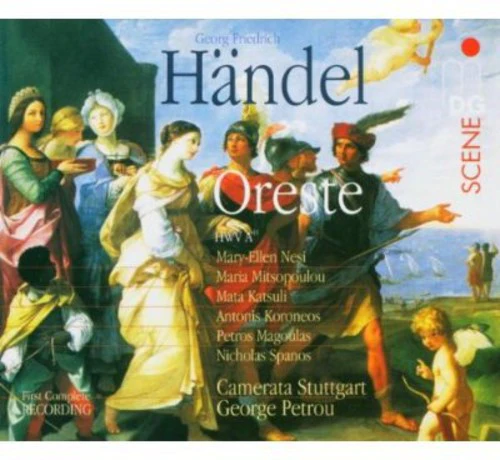
Scene Handel: Oreste / Petrou, Nesi, Mitsopolou, Et Al
First presented in 1734, Oreste isn't quite an "opera" by Handel. Rather, it's a pastiche, albeit put together by the composer himself for the cast who would star the following month in the newly composed Ariodante. Oreste, whose plot is much the same as Gluck's Iphigenie en Tauride, is almost entirely (there are a couple of newly composed dance sequences) made up of arias from the composer's other operas, some going back as far as 1707. There are bits of Partenope, Sosarme, Tamerlano, Rodrigo, Lotario, Ottone, Agrippina, and other operas, all here in different contexts, most with different texts and most arranged in slightly different ways. If this were the first Handel opera I'd ever heard, and I hadn't been told it was a collection of bits, I'd never know, and I'd be dazzled by it. Much to the composer's credit, the borrowings make an interesting whole, and the two hours and 25 minutes go by with alacrity, the dramatic moments piling one upon the other.
And as with any works by Handel, especially those designed for the greatest singers of his day, paramount to even the slightest success is a strong sense of what constitutes Baroque style and the ability of the performers to negotiate complicated vocal lines. So without a recognizable name in the crowd, you have to wonder, are these unknown singers--all of them Greek or of Greek parentage--up to their tasks? The answer is a delightful "yes".
In the castrato role of Oreste, Canadian-born mezzo Mary Ellen Nesi is a real find. The voice is expressive and handsome, and she has no trouble with the rapid passagework or with Handel's smoother lines that require a true legato. She is a singer to keep an eye on: even in our chock-full-of-good-mezzos time, she's worth hearing. Mata Katsuli as Ifigenia sings with a whitish tone that at times sounds unhealthy, but she too is "in" her role. Ermione (Orestes' wife, not in the Gluck, but apparently in the neighborhood of Tauride) is the big soprano role, and Maria Mitsopoulou has the temperament and the technique, and only some nasty top notes mar her performance. As the villainous Toante, bass Petros Magoulas is fluent and arresting. His captain, Filotete, is well done by the opaque-voiced countertenor Nicholas Spano, and tenor Antonis Koroneos as Oreste's pal Pilade is remarkable with his coloratura, but his voice almost entirely lacks body. George Petrou leads the expert Camerata Stuttgart with sensitivity to the singers, although you sometimes wish he had pushed them a bit more. In short, yes, it's a pasticcio, but it's terrific Handel, it's dramatically coherent, and it will make a good addition to your collection.
--Robert Levine, ClassicsToday.com
And as with any works by Handel, especially those designed for the greatest singers of his day, paramount to even the slightest success is a strong sense of what constitutes Baroque style and the ability of the performers to negotiate complicated vocal lines. So without a recognizable name in the crowd, you have to wonder, are these unknown singers--all of them Greek or of Greek parentage--up to their tasks? The answer is a delightful "yes".
In the castrato role of Oreste, Canadian-born mezzo Mary Ellen Nesi is a real find. The voice is expressive and handsome, and she has no trouble with the rapid passagework or with Handel's smoother lines that require a true legato. She is a singer to keep an eye on: even in our chock-full-of-good-mezzos time, she's worth hearing. Mata Katsuli as Ifigenia sings with a whitish tone that at times sounds unhealthy, but she too is "in" her role. Ermione (Orestes' wife, not in the Gluck, but apparently in the neighborhood of Tauride) is the big soprano role, and Maria Mitsopoulou has the temperament and the technique, and only some nasty top notes mar her performance. As the villainous Toante, bass Petros Magoulas is fluent and arresting. His captain, Filotete, is well done by the opaque-voiced countertenor Nicholas Spano, and tenor Antonis Koroneos as Oreste's pal Pilade is remarkable with his coloratura, but his voice almost entirely lacks body. George Petrou leads the expert Camerata Stuttgart with sensitivity to the singers, although you sometimes wish he had pushed them a bit more. In short, yes, it's a pasticcio, but it's terrific Handel, it's dramatically coherent, and it will make a good addition to your collection.
--Robert Levine, ClassicsToday.com
First presented in 1734, Oreste isn't quite an "opera" by Handel. Rather, it's a pastiche, albeit put together by the composer himself for the cast who would star the following month in the newly composed Ariodante. Oreste, whose plot is much the same as Gluck's Iphigenie en Tauride, is almost entirely (there are a couple of newly composed dance sequences) made up of arias from the composer's other operas, some going back as far as 1707. There are bits of Partenope, Sosarme, Tamerlano, Rodrigo, Lotario, Ottone, Agrippina, and other operas, all here in different contexts, most with different texts and most arranged in slightly different ways. If this were the first Handel opera I'd ever heard, and I hadn't been told it was a collection of bits, I'd never know, and I'd be dazzled by it. Much to the composer's credit, the borrowings make an interesting whole, and the two hours and 25 minutes go by with alacrity, the dramatic moments piling one upon the other.
And as with any works by Handel, especially those designed for the greatest singers of his day, paramount to even the slightest success is a strong sense of what constitutes Baroque style and the ability of the performers to negotiate complicated vocal lines. So without a recognizable name in the crowd, you have to wonder, are these unknown singers--all of them Greek or of Greek parentage--up to their tasks? The answer is a delightful "yes".
In the castrato role of Oreste, Canadian-born mezzo Mary Ellen Nesi is a real find. The voice is expressive and handsome, and she has no trouble with the rapid passagework or with Handel's smoother lines that require a true legato. She is a singer to keep an eye on: even in our chock-full-of-good-mezzos time, she's worth hearing. Mata Katsuli as Ifigenia sings with a whitish tone that at times sounds unhealthy, but she too is "in" her role. Ermione (Orestes' wife, not in the Gluck, but apparently in the neighborhood of Tauride) is the big soprano role, and Maria Mitsopoulou has the temperament and the technique, and only some nasty top notes mar her performance. As the villainous Toante, bass Petros Magoulas is fluent and arresting. His captain, Filotete, is well done by the opaque-voiced countertenor Nicholas Spano, and tenor Antonis Koroneos as Oreste's pal Pilade is remarkable with his coloratura, but his voice almost entirely lacks body. George Petrou leads the expert Camerata Stuttgart with sensitivity to the singers, although you sometimes wish he had pushed them a bit more. In short, yes, it's a pasticcio, but it's terrific Handel, it's dramatically coherent, and it will make a good addition to your collection.
--Robert Levine, ClassicsToday.com
And as with any works by Handel, especially those designed for the greatest singers of his day, paramount to even the slightest success is a strong sense of what constitutes Baroque style and the ability of the performers to negotiate complicated vocal lines. So without a recognizable name in the crowd, you have to wonder, are these unknown singers--all of them Greek or of Greek parentage--up to their tasks? The answer is a delightful "yes".
In the castrato role of Oreste, Canadian-born mezzo Mary Ellen Nesi is a real find. The voice is expressive and handsome, and she has no trouble with the rapid passagework or with Handel's smoother lines that require a true legato. She is a singer to keep an eye on: even in our chock-full-of-good-mezzos time, she's worth hearing. Mata Katsuli as Ifigenia sings with a whitish tone that at times sounds unhealthy, but she too is "in" her role. Ermione (Orestes' wife, not in the Gluck, but apparently in the neighborhood of Tauride) is the big soprano role, and Maria Mitsopoulou has the temperament and the technique, and only some nasty top notes mar her performance. As the villainous Toante, bass Petros Magoulas is fluent and arresting. His captain, Filotete, is well done by the opaque-voiced countertenor Nicholas Spano, and tenor Antonis Koroneos as Oreste's pal Pilade is remarkable with his coloratura, but his voice almost entirely lacks body. George Petrou leads the expert Camerata Stuttgart with sensitivity to the singers, although you sometimes wish he had pushed them a bit more. In short, yes, it's a pasticcio, but it's terrific Handel, it's dramatically coherent, and it will make a good addition to your collection.
--Robert Levine, ClassicsToday.com
$16.10
Original: $45.99
-65%Scene Handel: Oreste / Petrou, Nesi, Mitsopolou, Et Al—
$45.99
$16.10Description
First presented in 1734, Oreste isn't quite an "opera" by Handel. Rather, it's a pastiche, albeit put together by the composer himself for the cast who would star the following month in the newly composed Ariodante. Oreste, whose plot is much the same as Gluck's Iphigenie en Tauride, is almost entirely (there are a couple of newly composed dance sequences) made up of arias from the composer's other operas, some going back as far as 1707. There are bits of Partenope, Sosarme, Tamerlano, Rodrigo, Lotario, Ottone, Agrippina, and other operas, all here in different contexts, most with different texts and most arranged in slightly different ways. If this were the first Handel opera I'd ever heard, and I hadn't been told it was a collection of bits, I'd never know, and I'd be dazzled by it. Much to the composer's credit, the borrowings make an interesting whole, and the two hours and 25 minutes go by with alacrity, the dramatic moments piling one upon the other.
And as with any works by Handel, especially those designed for the greatest singers of his day, paramount to even the slightest success is a strong sense of what constitutes Baroque style and the ability of the performers to negotiate complicated vocal lines. So without a recognizable name in the crowd, you have to wonder, are these unknown singers--all of them Greek or of Greek parentage--up to their tasks? The answer is a delightful "yes".
In the castrato role of Oreste, Canadian-born mezzo Mary Ellen Nesi is a real find. The voice is expressive and handsome, and she has no trouble with the rapid passagework or with Handel's smoother lines that require a true legato. She is a singer to keep an eye on: even in our chock-full-of-good-mezzos time, she's worth hearing. Mata Katsuli as Ifigenia sings with a whitish tone that at times sounds unhealthy, but she too is "in" her role. Ermione (Orestes' wife, not in the Gluck, but apparently in the neighborhood of Tauride) is the big soprano role, and Maria Mitsopoulou has the temperament and the technique, and only some nasty top notes mar her performance. As the villainous Toante, bass Petros Magoulas is fluent and arresting. His captain, Filotete, is well done by the opaque-voiced countertenor Nicholas Spano, and tenor Antonis Koroneos as Oreste's pal Pilade is remarkable with his coloratura, but his voice almost entirely lacks body. George Petrou leads the expert Camerata Stuttgart with sensitivity to the singers, although you sometimes wish he had pushed them a bit more. In short, yes, it's a pasticcio, but it's terrific Handel, it's dramatically coherent, and it will make a good addition to your collection.
--Robert Levine, ClassicsToday.com
And as with any works by Handel, especially those designed for the greatest singers of his day, paramount to even the slightest success is a strong sense of what constitutes Baroque style and the ability of the performers to negotiate complicated vocal lines. So without a recognizable name in the crowd, you have to wonder, are these unknown singers--all of them Greek or of Greek parentage--up to their tasks? The answer is a delightful "yes".
In the castrato role of Oreste, Canadian-born mezzo Mary Ellen Nesi is a real find. The voice is expressive and handsome, and she has no trouble with the rapid passagework or with Handel's smoother lines that require a true legato. She is a singer to keep an eye on: even in our chock-full-of-good-mezzos time, she's worth hearing. Mata Katsuli as Ifigenia sings with a whitish tone that at times sounds unhealthy, but she too is "in" her role. Ermione (Orestes' wife, not in the Gluck, but apparently in the neighborhood of Tauride) is the big soprano role, and Maria Mitsopoulou has the temperament and the technique, and only some nasty top notes mar her performance. As the villainous Toante, bass Petros Magoulas is fluent and arresting. His captain, Filotete, is well done by the opaque-voiced countertenor Nicholas Spano, and tenor Antonis Koroneos as Oreste's pal Pilade is remarkable with his coloratura, but his voice almost entirely lacks body. George Petrou leads the expert Camerata Stuttgart with sensitivity to the singers, although you sometimes wish he had pushed them a bit more. In short, yes, it's a pasticcio, but it's terrific Handel, it's dramatically coherent, and it will make a good addition to your collection.
--Robert Levine, ClassicsToday.com






















