Schoenberg: Pierrot Lunaire, String Trio / Stiedry-Wagner
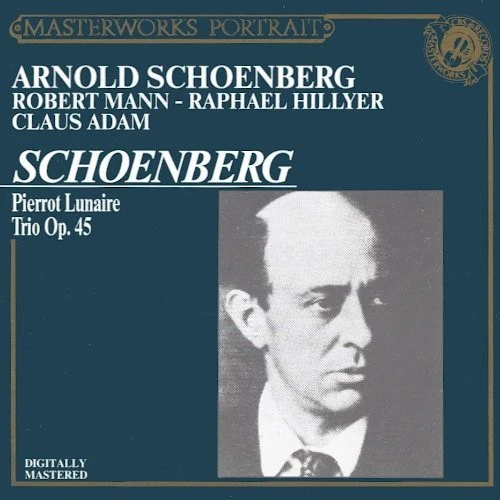
SCHOENBERG Pierrot Lunaire 1. String Trio 2 • 1 Arnold Schoenberg, cond; 1 Erika Stiedry-Wagner (voc); 1 Rudolph Kolisch (vn, va); 1 Stefan Auber (vc); 1 Kalman Bloch (cl); 1 Leonard Posella (fl, pic); 1 Eduard Steuermann (pn); 2 Robert Mann (vn); 2 Raphael Hillyer (va); 2 Claus Adam (vc) • SONY 45695, mono/stereo (52:53)
As in the case of several of my other CHoF recommendations, this one is for half-a-record, in this case for the 1940 recording of Pierrot Lunaire directed by the composer. It’s not that the 1967 performance of the String Trio is a poor one—it’s not—but the 1985 recording of the String Trio, also by members of the Juilliard String Quartet (for such they are) only with Samuel Rhodes on viola and Joel Krosnick on cello (Sony 47690) supercedes this one. It is the recording of Pierrot Lunaire that is wholly unique.
Directed by the composer, it was the first of Schoenberg’s mature works to be recorded (Leopold Stokowski had recorded the earlier Gurrelieder in 1932 for RCA Victor). It includes pianist Eduard Steuermann, who had been playing this work since its premiere in 1913, and soprano Erika Stiedry-Wagner, who had been speaking/singing the vocal part in performances under Schoenberg’s direction since 1921. (In Robert Craft’s book Stravinsky: Discoveries and Memories, reviewed elsewhere in this issue, he writes of a performance in Italy of Pierrot Lunaire under Schoenberg’s direction, attended by none other than Giacomo Puccini. Stiedry-Wagner was probably the speaker in that performance as well.)
Curiously for an experienced singer who had performed this work many times with Schoenberg, Stiedry-Wagner sings several wrong pitches in “Eine blasse Wäscherin”; but as Dr. Avior Byron, a musicologist and composer who is working on the book Schoenberg’s Writings on Aesthetics and Interpretation in Performance has said, these deviations from pitch were not only accepted by the composer but quite possibly encouraged as a later reconsideration of how this specific song was to be interpreted. You can read the details in Chapter Seven of his book, “ Sprechstimme Reconsidered,” at bymusic.org/images/stories/byronphd/chapter_7.pdf. To begin with, there were no less than five takes made of this song (in addition to five each of “Valse de Chopin” and “Madonna,” and four each of “Gebet an Pierrot,” “Raub,” “Rote Messe,” and “Galgenlied”), and Stiedry-Wagner deviates from the written pitch in all of them. With the composer in charge, this error could have been remedied with a 15-minute piano rehearsal; but the fact that he allowed the recordings to be made, and the take with the wrong pitches issued, indicates a much deeper level of tolerance on Schoenberg’s part. As Byron illustrates via written comments from Schoenberg, the composer wanted a stricter adherence to pitch in Pierrot Lunaire than in the spoken recitation of Gurrelieder, but in certain songs—“Eine blasse Wäscherin” was apparently one of them—the mode of expression, the curve of the voice delivering the words, the vocal melismas as it were, became more important to him than absolute fidelity of pitch. Therefore, one can indeed accept this deviation as composer-approved and not an errant mistake that the composer did not catch prior to issue.
The bottom line is that Stiedry-Wagner’s performance is utterly fascinating and enthralling in its own way. She rivets your attention much better, for instance, than does Yvonne Minton in the note-perfect recording made under Pierre Boulez’s direction. From start to finish, this Pierrot Lunaire creates an atmosphere that is spellbinding. These performers, most of whom had been doing this work for a long time under the composer’s direction, give about as authentic a performance as can be imagined; and, as Byron makes clear, even the pitch deviations are instructive to modern performers as to how the songs should be done. In tonal Western music, interpretive differences are generally given by means of variants in the phrasing and the stress given to certain words, as in opera and Lieder, but to Schoenberg, the rhythms of Pierrot Lunaire were inviolable; and though he demanded a higher degree of pitch accuracy in this work, he apparently allowed a certain degree of latitude considering the range of one’s voice and the way the music was spoken-sung. Stiedry-Wagner was an accomplished operetta soprano and particularly an actress, thus I suspect that she and Schoenberg discussed the pitch deviations in “Eine blasse Wäscherin” to some extent, especially since all of the five existing takes deviate in one way or another from score pitch and, in fact, each one is different.
So much for “historically informed” performances, eh?
FANFARE: Lynn René Bayley
SCHOENBERG Pierrot Lunaire 1. String Trio 2 • 1 Arnold Schoenberg, cond; 1 Erika Stiedry-Wagner (voc); 1 Rudolph Kolisch (vn, va); 1 Stefan Auber (vc); 1 Kalman Bloch (cl); 1 Leonard Posella (fl, pic); 1 Eduard Steuermann (pn); 2 Robert Mann (vn); 2 Raphael Hillyer (va); 2 Claus Adam (vc) • SONY 45695, mono/stereo (52:53)
As in the case of several of my other CHoF recommendations, this one is for half-a-record, in this case for the 1940 recording of Pierrot Lunaire directed by the composer. It’s not that the 1967 performance of the String Trio is a poor one—it’s not—but the 1985 recording of the String Trio, also by members of the Juilliard String Quartet (for such they are) only with Samuel Rhodes on viola and Joel Krosnick on cello (Sony 47690) supercedes this one. It is the recording of Pierrot Lunaire that is wholly unique.
Directed by the composer, it was the first of Schoenberg’s mature works to be recorded (Leopold Stokowski had recorded the earlier Gurrelieder in 1932 for RCA Victor). It includes pianist Eduard Steuermann, who had been playing this work since its premiere in 1913, and soprano Erika Stiedry-Wagner, who had been speaking/singing the vocal part in performances under Schoenberg’s direction since 1921. (In Robert Craft’s book Stravinsky: Discoveries and Memories, reviewed elsewhere in this issue, he writes of a performance in Italy of Pierrot Lunaire under Schoenberg’s direction, attended by none other than Giacomo Puccini. Stiedry-Wagner was probably the speaker in that performance as well.)
Curiously for an experienced singer who had performed this work many times with Schoenberg, Stiedry-Wagner sings several wrong pitches in “Eine blasse Wäscherin”; but as Dr. Avior Byron, a musicologist and composer who is working on the book Schoenberg’s Writings on Aesthetics and Interpretation in Performance has said, these deviations from pitch were not only accepted by the composer but quite possibly encouraged as a later reconsideration of how this specific song was to be interpreted. You can read the details in Chapter Seven of his book, “ Sprechstimme Reconsidered,” at bymusic.org/images/stories/byronphd/chapter_7.pdf. To begin with, there were no less than five takes made of this song (in addition to five each of “Valse de Chopin” and “Madonna,” and four each of “Gebet an Pierrot,” “Raub,” “Rote Messe,” and “Galgenlied”), and Stiedry-Wagner deviates from the written pitch in all of them. With the composer in charge, this error could have been remedied with a 15-minute piano rehearsal; but the fact that he allowed the recordings to be made, and the take with the wrong pitches issued, indicates a much deeper level of tolerance on Schoenberg’s part. As Byron illustrates via written comments from Schoenberg, the composer wanted a stricter adherence to pitch in Pierrot Lunaire than in the spoken recitation of Gurrelieder, but in certain songs—“Eine blasse Wäscherin” was apparently one of them—the mode of expression, the curve of the voice delivering the words, the vocal melismas as it were, became more important to him than absolute fidelity of pitch. Therefore, one can indeed accept this deviation as composer-approved and not an errant mistake that the composer did not catch prior to issue.
The bottom line is that Stiedry-Wagner’s performance is utterly fascinating and enthralling in its own way. She rivets your attention much better, for instance, than does Yvonne Minton in the note-perfect recording made under Pierre Boulez’s direction. From start to finish, this Pierrot Lunaire creates an atmosphere that is spellbinding. These performers, most of whom had been doing this work for a long time under the composer’s direction, give about as authentic a performance as can be imagined; and, as Byron makes clear, even the pitch deviations are instructive to modern performers as to how the songs should be done. In tonal Western music, interpretive differences are generally given by means of variants in the phrasing and the stress given to certain words, as in opera and Lieder, but to Schoenberg, the rhythms of Pierrot Lunaire were inviolable; and though he demanded a higher degree of pitch accuracy in this work, he apparently allowed a certain degree of latitude considering the range of one’s voice and the way the music was spoken-sung. Stiedry-Wagner was an accomplished operetta soprano and particularly an actress, thus I suspect that she and Schoenberg discussed the pitch deviations in “Eine blasse Wäscherin” to some extent, especially since all of the five existing takes deviate in one way or another from score pitch and, in fact, each one is different.
So much for “historically informed” performances, eh?
FANFARE: Lynn René Bayley
Description
SCHOENBERG Pierrot Lunaire 1. String Trio 2 • 1 Arnold Schoenberg, cond; 1 Erika Stiedry-Wagner (voc); 1 Rudolph Kolisch (vn, va); 1 Stefan Auber (vc); 1 Kalman Bloch (cl); 1 Leonard Posella (fl, pic); 1 Eduard Steuermann (pn); 2 Robert Mann (vn); 2 Raphael Hillyer (va); 2 Claus Adam (vc) • SONY 45695, mono/stereo (52:53)
As in the case of several of my other CHoF recommendations, this one is for half-a-record, in this case for the 1940 recording of Pierrot Lunaire directed by the composer. It’s not that the 1967 performance of the String Trio is a poor one—it’s not—but the 1985 recording of the String Trio, also by members of the Juilliard String Quartet (for such they are) only with Samuel Rhodes on viola and Joel Krosnick on cello (Sony 47690) supercedes this one. It is the recording of Pierrot Lunaire that is wholly unique.
Directed by the composer, it was the first of Schoenberg’s mature works to be recorded (Leopold Stokowski had recorded the earlier Gurrelieder in 1932 for RCA Victor). It includes pianist Eduard Steuermann, who had been playing this work since its premiere in 1913, and soprano Erika Stiedry-Wagner, who had been speaking/singing the vocal part in performances under Schoenberg’s direction since 1921. (In Robert Craft’s book Stravinsky: Discoveries and Memories, reviewed elsewhere in this issue, he writes of a performance in Italy of Pierrot Lunaire under Schoenberg’s direction, attended by none other than Giacomo Puccini. Stiedry-Wagner was probably the speaker in that performance as well.)
Curiously for an experienced singer who had performed this work many times with Schoenberg, Stiedry-Wagner sings several wrong pitches in “Eine blasse Wäscherin”; but as Dr. Avior Byron, a musicologist and composer who is working on the book Schoenberg’s Writings on Aesthetics and Interpretation in Performance has said, these deviations from pitch were not only accepted by the composer but quite possibly encouraged as a later reconsideration of how this specific song was to be interpreted. You can read the details in Chapter Seven of his book, “ Sprechstimme Reconsidered,” at bymusic.org/images/stories/byronphd/chapter_7.pdf. To begin with, there were no less than five takes made of this song (in addition to five each of “Valse de Chopin” and “Madonna,” and four each of “Gebet an Pierrot,” “Raub,” “Rote Messe,” and “Galgenlied”), and Stiedry-Wagner deviates from the written pitch in all of them. With the composer in charge, this error could have been remedied with a 15-minute piano rehearsal; but the fact that he allowed the recordings to be made, and the take with the wrong pitches issued, indicates a much deeper level of tolerance on Schoenberg’s part. As Byron illustrates via written comments from Schoenberg, the composer wanted a stricter adherence to pitch in Pierrot Lunaire than in the spoken recitation of Gurrelieder, but in certain songs—“Eine blasse Wäscherin” was apparently one of them—the mode of expression, the curve of the voice delivering the words, the vocal melismas as it were, became more important to him than absolute fidelity of pitch. Therefore, one can indeed accept this deviation as composer-approved and not an errant mistake that the composer did not catch prior to issue.
The bottom line is that Stiedry-Wagner’s performance is utterly fascinating and enthralling in its own way. She rivets your attention much better, for instance, than does Yvonne Minton in the note-perfect recording made under Pierre Boulez’s direction. From start to finish, this Pierrot Lunaire creates an atmosphere that is spellbinding. These performers, most of whom had been doing this work for a long time under the composer’s direction, give about as authentic a performance as can be imagined; and, as Byron makes clear, even the pitch deviations are instructive to modern performers as to how the songs should be done. In tonal Western music, interpretive differences are generally given by means of variants in the phrasing and the stress given to certain words, as in opera and Lieder, but to Schoenberg, the rhythms of Pierrot Lunaire were inviolable; and though he demanded a higher degree of pitch accuracy in this work, he apparently allowed a certain degree of latitude considering the range of one’s voice and the way the music was spoken-sung. Stiedry-Wagner was an accomplished operetta soprano and particularly an actress, thus I suspect that she and Schoenberg discussed the pitch deviations in “Eine blasse Wäscherin” to some extent, especially since all of the five existing takes deviate in one way or another from score pitch and, in fact, each one is different.
So much for “historically informed” performances, eh?
FANFARE: Lynn René Bayley