🎉 Up to 70% Off Selected ItemsShop Sale

1 / 2
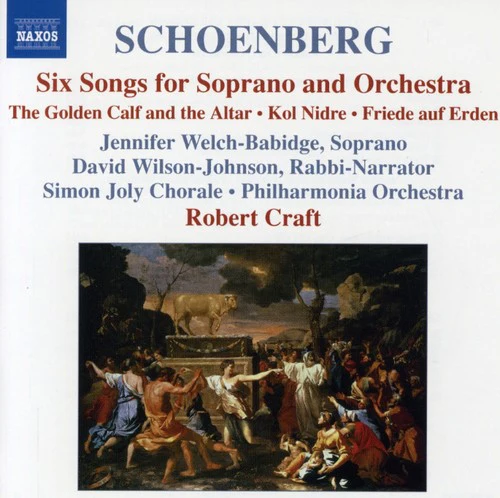
Schoenberg: Six Songs for Soprano and Orchestra / Craft, Welch-Babidge
SCHOENBERG 6 Songs, op. 8. 1 Friede auf Erden. 2 6 Pieces, op. 35. 3 Ei, du Lütte. 4 Kol Nidre. 5 Moses und Aron: act II, sc. 3 excerpts 6 • Robert Craft, cond; Jennifer Welch-Babidge (sop); 1,6 David Wilson-Johnson (rabbi-narr); 5 Simon Joly Chorale; 2–6 Philharmonia O 1,5,6 • NAXOS 8.557525 (78:31)
It’s our job to listen carefully to every recording, but I sometimes put on a disc—for its first hearing—while doing something else, just to let its music seep into my (un?) consciousness. My immediate response was: This is Schoenberg ? Most of the Six Songs, op. 8, of 1903–04 have somehow escaped this Schoenberg-lover; they are all flat-out gorgeous. The Brahms-loving composer leaned more on Wagner here, the rich harmonies only a touch more adventurous than his. The vocal writing is thoroughly operatic; these could be six dramatic arias, each with an orchestral prelude and postlude. The orchestrations are varied and colorful, hinting at Zemlinsky and even Tchaikovsky, as well as The Ring . The results are closer to Gurrelieder than to anything else of Schoenberg. Perhaps the popularity of these songs has been limited because they are not a united song cycle but six separate works, or perhaps it’s because no one has sung them like Welch-Babidge (there are recordings by Anya Silya and by Eva Marton). I was not particularly impressed by her Marzelline in the Met’s Fidelio , but she is magnificent here, displaying full, rounded tones over a wide register and dynamic range, consistently landing on pitch across many leaps. Her voice recalls a young Phyllis Bryn-Julson, although I never heard the latter tackle dramatic writing with such a high tessitura. Each song is a major piece; they vary in length from one-and-a-half to nearly six minutes, spanning over 25 minutes altogether.
This is the a cappella original of Friede auf Erden (“Peace on Earth”), written in 1907 when Schoenberg was searching for new ways but hadn’t yet settled on any. Craft’s chorus manages the difficult music well, but the piece still fails to make much of an effect. The Six Pieces for male chorus (“Inhibitions,” “The Law,” “Expression,” “Happiness,” “Mercenaries,” and “Obligation”) are no more successful. Schoenberg wrote his own texts, which are poorly expressed pieces of vague social and religious philosophy—at least in English translation; it’s difficult to imagine what he had in mind. The music may be more interesting to analyze than to hear; Craft does so at length in his always-educational program notes. Ei, du Lütte (“Oh, you little one”) is a brief, charming chorus written when Schoenberg was 21.
With Kol Nidre (1938) we return to top-notch Schoenberg—the return of the orchestra is equally welcome. The Kol Nidre is a Jewish liturgy; Schoenberg—writing in English—had objections to the historical text, but his modifications merely served to get his piece banned from use in synagogues. This performance is sensational, putting all others I have heard to shame. Craft and the Philharmonia realize all of the music’s oddly moving details, and Wilson-Johnson, who is a singer rather than an actor, gives a superb reading of the extensive, dramatic narration, a no-holds-barred emoting which works perfectly in this wild piece.
Three excerpts from “The Golden Calf at the Altar” scene of Moses und Aron are an odd filler, as there are several top-notch presentations of the opera on disc (and a superlative one on DVD; see Fanfare 31:2, page 344). Craft matches any of them but does not offer any special insight, nor does Welch-Babidge singing the Young Girl. The best part may be Craft’s notes: “An orgy follows, but at this point the excerpt ends.” And so does the disc.
The generally excellent recordings come from six sessions held from 2003 to 2006, all at Abbey Road Studio One. The orchestral songs are very well balanced; Welch-Babidge remains in front of the orchestra, yet instrumental details are always clear, and the whole has beauty and life. An awkward splice at 1:29 of the opening song is unfortunate. A major handicap to appreciating this all-vocal disc is the lack of texts. They are available, but only in German, at www.naxos.com/libretti/557525.htm. Sony’s two-CD set of Schoenberg choral music under Boulez (44571) has German and English texts for much of this music, but not the songs for soprano.
For the orchestral songs and Kol Nidre , a Want List candidate.
FANFARE: James H. North
SCHOENBERG 6 Songs, op. 8. 1 Friede auf Erden. 2 6 Pieces, op. 35. 3 Ei, du Lütte. 4 Kol Nidre. 5 Moses und Aron: act II, sc. 3 excerpts 6 • Robert Craft, cond; Jennifer Welch-Babidge (sop); 1,6 David Wilson-Johnson (rabbi-narr); 5 Simon Joly Chorale; 2–6 Philharmonia O 1,5,6 • NAXOS 8.557525 (78:31)
It’s our job to listen carefully to every recording, but I sometimes put on a disc—for its first hearing—while doing something else, just to let its music seep into my (un?) consciousness. My immediate response was: This is Schoenberg ? Most of the Six Songs, op. 8, of 1903–04 have somehow escaped this Schoenberg-lover; they are all flat-out gorgeous. The Brahms-loving composer leaned more on Wagner here, the rich harmonies only a touch more adventurous than his. The vocal writing is thoroughly operatic; these could be six dramatic arias, each with an orchestral prelude and postlude. The orchestrations are varied and colorful, hinting at Zemlinsky and even Tchaikovsky, as well as The Ring . The results are closer to Gurrelieder than to anything else of Schoenberg. Perhaps the popularity of these songs has been limited because they are not a united song cycle but six separate works, or perhaps it’s because no one has sung them like Welch-Babidge (there are recordings by Anya Silya and by Eva Marton). I was not particularly impressed by her Marzelline in the Met’s Fidelio , but she is magnificent here, displaying full, rounded tones over a wide register and dynamic range, consistently landing on pitch across many leaps. Her voice recalls a young Phyllis Bryn-Julson, although I never heard the latter tackle dramatic writing with such a high tessitura. Each song is a major piece; they vary in length from one-and-a-half to nearly six minutes, spanning over 25 minutes altogether.
This is the a cappella original of Friede auf Erden (“Peace on Earth”), written in 1907 when Schoenberg was searching for new ways but hadn’t yet settled on any. Craft’s chorus manages the difficult music well, but the piece still fails to make much of an effect. The Six Pieces for male chorus (“Inhibitions,” “The Law,” “Expression,” “Happiness,” “Mercenaries,” and “Obligation”) are no more successful. Schoenberg wrote his own texts, which are poorly expressed pieces of vague social and religious philosophy—at least in English translation; it’s difficult to imagine what he had in mind. The music may be more interesting to analyze than to hear; Craft does so at length in his always-educational program notes. Ei, du Lütte (“Oh, you little one”) is a brief, charming chorus written when Schoenberg was 21.
With Kol Nidre (1938) we return to top-notch Schoenberg—the return of the orchestra is equally welcome. The Kol Nidre is a Jewish liturgy; Schoenberg—writing in English—had objections to the historical text, but his modifications merely served to get his piece banned from use in synagogues. This performance is sensational, putting all others I have heard to shame. Craft and the Philharmonia realize all of the music’s oddly moving details, and Wilson-Johnson, who is a singer rather than an actor, gives a superb reading of the extensive, dramatic narration, a no-holds-barred emoting which works perfectly in this wild piece.
Three excerpts from “The Golden Calf at the Altar” scene of Moses und Aron are an odd filler, as there are several top-notch presentations of the opera on disc (and a superlative one on DVD; see Fanfare 31:2, page 344). Craft matches any of them but does not offer any special insight, nor does Welch-Babidge singing the Young Girl. The best part may be Craft’s notes: “An orgy follows, but at this point the excerpt ends.” And so does the disc.
The generally excellent recordings come from six sessions held from 2003 to 2006, all at Abbey Road Studio One. The orchestral songs are very well balanced; Welch-Babidge remains in front of the orchestra, yet instrumental details are always clear, and the whole has beauty and life. An awkward splice at 1:29 of the opening song is unfortunate. A major handicap to appreciating this all-vocal disc is the lack of texts. They are available, but only in German, at www.naxos.com/libretti/557525.htm. Sony’s two-CD set of Schoenberg choral music under Boulez (44571) has German and English texts for much of this music, but not the songs for soprano.
For the orchestral songs and Kol Nidre , a Want List candidate.
FANFARE: James H. North
$13.99
Schoenberg: Six Songs for Soprano and Orchestra / Craft, Welch-Babidge—
$13.99
Description
SCHOENBERG 6 Songs, op. 8. 1 Friede auf Erden. 2 6 Pieces, op. 35. 3 Ei, du Lütte. 4 Kol Nidre. 5 Moses und Aron: act II, sc. 3 excerpts 6 • Robert Craft, cond; Jennifer Welch-Babidge (sop); 1,6 David Wilson-Johnson (rabbi-narr); 5 Simon Joly Chorale; 2–6 Philharmonia O 1,5,6 • NAXOS 8.557525 (78:31)
It’s our job to listen carefully to every recording, but I sometimes put on a disc—for its first hearing—while doing something else, just to let its music seep into my (un?) consciousness. My immediate response was: This is Schoenberg ? Most of the Six Songs, op. 8, of 1903–04 have somehow escaped this Schoenberg-lover; they are all flat-out gorgeous. The Brahms-loving composer leaned more on Wagner here, the rich harmonies only a touch more adventurous than his. The vocal writing is thoroughly operatic; these could be six dramatic arias, each with an orchestral prelude and postlude. The orchestrations are varied and colorful, hinting at Zemlinsky and even Tchaikovsky, as well as The Ring . The results are closer to Gurrelieder than to anything else of Schoenberg. Perhaps the popularity of these songs has been limited because they are not a united song cycle but six separate works, or perhaps it’s because no one has sung them like Welch-Babidge (there are recordings by Anya Silya and by Eva Marton). I was not particularly impressed by her Marzelline in the Met’s Fidelio , but she is magnificent here, displaying full, rounded tones over a wide register and dynamic range, consistently landing on pitch across many leaps. Her voice recalls a young Phyllis Bryn-Julson, although I never heard the latter tackle dramatic writing with such a high tessitura. Each song is a major piece; they vary in length from one-and-a-half to nearly six minutes, spanning over 25 minutes altogether.
This is the a cappella original of Friede auf Erden (“Peace on Earth”), written in 1907 when Schoenberg was searching for new ways but hadn’t yet settled on any. Craft’s chorus manages the difficult music well, but the piece still fails to make much of an effect. The Six Pieces for male chorus (“Inhibitions,” “The Law,” “Expression,” “Happiness,” “Mercenaries,” and “Obligation”) are no more successful. Schoenberg wrote his own texts, which are poorly expressed pieces of vague social and religious philosophy—at least in English translation; it’s difficult to imagine what he had in mind. The music may be more interesting to analyze than to hear; Craft does so at length in his always-educational program notes. Ei, du Lütte (“Oh, you little one”) is a brief, charming chorus written when Schoenberg was 21.
With Kol Nidre (1938) we return to top-notch Schoenberg—the return of the orchestra is equally welcome. The Kol Nidre is a Jewish liturgy; Schoenberg—writing in English—had objections to the historical text, but his modifications merely served to get his piece banned from use in synagogues. This performance is sensational, putting all others I have heard to shame. Craft and the Philharmonia realize all of the music’s oddly moving details, and Wilson-Johnson, who is a singer rather than an actor, gives a superb reading of the extensive, dramatic narration, a no-holds-barred emoting which works perfectly in this wild piece.
Three excerpts from “The Golden Calf at the Altar” scene of Moses und Aron are an odd filler, as there are several top-notch presentations of the opera on disc (and a superlative one on DVD; see Fanfare 31:2, page 344). Craft matches any of them but does not offer any special insight, nor does Welch-Babidge singing the Young Girl. The best part may be Craft’s notes: “An orgy follows, but at this point the excerpt ends.” And so does the disc.
The generally excellent recordings come from six sessions held from 2003 to 2006, all at Abbey Road Studio One. The orchestral songs are very well balanced; Welch-Babidge remains in front of the orchestra, yet instrumental details are always clear, and the whole has beauty and life. An awkward splice at 1:29 of the opening song is unfortunate. A major handicap to appreciating this all-vocal disc is the lack of texts. They are available, but only in German, at www.naxos.com/libretti/557525.htm. Sony’s two-CD set of Schoenberg choral music under Boulez (44571) has German and English texts for much of this music, but not the songs for soprano.
For the orchestral songs and Kol Nidre , a Want List candidate.
FANFARE: James H. North