🎉 Up to 70% Off Selected ItemsShop Sale

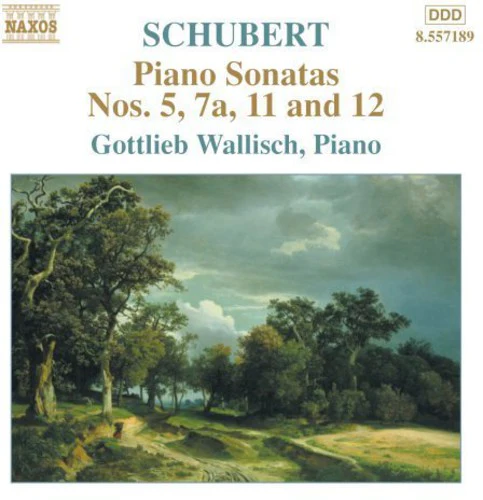
Schubert: Piano Sonatas No 5, 7a, 11 And 12 / Wallisch
This recording contains four of Schubert's 12 piano sonatas that survive in fragmentary form. Notwithstanding their varied states of incompletion, the works are well worth getting to know for their harmonic daring and melodic strength. Beethoven's Appassionata, for instance, casts a strong shadow over the F minor sonata's finale, although its unpredictable modulations and thematic detours are vintage Schubert. Listeners who know the E-flat Sonata D. 568 will be fascinated to encounter this earlier, more difficult D-flat major incarnation, minus the minuet and trio Schubert added later. All three movements of the A-flat D. 557 sonata exist intact and include a delightful Allegro whose opening theme would manifest itself more fully in the familiar "little" A major D. 664 sonata.
Many attempts have been made to complete these works, yet pianist Gottlieb Wallisch performs them as they stand. (Consequently, the F minor sonata's opening Allegro suddenly trails off and vanishes at the start of the recapitulation.) As a Schubert pianist, though, Wallisch is quite complete! He plays the A-flat sonata marginally faster than Kempff and with greater brio all around, and his winged, pliable accounts of the F minor's first three movements contrast to the statuesque Richter versions. But the Russian pianist's long-lined power in the finale surpasses Wallisch's smaller-scaled note-spinning. For the most part, however, Wallisch's solid technique and sound musicianship operate on a high level and benefit from Naxos' top-notch engineering. Wallisch also provides his own excellent, informative booklet notes. Highly recommended for Schubertians of every stripe. [7/6/2004]
--Jed Distler, ClassicsToday.com
Many attempts have been made to complete these works, yet pianist Gottlieb Wallisch performs them as they stand. (Consequently, the F minor sonata's opening Allegro suddenly trails off and vanishes at the start of the recapitulation.) As a Schubert pianist, though, Wallisch is quite complete! He plays the A-flat sonata marginally faster than Kempff and with greater brio all around, and his winged, pliable accounts of the F minor's first three movements contrast to the statuesque Richter versions. But the Russian pianist's long-lined power in the finale surpasses Wallisch's smaller-scaled note-spinning. For the most part, however, Wallisch's solid technique and sound musicianship operate on a high level and benefit from Naxos' top-notch engineering. Wallisch also provides his own excellent, informative booklet notes. Highly recommended for Schubertians of every stripe. [7/6/2004]
--Jed Distler, ClassicsToday.com
This recording contains four of Schubert's 12 piano sonatas that survive in fragmentary form. Notwithstanding their varied states of incompletion, the works are well worth getting to know for their harmonic daring and melodic strength. Beethoven's Appassionata, for instance, casts a strong shadow over the F minor sonata's finale, although its unpredictable modulations and thematic detours are vintage Schubert. Listeners who know the E-flat Sonata D. 568 will be fascinated to encounter this earlier, more difficult D-flat major incarnation, minus the minuet and trio Schubert added later. All three movements of the A-flat D. 557 sonata exist intact and include a delightful Allegro whose opening theme would manifest itself more fully in the familiar "little" A major D. 664 sonata.
Many attempts have been made to complete these works, yet pianist Gottlieb Wallisch performs them as they stand. (Consequently, the F minor sonata's opening Allegro suddenly trails off and vanishes at the start of the recapitulation.) As a Schubert pianist, though, Wallisch is quite complete! He plays the A-flat sonata marginally faster than Kempff and with greater brio all around, and his winged, pliable accounts of the F minor's first three movements contrast to the statuesque Richter versions. But the Russian pianist's long-lined power in the finale surpasses Wallisch's smaller-scaled note-spinning. For the most part, however, Wallisch's solid technique and sound musicianship operate on a high level and benefit from Naxos' top-notch engineering. Wallisch also provides his own excellent, informative booklet notes. Highly recommended for Schubertians of every stripe. [7/6/2004]
--Jed Distler, ClassicsToday.com
Many attempts have been made to complete these works, yet pianist Gottlieb Wallisch performs them as they stand. (Consequently, the F minor sonata's opening Allegro suddenly trails off and vanishes at the start of the recapitulation.) As a Schubert pianist, though, Wallisch is quite complete! He plays the A-flat sonata marginally faster than Kempff and with greater brio all around, and his winged, pliable accounts of the F minor's first three movements contrast to the statuesque Richter versions. But the Russian pianist's long-lined power in the finale surpasses Wallisch's smaller-scaled note-spinning. For the most part, however, Wallisch's solid technique and sound musicianship operate on a high level and benefit from Naxos' top-notch engineering. Wallisch also provides his own excellent, informative booklet notes. Highly recommended for Schubertians of every stripe. [7/6/2004]
--Jed Distler, ClassicsToday.com
$19.99
Schubert: Piano Sonatas No 5, 7a, 11 And 12 / Wallisch—
$19.99
Description
This recording contains four of Schubert's 12 piano sonatas that survive in fragmentary form. Notwithstanding their varied states of incompletion, the works are well worth getting to know for their harmonic daring and melodic strength. Beethoven's Appassionata, for instance, casts a strong shadow over the F minor sonata's finale, although its unpredictable modulations and thematic detours are vintage Schubert. Listeners who know the E-flat Sonata D. 568 will be fascinated to encounter this earlier, more difficult D-flat major incarnation, minus the minuet and trio Schubert added later. All three movements of the A-flat D. 557 sonata exist intact and include a delightful Allegro whose opening theme would manifest itself more fully in the familiar "little" A major D. 664 sonata.
Many attempts have been made to complete these works, yet pianist Gottlieb Wallisch performs them as they stand. (Consequently, the F minor sonata's opening Allegro suddenly trails off and vanishes at the start of the recapitulation.) As a Schubert pianist, though, Wallisch is quite complete! He plays the A-flat sonata marginally faster than Kempff and with greater brio all around, and his winged, pliable accounts of the F minor's first three movements contrast to the statuesque Richter versions. But the Russian pianist's long-lined power in the finale surpasses Wallisch's smaller-scaled note-spinning. For the most part, however, Wallisch's solid technique and sound musicianship operate on a high level and benefit from Naxos' top-notch engineering. Wallisch also provides his own excellent, informative booklet notes. Highly recommended for Schubertians of every stripe. [7/6/2004]
--Jed Distler, ClassicsToday.com
Many attempts have been made to complete these works, yet pianist Gottlieb Wallisch performs them as they stand. (Consequently, the F minor sonata's opening Allegro suddenly trails off and vanishes at the start of the recapitulation.) As a Schubert pianist, though, Wallisch is quite complete! He plays the A-flat sonata marginally faster than Kempff and with greater brio all around, and his winged, pliable accounts of the F minor's first three movements contrast to the statuesque Richter versions. But the Russian pianist's long-lined power in the finale surpasses Wallisch's smaller-scaled note-spinning. For the most part, however, Wallisch's solid technique and sound musicianship operate on a high level and benefit from Naxos' top-notch engineering. Wallisch also provides his own excellent, informative booklet notes. Highly recommended for Schubertians of every stripe. [7/6/2004]
--Jed Distler, ClassicsToday.com