🎉 Up to 70% Off Selected ItemsShop Sale

1 / 2
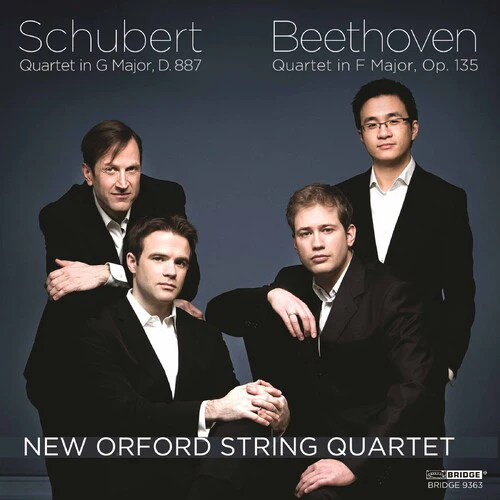
Schubert & Beethoven: String Quartets / New Orford String Quartet
SCHUBERT String Quartet No. 15. BEETHOVEN String No. 16 • New Orford Str Qrt • BRIDGE 9363 (74:47)
This would be an impressive release for any seasoned ensemble; all the more so then that it marks the New Orford String Quartet’s debut album. An ensemble entering into the fray of such highly competitive arenas as Schubert’s and Beethoven’s quartets often raises the question critics invariably ask, “Do these performances offer new insights or have something special to say?” To that I can answer with a most emphatic yes.
“Unstable” is a key word in describing Schubert’s G-Major Quartet—harmonically unstable in its vacillation between major and minor and its undermining of tonality; rhythmically unstable in its strange leaping figures and shuddering tremolos; and most of all, emotionally unstable in its dizzying mood swings, evidence of a mind in the grip of a serious mental disorder. Much of Schubert’s private life and personal affairs has been revealed in recent years, but in many ways the boy-man remains an enigma.
Save for a fragment of a string quartet in F Major that appears in the Schubert catalog as D 998, the G-Major Quartet is the end of the line for the composer’s string quartets, though it would not be his last great chamber work for strings. That would be the String Quintet in C Major, which came two years later, in 1828, not long before his death. In a number of ways, this G-Major work, the last of Schubert’s completed quartets, picks up where its immediate predecessor, the “Death and the Maiden” Quartet of 1824, left off. I’m reminded of what Mahler is reputed to have said in reply to someone who had asked him why the funeral march in his First Symphony was so much different from the funeral march in Beethoven’s “Eroica” Symphony. “Ah,” replied Mahler, “Beethoven describes the mourner; I depict the corpse.” Gruesome as the medical examiner’s lab imagery may be, Schubert’s G-Major Quartet strikes me as the Maiden on the autopsy table.
I don’t wish to go down the road of this analogy too far by saying that the New Orford Quartet’s performance resembles an autopsy on the deceased, but the ensemble’s reading does have a laser-sharp focus to it that lays bare every strand and fiber of the piece. The players take their time and exercise meticulous care, as well as respect, in cutting through and folding back the many layers of tissue. Oftentimes, performances of this work can have a frantic edge to them; I’m thinking, for example, of the recording by the Hagen Quartet. But tension built more slowly over longer arches can turn the emotional screws even tighter than sudden explosive outbursts. The New Orford’s reading of Schubert’s G-Major Quartet is an exemplary study in how to put the most elegant and refined playing to the purpose of delivering the most upsetting news—tragedy without the hysterics.
It’s obvious from the above interview that cellist Brian Manker and I don’t see completely eye-to-eye (or, should I say, don’t hear completely ear-to-ear?) on Beethoven’s final complete quartet, the F Major, op. 135. His speculation about the connection between the es in the Muss es sein introduction to the last movement and Es in German being the designation for E?, which could be an internal musical joke referring back to an event in the first movement, is certainly interesting and worth entertaining. But there is another joke, less abstruse, that has been connected to the Muss es sein incipit, and that is a scribbled note in which Beethoven is allegedly complaining about his housekeeper insisting on putting too much starch in his shirts: “Must it be? It must be.” This, in combination with the actual musical content of the movement, has always led me to hear the whole thing as a fairly lighthearted, even silly, romp. I think we would agree, however, that the Lento assai movement is one of Beethoven’s profoundest utterances.
The New Orford’s tempo at the outset of the quartet is a bit slower than I’m accustomed to hearing it. But it’s not one of the works Beethoven provided metronome markings for—only his quartets through op. 95 contain his own markings—and the first movement is marked Allegretto, so the New Orford’s reading may be entirely justified. But something else emerges at this slightly slower tempo that I find interesting and quite delightful, and that is a sly, slightly underplayed, tongue-in-cheek humor that tickles the funny bone in a different, perhaps more sophisticated way than other, more slapstick approaches.
Take, for example, the hiccups in the cello part that come shortly into the development section following the double bar and change of key signature to one sharp. Not a few cellists take these for rude, sophomoric belches, which, admittedly, is funny, especially if you’re into high school hijinks. But Manker sees these more as little burps that slip out embarrassedly in polite company, making them all the funnier for their lack of social propriety and grace. It puts me in mind of the long-circulated tale, 1601 , attributed to Mark Twain, in which he is privy to a conversation among Francis Bacon, Sir Walter Raleigh, Ben Johnson, and 16-year-old Francis Beaumonte engaged in sniffing out who broke wind in company of the Queen. If memory serves, I think the culprit turns out to be the Queen herself. Twain, of course (whether he was the author of this particular farce or not) can always be counted on to entertain and edify and, so too, I think, can the playing of the New Orford Quartet.
FANFARE: Jerry Dubins
This would be an impressive release for any seasoned ensemble; all the more so then that it marks the New Orford String Quartet’s debut album. An ensemble entering into the fray of such highly competitive arenas as Schubert’s and Beethoven’s quartets often raises the question critics invariably ask, “Do these performances offer new insights or have something special to say?” To that I can answer with a most emphatic yes.
“Unstable” is a key word in describing Schubert’s G-Major Quartet—harmonically unstable in its vacillation between major and minor and its undermining of tonality; rhythmically unstable in its strange leaping figures and shuddering tremolos; and most of all, emotionally unstable in its dizzying mood swings, evidence of a mind in the grip of a serious mental disorder. Much of Schubert’s private life and personal affairs has been revealed in recent years, but in many ways the boy-man remains an enigma.
Save for a fragment of a string quartet in F Major that appears in the Schubert catalog as D 998, the G-Major Quartet is the end of the line for the composer’s string quartets, though it would not be his last great chamber work for strings. That would be the String Quintet in C Major, which came two years later, in 1828, not long before his death. In a number of ways, this G-Major work, the last of Schubert’s completed quartets, picks up where its immediate predecessor, the “Death and the Maiden” Quartet of 1824, left off. I’m reminded of what Mahler is reputed to have said in reply to someone who had asked him why the funeral march in his First Symphony was so much different from the funeral march in Beethoven’s “Eroica” Symphony. “Ah,” replied Mahler, “Beethoven describes the mourner; I depict the corpse.” Gruesome as the medical examiner’s lab imagery may be, Schubert’s G-Major Quartet strikes me as the Maiden on the autopsy table.
I don’t wish to go down the road of this analogy too far by saying that the New Orford Quartet’s performance resembles an autopsy on the deceased, but the ensemble’s reading does have a laser-sharp focus to it that lays bare every strand and fiber of the piece. The players take their time and exercise meticulous care, as well as respect, in cutting through and folding back the many layers of tissue. Oftentimes, performances of this work can have a frantic edge to them; I’m thinking, for example, of the recording by the Hagen Quartet. But tension built more slowly over longer arches can turn the emotional screws even tighter than sudden explosive outbursts. The New Orford’s reading of Schubert’s G-Major Quartet is an exemplary study in how to put the most elegant and refined playing to the purpose of delivering the most upsetting news—tragedy without the hysterics.
It’s obvious from the above interview that cellist Brian Manker and I don’t see completely eye-to-eye (or, should I say, don’t hear completely ear-to-ear?) on Beethoven’s final complete quartet, the F Major, op. 135. His speculation about the connection between the es in the Muss es sein introduction to the last movement and Es in German being the designation for E?, which could be an internal musical joke referring back to an event in the first movement, is certainly interesting and worth entertaining. But there is another joke, less abstruse, that has been connected to the Muss es sein incipit, and that is a scribbled note in which Beethoven is allegedly complaining about his housekeeper insisting on putting too much starch in his shirts: “Must it be? It must be.” This, in combination with the actual musical content of the movement, has always led me to hear the whole thing as a fairly lighthearted, even silly, romp. I think we would agree, however, that the Lento assai movement is one of Beethoven’s profoundest utterances.
The New Orford’s tempo at the outset of the quartet is a bit slower than I’m accustomed to hearing it. But it’s not one of the works Beethoven provided metronome markings for—only his quartets through op. 95 contain his own markings—and the first movement is marked Allegretto, so the New Orford’s reading may be entirely justified. But something else emerges at this slightly slower tempo that I find interesting and quite delightful, and that is a sly, slightly underplayed, tongue-in-cheek humor that tickles the funny bone in a different, perhaps more sophisticated way than other, more slapstick approaches.
Take, for example, the hiccups in the cello part that come shortly into the development section following the double bar and change of key signature to one sharp. Not a few cellists take these for rude, sophomoric belches, which, admittedly, is funny, especially if you’re into high school hijinks. But Manker sees these more as little burps that slip out embarrassedly in polite company, making them all the funnier for their lack of social propriety and grace. It puts me in mind of the long-circulated tale, 1601 , attributed to Mark Twain, in which he is privy to a conversation among Francis Bacon, Sir Walter Raleigh, Ben Johnson, and 16-year-old Francis Beaumonte engaged in sniffing out who broke wind in company of the Queen. If memory serves, I think the culprit turns out to be the Queen herself. Twain, of course (whether he was the author of this particular farce or not) can always be counted on to entertain and edify and, so too, I think, can the playing of the New Orford Quartet.
FANFARE: Jerry Dubins
SCHUBERT String Quartet No. 15. BEETHOVEN String No. 16 • New Orford Str Qrt • BRIDGE 9363 (74:47)
This would be an impressive release for any seasoned ensemble; all the more so then that it marks the New Orford String Quartet’s debut album. An ensemble entering into the fray of such highly competitive arenas as Schubert’s and Beethoven’s quartets often raises the question critics invariably ask, “Do these performances offer new insights or have something special to say?” To that I can answer with a most emphatic yes.
“Unstable” is a key word in describing Schubert’s G-Major Quartet—harmonically unstable in its vacillation between major and minor and its undermining of tonality; rhythmically unstable in its strange leaping figures and shuddering tremolos; and most of all, emotionally unstable in its dizzying mood swings, evidence of a mind in the grip of a serious mental disorder. Much of Schubert’s private life and personal affairs has been revealed in recent years, but in many ways the boy-man remains an enigma.
Save for a fragment of a string quartet in F Major that appears in the Schubert catalog as D 998, the G-Major Quartet is the end of the line for the composer’s string quartets, though it would not be his last great chamber work for strings. That would be the String Quintet in C Major, which came two years later, in 1828, not long before his death. In a number of ways, this G-Major work, the last of Schubert’s completed quartets, picks up where its immediate predecessor, the “Death and the Maiden” Quartet of 1824, left off. I’m reminded of what Mahler is reputed to have said in reply to someone who had asked him why the funeral march in his First Symphony was so much different from the funeral march in Beethoven’s “Eroica” Symphony. “Ah,” replied Mahler, “Beethoven describes the mourner; I depict the corpse.” Gruesome as the medical examiner’s lab imagery may be, Schubert’s G-Major Quartet strikes me as the Maiden on the autopsy table.
I don’t wish to go down the road of this analogy too far by saying that the New Orford Quartet’s performance resembles an autopsy on the deceased, but the ensemble’s reading does have a laser-sharp focus to it that lays bare every strand and fiber of the piece. The players take their time and exercise meticulous care, as well as respect, in cutting through and folding back the many layers of tissue. Oftentimes, performances of this work can have a frantic edge to them; I’m thinking, for example, of the recording by the Hagen Quartet. But tension built more slowly over longer arches can turn the emotional screws even tighter than sudden explosive outbursts. The New Orford’s reading of Schubert’s G-Major Quartet is an exemplary study in how to put the most elegant and refined playing to the purpose of delivering the most upsetting news—tragedy without the hysterics.
It’s obvious from the above interview that cellist Brian Manker and I don’t see completely eye-to-eye (or, should I say, don’t hear completely ear-to-ear?) on Beethoven’s final complete quartet, the F Major, op. 135. His speculation about the connection between the es in the Muss es sein introduction to the last movement and Es in German being the designation for E?, which could be an internal musical joke referring back to an event in the first movement, is certainly interesting and worth entertaining. But there is another joke, less abstruse, that has been connected to the Muss es sein incipit, and that is a scribbled note in which Beethoven is allegedly complaining about his housekeeper insisting on putting too much starch in his shirts: “Must it be? It must be.” This, in combination with the actual musical content of the movement, has always led me to hear the whole thing as a fairly lighthearted, even silly, romp. I think we would agree, however, that the Lento assai movement is one of Beethoven’s profoundest utterances.
The New Orford’s tempo at the outset of the quartet is a bit slower than I’m accustomed to hearing it. But it’s not one of the works Beethoven provided metronome markings for—only his quartets through op. 95 contain his own markings—and the first movement is marked Allegretto, so the New Orford’s reading may be entirely justified. But something else emerges at this slightly slower tempo that I find interesting and quite delightful, and that is a sly, slightly underplayed, tongue-in-cheek humor that tickles the funny bone in a different, perhaps more sophisticated way than other, more slapstick approaches.
Take, for example, the hiccups in the cello part that come shortly into the development section following the double bar and change of key signature to one sharp. Not a few cellists take these for rude, sophomoric belches, which, admittedly, is funny, especially if you’re into high school hijinks. But Manker sees these more as little burps that slip out embarrassedly in polite company, making them all the funnier for their lack of social propriety and grace. It puts me in mind of the long-circulated tale, 1601 , attributed to Mark Twain, in which he is privy to a conversation among Francis Bacon, Sir Walter Raleigh, Ben Johnson, and 16-year-old Francis Beaumonte engaged in sniffing out who broke wind in company of the Queen. If memory serves, I think the culprit turns out to be the Queen herself. Twain, of course (whether he was the author of this particular farce or not) can always be counted on to entertain and edify and, so too, I think, can the playing of the New Orford Quartet.
FANFARE: Jerry Dubins
This would be an impressive release for any seasoned ensemble; all the more so then that it marks the New Orford String Quartet’s debut album. An ensemble entering into the fray of such highly competitive arenas as Schubert’s and Beethoven’s quartets often raises the question critics invariably ask, “Do these performances offer new insights or have something special to say?” To that I can answer with a most emphatic yes.
“Unstable” is a key word in describing Schubert’s G-Major Quartet—harmonically unstable in its vacillation between major and minor and its undermining of tonality; rhythmically unstable in its strange leaping figures and shuddering tremolos; and most of all, emotionally unstable in its dizzying mood swings, evidence of a mind in the grip of a serious mental disorder. Much of Schubert’s private life and personal affairs has been revealed in recent years, but in many ways the boy-man remains an enigma.
Save for a fragment of a string quartet in F Major that appears in the Schubert catalog as D 998, the G-Major Quartet is the end of the line for the composer’s string quartets, though it would not be his last great chamber work for strings. That would be the String Quintet in C Major, which came two years later, in 1828, not long before his death. In a number of ways, this G-Major work, the last of Schubert’s completed quartets, picks up where its immediate predecessor, the “Death and the Maiden” Quartet of 1824, left off. I’m reminded of what Mahler is reputed to have said in reply to someone who had asked him why the funeral march in his First Symphony was so much different from the funeral march in Beethoven’s “Eroica” Symphony. “Ah,” replied Mahler, “Beethoven describes the mourner; I depict the corpse.” Gruesome as the medical examiner’s lab imagery may be, Schubert’s G-Major Quartet strikes me as the Maiden on the autopsy table.
I don’t wish to go down the road of this analogy too far by saying that the New Orford Quartet’s performance resembles an autopsy on the deceased, but the ensemble’s reading does have a laser-sharp focus to it that lays bare every strand and fiber of the piece. The players take their time and exercise meticulous care, as well as respect, in cutting through and folding back the many layers of tissue. Oftentimes, performances of this work can have a frantic edge to them; I’m thinking, for example, of the recording by the Hagen Quartet. But tension built more slowly over longer arches can turn the emotional screws even tighter than sudden explosive outbursts. The New Orford’s reading of Schubert’s G-Major Quartet is an exemplary study in how to put the most elegant and refined playing to the purpose of delivering the most upsetting news—tragedy without the hysterics.
It’s obvious from the above interview that cellist Brian Manker and I don’t see completely eye-to-eye (or, should I say, don’t hear completely ear-to-ear?) on Beethoven’s final complete quartet, the F Major, op. 135. His speculation about the connection between the es in the Muss es sein introduction to the last movement and Es in German being the designation for E?, which could be an internal musical joke referring back to an event in the first movement, is certainly interesting and worth entertaining. But there is another joke, less abstruse, that has been connected to the Muss es sein incipit, and that is a scribbled note in which Beethoven is allegedly complaining about his housekeeper insisting on putting too much starch in his shirts: “Must it be? It must be.” This, in combination with the actual musical content of the movement, has always led me to hear the whole thing as a fairly lighthearted, even silly, romp. I think we would agree, however, that the Lento assai movement is one of Beethoven’s profoundest utterances.
The New Orford’s tempo at the outset of the quartet is a bit slower than I’m accustomed to hearing it. But it’s not one of the works Beethoven provided metronome markings for—only his quartets through op. 95 contain his own markings—and the first movement is marked Allegretto, so the New Orford’s reading may be entirely justified. But something else emerges at this slightly slower tempo that I find interesting and quite delightful, and that is a sly, slightly underplayed, tongue-in-cheek humor that tickles the funny bone in a different, perhaps more sophisticated way than other, more slapstick approaches.
Take, for example, the hiccups in the cello part that come shortly into the development section following the double bar and change of key signature to one sharp. Not a few cellists take these for rude, sophomoric belches, which, admittedly, is funny, especially if you’re into high school hijinks. But Manker sees these more as little burps that slip out embarrassedly in polite company, making them all the funnier for their lack of social propriety and grace. It puts me in mind of the long-circulated tale, 1601 , attributed to Mark Twain, in which he is privy to a conversation among Francis Bacon, Sir Walter Raleigh, Ben Johnson, and 16-year-old Francis Beaumonte engaged in sniffing out who broke wind in company of the Queen. If memory serves, I think the culprit turns out to be the Queen herself. Twain, of course (whether he was the author of this particular farce or not) can always be counted on to entertain and edify and, so too, I think, can the playing of the New Orford Quartet.
FANFARE: Jerry Dubins
$18.99
Schubert & Beethoven: String Quartets / New Orford String Quartet—
$18.99
Description
SCHUBERT String Quartet No. 15. BEETHOVEN String No. 16 • New Orford Str Qrt • BRIDGE 9363 (74:47)
This would be an impressive release for any seasoned ensemble; all the more so then that it marks the New Orford String Quartet’s debut album. An ensemble entering into the fray of such highly competitive arenas as Schubert’s and Beethoven’s quartets often raises the question critics invariably ask, “Do these performances offer new insights or have something special to say?” To that I can answer with a most emphatic yes.
“Unstable” is a key word in describing Schubert’s G-Major Quartet—harmonically unstable in its vacillation between major and minor and its undermining of tonality; rhythmically unstable in its strange leaping figures and shuddering tremolos; and most of all, emotionally unstable in its dizzying mood swings, evidence of a mind in the grip of a serious mental disorder. Much of Schubert’s private life and personal affairs has been revealed in recent years, but in many ways the boy-man remains an enigma.
Save for a fragment of a string quartet in F Major that appears in the Schubert catalog as D 998, the G-Major Quartet is the end of the line for the composer’s string quartets, though it would not be his last great chamber work for strings. That would be the String Quintet in C Major, which came two years later, in 1828, not long before his death. In a number of ways, this G-Major work, the last of Schubert’s completed quartets, picks up where its immediate predecessor, the “Death and the Maiden” Quartet of 1824, left off. I’m reminded of what Mahler is reputed to have said in reply to someone who had asked him why the funeral march in his First Symphony was so much different from the funeral march in Beethoven’s “Eroica” Symphony. “Ah,” replied Mahler, “Beethoven describes the mourner; I depict the corpse.” Gruesome as the medical examiner’s lab imagery may be, Schubert’s G-Major Quartet strikes me as the Maiden on the autopsy table.
I don’t wish to go down the road of this analogy too far by saying that the New Orford Quartet’s performance resembles an autopsy on the deceased, but the ensemble’s reading does have a laser-sharp focus to it that lays bare every strand and fiber of the piece. The players take their time and exercise meticulous care, as well as respect, in cutting through and folding back the many layers of tissue. Oftentimes, performances of this work can have a frantic edge to them; I’m thinking, for example, of the recording by the Hagen Quartet. But tension built more slowly over longer arches can turn the emotional screws even tighter than sudden explosive outbursts. The New Orford’s reading of Schubert’s G-Major Quartet is an exemplary study in how to put the most elegant and refined playing to the purpose of delivering the most upsetting news—tragedy without the hysterics.
It’s obvious from the above interview that cellist Brian Manker and I don’t see completely eye-to-eye (or, should I say, don’t hear completely ear-to-ear?) on Beethoven’s final complete quartet, the F Major, op. 135. His speculation about the connection between the es in the Muss es sein introduction to the last movement and Es in German being the designation for E?, which could be an internal musical joke referring back to an event in the first movement, is certainly interesting and worth entertaining. But there is another joke, less abstruse, that has been connected to the Muss es sein incipit, and that is a scribbled note in which Beethoven is allegedly complaining about his housekeeper insisting on putting too much starch in his shirts: “Must it be? It must be.” This, in combination with the actual musical content of the movement, has always led me to hear the whole thing as a fairly lighthearted, even silly, romp. I think we would agree, however, that the Lento assai movement is one of Beethoven’s profoundest utterances.
The New Orford’s tempo at the outset of the quartet is a bit slower than I’m accustomed to hearing it. But it’s not one of the works Beethoven provided metronome markings for—only his quartets through op. 95 contain his own markings—and the first movement is marked Allegretto, so the New Orford’s reading may be entirely justified. But something else emerges at this slightly slower tempo that I find interesting and quite delightful, and that is a sly, slightly underplayed, tongue-in-cheek humor that tickles the funny bone in a different, perhaps more sophisticated way than other, more slapstick approaches.
Take, for example, the hiccups in the cello part that come shortly into the development section following the double bar and change of key signature to one sharp. Not a few cellists take these for rude, sophomoric belches, which, admittedly, is funny, especially if you’re into high school hijinks. But Manker sees these more as little burps that slip out embarrassedly in polite company, making them all the funnier for their lack of social propriety and grace. It puts me in mind of the long-circulated tale, 1601 , attributed to Mark Twain, in which he is privy to a conversation among Francis Bacon, Sir Walter Raleigh, Ben Johnson, and 16-year-old Francis Beaumonte engaged in sniffing out who broke wind in company of the Queen. If memory serves, I think the culprit turns out to be the Queen herself. Twain, of course (whether he was the author of this particular farce or not) can always be counted on to entertain and edify and, so too, I think, can the playing of the New Orford Quartet.
FANFARE: Jerry Dubins
This would be an impressive release for any seasoned ensemble; all the more so then that it marks the New Orford String Quartet’s debut album. An ensemble entering into the fray of such highly competitive arenas as Schubert’s and Beethoven’s quartets often raises the question critics invariably ask, “Do these performances offer new insights or have something special to say?” To that I can answer with a most emphatic yes.
“Unstable” is a key word in describing Schubert’s G-Major Quartet—harmonically unstable in its vacillation between major and minor and its undermining of tonality; rhythmically unstable in its strange leaping figures and shuddering tremolos; and most of all, emotionally unstable in its dizzying mood swings, evidence of a mind in the grip of a serious mental disorder. Much of Schubert’s private life and personal affairs has been revealed in recent years, but in many ways the boy-man remains an enigma.
Save for a fragment of a string quartet in F Major that appears in the Schubert catalog as D 998, the G-Major Quartet is the end of the line for the composer’s string quartets, though it would not be his last great chamber work for strings. That would be the String Quintet in C Major, which came two years later, in 1828, not long before his death. In a number of ways, this G-Major work, the last of Schubert’s completed quartets, picks up where its immediate predecessor, the “Death and the Maiden” Quartet of 1824, left off. I’m reminded of what Mahler is reputed to have said in reply to someone who had asked him why the funeral march in his First Symphony was so much different from the funeral march in Beethoven’s “Eroica” Symphony. “Ah,” replied Mahler, “Beethoven describes the mourner; I depict the corpse.” Gruesome as the medical examiner’s lab imagery may be, Schubert’s G-Major Quartet strikes me as the Maiden on the autopsy table.
I don’t wish to go down the road of this analogy too far by saying that the New Orford Quartet’s performance resembles an autopsy on the deceased, but the ensemble’s reading does have a laser-sharp focus to it that lays bare every strand and fiber of the piece. The players take their time and exercise meticulous care, as well as respect, in cutting through and folding back the many layers of tissue. Oftentimes, performances of this work can have a frantic edge to them; I’m thinking, for example, of the recording by the Hagen Quartet. But tension built more slowly over longer arches can turn the emotional screws even tighter than sudden explosive outbursts. The New Orford’s reading of Schubert’s G-Major Quartet is an exemplary study in how to put the most elegant and refined playing to the purpose of delivering the most upsetting news—tragedy without the hysterics.
It’s obvious from the above interview that cellist Brian Manker and I don’t see completely eye-to-eye (or, should I say, don’t hear completely ear-to-ear?) on Beethoven’s final complete quartet, the F Major, op. 135. His speculation about the connection between the es in the Muss es sein introduction to the last movement and Es in German being the designation for E?, which could be an internal musical joke referring back to an event in the first movement, is certainly interesting and worth entertaining. But there is another joke, less abstruse, that has been connected to the Muss es sein incipit, and that is a scribbled note in which Beethoven is allegedly complaining about his housekeeper insisting on putting too much starch in his shirts: “Must it be? It must be.” This, in combination with the actual musical content of the movement, has always led me to hear the whole thing as a fairly lighthearted, even silly, romp. I think we would agree, however, that the Lento assai movement is one of Beethoven’s profoundest utterances.
The New Orford’s tempo at the outset of the quartet is a bit slower than I’m accustomed to hearing it. But it’s not one of the works Beethoven provided metronome markings for—only his quartets through op. 95 contain his own markings—and the first movement is marked Allegretto, so the New Orford’s reading may be entirely justified. But something else emerges at this slightly slower tempo that I find interesting and quite delightful, and that is a sly, slightly underplayed, tongue-in-cheek humor that tickles the funny bone in a different, perhaps more sophisticated way than other, more slapstick approaches.
Take, for example, the hiccups in the cello part that come shortly into the development section following the double bar and change of key signature to one sharp. Not a few cellists take these for rude, sophomoric belches, which, admittedly, is funny, especially if you’re into high school hijinks. But Manker sees these more as little burps that slip out embarrassedly in polite company, making them all the funnier for their lack of social propriety and grace. It puts me in mind of the long-circulated tale, 1601 , attributed to Mark Twain, in which he is privy to a conversation among Francis Bacon, Sir Walter Raleigh, Ben Johnson, and 16-year-old Francis Beaumonte engaged in sniffing out who broke wind in company of the Queen. If memory serves, I think the culprit turns out to be the Queen herself. Twain, of course (whether he was the author of this particular farce or not) can always be counted on to entertain and edify and, so too, I think, can the playing of the New Orford Quartet.
FANFARE: Jerry Dubins