🎉 Up to 70% Off Selected ItemsShop Sale

1 / 2
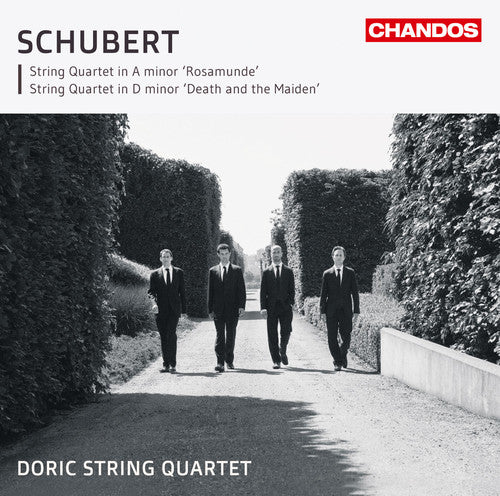
Schubert: String Quartets "Rosamunde", "Death and the Maiden" / Doric String Quartet
On its new release, the Doric String Quartet turns to the music of Franz Schubert. It is the Quartet’s fifth release for Chandos, and the discography has gone from strength to strength. MusicWeb International said of the recent Korngold release (CHAN 10707): ‘The Doric Quartet seem to have a Midas touch, and any repertoire they commit to disc comes out sparkling.’ Their Schumann release (CHAN 10692) was ‘Recording of the Month’ in both Gramophone and BBC Music.
In March 1824, despite describing himself as ‘the most unhappy and wretched creature in the world’, Schubert completed not only the great Octet, but also the two String Quartets recorded here.
The String Quartet in D minor is considered the greatest of Schubert’s late quartets, mainly on account of its raw emotional honesty, which reaches an almost unendurable pitch in the second movement, a set of variations based on Schubert’s song Der Tod und das Mädchen. All four movements are driven by extensively repeated rhythmic figures, reminiscent of the musical style of Schubert’s great idol, Beethoven.
Full of Schubertian ambivalence, the String Quartet in A minor is a deeply intimate work. The opening, expressing brooding sadness, is played by the first violin over a restless accompaniment, subsequently interrupted by flurries of almost manic energy. In the second movement, Schubert ‘borrowed’ the main melody from the third Entr’acte of his incidental music to the play Rosamunde, Fürstin von Zypern (1823) by Wilhelmine von Chézy.
- Chandos
In March 1824, despite describing himself as ‘the most unhappy and wretched creature in the world’, Schubert completed not only the great Octet, but also the two String Quartets recorded here.
The String Quartet in D minor is considered the greatest of Schubert’s late quartets, mainly on account of its raw emotional honesty, which reaches an almost unendurable pitch in the second movement, a set of variations based on Schubert’s song Der Tod und das Mädchen. All four movements are driven by extensively repeated rhythmic figures, reminiscent of the musical style of Schubert’s great idol, Beethoven.
Full of Schubertian ambivalence, the String Quartet in A minor is a deeply intimate work. The opening, expressing brooding sadness, is played by the first violin over a restless accompaniment, subsequently interrupted by flurries of almost manic energy. In the second movement, Schubert ‘borrowed’ the main melody from the third Entr’acte of his incidental music to the play Rosamunde, Fürstin von Zypern (1823) by Wilhelmine von Chézy.
- Chandos
On its new release, the Doric String Quartet turns to the music of Franz Schubert. It is the Quartet’s fifth release for Chandos, and the discography has gone from strength to strength. MusicWeb International said of the recent Korngold release (CHAN 10707): ‘The Doric Quartet seem to have a Midas touch, and any repertoire they commit to disc comes out sparkling.’ Their Schumann release (CHAN 10692) was ‘Recording of the Month’ in both Gramophone and BBC Music.
In March 1824, despite describing himself as ‘the most unhappy and wretched creature in the world’, Schubert completed not only the great Octet, but also the two String Quartets recorded here.
The String Quartet in D minor is considered the greatest of Schubert’s late quartets, mainly on account of its raw emotional honesty, which reaches an almost unendurable pitch in the second movement, a set of variations based on Schubert’s song Der Tod und das Mädchen. All four movements are driven by extensively repeated rhythmic figures, reminiscent of the musical style of Schubert’s great idol, Beethoven.
Full of Schubertian ambivalence, the String Quartet in A minor is a deeply intimate work. The opening, expressing brooding sadness, is played by the first violin over a restless accompaniment, subsequently interrupted by flurries of almost manic energy. In the second movement, Schubert ‘borrowed’ the main melody from the third Entr’acte of his incidental music to the play Rosamunde, Fürstin von Zypern (1823) by Wilhelmine von Chézy.
- Chandos
In March 1824, despite describing himself as ‘the most unhappy and wretched creature in the world’, Schubert completed not only the great Octet, but also the two String Quartets recorded here.
The String Quartet in D minor is considered the greatest of Schubert’s late quartets, mainly on account of its raw emotional honesty, which reaches an almost unendurable pitch in the second movement, a set of variations based on Schubert’s song Der Tod und das Mädchen. All four movements are driven by extensively repeated rhythmic figures, reminiscent of the musical style of Schubert’s great idol, Beethoven.
Full of Schubertian ambivalence, the String Quartet in A minor is a deeply intimate work. The opening, expressing brooding sadness, is played by the first violin over a restless accompaniment, subsequently interrupted by flurries of almost manic energy. In the second movement, Schubert ‘borrowed’ the main melody from the third Entr’acte of his incidental music to the play Rosamunde, Fürstin von Zypern (1823) by Wilhelmine von Chézy.
- Chandos
$10.99
Schubert: String Quartets "Rosamunde", "Death and the Maiden" / Doric String Quartet—
$10.99
Description
On its new release, the Doric String Quartet turns to the music of Franz Schubert. It is the Quartet’s fifth release for Chandos, and the discography has gone from strength to strength. MusicWeb International said of the recent Korngold release (CHAN 10707): ‘The Doric Quartet seem to have a Midas touch, and any repertoire they commit to disc comes out sparkling.’ Their Schumann release (CHAN 10692) was ‘Recording of the Month’ in both Gramophone and BBC Music.
In March 1824, despite describing himself as ‘the most unhappy and wretched creature in the world’, Schubert completed not only the great Octet, but also the two String Quartets recorded here.
The String Quartet in D minor is considered the greatest of Schubert’s late quartets, mainly on account of its raw emotional honesty, which reaches an almost unendurable pitch in the second movement, a set of variations based on Schubert’s song Der Tod und das Mädchen. All four movements are driven by extensively repeated rhythmic figures, reminiscent of the musical style of Schubert’s great idol, Beethoven.
Full of Schubertian ambivalence, the String Quartet in A minor is a deeply intimate work. The opening, expressing brooding sadness, is played by the first violin over a restless accompaniment, subsequently interrupted by flurries of almost manic energy. In the second movement, Schubert ‘borrowed’ the main melody from the third Entr’acte of his incidental music to the play Rosamunde, Fürstin von Zypern (1823) by Wilhelmine von Chézy.
- Chandos
In March 1824, despite describing himself as ‘the most unhappy and wretched creature in the world’, Schubert completed not only the great Octet, but also the two String Quartets recorded here.
The String Quartet in D minor is considered the greatest of Schubert’s late quartets, mainly on account of its raw emotional honesty, which reaches an almost unendurable pitch in the second movement, a set of variations based on Schubert’s song Der Tod und das Mädchen. All four movements are driven by extensively repeated rhythmic figures, reminiscent of the musical style of Schubert’s great idol, Beethoven.
Full of Schubertian ambivalence, the String Quartet in A minor is a deeply intimate work. The opening, expressing brooding sadness, is played by the first violin over a restless accompaniment, subsequently interrupted by flurries of almost manic energy. In the second movement, Schubert ‘borrowed’ the main melody from the third Entr’acte of his incidental music to the play Rosamunde, Fürstin von Zypern (1823) by Wilhelmine von Chézy.
- Chandos