🎉 Up to 70% Off Selected ItemsShop Sale

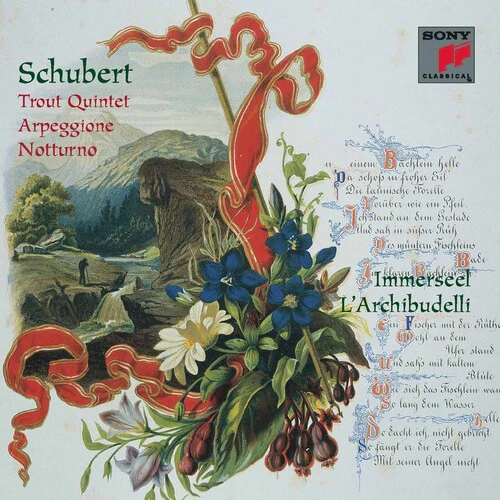
Schubert: Trout Quintet, Etc / Immerseel, Beths, Et Al
This is a very sprightly Trout. The first movement, a true Allegro vivace, gives a joyful feeling of onward momentum, but poised and well in control so there's no sense of undue hurry. The lively yet easygoing style persists in the Scherzo and finale. The quintet's bright textures suit the clear, picturesque sounds of period instruments admirably: I especially enjoyed the light, seemingly effortless brilliance of the piano's upper register — the third variation in the fourth movement shows this off to perfection — and the way the characteristic 68 Gramophone February 1999 sonorities of the lower strings emerge so clearly. But there are some disappointments; Schubert's many pianissimos rarely sound soft or mysterious enough, and I felt often that the string phrasing should move further away from classical elegance towards romantic breadth. In the two slower movements particularly, the best modern instrumental versions, such as those led by Brendel and Curzon, achieve a more intense expression of Schubert's unique lyricism.
Bylsma plays the Arpeggione Sonata on a five-string violoncello piccolo. The result is wonderfully convincing; the light, reedy tone, often with minimal vibrato, is very appealing, and the high-register passages sound entirely natural and unforced. Immerseel's Viennese-action instrument, too, is especially evocative and sweet-toned here. The Notturno, however, despite some fine playing, slightly misfires, missing the mystery and excitement of La Gaia Scienza (also on period instruments), or the tranquillity and grandeur of Schiff, Shiokawa and Perenyi (their two-disc set of the piano trios also includes a warmly expressive account of the Arpeggione Sonata).
This well-recorded disc is certainly a recommendation for a period-instrument Trout, and as authentic-sounding an Arpeggione as one is likely to hear.
-- Gramophone [2/1999]
Bylsma plays the Arpeggione Sonata on a five-string violoncello piccolo. The result is wonderfully convincing; the light, reedy tone, often with minimal vibrato, is very appealing, and the high-register passages sound entirely natural and unforced. Immerseel's Viennese-action instrument, too, is especially evocative and sweet-toned here. The Notturno, however, despite some fine playing, slightly misfires, missing the mystery and excitement of La Gaia Scienza (also on period instruments), or the tranquillity and grandeur of Schiff, Shiokawa and Perenyi (their two-disc set of the piano trios also includes a warmly expressive account of the Arpeggione Sonata).
This well-recorded disc is certainly a recommendation for a period-instrument Trout, and as authentic-sounding an Arpeggione as one is likely to hear.
-- Gramophone [2/1999]
This is a very sprightly Trout. The first movement, a true Allegro vivace, gives a joyful feeling of onward momentum, but poised and well in control so there's no sense of undue hurry. The lively yet easygoing style persists in the Scherzo and finale. The quintet's bright textures suit the clear, picturesque sounds of period instruments admirably: I especially enjoyed the light, seemingly effortless brilliance of the piano's upper register — the third variation in the fourth movement shows this off to perfection — and the way the characteristic 68 Gramophone February 1999 sonorities of the lower strings emerge so clearly. But there are some disappointments; Schubert's many pianissimos rarely sound soft or mysterious enough, and I felt often that the string phrasing should move further away from classical elegance towards romantic breadth. In the two slower movements particularly, the best modern instrumental versions, such as those led by Brendel and Curzon, achieve a more intense expression of Schubert's unique lyricism.
Bylsma plays the Arpeggione Sonata on a five-string violoncello piccolo. The result is wonderfully convincing; the light, reedy tone, often with minimal vibrato, is very appealing, and the high-register passages sound entirely natural and unforced. Immerseel's Viennese-action instrument, too, is especially evocative and sweet-toned here. The Notturno, however, despite some fine playing, slightly misfires, missing the mystery and excitement of La Gaia Scienza (also on period instruments), or the tranquillity and grandeur of Schiff, Shiokawa and Perenyi (their two-disc set of the piano trios also includes a warmly expressive account of the Arpeggione Sonata).
This well-recorded disc is certainly a recommendation for a period-instrument Trout, and as authentic-sounding an Arpeggione as one is likely to hear.
-- Gramophone [2/1999]
Bylsma plays the Arpeggione Sonata on a five-string violoncello piccolo. The result is wonderfully convincing; the light, reedy tone, often with minimal vibrato, is very appealing, and the high-register passages sound entirely natural and unforced. Immerseel's Viennese-action instrument, too, is especially evocative and sweet-toned here. The Notturno, however, despite some fine playing, slightly misfires, missing the mystery and excitement of La Gaia Scienza (also on period instruments), or the tranquillity and grandeur of Schiff, Shiokawa and Perenyi (their two-disc set of the piano trios also includes a warmly expressive account of the Arpeggione Sonata).
This well-recorded disc is certainly a recommendation for a period-instrument Trout, and as authentic-sounding an Arpeggione as one is likely to hear.
-- Gramophone [2/1999]
$17.99
Schubert: Trout Quintet, Etc / Immerseel, Beths, Et Al—
$17.99
Description
This is a very sprightly Trout. The first movement, a true Allegro vivace, gives a joyful feeling of onward momentum, but poised and well in control so there's no sense of undue hurry. The lively yet easygoing style persists in the Scherzo and finale. The quintet's bright textures suit the clear, picturesque sounds of period instruments admirably: I especially enjoyed the light, seemingly effortless brilliance of the piano's upper register — the third variation in the fourth movement shows this off to perfection — and the way the characteristic 68 Gramophone February 1999 sonorities of the lower strings emerge so clearly. But there are some disappointments; Schubert's many pianissimos rarely sound soft or mysterious enough, and I felt often that the string phrasing should move further away from classical elegance towards romantic breadth. In the two slower movements particularly, the best modern instrumental versions, such as those led by Brendel and Curzon, achieve a more intense expression of Schubert's unique lyricism.
Bylsma plays the Arpeggione Sonata on a five-string violoncello piccolo. The result is wonderfully convincing; the light, reedy tone, often with minimal vibrato, is very appealing, and the high-register passages sound entirely natural and unforced. Immerseel's Viennese-action instrument, too, is especially evocative and sweet-toned here. The Notturno, however, despite some fine playing, slightly misfires, missing the mystery and excitement of La Gaia Scienza (also on period instruments), or the tranquillity and grandeur of Schiff, Shiokawa and Perenyi (their two-disc set of the piano trios also includes a warmly expressive account of the Arpeggione Sonata).
This well-recorded disc is certainly a recommendation for a period-instrument Trout, and as authentic-sounding an Arpeggione as one is likely to hear.
-- Gramophone [2/1999]
Bylsma plays the Arpeggione Sonata on a five-string violoncello piccolo. The result is wonderfully convincing; the light, reedy tone, often with minimal vibrato, is very appealing, and the high-register passages sound entirely natural and unforced. Immerseel's Viennese-action instrument, too, is especially evocative and sweet-toned here. The Notturno, however, despite some fine playing, slightly misfires, missing the mystery and excitement of La Gaia Scienza (also on period instruments), or the tranquillity and grandeur of Schiff, Shiokawa and Perenyi (their two-disc set of the piano trios also includes a warmly expressive account of the Arpeggione Sonata).
This well-recorded disc is certainly a recommendation for a period-instrument Trout, and as authentic-sounding an Arpeggione as one is likely to hear.
-- Gramophone [2/1999]