🎉 Up to 70% Off Selected ItemsShop Sale

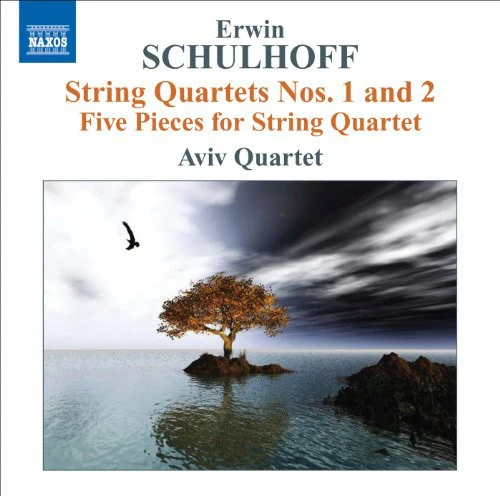
Schulhoff: Music For String Quartet / Aviv Quartet
Erwin Schulhoff’s three major works for string quartet fit neatly onto a single, rather short (51 minutes here) CD. They consist of the two numbered works, plus the Five Pieces of 1923, this latter a wonderful dance suite that includes a Viennese waltz, a tarantella, and a “Tango Milonga” in addition to a Serenata and a folksy “Alla Czeca.” This last idiom also features prominently in the First Quartet, where it becomes an Allegro giocoso alla slovacca. You may recognize the melody as the first cousin of the trumpet tune that concludes Kodály’s Háry János Suite (The Entrance of the Emperor and his Court).
This music, rhythmically charged and alternately folk-inflected and harmonically contemporary, is absolutely wonderful, and it’s very well played here by the Aviv Quartet. The group isn’t quite as edgy and hard-driving as the benchmark Petersen Quartett on Capriccio, but their more rounded tone never comes at the expense of Schulhoff’s madcap energy, and they arguably make more out of the First Quartet’s concluding Andante, never mind the Second Quartet’s highly contrasted second movement variations. The group is also quite sensitive to Schulhoff’s use of tone-color–everything from col legno strokes with the back of the bow to the senza vibrato conclusion of the First Quartet’s finale.
Naxos’ engineering is also warm, well-balanced, and natural. If you don’t know this music, you should, and I can recommend this reasonably priced disc with enthusiasm.
-- David Hurwitz, ClassicsToday.com
--------
An overlooked modernist thrills, chills and dances.
"Erwin Schulhoff’s music for string quartet is built on forceful rhythms and startling juxtapositions of material; it dances, yes, but with fiery intensity and rough humor. His style is the polar opposite of works like Tchaikovsky’s First Quartet or Borodin’s Second; in the most famous moments of those quartets, the four players sing together with one voice, melodies flowing naturally along in seamless harmony. Schulhoff’s model is a radically different one: here the interplay between instruments sounds not like a romance but like a brilliantly choreographed action-film fight scene, the players darting and weaving about each other, poised and ready to strike.
The First String Quartet comprises three studies in rhythm followed by an agonized slow movement. The first movement is jaunty and refreshingly melodic, with echoes of Stravinsky in an ebullient mood. The second movement is more menacing, the central section’s thematic material given slithering accompaniment, but it is the slow movement, which serves as the quartet’s finale, that acts as this work’s emotional core.
Of the three works on the disc, the First Quartet was most successful during Schulhoff’s lifetime, and its appeal is immediate. This is an engaging and rewarding piece waiting for a concert-hall revival, and, since it is a scant seventeen minutes, the quartet could safely be squeezed onto many a recital program.
The Five Pieces are a suite of dance movements which seem straightforward: a Viennese waltz, a serenade and a tango are among their number. But these works are not for the faint of heart; they are traditional dances viewed through the prism of Stravinsky or, perhaps, Schoenberg, and, like Ravel’s La Valse but with more of a bite, they are probably meant to some degree to be satirical. The waltz is almost unrecognizable as such in the opening bars, but soon becomes irresistible; the other dances are similarly magnetic. The tarantella is a good example: relatively straightforward in form, the harmonies nevertheless make us feel as if we are in the musical equivalent of a house of mirrors.
The Second String Quartet, composed just a year after the First in 1925, is arguably a masterpiece. The first movement finds Schulhoff’s tense style slightly matured, and the slow theme and variations begin with a beautiful viola solo. The highlight of the variations is an amiable folksy dance beginning at roughly the three-minute mark; another intriguing dance, with the unique marking “Allegro gajo,” follows in the third movement, but the finale is a fierce, very modern battle with some of the most thrilling unison playing on the album.
Fortunately for Schulhoff’s legacy, these are terrific performances. The Aviv Quartet have been playing together for a decade now, since they inaugurated their career amid a flurry of international competition victories in 1999, and they sound simply fantastic on this disc. The playing is electric; no position is a weak link. Schulhoff’s music for string quartet has been assembled on another disc, a 1994 Capriccio release, but this Naxos album is more widely available, and at half the price. Neither represents the complete quartet music (a Divertimento has gone unrecorded), but only completists will really be bothered by this quibble.
A terrific introduction to Schulhoff’s chamber music, then, although there are other works (like the surprising Concertino for Flute, Viola and Double Bass) which are more immediately appealing, and although other albums may simply have more music (this one is barely fifty minutes long). But this recording will be an eye-opener for those who prefer their string quartets to be perfume-soaked romantic treasures, and a treasure for admirers of modern chamber music. A good way to expand one’s horizons."
-- Brian Reinhart, MusicWeb International
This music, rhythmically charged and alternately folk-inflected and harmonically contemporary, is absolutely wonderful, and it’s very well played here by the Aviv Quartet. The group isn’t quite as edgy and hard-driving as the benchmark Petersen Quartett on Capriccio, but their more rounded tone never comes at the expense of Schulhoff’s madcap energy, and they arguably make more out of the First Quartet’s concluding Andante, never mind the Second Quartet’s highly contrasted second movement variations. The group is also quite sensitive to Schulhoff’s use of tone-color–everything from col legno strokes with the back of the bow to the senza vibrato conclusion of the First Quartet’s finale.
Naxos’ engineering is also warm, well-balanced, and natural. If you don’t know this music, you should, and I can recommend this reasonably priced disc with enthusiasm.
-- David Hurwitz, ClassicsToday.com
--------
An overlooked modernist thrills, chills and dances.
"Erwin Schulhoff’s music for string quartet is built on forceful rhythms and startling juxtapositions of material; it dances, yes, but with fiery intensity and rough humor. His style is the polar opposite of works like Tchaikovsky’s First Quartet or Borodin’s Second; in the most famous moments of those quartets, the four players sing together with one voice, melodies flowing naturally along in seamless harmony. Schulhoff’s model is a radically different one: here the interplay between instruments sounds not like a romance but like a brilliantly choreographed action-film fight scene, the players darting and weaving about each other, poised and ready to strike.
The First String Quartet comprises three studies in rhythm followed by an agonized slow movement. The first movement is jaunty and refreshingly melodic, with echoes of Stravinsky in an ebullient mood. The second movement is more menacing, the central section’s thematic material given slithering accompaniment, but it is the slow movement, which serves as the quartet’s finale, that acts as this work’s emotional core.
Of the three works on the disc, the First Quartet was most successful during Schulhoff’s lifetime, and its appeal is immediate. This is an engaging and rewarding piece waiting for a concert-hall revival, and, since it is a scant seventeen minutes, the quartet could safely be squeezed onto many a recital program.
The Five Pieces are a suite of dance movements which seem straightforward: a Viennese waltz, a serenade and a tango are among their number. But these works are not for the faint of heart; they are traditional dances viewed through the prism of Stravinsky or, perhaps, Schoenberg, and, like Ravel’s La Valse but with more of a bite, they are probably meant to some degree to be satirical. The waltz is almost unrecognizable as such in the opening bars, but soon becomes irresistible; the other dances are similarly magnetic. The tarantella is a good example: relatively straightforward in form, the harmonies nevertheless make us feel as if we are in the musical equivalent of a house of mirrors.
The Second String Quartet, composed just a year after the First in 1925, is arguably a masterpiece. The first movement finds Schulhoff’s tense style slightly matured, and the slow theme and variations begin with a beautiful viola solo. The highlight of the variations is an amiable folksy dance beginning at roughly the three-minute mark; another intriguing dance, with the unique marking “Allegro gajo,” follows in the third movement, but the finale is a fierce, very modern battle with some of the most thrilling unison playing on the album.
Fortunately for Schulhoff’s legacy, these are terrific performances. The Aviv Quartet have been playing together for a decade now, since they inaugurated their career amid a flurry of international competition victories in 1999, and they sound simply fantastic on this disc. The playing is electric; no position is a weak link. Schulhoff’s music for string quartet has been assembled on another disc, a 1994 Capriccio release, but this Naxos album is more widely available, and at half the price. Neither represents the complete quartet music (a Divertimento has gone unrecorded), but only completists will really be bothered by this quibble.
A terrific introduction to Schulhoff’s chamber music, then, although there are other works (like the surprising Concertino for Flute, Viola and Double Bass) which are more immediately appealing, and although other albums may simply have more music (this one is barely fifty minutes long). But this recording will be an eye-opener for those who prefer their string quartets to be perfume-soaked romantic treasures, and a treasure for admirers of modern chamber music. A good way to expand one’s horizons."
-- Brian Reinhart, MusicWeb International
Erwin Schulhoff’s three major works for string quartet fit neatly onto a single, rather short (51 minutes here) CD. They consist of the two numbered works, plus the Five Pieces of 1923, this latter a wonderful dance suite that includes a Viennese waltz, a tarantella, and a “Tango Milonga” in addition to a Serenata and a folksy “Alla Czeca.” This last idiom also features prominently in the First Quartet, where it becomes an Allegro giocoso alla slovacca. You may recognize the melody as the first cousin of the trumpet tune that concludes Kodály’s Háry János Suite (The Entrance of the Emperor and his Court).
This music, rhythmically charged and alternately folk-inflected and harmonically contemporary, is absolutely wonderful, and it’s very well played here by the Aviv Quartet. The group isn’t quite as edgy and hard-driving as the benchmark Petersen Quartett on Capriccio, but their more rounded tone never comes at the expense of Schulhoff’s madcap energy, and they arguably make more out of the First Quartet’s concluding Andante, never mind the Second Quartet’s highly contrasted second movement variations. The group is also quite sensitive to Schulhoff’s use of tone-color–everything from col legno strokes with the back of the bow to the senza vibrato conclusion of the First Quartet’s finale.
Naxos’ engineering is also warm, well-balanced, and natural. If you don’t know this music, you should, and I can recommend this reasonably priced disc with enthusiasm.
-- David Hurwitz, ClassicsToday.com
--------
An overlooked modernist thrills, chills and dances.
"Erwin Schulhoff’s music for string quartet is built on forceful rhythms and startling juxtapositions of material; it dances, yes, but with fiery intensity and rough humor. His style is the polar opposite of works like Tchaikovsky’s First Quartet or Borodin’s Second; in the most famous moments of those quartets, the four players sing together with one voice, melodies flowing naturally along in seamless harmony. Schulhoff’s model is a radically different one: here the interplay between instruments sounds not like a romance but like a brilliantly choreographed action-film fight scene, the players darting and weaving about each other, poised and ready to strike.
The First String Quartet comprises three studies in rhythm followed by an agonized slow movement. The first movement is jaunty and refreshingly melodic, with echoes of Stravinsky in an ebullient mood. The second movement is more menacing, the central section’s thematic material given slithering accompaniment, but it is the slow movement, which serves as the quartet’s finale, that acts as this work’s emotional core.
Of the three works on the disc, the First Quartet was most successful during Schulhoff’s lifetime, and its appeal is immediate. This is an engaging and rewarding piece waiting for a concert-hall revival, and, since it is a scant seventeen minutes, the quartet could safely be squeezed onto many a recital program.
The Five Pieces are a suite of dance movements which seem straightforward: a Viennese waltz, a serenade and a tango are among their number. But these works are not for the faint of heart; they are traditional dances viewed through the prism of Stravinsky or, perhaps, Schoenberg, and, like Ravel’s La Valse but with more of a bite, they are probably meant to some degree to be satirical. The waltz is almost unrecognizable as such in the opening bars, but soon becomes irresistible; the other dances are similarly magnetic. The tarantella is a good example: relatively straightforward in form, the harmonies nevertheless make us feel as if we are in the musical equivalent of a house of mirrors.
The Second String Quartet, composed just a year after the First in 1925, is arguably a masterpiece. The first movement finds Schulhoff’s tense style slightly matured, and the slow theme and variations begin with a beautiful viola solo. The highlight of the variations is an amiable folksy dance beginning at roughly the three-minute mark; another intriguing dance, with the unique marking “Allegro gajo,” follows in the third movement, but the finale is a fierce, very modern battle with some of the most thrilling unison playing on the album.
Fortunately for Schulhoff’s legacy, these are terrific performances. The Aviv Quartet have been playing together for a decade now, since they inaugurated their career amid a flurry of international competition victories in 1999, and they sound simply fantastic on this disc. The playing is electric; no position is a weak link. Schulhoff’s music for string quartet has been assembled on another disc, a 1994 Capriccio release, but this Naxos album is more widely available, and at half the price. Neither represents the complete quartet music (a Divertimento has gone unrecorded), but only completists will really be bothered by this quibble.
A terrific introduction to Schulhoff’s chamber music, then, although there are other works (like the surprising Concertino for Flute, Viola and Double Bass) which are more immediately appealing, and although other albums may simply have more music (this one is barely fifty minutes long). But this recording will be an eye-opener for those who prefer their string quartets to be perfume-soaked romantic treasures, and a treasure for admirers of modern chamber music. A good way to expand one’s horizons."
-- Brian Reinhart, MusicWeb International
This music, rhythmically charged and alternately folk-inflected and harmonically contemporary, is absolutely wonderful, and it’s very well played here by the Aviv Quartet. The group isn’t quite as edgy and hard-driving as the benchmark Petersen Quartett on Capriccio, but their more rounded tone never comes at the expense of Schulhoff’s madcap energy, and they arguably make more out of the First Quartet’s concluding Andante, never mind the Second Quartet’s highly contrasted second movement variations. The group is also quite sensitive to Schulhoff’s use of tone-color–everything from col legno strokes with the back of the bow to the senza vibrato conclusion of the First Quartet’s finale.
Naxos’ engineering is also warm, well-balanced, and natural. If you don’t know this music, you should, and I can recommend this reasonably priced disc with enthusiasm.
-- David Hurwitz, ClassicsToday.com
--------
An overlooked modernist thrills, chills and dances.
"Erwin Schulhoff’s music for string quartet is built on forceful rhythms and startling juxtapositions of material; it dances, yes, but with fiery intensity and rough humor. His style is the polar opposite of works like Tchaikovsky’s First Quartet or Borodin’s Second; in the most famous moments of those quartets, the four players sing together with one voice, melodies flowing naturally along in seamless harmony. Schulhoff’s model is a radically different one: here the interplay between instruments sounds not like a romance but like a brilliantly choreographed action-film fight scene, the players darting and weaving about each other, poised and ready to strike.
The First String Quartet comprises three studies in rhythm followed by an agonized slow movement. The first movement is jaunty and refreshingly melodic, with echoes of Stravinsky in an ebullient mood. The second movement is more menacing, the central section’s thematic material given slithering accompaniment, but it is the slow movement, which serves as the quartet’s finale, that acts as this work’s emotional core.
Of the three works on the disc, the First Quartet was most successful during Schulhoff’s lifetime, and its appeal is immediate. This is an engaging and rewarding piece waiting for a concert-hall revival, and, since it is a scant seventeen minutes, the quartet could safely be squeezed onto many a recital program.
The Five Pieces are a suite of dance movements which seem straightforward: a Viennese waltz, a serenade and a tango are among their number. But these works are not for the faint of heart; they are traditional dances viewed through the prism of Stravinsky or, perhaps, Schoenberg, and, like Ravel’s La Valse but with more of a bite, they are probably meant to some degree to be satirical. The waltz is almost unrecognizable as such in the opening bars, but soon becomes irresistible; the other dances are similarly magnetic. The tarantella is a good example: relatively straightforward in form, the harmonies nevertheless make us feel as if we are in the musical equivalent of a house of mirrors.
The Second String Quartet, composed just a year after the First in 1925, is arguably a masterpiece. The first movement finds Schulhoff’s tense style slightly matured, and the slow theme and variations begin with a beautiful viola solo. The highlight of the variations is an amiable folksy dance beginning at roughly the three-minute mark; another intriguing dance, with the unique marking “Allegro gajo,” follows in the third movement, but the finale is a fierce, very modern battle with some of the most thrilling unison playing on the album.
Fortunately for Schulhoff’s legacy, these are terrific performances. The Aviv Quartet have been playing together for a decade now, since they inaugurated their career amid a flurry of international competition victories in 1999, and they sound simply fantastic on this disc. The playing is electric; no position is a weak link. Schulhoff’s music for string quartet has been assembled on another disc, a 1994 Capriccio release, but this Naxos album is more widely available, and at half the price. Neither represents the complete quartet music (a Divertimento has gone unrecorded), but only completists will really be bothered by this quibble.
A terrific introduction to Schulhoff’s chamber music, then, although there are other works (like the surprising Concertino for Flute, Viola and Double Bass) which are more immediately appealing, and although other albums may simply have more music (this one is barely fifty minutes long). But this recording will be an eye-opener for those who prefer their string quartets to be perfume-soaked romantic treasures, and a treasure for admirers of modern chamber music. A good way to expand one’s horizons."
-- Brian Reinhart, MusicWeb International
$7.00
Original: $19.99
-65%Schulhoff: Music For String Quartet / Aviv Quartet—
$19.99
$7.00Description
Erwin Schulhoff’s three major works for string quartet fit neatly onto a single, rather short (51 minutes here) CD. They consist of the two numbered works, plus the Five Pieces of 1923, this latter a wonderful dance suite that includes a Viennese waltz, a tarantella, and a “Tango Milonga” in addition to a Serenata and a folksy “Alla Czeca.” This last idiom also features prominently in the First Quartet, where it becomes an Allegro giocoso alla slovacca. You may recognize the melody as the first cousin of the trumpet tune that concludes Kodály’s Háry János Suite (The Entrance of the Emperor and his Court).
This music, rhythmically charged and alternately folk-inflected and harmonically contemporary, is absolutely wonderful, and it’s very well played here by the Aviv Quartet. The group isn’t quite as edgy and hard-driving as the benchmark Petersen Quartett on Capriccio, but their more rounded tone never comes at the expense of Schulhoff’s madcap energy, and they arguably make more out of the First Quartet’s concluding Andante, never mind the Second Quartet’s highly contrasted second movement variations. The group is also quite sensitive to Schulhoff’s use of tone-color–everything from col legno strokes with the back of the bow to the senza vibrato conclusion of the First Quartet’s finale.
Naxos’ engineering is also warm, well-balanced, and natural. If you don’t know this music, you should, and I can recommend this reasonably priced disc with enthusiasm.
-- David Hurwitz, ClassicsToday.com
--------
An overlooked modernist thrills, chills and dances.
"Erwin Schulhoff’s music for string quartet is built on forceful rhythms and startling juxtapositions of material; it dances, yes, but with fiery intensity and rough humor. His style is the polar opposite of works like Tchaikovsky’s First Quartet or Borodin’s Second; in the most famous moments of those quartets, the four players sing together with one voice, melodies flowing naturally along in seamless harmony. Schulhoff’s model is a radically different one: here the interplay between instruments sounds not like a romance but like a brilliantly choreographed action-film fight scene, the players darting and weaving about each other, poised and ready to strike.
The First String Quartet comprises three studies in rhythm followed by an agonized slow movement. The first movement is jaunty and refreshingly melodic, with echoes of Stravinsky in an ebullient mood. The second movement is more menacing, the central section’s thematic material given slithering accompaniment, but it is the slow movement, which serves as the quartet’s finale, that acts as this work’s emotional core.
Of the three works on the disc, the First Quartet was most successful during Schulhoff’s lifetime, and its appeal is immediate. This is an engaging and rewarding piece waiting for a concert-hall revival, and, since it is a scant seventeen minutes, the quartet could safely be squeezed onto many a recital program.
The Five Pieces are a suite of dance movements which seem straightforward: a Viennese waltz, a serenade and a tango are among their number. But these works are not for the faint of heart; they are traditional dances viewed through the prism of Stravinsky or, perhaps, Schoenberg, and, like Ravel’s La Valse but with more of a bite, they are probably meant to some degree to be satirical. The waltz is almost unrecognizable as such in the opening bars, but soon becomes irresistible; the other dances are similarly magnetic. The tarantella is a good example: relatively straightforward in form, the harmonies nevertheless make us feel as if we are in the musical equivalent of a house of mirrors.
The Second String Quartet, composed just a year after the First in 1925, is arguably a masterpiece. The first movement finds Schulhoff’s tense style slightly matured, and the slow theme and variations begin with a beautiful viola solo. The highlight of the variations is an amiable folksy dance beginning at roughly the three-minute mark; another intriguing dance, with the unique marking “Allegro gajo,” follows in the third movement, but the finale is a fierce, very modern battle with some of the most thrilling unison playing on the album.
Fortunately for Schulhoff’s legacy, these are terrific performances. The Aviv Quartet have been playing together for a decade now, since they inaugurated their career amid a flurry of international competition victories in 1999, and they sound simply fantastic on this disc. The playing is electric; no position is a weak link. Schulhoff’s music for string quartet has been assembled on another disc, a 1994 Capriccio release, but this Naxos album is more widely available, and at half the price. Neither represents the complete quartet music (a Divertimento has gone unrecorded), but only completists will really be bothered by this quibble.
A terrific introduction to Schulhoff’s chamber music, then, although there are other works (like the surprising Concertino for Flute, Viola and Double Bass) which are more immediately appealing, and although other albums may simply have more music (this one is barely fifty minutes long). But this recording will be an eye-opener for those who prefer their string quartets to be perfume-soaked romantic treasures, and a treasure for admirers of modern chamber music. A good way to expand one’s horizons."
-- Brian Reinhart, MusicWeb International
This music, rhythmically charged and alternately folk-inflected and harmonically contemporary, is absolutely wonderful, and it’s very well played here by the Aviv Quartet. The group isn’t quite as edgy and hard-driving as the benchmark Petersen Quartett on Capriccio, but their more rounded tone never comes at the expense of Schulhoff’s madcap energy, and they arguably make more out of the First Quartet’s concluding Andante, never mind the Second Quartet’s highly contrasted second movement variations. The group is also quite sensitive to Schulhoff’s use of tone-color–everything from col legno strokes with the back of the bow to the senza vibrato conclusion of the First Quartet’s finale.
Naxos’ engineering is also warm, well-balanced, and natural. If you don’t know this music, you should, and I can recommend this reasonably priced disc with enthusiasm.
-- David Hurwitz, ClassicsToday.com
--------
An overlooked modernist thrills, chills and dances.
"Erwin Schulhoff’s music for string quartet is built on forceful rhythms and startling juxtapositions of material; it dances, yes, but with fiery intensity and rough humor. His style is the polar opposite of works like Tchaikovsky’s First Quartet or Borodin’s Second; in the most famous moments of those quartets, the four players sing together with one voice, melodies flowing naturally along in seamless harmony. Schulhoff’s model is a radically different one: here the interplay between instruments sounds not like a romance but like a brilliantly choreographed action-film fight scene, the players darting and weaving about each other, poised and ready to strike.
The First String Quartet comprises three studies in rhythm followed by an agonized slow movement. The first movement is jaunty and refreshingly melodic, with echoes of Stravinsky in an ebullient mood. The second movement is more menacing, the central section’s thematic material given slithering accompaniment, but it is the slow movement, which serves as the quartet’s finale, that acts as this work’s emotional core.
Of the three works on the disc, the First Quartet was most successful during Schulhoff’s lifetime, and its appeal is immediate. This is an engaging and rewarding piece waiting for a concert-hall revival, and, since it is a scant seventeen minutes, the quartet could safely be squeezed onto many a recital program.
The Five Pieces are a suite of dance movements which seem straightforward: a Viennese waltz, a serenade and a tango are among their number. But these works are not for the faint of heart; they are traditional dances viewed through the prism of Stravinsky or, perhaps, Schoenberg, and, like Ravel’s La Valse but with more of a bite, they are probably meant to some degree to be satirical. The waltz is almost unrecognizable as such in the opening bars, but soon becomes irresistible; the other dances are similarly magnetic. The tarantella is a good example: relatively straightforward in form, the harmonies nevertheless make us feel as if we are in the musical equivalent of a house of mirrors.
The Second String Quartet, composed just a year after the First in 1925, is arguably a masterpiece. The first movement finds Schulhoff’s tense style slightly matured, and the slow theme and variations begin with a beautiful viola solo. The highlight of the variations is an amiable folksy dance beginning at roughly the three-minute mark; another intriguing dance, with the unique marking “Allegro gajo,” follows in the third movement, but the finale is a fierce, very modern battle with some of the most thrilling unison playing on the album.
Fortunately for Schulhoff’s legacy, these are terrific performances. The Aviv Quartet have been playing together for a decade now, since they inaugurated their career amid a flurry of international competition victories in 1999, and they sound simply fantastic on this disc. The playing is electric; no position is a weak link. Schulhoff’s music for string quartet has been assembled on another disc, a 1994 Capriccio release, but this Naxos album is more widely available, and at half the price. Neither represents the complete quartet music (a Divertimento has gone unrecorded), but only completists will really be bothered by this quibble.
A terrific introduction to Schulhoff’s chamber music, then, although there are other works (like the surprising Concertino for Flute, Viola and Double Bass) which are more immediately appealing, and although other albums may simply have more music (this one is barely fifty minutes long). But this recording will be an eye-opener for those who prefer their string quartets to be perfume-soaked romantic treasures, and a treasure for admirers of modern chamber music. A good way to expand one’s horizons."
-- Brian Reinhart, MusicWeb International