🎉 Up to 70% Off Selected ItemsShop Sale

1 / 2
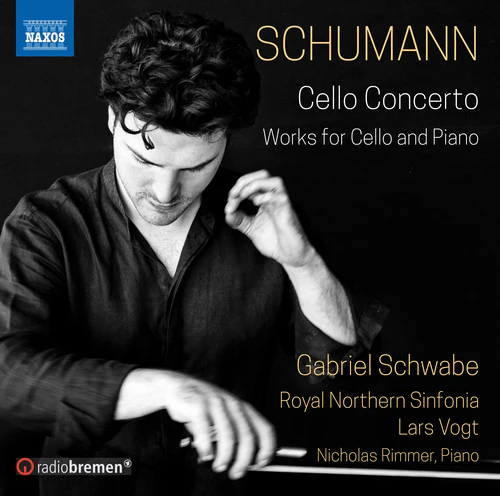
Schumann: Cello Concerto, Etc / Schwabe, Vogt, Royal Northern Sinfonia
Schumann’s love of the cello, which developed when he learned the instrument as a young man, is expressed most fully in his ‘Cello Concerto in A minor.’ It is a work marked by freshness of spirit and singing lyricism and stands as a rich example of mid-19th-century Romanticism. The series of characterful small pieces that include ‘Funf Stucke im Volkston’ reveals Schumann’s joy in the cello’s unique lyrical capabilities. The ‘Drei Romanzen’ and the ‘Intermezzo’ from the ‘F-A-E Sonata’ are presented here in new arrangements for cello and piano by Gabriel Schwabe. Gabriel Schwabe has established himself among the leading cellists of his generation. He is a laureate of numerous national and international competitions, including the Grand Prix Emanuel Feuermann and the Concours Rostropovich in Paris. As a soloist he has worked with orchestras such as the Philharmonia Orchestra, the NDR Radiophilharmonie, the Berlin Radio Symphony Orchestra, the Deutsches Symphonie-Orchester Berlin, the Malmo and Norrkoping Symphony Orchestras and the Royal Northern Sinfonia. He plays a rare Italian instrument made in Brescia (c. 1600).
-----
REVIEW:
With just the necessary amount of vibrato, Gabriel Schwabe's cello, dating from around 1600, sings eloquently for him. The score of the concerto’s central section contains much sadness; without any undue haste, he generates an appropriate sense of triumphant brilliance as the work ends.
Schwabe and pianist Nicholas Rimmer give a particularly fast and vibrant account of the Allegro, in the Adagio and Allegro. It is a similarly outgoing performance of the Fantasiestucke that acts as a foil to the moments of beauty in the Three Romances; the five Volkston vividly characterised and contrasted, while the arrangement of the Intermezzo has simply taken the solo part down by an octave.
The catalogue is certainly not short of recordings of the Concerto, but this coupling is unusual and most enjoyable.
– David's Review Corner (David Denton)
-----
REVIEW:
With just the necessary amount of vibrato, Gabriel Schwabe's cello, dating from around 1600, sings eloquently for him. The score of the concerto’s central section contains much sadness; without any undue haste, he generates an appropriate sense of triumphant brilliance as the work ends.
Schwabe and pianist Nicholas Rimmer give a particularly fast and vibrant account of the Allegro, in the Adagio and Allegro. It is a similarly outgoing performance of the Fantasiestucke that acts as a foil to the moments of beauty in the Three Romances; the five Volkston vividly characterised and contrasted, while the arrangement of the Intermezzo has simply taken the solo part down by an octave.
The catalogue is certainly not short of recordings of the Concerto, but this coupling is unusual and most enjoyable.
– David's Review Corner (David Denton)
Schumann’s love of the cello, which developed when he learned the instrument as a young man, is expressed most fully in his ‘Cello Concerto in A minor.’ It is a work marked by freshness of spirit and singing lyricism and stands as a rich example of mid-19th-century Romanticism. The series of characterful small pieces that include ‘Funf Stucke im Volkston’ reveals Schumann’s joy in the cello’s unique lyrical capabilities. The ‘Drei Romanzen’ and the ‘Intermezzo’ from the ‘F-A-E Sonata’ are presented here in new arrangements for cello and piano by Gabriel Schwabe. Gabriel Schwabe has established himself among the leading cellists of his generation. He is a laureate of numerous national and international competitions, including the Grand Prix Emanuel Feuermann and the Concours Rostropovich in Paris. As a soloist he has worked with orchestras such as the Philharmonia Orchestra, the NDR Radiophilharmonie, the Berlin Radio Symphony Orchestra, the Deutsches Symphonie-Orchester Berlin, the Malmo and Norrkoping Symphony Orchestras and the Royal Northern Sinfonia. He plays a rare Italian instrument made in Brescia (c. 1600).
-----
REVIEW:
With just the necessary amount of vibrato, Gabriel Schwabe's cello, dating from around 1600, sings eloquently for him. The score of the concerto’s central section contains much sadness; without any undue haste, he generates an appropriate sense of triumphant brilliance as the work ends.
Schwabe and pianist Nicholas Rimmer give a particularly fast and vibrant account of the Allegro, in the Adagio and Allegro. It is a similarly outgoing performance of the Fantasiestucke that acts as a foil to the moments of beauty in the Three Romances; the five Volkston vividly characterised and contrasted, while the arrangement of the Intermezzo has simply taken the solo part down by an octave.
The catalogue is certainly not short of recordings of the Concerto, but this coupling is unusual and most enjoyable.
– David's Review Corner (David Denton)
-----
REVIEW:
With just the necessary amount of vibrato, Gabriel Schwabe's cello, dating from around 1600, sings eloquently for him. The score of the concerto’s central section contains much sadness; without any undue haste, he generates an appropriate sense of triumphant brilliance as the work ends.
Schwabe and pianist Nicholas Rimmer give a particularly fast and vibrant account of the Allegro, in the Adagio and Allegro. It is a similarly outgoing performance of the Fantasiestucke that acts as a foil to the moments of beauty in the Three Romances; the five Volkston vividly characterised and contrasted, while the arrangement of the Intermezzo has simply taken the solo part down by an octave.
The catalogue is certainly not short of recordings of the Concerto, but this coupling is unusual and most enjoyable.
– David's Review Corner (David Denton)
$13.99
Schumann: Cello Concerto, Etc / Schwabe, Vogt, Royal Northern Sinfonia—
$13.99
Description
Schumann’s love of the cello, which developed when he learned the instrument as a young man, is expressed most fully in his ‘Cello Concerto in A minor.’ It is a work marked by freshness of spirit and singing lyricism and stands as a rich example of mid-19th-century Romanticism. The series of characterful small pieces that include ‘Funf Stucke im Volkston’ reveals Schumann’s joy in the cello’s unique lyrical capabilities. The ‘Drei Romanzen’ and the ‘Intermezzo’ from the ‘F-A-E Sonata’ are presented here in new arrangements for cello and piano by Gabriel Schwabe. Gabriel Schwabe has established himself among the leading cellists of his generation. He is a laureate of numerous national and international competitions, including the Grand Prix Emanuel Feuermann and the Concours Rostropovich in Paris. As a soloist he has worked with orchestras such as the Philharmonia Orchestra, the NDR Radiophilharmonie, the Berlin Radio Symphony Orchestra, the Deutsches Symphonie-Orchester Berlin, the Malmo and Norrkoping Symphony Orchestras and the Royal Northern Sinfonia. He plays a rare Italian instrument made in Brescia (c. 1600).
-----
REVIEW:
With just the necessary amount of vibrato, Gabriel Schwabe's cello, dating from around 1600, sings eloquently for him. The score of the concerto’s central section contains much sadness; without any undue haste, he generates an appropriate sense of triumphant brilliance as the work ends.
Schwabe and pianist Nicholas Rimmer give a particularly fast and vibrant account of the Allegro, in the Adagio and Allegro. It is a similarly outgoing performance of the Fantasiestucke that acts as a foil to the moments of beauty in the Three Romances; the five Volkston vividly characterised and contrasted, while the arrangement of the Intermezzo has simply taken the solo part down by an octave.
The catalogue is certainly not short of recordings of the Concerto, but this coupling is unusual and most enjoyable.
– David's Review Corner (David Denton)
-----
REVIEW:
With just the necessary amount of vibrato, Gabriel Schwabe's cello, dating from around 1600, sings eloquently for him. The score of the concerto’s central section contains much sadness; without any undue haste, he generates an appropriate sense of triumphant brilliance as the work ends.
Schwabe and pianist Nicholas Rimmer give a particularly fast and vibrant account of the Allegro, in the Adagio and Allegro. It is a similarly outgoing performance of the Fantasiestucke that acts as a foil to the moments of beauty in the Three Romances; the five Volkston vividly characterised and contrasted, while the arrangement of the Intermezzo has simply taken the solo part down by an octave.
The catalogue is certainly not short of recordings of the Concerto, but this coupling is unusual and most enjoyable.
– David's Review Corner (David Denton)