🎉 Up to 70% Off Selected ItemsShop Sale

1 / 2
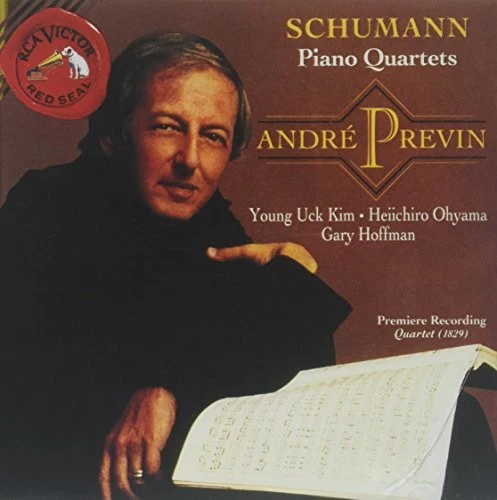
Schumann: Piano Quartets / Previn, Kim, Ohyama, Hoffman
The special interest here is the ''world premiere recording'' of Schumann's first Piano Quartet in C minor, completed in March, 1829, when he was still only 18. Though his Leipzig piano teacher, Friedrich Wieck, and other discerning music-loving friends found much in the work to praise after a domestic performance by Schumann and some fellow-students, he himself lost faith in it and the score remained unpublished until the Schumann scholar, Wolfgang Boetticher, prepared a performing edition in 1979. The gem of the four movements is the nimble Minuetto, with a trio (its leading theme reappears in the fourth of his Op. 4 Intermezzos for solo piano) subsequently picked out by him as the moment when he first recognized himself as a ''romantic... departing from the former musical style''. The tenderly spun Andante is winning too, and even though the Beethoven-cum-Schubert-inspired faster flanking movements (the last dominated by an obsessively reiterated dotted rhythm) need—and I think in this performance receive—some pruning, both have an irresistible youthful elan. Andre Previn and his three colleagues cannot be over-praised for coming to the Quartet's rescue with such immediacy and warmth of sympathy.
Though never enjoying the popularity of the Piano Quintet, the E flat Piano Quartet, written some 13 years after the C minor work, has rarely lacked dedicated protagonists. These players hold their own with them all, especially the very lively pianist with his keen ear for textural clarity.
-- Joan Chissell, Gramophone [5/1993]
Though never enjoying the popularity of the Piano Quintet, the E flat Piano Quartet, written some 13 years after the C minor work, has rarely lacked dedicated protagonists. These players hold their own with them all, especially the very lively pianist with his keen ear for textural clarity.
-- Joan Chissell, Gramophone [5/1993]
The special interest here is the ''world premiere recording'' of Schumann's first Piano Quartet in C minor, completed in March, 1829, when he was still only 18. Though his Leipzig piano teacher, Friedrich Wieck, and other discerning music-loving friends found much in the work to praise after a domestic performance by Schumann and some fellow-students, he himself lost faith in it and the score remained unpublished until the Schumann scholar, Wolfgang Boetticher, prepared a performing edition in 1979. The gem of the four movements is the nimble Minuetto, with a trio (its leading theme reappears in the fourth of his Op. 4 Intermezzos for solo piano) subsequently picked out by him as the moment when he first recognized himself as a ''romantic... departing from the former musical style''. The tenderly spun Andante is winning too, and even though the Beethoven-cum-Schubert-inspired faster flanking movements (the last dominated by an obsessively reiterated dotted rhythm) need—and I think in this performance receive—some pruning, both have an irresistible youthful elan. Andre Previn and his three colleagues cannot be over-praised for coming to the Quartet's rescue with such immediacy and warmth of sympathy.
Though never enjoying the popularity of the Piano Quintet, the E flat Piano Quartet, written some 13 years after the C minor work, has rarely lacked dedicated protagonists. These players hold their own with them all, especially the very lively pianist with his keen ear for textural clarity.
-- Joan Chissell, Gramophone [5/1993]
Though never enjoying the popularity of the Piano Quintet, the E flat Piano Quartet, written some 13 years after the C minor work, has rarely lacked dedicated protagonists. These players hold their own with them all, especially the very lively pianist with his keen ear for textural clarity.
-- Joan Chissell, Gramophone [5/1993]
$17.99
Schumann: Piano Quartets / Previn, Kim, Ohyama, Hoffman—
$17.99
Description
The special interest here is the ''world premiere recording'' of Schumann's first Piano Quartet in C minor, completed in March, 1829, when he was still only 18. Though his Leipzig piano teacher, Friedrich Wieck, and other discerning music-loving friends found much in the work to praise after a domestic performance by Schumann and some fellow-students, he himself lost faith in it and the score remained unpublished until the Schumann scholar, Wolfgang Boetticher, prepared a performing edition in 1979. The gem of the four movements is the nimble Minuetto, with a trio (its leading theme reappears in the fourth of his Op. 4 Intermezzos for solo piano) subsequently picked out by him as the moment when he first recognized himself as a ''romantic... departing from the former musical style''. The tenderly spun Andante is winning too, and even though the Beethoven-cum-Schubert-inspired faster flanking movements (the last dominated by an obsessively reiterated dotted rhythm) need—and I think in this performance receive—some pruning, both have an irresistible youthful elan. Andre Previn and his three colleagues cannot be over-praised for coming to the Quartet's rescue with such immediacy and warmth of sympathy.
Though never enjoying the popularity of the Piano Quintet, the E flat Piano Quartet, written some 13 years after the C minor work, has rarely lacked dedicated protagonists. These players hold their own with them all, especially the very lively pianist with his keen ear for textural clarity.
-- Joan Chissell, Gramophone [5/1993]
Though never enjoying the popularity of the Piano Quintet, the E flat Piano Quartet, written some 13 years after the C minor work, has rarely lacked dedicated protagonists. These players hold their own with them all, especially the very lively pianist with his keen ear for textural clarity.
-- Joan Chissell, Gramophone [5/1993]