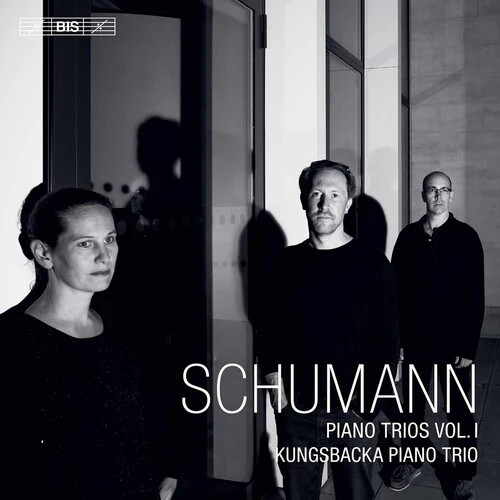
Schumann: Piano Trios, Vol. 1 / Kungsbacka Piano Trio
It was in 1842, his ‘year of chamber music’ that Robert Schumann took on the combination of violin, cello and piano for the first time. He seems to have decided against releasing the resulting Fantasiestücke as a fully-fledged piano trio, however, but later returned to the work, revising it for publication in 1850. The model here is not the large-scale, quasi-symphonic trios of Beethoven or Schubert – instead Haydn’s characteristic trio textures spring to mind, especially in the first two movements where the cello largely follows the piano’s left-hand bass line. By the time the Fantasiestücke was published, Schumann had already written two ‘proper’ piano trios, No. 1 in D minor and No. 2 in F major. According to the composer the second of these ‘makes a friendlier and more immediate impression’ but it is in fact the D minor trio that has long been the more popular: passionate, mainly extrovert and bursting with fine thematic material it is the easiest to grasp on one hearing. Both works are filled to capacity with imitative writing, sometimes conspicuously so but often subtly as if on a subconscious level – an aspect that the members of the Kungsbacka Piano Trio, with more than 20 years of playing together, are able to make the most of.
It was in 1842, his ‘year of chamber music’ that Robert Schumann took on the combination of violin, cello and piano for the first time. He seems to have decided against releasing the resulting Fantasiestücke as a fully-fledged piano trio, however, but later returned to the work, revising it for publication in 1850. The model here is not the large-scale, quasi-symphonic trios of Beethoven or Schubert – instead Haydn’s characteristic trio textures spring to mind, especially in the first two movements where the cello largely follows the piano’s left-hand bass line. By the time the Fantasiestücke was published, Schumann had already written two ‘proper’ piano trios, No. 1 in D minor and No. 2 in F major. According to the composer the second of these ‘makes a friendlier and more immediate impression’ but it is in fact the D minor trio that has long been the more popular: passionate, mainly extrovert and bursting with fine thematic material it is the easiest to grasp on one hearing. Both works are filled to capacity with imitative writing, sometimes conspicuously so but often subtly as if on a subconscious level – an aspect that the members of the Kungsbacka Piano Trio, with more than 20 years of playing together, are able to make the most of.
Description
It was in 1842, his ‘year of chamber music’ that Robert Schumann took on the combination of violin, cello and piano for the first time. He seems to have decided against releasing the resulting Fantasiestücke as a fully-fledged piano trio, however, but later returned to the work, revising it for publication in 1850. The model here is not the large-scale, quasi-symphonic trios of Beethoven or Schubert – instead Haydn’s characteristic trio textures spring to mind, especially in the first two movements where the cello largely follows the piano’s left-hand bass line. By the time the Fantasiestücke was published, Schumann had already written two ‘proper’ piano trios, No. 1 in D minor and No. 2 in F major. According to the composer the second of these ‘makes a friendlier and more immediate impression’ but it is in fact the D minor trio that has long been the more popular: passionate, mainly extrovert and bursting with fine thematic material it is the easiest to grasp on one hearing. Both works are filled to capacity with imitative writing, sometimes conspicuously so but often subtly as if on a subconscious level – an aspect that the members of the Kungsbacka Piano Trio, with more than 20 years of playing together, are able to make the most of.