🎉 Up to 70% Off Selected ItemsShop Sale

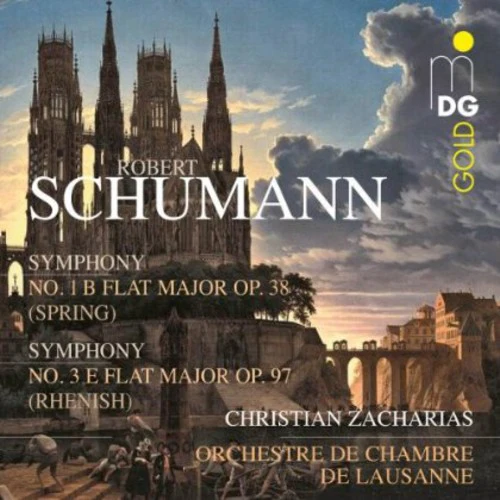
Schumann: Symphonies Nos. 1 & 3 / Zacharias, Lausanne Chamber Orchestra
SCHUMANN Symphonies: No. 1; No. 3 • Christian Zacharias, cond; Lausanne CO • MDG 940 1772-6 (65:34)
When Schumann’s orchestral music is discussed what almost inevitably comes up are his difficulties dealing with orchestration, especially later in his career. In assessing Schumann’s “skills” as an orchestrator, Felix Weingartner was blunt, if not brutal: “…he did not know how to handle the orchestra, either as director or as composer. He worked almost always with the full material but did not take the pains to elaborate the parts according to the character of the separate instruments. With almost childlike stupidity he expected to attain fullness and strength by doubling the instruments. Therefore the instrumentation is heavy and inflexible; the color gray against gray; the most important themes, if played according to his directions, sometimes cannot be heard; and a true forte is almost as impossible as a true piano …Schumann’s symphonies are composed for the pianoforte, and arranged—unhappily not well at that—for the orchestra.”
Schumann ran into difficulty at the very first rehearsal of the First Symphony. The first two measures of the opening fanfare were originally a third lower but Schumann discovered that, since the Leipzig Gewandhaus Orchestra performed on “natural” horns and trumpets, the next-to-last pair of notes had to be played by “stopping” the instruments, resulting in a sound that Schumann compared to “a violent cold in the head.” Mendelssohn, who was conducting, suggested moving the passage up a third and Schumann assented. Interestingly, even with valved instruments now in use, most conductors, at least on recordings, stick to Mendelssohn’s solution. Many conductors handle the “thickness” that Weingartner complained of by following his advice and thinning out the orchestration; some, on the other hand, either reorchestrate to bring out important themes or stick to Schumann’s orchestration but make adjustments in the sectional balance.
Conducting the Lausanne Chamber Orchestra, Christian Zacharias has an ensemble that, with something close to 50 players, is approximately the same size as Mendelssohn’s Leipzig Gewandhaus Orchestra so no thinning out is probably necessary. Although I wish the horns were a little louder, one hears much interesting detail that is often lost when the symphonies are played by a large orchestra using Schumann’s orchestration (most of the problems emerge in the later symphonies which Schumann composed during and after his bad experience conducting an orchestra in Düsseldorf). Zacharias’s “Spring” Symphony is a relaxed, moderately paced performance. Tempo-wise, it inhabits the middle of the pack and, for my taste, challenges the very best ones, my favorite of which is Peter Maag’s, with the Bern Symphony Orchestra. I wouldn’t have minded a little more playfulness in the finale—he’s pretty straightforward here and in the “Rhenish,” with the most grudging observation of ritardandos and other such tempo adjustments. Both performances abound in snappy rhythms, giving them a kind of buoyant “innocence” that I found quite charming. MDG has provided clear, detailed sound. There are a good many strong performances out there but these two carve out a special niche for themselves. I’ll bet Weingartner would have approved.
FANFARE: James Miller
SCHUMANN Symphonies: No. 1; No. 3 • Christian Zacharias, cond; Lausanne CO • MDG 940 1772-6 (65:34)
When Schumann’s orchestral music is discussed what almost inevitably comes up are his difficulties dealing with orchestration, especially later in his career. In assessing Schumann’s “skills” as an orchestrator, Felix Weingartner was blunt, if not brutal: “…he did not know how to handle the orchestra, either as director or as composer. He worked almost always with the full material but did not take the pains to elaborate the parts according to the character of the separate instruments. With almost childlike stupidity he expected to attain fullness and strength by doubling the instruments. Therefore the instrumentation is heavy and inflexible; the color gray against gray; the most important themes, if played according to his directions, sometimes cannot be heard; and a true forte is almost as impossible as a true piano …Schumann’s symphonies are composed for the pianoforte, and arranged—unhappily not well at that—for the orchestra.”
Schumann ran into difficulty at the very first rehearsal of the First Symphony. The first two measures of the opening fanfare were originally a third lower but Schumann discovered that, since the Leipzig Gewandhaus Orchestra performed on “natural” horns and trumpets, the next-to-last pair of notes had to be played by “stopping” the instruments, resulting in a sound that Schumann compared to “a violent cold in the head.” Mendelssohn, who was conducting, suggested moving the passage up a third and Schumann assented. Interestingly, even with valved instruments now in use, most conductors, at least on recordings, stick to Mendelssohn’s solution. Many conductors handle the “thickness” that Weingartner complained of by following his advice and thinning out the orchestration; some, on the other hand, either reorchestrate to bring out important themes or stick to Schumann’s orchestration but make adjustments in the sectional balance.
Conducting the Lausanne Chamber Orchestra, Christian Zacharias has an ensemble that, with something close to 50 players, is approximately the same size as Mendelssohn’s Leipzig Gewandhaus Orchestra so no thinning out is probably necessary. Although I wish the horns were a little louder, one hears much interesting detail that is often lost when the symphonies are played by a large orchestra using Schumann’s orchestration (most of the problems emerge in the later symphonies which Schumann composed during and after his bad experience conducting an orchestra in Düsseldorf). Zacharias’s “Spring” Symphony is a relaxed, moderately paced performance. Tempo-wise, it inhabits the middle of the pack and, for my taste, challenges the very best ones, my favorite of which is Peter Maag’s, with the Bern Symphony Orchestra. I wouldn’t have minded a little more playfulness in the finale—he’s pretty straightforward here and in the “Rhenish,” with the most grudging observation of ritardandos and other such tempo adjustments. Both performances abound in snappy rhythms, giving them a kind of buoyant “innocence” that I found quite charming. MDG has provided clear, detailed sound. There are a good many strong performances out there but these two carve out a special niche for themselves. I’ll bet Weingartner would have approved.
FANFARE: James Miller
$18.99
Schumann: Symphonies Nos. 1 & 3 / Zacharias, Lausanne Chamber Orchestra—
$18.99
Description
SCHUMANN Symphonies: No. 1; No. 3 • Christian Zacharias, cond; Lausanne CO • MDG 940 1772-6 (65:34)
When Schumann’s orchestral music is discussed what almost inevitably comes up are his difficulties dealing with orchestration, especially later in his career. In assessing Schumann’s “skills” as an orchestrator, Felix Weingartner was blunt, if not brutal: “…he did not know how to handle the orchestra, either as director or as composer. He worked almost always with the full material but did not take the pains to elaborate the parts according to the character of the separate instruments. With almost childlike stupidity he expected to attain fullness and strength by doubling the instruments. Therefore the instrumentation is heavy and inflexible; the color gray against gray; the most important themes, if played according to his directions, sometimes cannot be heard; and a true forte is almost as impossible as a true piano …Schumann’s symphonies are composed for the pianoforte, and arranged—unhappily not well at that—for the orchestra.”
Schumann ran into difficulty at the very first rehearsal of the First Symphony. The first two measures of the opening fanfare were originally a third lower but Schumann discovered that, since the Leipzig Gewandhaus Orchestra performed on “natural” horns and trumpets, the next-to-last pair of notes had to be played by “stopping” the instruments, resulting in a sound that Schumann compared to “a violent cold in the head.” Mendelssohn, who was conducting, suggested moving the passage up a third and Schumann assented. Interestingly, even with valved instruments now in use, most conductors, at least on recordings, stick to Mendelssohn’s solution. Many conductors handle the “thickness” that Weingartner complained of by following his advice and thinning out the orchestration; some, on the other hand, either reorchestrate to bring out important themes or stick to Schumann’s orchestration but make adjustments in the sectional balance.
Conducting the Lausanne Chamber Orchestra, Christian Zacharias has an ensemble that, with something close to 50 players, is approximately the same size as Mendelssohn’s Leipzig Gewandhaus Orchestra so no thinning out is probably necessary. Although I wish the horns were a little louder, one hears much interesting detail that is often lost when the symphonies are played by a large orchestra using Schumann’s orchestration (most of the problems emerge in the later symphonies which Schumann composed during and after his bad experience conducting an orchestra in Düsseldorf). Zacharias’s “Spring” Symphony is a relaxed, moderately paced performance. Tempo-wise, it inhabits the middle of the pack and, for my taste, challenges the very best ones, my favorite of which is Peter Maag’s, with the Bern Symphony Orchestra. I wouldn’t have minded a little more playfulness in the finale—he’s pretty straightforward here and in the “Rhenish,” with the most grudging observation of ritardandos and other such tempo adjustments. Both performances abound in snappy rhythms, giving them a kind of buoyant “innocence” that I found quite charming. MDG has provided clear, detailed sound. There are a good many strong performances out there but these two carve out a special niche for themselves. I’ll bet Weingartner would have approved.
FANFARE: James Miller






















