🎉 Up to 70% Off Selected ItemsShop Sale

1 / 2
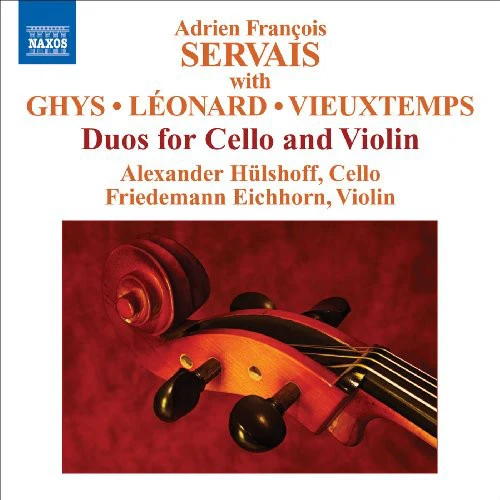
Servais: Duos For Cello And Violin / Hulshoff, Eichhorn
DUOS FOR CELLO AND VIOLIN • Alexander Hülshoff (vc); Friedemann Eichhorn (vn) • NAXOS 8.572188 (68:20)
GHYS AND SERVAIS Variations brillantes et concertants sur l’air “God Save the King.” LÉONARD AND SERVAIS Grand Duo de Concert No. 4 sur des motifs de l’opéra “L’Africaine.” Grand Duo de Concert No. 3. Grand Duo de Concert No. 2 sur des thèmes de Beethoven. Grand Duo de Concert No. 1 sur des airs nationaux anglais. VIEUXTEMPS AND SERVAIS Grand Duo sur des motifs de l’opéra “Les Huguenots de Meyerbeer”
The first duo in Alexander Hülshoff and Friedemann Eichhorn’s collection of fantasies written in collaboration by Adrien François Servais and violinists Joseph Ghys, Hubert Léonard, and Henri Vieuxtemps seems, in comparison to the others, almost like a warhorse; it’s been recorded twice before, by Gidon Kremer on Nonesuch 79657, Fanfare 26:5, and by Rudens Turku and Wen-Sinn Yang on Avie 2124, 31:6. After a brilliant and rather long introduction, the familiar theme appears in stately double-stops. Bruce R. Scheuneman’s booklet notes make a great deal of the equal partnership of the violin and cello, not only melodically and thematically but in virtuosity as well. In Ghys’s and Servais’s variations, in fact, both instruments engage in Paganini-like hypervirtuosic exchanges. If it’s a competition, it’s not clear who wins. Perhaps that’s because it’s not clear whether Hülshoff or Eichhorn makes the stronger impression: Just when one has done something that seemingly can’t be topped, the other tops it. Both possess electrifying staccatos, crackling with bracing energy; and both revel in the passages assigned to them. Both play with the kind of panache that undoubtedly put it across at the time of its composition. I remember the impression Ruggiero Ricci made in Bottesini’s Gran Duo Concertante, and as brilliant as that might have been, it couldn’t compare to the effect of these performances—in fact, Ricci and Francesco Petracchi (reissued on CD as CBS 72995) seemed to be punching the clock in comparison to Hülshoff and Eichhorn in this kind of repertoire. And if Rudens Turku and Wen-Sinn Yang don’t quite match the boldness of Hülshoff’s and Eichhorn’s virtuosic gestures, Kremer does, in perhaps richer recorded sound. But the collection’s the thing, and those seeking Servais’s duos get them in full force in Naxos’s collection.
The Grand Duo de Concert on L’Africaine , composed in cooperation with Léonard, sounds, if anything, even more amazing. When Eichhorn’s violin sings, it’s clear that he’s not just a shallow virtuoso, in the mold of early quasi-charlatans like Lolli and Woldemar. And the music, despite sounding like a revolving door of effects on steroids, doesn’t actually sound so circus-like as the descriptions above might suggest. Léonard’s and Servais’s Grand Duo No. 3, including two variations on what must have been an original theme, still breathes the atmosphere of the operatic fantasy.
Vieuxtemps’s and Servais’s Grand Duo opens with a surreal version of A Mighty Fortress before taking off into the main theme (from Meyerbeer). Anyone who might expect from Vieuxtemps’s contribution the same noble restraint so evident in his concertos will find that here, but whipped to a frenzied pitch of virtuoso excitement (remember that Servais took a hand in all these pieces). Still, some of Vieuxtemps’s chromatic mannerisms can be discerned through the tracery.
Léonard’s and Servais’s Second Grand Duo, this time on themes by Beethoven, returns to an excitement undampened by any obstructive view of the composer of the music being varied (or parodied). In this case, I won’t spoil the plot by mentioning some of the themes that flit by in an intoxicating phantasmagoria, but it’s as much fun as listening to a quodlibet must have been for listeners in the know centuries ago. Let’s just say that when the variations come, Léonard and Servais try, with tongues in cheeks, I’d suspect, to outdo Beethoven in a set he’d previously attempted—and there’s a hint for you. Violinists might find that these few minutes alone make the CD worth acquiring—and there’s another.
The program concludes with Léonard’s and Servais’s First Grand Duo, this time featuring variations on God Save the King (again) and Yankee Doodle (with some other familiar things thrown in for good measure). Paganini wrote a set of variations on the first and Vieuxtemps on the second. But again, here the power of two creates more than double the fun.
So consider the effect of a set of Paganini’s variations and raise that to the second or third or even fourth power (anyway, think of more than a simple addition of two parts), and you have the magnitude of the payload these pieces deliver. The engineers have … but with playing like this, who really cares, so long as you can hear the soloists reasonably well? (Actually, you can hear them very well in Naxos’s clear recorded sound, but that’s almost beside the point; would you mind sitting in the highest loge to hear Paganini?) Urgently recommended as a great deal of fun for listeners not too tightly buttoned down to enjoy it on its own terms. I don’t think there’s anything else quite like it.
FANFARE: Robert Maxham
DUOS FOR CELLO AND VIOLIN • Alexander Hülshoff (vc); Friedemann Eichhorn (vn) • NAXOS 8.572188 (68:20)
GHYS AND SERVAIS Variations brillantes et concertants sur l’air “God Save the King.” LÉONARD AND SERVAIS Grand Duo de Concert No. 4 sur des motifs de l’opéra “L’Africaine.” Grand Duo de Concert No. 3. Grand Duo de Concert No. 2 sur des thèmes de Beethoven. Grand Duo de Concert No. 1 sur des airs nationaux anglais. VIEUXTEMPS AND SERVAIS Grand Duo sur des motifs de l’opéra “Les Huguenots de Meyerbeer”
The first duo in Alexander Hülshoff and Friedemann Eichhorn’s collection of fantasies written in collaboration by Adrien François Servais and violinists Joseph Ghys, Hubert Léonard, and Henri Vieuxtemps seems, in comparison to the others, almost like a warhorse; it’s been recorded twice before, by Gidon Kremer on Nonesuch 79657, Fanfare 26:5, and by Rudens Turku and Wen-Sinn Yang on Avie 2124, 31:6. After a brilliant and rather long introduction, the familiar theme appears in stately double-stops. Bruce R. Scheuneman’s booklet notes make a great deal of the equal partnership of the violin and cello, not only melodically and thematically but in virtuosity as well. In Ghys’s and Servais’s variations, in fact, both instruments engage in Paganini-like hypervirtuosic exchanges. If it’s a competition, it’s not clear who wins. Perhaps that’s because it’s not clear whether Hülshoff or Eichhorn makes the stronger impression: Just when one has done something that seemingly can’t be topped, the other tops it. Both possess electrifying staccatos, crackling with bracing energy; and both revel in the passages assigned to them. Both play with the kind of panache that undoubtedly put it across at the time of its composition. I remember the impression Ruggiero Ricci made in Bottesini’s Gran Duo Concertante, and as brilliant as that might have been, it couldn’t compare to the effect of these performances—in fact, Ricci and Francesco Petracchi (reissued on CD as CBS 72995) seemed to be punching the clock in comparison to Hülshoff and Eichhorn in this kind of repertoire. And if Rudens Turku and Wen-Sinn Yang don’t quite match the boldness of Hülshoff’s and Eichhorn’s virtuosic gestures, Kremer does, in perhaps richer recorded sound. But the collection’s the thing, and those seeking Servais’s duos get them in full force in Naxos’s collection.
The Grand Duo de Concert on L’Africaine , composed in cooperation with Léonard, sounds, if anything, even more amazing. When Eichhorn’s violin sings, it’s clear that he’s not just a shallow virtuoso, in the mold of early quasi-charlatans like Lolli and Woldemar. And the music, despite sounding like a revolving door of effects on steroids, doesn’t actually sound so circus-like as the descriptions above might suggest. Léonard’s and Servais’s Grand Duo No. 3, including two variations on what must have been an original theme, still breathes the atmosphere of the operatic fantasy.
Vieuxtemps’s and Servais’s Grand Duo opens with a surreal version of A Mighty Fortress before taking off into the main theme (from Meyerbeer). Anyone who might expect from Vieuxtemps’s contribution the same noble restraint so evident in his concertos will find that here, but whipped to a frenzied pitch of virtuoso excitement (remember that Servais took a hand in all these pieces). Still, some of Vieuxtemps’s chromatic mannerisms can be discerned through the tracery.
Léonard’s and Servais’s Second Grand Duo, this time on themes by Beethoven, returns to an excitement undampened by any obstructive view of the composer of the music being varied (or parodied). In this case, I won’t spoil the plot by mentioning some of the themes that flit by in an intoxicating phantasmagoria, but it’s as much fun as listening to a quodlibet must have been for listeners in the know centuries ago. Let’s just say that when the variations come, Léonard and Servais try, with tongues in cheeks, I’d suspect, to outdo Beethoven in a set he’d previously attempted—and there’s a hint for you. Violinists might find that these few minutes alone make the CD worth acquiring—and there’s another.
The program concludes with Léonard’s and Servais’s First Grand Duo, this time featuring variations on God Save the King (again) and Yankee Doodle (with some other familiar things thrown in for good measure). Paganini wrote a set of variations on the first and Vieuxtemps on the second. But again, here the power of two creates more than double the fun.
So consider the effect of a set of Paganini’s variations and raise that to the second or third or even fourth power (anyway, think of more than a simple addition of two parts), and you have the magnitude of the payload these pieces deliver. The engineers have … but with playing like this, who really cares, so long as you can hear the soloists reasonably well? (Actually, you can hear them very well in Naxos’s clear recorded sound, but that’s almost beside the point; would you mind sitting in the highest loge to hear Paganini?) Urgently recommended as a great deal of fun for listeners not too tightly buttoned down to enjoy it on its own terms. I don’t think there’s anything else quite like it.
FANFARE: Robert Maxham
$7.00
Original: $19.99
-65%Servais: Duos For Cello And Violin / Hulshoff, Eichhorn—
$19.99
$7.00Description
DUOS FOR CELLO AND VIOLIN • Alexander Hülshoff (vc); Friedemann Eichhorn (vn) • NAXOS 8.572188 (68:20)
GHYS AND SERVAIS Variations brillantes et concertants sur l’air “God Save the King.” LÉONARD AND SERVAIS Grand Duo de Concert No. 4 sur des motifs de l’opéra “L’Africaine.” Grand Duo de Concert No. 3. Grand Duo de Concert No. 2 sur des thèmes de Beethoven. Grand Duo de Concert No. 1 sur des airs nationaux anglais. VIEUXTEMPS AND SERVAIS Grand Duo sur des motifs de l’opéra “Les Huguenots de Meyerbeer”
The first duo in Alexander Hülshoff and Friedemann Eichhorn’s collection of fantasies written in collaboration by Adrien François Servais and violinists Joseph Ghys, Hubert Léonard, and Henri Vieuxtemps seems, in comparison to the others, almost like a warhorse; it’s been recorded twice before, by Gidon Kremer on Nonesuch 79657, Fanfare 26:5, and by Rudens Turku and Wen-Sinn Yang on Avie 2124, 31:6. After a brilliant and rather long introduction, the familiar theme appears in stately double-stops. Bruce R. Scheuneman’s booklet notes make a great deal of the equal partnership of the violin and cello, not only melodically and thematically but in virtuosity as well. In Ghys’s and Servais’s variations, in fact, both instruments engage in Paganini-like hypervirtuosic exchanges. If it’s a competition, it’s not clear who wins. Perhaps that’s because it’s not clear whether Hülshoff or Eichhorn makes the stronger impression: Just when one has done something that seemingly can’t be topped, the other tops it. Both possess electrifying staccatos, crackling with bracing energy; and both revel in the passages assigned to them. Both play with the kind of panache that undoubtedly put it across at the time of its composition. I remember the impression Ruggiero Ricci made in Bottesini’s Gran Duo Concertante, and as brilliant as that might have been, it couldn’t compare to the effect of these performances—in fact, Ricci and Francesco Petracchi (reissued on CD as CBS 72995) seemed to be punching the clock in comparison to Hülshoff and Eichhorn in this kind of repertoire. And if Rudens Turku and Wen-Sinn Yang don’t quite match the boldness of Hülshoff’s and Eichhorn’s virtuosic gestures, Kremer does, in perhaps richer recorded sound. But the collection’s the thing, and those seeking Servais’s duos get them in full force in Naxos’s collection.
The Grand Duo de Concert on L’Africaine , composed in cooperation with Léonard, sounds, if anything, even more amazing. When Eichhorn’s violin sings, it’s clear that he’s not just a shallow virtuoso, in the mold of early quasi-charlatans like Lolli and Woldemar. And the music, despite sounding like a revolving door of effects on steroids, doesn’t actually sound so circus-like as the descriptions above might suggest. Léonard’s and Servais’s Grand Duo No. 3, including two variations on what must have been an original theme, still breathes the atmosphere of the operatic fantasy.
Vieuxtemps’s and Servais’s Grand Duo opens with a surreal version of A Mighty Fortress before taking off into the main theme (from Meyerbeer). Anyone who might expect from Vieuxtemps’s contribution the same noble restraint so evident in his concertos will find that here, but whipped to a frenzied pitch of virtuoso excitement (remember that Servais took a hand in all these pieces). Still, some of Vieuxtemps’s chromatic mannerisms can be discerned through the tracery.
Léonard’s and Servais’s Second Grand Duo, this time on themes by Beethoven, returns to an excitement undampened by any obstructive view of the composer of the music being varied (or parodied). In this case, I won’t spoil the plot by mentioning some of the themes that flit by in an intoxicating phantasmagoria, but it’s as much fun as listening to a quodlibet must have been for listeners in the know centuries ago. Let’s just say that when the variations come, Léonard and Servais try, with tongues in cheeks, I’d suspect, to outdo Beethoven in a set he’d previously attempted—and there’s a hint for you. Violinists might find that these few minutes alone make the CD worth acquiring—and there’s another.
The program concludes with Léonard’s and Servais’s First Grand Duo, this time featuring variations on God Save the King (again) and Yankee Doodle (with some other familiar things thrown in for good measure). Paganini wrote a set of variations on the first and Vieuxtemps on the second. But again, here the power of two creates more than double the fun.
So consider the effect of a set of Paganini’s variations and raise that to the second or third or even fourth power (anyway, think of more than a simple addition of two parts), and you have the magnitude of the payload these pieces deliver. The engineers have … but with playing like this, who really cares, so long as you can hear the soloists reasonably well? (Actually, you can hear them very well in Naxos’s clear recorded sound, but that’s almost beside the point; would you mind sitting in the highest loge to hear Paganini?) Urgently recommended as a great deal of fun for listeners not too tightly buttoned down to enjoy it on its own terms. I don’t think there’s anything else quite like it.
FANFARE: Robert Maxham