🎉 Up to 70% Off Selected ItemsShop Sale

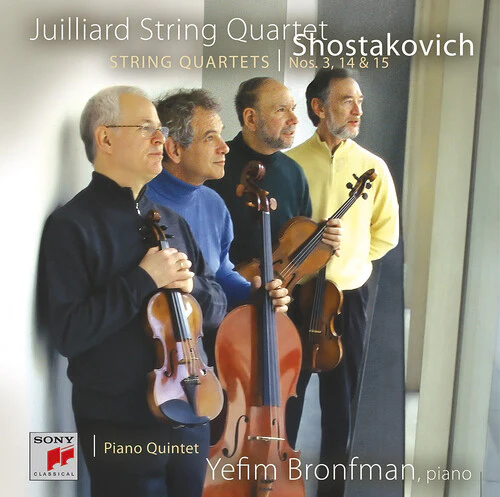
Shostakovich: Quartets No 3, 14, 15, Quintet / Juilliard Sq
SHOSTAKOVICH String Quartets: No. 3; No. 14; No. 15. Piano Quintet • Juilliard Str Qrt; Yefim Bronfman (pn) • SONY 79018 (2 CDs: 127:38)
Among the releases celebrating the 60th anniversary of the founding of the Juilliard String Quartet (of course, none of the original members remain) is this most welcome set of Shostakovich quartets. Welcome because, despite the Juilliard’s longstanding commitment to 20th-century music in general and their having given the American premiere of the 15th Quartet in 1975 (with two of the current members, cellist Joel Krosnick and violist Samuel Rhodes, participating) in particular, this is apparently their first recording of any Shostakovich quartets. (The performance of the Piano Quintet, however, was recorded in 1999 and originally issued along with Bronfman’s account of Shostakovich’s two piano concertos—see Fanfare 23:4.) Most welcome because the quartet brings its usual penetrating insight and commitment to this music.
Truth be told, their account of the Third Quartet didn’t grab me on first hearing. With the rich, resonant, tonally nuanced sound of the Borodin Quartet foremost in my memory, the Juilliards initially seemed lean and distant, and the way they speed through the score came across as unfocused nervous energy (following a moderately paced Allegretto, slower than most, they take three of the four remaining movements significantly faster than the Borodins). But after several rehearings, I came to appreciate the different interpretive details they bring out—such as the jangly Cubist feel they give the first movement’s quasi-fugue and the excitement they obtain by whipping up the tempo in its concluding pages, or the gypsyish quality that their quick phrasing suggests after reference point 55 in the third movement. They may not dig as deep as the Borodins; instead, theirs is a more measured, varied perspective—for example, though lacking the Borodins’ remarkable tension at dramatic points, such as the expressive passage at 108 in the finale, they redeem themselves by deftly emphasizing the dance tune that appears almost immediately thereafter, as if to soften the blow. My ears also gradually adjusted to the recorded sound, so that I came to realize what at first seemed distant was actually more of a natural concert hall ambience and balance than the beefed up (and effective, but enhanced) engineering afforded the Borodins (EMI).
If the Third Quartet benefited from a bit of familiarity to reveal its irony and edginess, the Juilliard’s 14th and 15th Quartets were immediately engaging and convincing—all the more impressive as these are Shostakovich’s two most enigmatic quartets. The 14th is dedicated to Sergei Shirinsky, cellist of the Beethoven Quartet, and here Joel Krosnick makes the most of his featured role. I once wrote in a review that I wouldn’t argue with Royal S. Brown’s assessment of this quartet as “the least appealing, least original, and least successful of the 15” ( Fanfare 12:1), but the Juilliard interpretation has put this music into a new light for me. They fearlessly attack the score’s dissonances, making it sound more tonally ambiguous—and thus simultaneously more original and mysterious—than has any other ensemble in my experience. In their hands, the opening pages sound like a drunken Beethovenian aborted fugue—high spirited but slightly off-kilter—and even the fragmented finale is played with an intensity that makes it sound more coherent than ever before.
In the 15th Quartet as well, notorious for its six introspective Adagio movements, the Juilliards don’t shy away from the music’s bleakness and occasional harshness. They embrace its stark, transparent textures—the waltz in the second movement (ironically titled “Serenade”) isolates individual lines like exposed nerves, and Rhodes’s viola solo opening the “Nocturne” is not pretty, but painfully necessary. Though separated by 35 years, the mood of the opening pages of the final quartet is remarkably similar to that of the second movement fugue in the Piano Quintet, growing from simple motifs into a contrapuntal web of deep emotion until chant-like themes emerge as temporary balm, offered without exaggeration or pathos. Speaking of the Piano Quintet, Bronfman is an ideal partner—a powerful presence in the Richter mold, who can project tenderness or urgency as called for, and whose attitude is perfectly in sync with the Juilliard’s direct, yet dramatic approach.
In sum, these are distinguished, distinctive performances that interpretively fall in between the robust, sometimes exaggerated Russianness of the Borodin or Sorrel style, and the brisk, almost analytical precision of the Fitzwilliam and Emerson accounts. Is it too early to start thinking about this year’s Want List?
FANFARE: Art Lange
SHOSTAKOVICH String Quartets: No. 3; No. 14; No. 15. Piano Quintet • Juilliard Str Qrt; Yefim Bronfman (pn) • SONY 79018 (2 CDs: 127:38)
Among the releases celebrating the 60th anniversary of the founding of the Juilliard String Quartet (of course, none of the original members remain) is this most welcome set of Shostakovich quartets. Welcome because, despite the Juilliard’s longstanding commitment to 20th-century music in general and their having given the American premiere of the 15th Quartet in 1975 (with two of the current members, cellist Joel Krosnick and violist Samuel Rhodes, participating) in particular, this is apparently their first recording of any Shostakovich quartets. (The performance of the Piano Quintet, however, was recorded in 1999 and originally issued along with Bronfman’s account of Shostakovich’s two piano concertos—see Fanfare 23:4.) Most welcome because the quartet brings its usual penetrating insight and commitment to this music.
Truth be told, their account of the Third Quartet didn’t grab me on first hearing. With the rich, resonant, tonally nuanced sound of the Borodin Quartet foremost in my memory, the Juilliards initially seemed lean and distant, and the way they speed through the score came across as unfocused nervous energy (following a moderately paced Allegretto, slower than most, they take three of the four remaining movements significantly faster than the Borodins). But after several rehearings, I came to appreciate the different interpretive details they bring out—such as the jangly Cubist feel they give the first movement’s quasi-fugue and the excitement they obtain by whipping up the tempo in its concluding pages, or the gypsyish quality that their quick phrasing suggests after reference point 55 in the third movement. They may not dig as deep as the Borodins; instead, theirs is a more measured, varied perspective—for example, though lacking the Borodins’ remarkable tension at dramatic points, such as the expressive passage at 108 in the finale, they redeem themselves by deftly emphasizing the dance tune that appears almost immediately thereafter, as if to soften the blow. My ears also gradually adjusted to the recorded sound, so that I came to realize what at first seemed distant was actually more of a natural concert hall ambience and balance than the beefed up (and effective, but enhanced) engineering afforded the Borodins (EMI).
If the Third Quartet benefited from a bit of familiarity to reveal its irony and edginess, the Juilliard’s 14th and 15th Quartets were immediately engaging and convincing—all the more impressive as these are Shostakovich’s two most enigmatic quartets. The 14th is dedicated to Sergei Shirinsky, cellist of the Beethoven Quartet, and here Joel Krosnick makes the most of his featured role. I once wrote in a review that I wouldn’t argue with Royal S. Brown’s assessment of this quartet as “the least appealing, least original, and least successful of the 15” ( Fanfare 12:1), but the Juilliard interpretation has put this music into a new light for me. They fearlessly attack the score’s dissonances, making it sound more tonally ambiguous—and thus simultaneously more original and mysterious—than has any other ensemble in my experience. In their hands, the opening pages sound like a drunken Beethovenian aborted fugue—high spirited but slightly off-kilter—and even the fragmented finale is played with an intensity that makes it sound more coherent than ever before.
In the 15th Quartet as well, notorious for its six introspective Adagio movements, the Juilliards don’t shy away from the music’s bleakness and occasional harshness. They embrace its stark, transparent textures—the waltz in the second movement (ironically titled “Serenade”) isolates individual lines like exposed nerves, and Rhodes’s viola solo opening the “Nocturne” is not pretty, but painfully necessary. Though separated by 35 years, the mood of the opening pages of the final quartet is remarkably similar to that of the second movement fugue in the Piano Quintet, growing from simple motifs into a contrapuntal web of deep emotion until chant-like themes emerge as temporary balm, offered without exaggeration or pathos. Speaking of the Piano Quintet, Bronfman is an ideal partner—a powerful presence in the Richter mold, who can project tenderness or urgency as called for, and whose attitude is perfectly in sync with the Juilliard’s direct, yet dramatic approach.
In sum, these are distinguished, distinctive performances that interpretively fall in between the robust, sometimes exaggerated Russianness of the Borodin or Sorrel style, and the brisk, almost analytical precision of the Fitzwilliam and Emerson accounts. Is it too early to start thinking about this year’s Want List?
FANFARE: Art Lange
$12.99
Shostakovich: Quartets No 3, 14, 15, Quintet / Juilliard Sq—
$12.99
Description
SHOSTAKOVICH String Quartets: No. 3; No. 14; No. 15. Piano Quintet • Juilliard Str Qrt; Yefim Bronfman (pn) • SONY 79018 (2 CDs: 127:38)
Among the releases celebrating the 60th anniversary of the founding of the Juilliard String Quartet (of course, none of the original members remain) is this most welcome set of Shostakovich quartets. Welcome because, despite the Juilliard’s longstanding commitment to 20th-century music in general and their having given the American premiere of the 15th Quartet in 1975 (with two of the current members, cellist Joel Krosnick and violist Samuel Rhodes, participating) in particular, this is apparently their first recording of any Shostakovich quartets. (The performance of the Piano Quintet, however, was recorded in 1999 and originally issued along with Bronfman’s account of Shostakovich’s two piano concertos—see Fanfare 23:4.) Most welcome because the quartet brings its usual penetrating insight and commitment to this music.
Truth be told, their account of the Third Quartet didn’t grab me on first hearing. With the rich, resonant, tonally nuanced sound of the Borodin Quartet foremost in my memory, the Juilliards initially seemed lean and distant, and the way they speed through the score came across as unfocused nervous energy (following a moderately paced Allegretto, slower than most, they take three of the four remaining movements significantly faster than the Borodins). But after several rehearings, I came to appreciate the different interpretive details they bring out—such as the jangly Cubist feel they give the first movement’s quasi-fugue and the excitement they obtain by whipping up the tempo in its concluding pages, or the gypsyish quality that their quick phrasing suggests after reference point 55 in the third movement. They may not dig as deep as the Borodins; instead, theirs is a more measured, varied perspective—for example, though lacking the Borodins’ remarkable tension at dramatic points, such as the expressive passage at 108 in the finale, they redeem themselves by deftly emphasizing the dance tune that appears almost immediately thereafter, as if to soften the blow. My ears also gradually adjusted to the recorded sound, so that I came to realize what at first seemed distant was actually more of a natural concert hall ambience and balance than the beefed up (and effective, but enhanced) engineering afforded the Borodins (EMI).
If the Third Quartet benefited from a bit of familiarity to reveal its irony and edginess, the Juilliard’s 14th and 15th Quartets were immediately engaging and convincing—all the more impressive as these are Shostakovich’s two most enigmatic quartets. The 14th is dedicated to Sergei Shirinsky, cellist of the Beethoven Quartet, and here Joel Krosnick makes the most of his featured role. I once wrote in a review that I wouldn’t argue with Royal S. Brown’s assessment of this quartet as “the least appealing, least original, and least successful of the 15” ( Fanfare 12:1), but the Juilliard interpretation has put this music into a new light for me. They fearlessly attack the score’s dissonances, making it sound more tonally ambiguous—and thus simultaneously more original and mysterious—than has any other ensemble in my experience. In their hands, the opening pages sound like a drunken Beethovenian aborted fugue—high spirited but slightly off-kilter—and even the fragmented finale is played with an intensity that makes it sound more coherent than ever before.
In the 15th Quartet as well, notorious for its six introspective Adagio movements, the Juilliards don’t shy away from the music’s bleakness and occasional harshness. They embrace its stark, transparent textures—the waltz in the second movement (ironically titled “Serenade”) isolates individual lines like exposed nerves, and Rhodes’s viola solo opening the “Nocturne” is not pretty, but painfully necessary. Though separated by 35 years, the mood of the opening pages of the final quartet is remarkably similar to that of the second movement fugue in the Piano Quintet, growing from simple motifs into a contrapuntal web of deep emotion until chant-like themes emerge as temporary balm, offered without exaggeration or pathos. Speaking of the Piano Quintet, Bronfman is an ideal partner—a powerful presence in the Richter mold, who can project tenderness or urgency as called for, and whose attitude is perfectly in sync with the Juilliard’s direct, yet dramatic approach.
In sum, these are distinguished, distinctive performances that interpretively fall in between the robust, sometimes exaggerated Russianness of the Borodin or Sorrel style, and the brisk, almost analytical precision of the Fitzwilliam and Emerson accounts. Is it too early to start thinking about this year’s Want List?
FANFARE: Art Lange