🎉 Up to 70% Off Selected ItemsShop Sale

1 / 2
Shostakovich: Symphony no 10 / Svetlanov, USSR State Symphony
SHOSTAKOVICH Symphony No. 10. TCHAIKOVSKY The Snow Maiden: Melodrama. RIMSKY-KORSAKOV The Legend of the Invisible City of Kitezh: Hymn to Nature; The Battle of Kerzhenets • Yevgeny Svetlanov, cond; USSR St SO • ICA ICAC 5036 (62:17) Live: London 08/21–30/1968
As mentioned in my review elsewhere of the Dvo?ák Cello Concerto in a three-CD set of live Mstislav Rostropovich performances issued by BBC Music, this recording is the other half of the famous—or perhaps notorious—Royal Albert Hall concert of August 21, 1968. Hours before, Soviet tanks rolled into Czechoslovakia to crush the Prague Spring effort to advance “socialism with a human face” that threatened to crack the solidarity of the Iron Curtain. Consequently, the contents of the program—the celebrated concerto masterpiece by the iconic master of Czech music, and the profoundly brooding symphony of the Soviet Union’s greatest composer—could not possibly have been more ironic choices. The irony is further compounded for us by subsequent knowledge that the symphony’s scherzo is Shostakovich’s musical depiction of the brutal dictator Josef Stalin, who imposed upon the Eastern bloc the repressive tyranny that the invasion was now enforcing anew.
When the Russian orchestra—whose members (unlike Rostropovich) most likely had no inkling of what had occurred—came on stage, instead of being greeted with the usual round of applause, they encountered an uproar of shouted political slogans by protestors seeking to disrupt the concert. The yelling and scuffling persist through the first several measures of the symphony’s first movement, almost obscuring the quiet, somber opening on the lower strings, before coming to a sudden halt. However unnerving the uproar may have been to the players, they show no signs of it in any loss of steadiness of musical execution. Much the same can be said of conductor Yevgeny Svetlanov, who I presume was cognizant of the situation. However fairly or unfairly—the matter is a subject of dispute—Svetlanov is often characterized as being something of a Soviet party hack; while his real musical abilities cannot be denied, it is sometimes asserted that he rose to his prominent positions in part through political intrigues, and was regarded by apparatchiks as being more politically reliable than figures such as Kondrashin, Mravinsky, or Rozhdestvensky. In any case, he too rises to the occasion. Long on visceral emotional impact but short on subtlety, as was his wont, Svetlanov here produces a powerful musical juggernaut that, akin to the army tanks then rolling into Prague, moves forward with an inexorable, implacable power that upon its close is rewarded with a tumultuous, roaring ovation from the audience. While not my favorite version of this, my favorite post-Sibelius 20th-century symphony—my two top choices remain live performances by Yevgeny Mravinsky with the Leningrad Philharmonic from March 31, 1976, and Herbert von Karajan with the Berlin Philharmonic (in Moscow) from May 29, 1969—it belongs in the upper echelons of recordings of the work, and should not be missed by anyone who values it.
The brief filler pieces of Tchaikovsky and Rimsky-Korsakov concert-hall rarities are likewise given committed, heartfelt performances. The sound quality is a bit murky in spots and has some background tape hiss but is generally quite fine for a live recording of this vintage. The Rimsky-Korsakov excerpts are asserted to be in stereo, though I can’t hear any real difference between those and the monaurally recorded pieces. One wishes that the Shostakovich presented here and the Dvo?ák concerto published by BBC Music were issued as an intact concert in a single two-CD set on a single label; as it is, we can be grateful for the opportunity to acquire them as presently available. Strongly recommended.
FANFARE: James A. Altena
-------
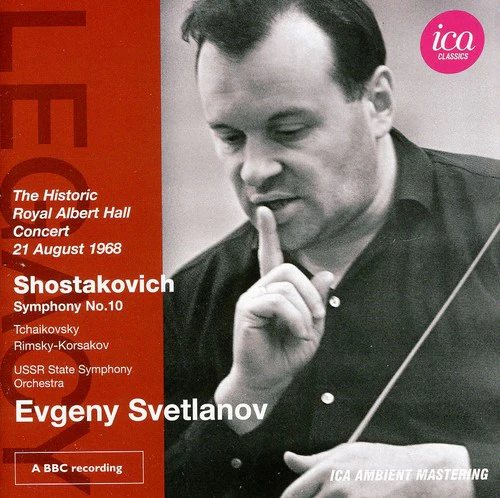
How’s this for a page ripped from history? On the night of 20-21 August 1968 tanks from the Warsaw Pact rolled into Czechoslovakia, bringing the ‘Prague Spring’ to an end. In that raw, angry atmosphere it’s no surprise that Svetlanov and his Soviet orchestra were given a rough reception at the BBC Proms just hours later. Indeed, the opening bars of the symphony emerge from what sounds like a near riot in the hall, the music growing in strength as the clamour subsides. What irony that this symphony - written in the year of Stalin’s death - should be the curtain-raiser for another age of repression. And the cover photograph of Svetlanov - finger to his lips - is a strong visual metaphor for the day’s momentous events.
There’s no way of knowing what went through the minds of this conductor and his players that night, but there’s little doubt that these extra-musical tensions - added to the purely musical ones - spawned a gaunt, hard-driven performance of this great work that’s impossible to forget. Extraordinary circumstances aside, does this recording rank alongside those of Kondrashin, Järvi, Karajan et al? Emphatically, yes; unsparing and idiomatically rough-edged, it will grab you by the scruff and pin you to the wall for fifty relentless minutes.
The BBC sound isn’t bad either - I imagine ICA remastered it for this release - the martial second movement as lacerating as I’ve ever heard it; indeed, this music can so easily be heard as a grim accompaniment to the newsreel footage of the day. The darkly menacing bass drum in the next movement is especially well caught, as are the wobblesome winds. One can only imagine the tension in the hall that night, and no one could have known how the audience would react at the end. As it happens, the sheer guts and cathartic power of this performance silence all criticism, the hardy Prommers - not easily won over - responding with cheers and applause.
The fillers are barely that; signposted as ‘bonus’ items they’re pleasing enough. Blink and you’ll miss the Tchaikovsky, but the excerpts from Kitezh are most enjoyable; no evidence of extra-musical tensions in the band’s easeful playing. As I was reminded when listening to Svetlanov’s Rimsky box, this is natural territory for him. One could have wished for more, but the symphony takes centre-stage - and rightly so.
ICA must be congratulated for issuing so much intriguing, good-quality material in the short time they’ve been in business. I was very impressed by the Rozhdestvensky Tchaikovsky Fourth and look forward to more of the same. Indeed, their very active Twitter feed suggests we won’t have long to wait.
Taut Shostakovich, stretched to breaking point by contemporary events.
-- Dan Morgan, MusicWeb International
SHOSTAKOVICH Symphony No. 10. TCHAIKOVSKY The Snow Maiden: Melodrama. RIMSKY-KORSAKOV The Legend of the Invisible City of Kitezh: Hymn to Nature; The Battle of Kerzhenets • Yevgeny Svetlanov, cond; USSR St SO • ICA ICAC 5036 (62:17) Live: London 08/21–30/1968
As mentioned in my review elsewhere of the Dvo?ák Cello Concerto in a three-CD set of live Mstislav Rostropovich performances issued by BBC Music, this recording is the other half of the famous—or perhaps notorious—Royal Albert Hall concert of August 21, 1968. Hours before, Soviet tanks rolled into Czechoslovakia to crush the Prague Spring effort to advance “socialism with a human face” that threatened to crack the solidarity of the Iron Curtain. Consequently, the contents of the program—the celebrated concerto masterpiece by the iconic master of Czech music, and the profoundly brooding symphony of the Soviet Union’s greatest composer—could not possibly have been more ironic choices. The irony is further compounded for us by subsequent knowledge that the symphony’s scherzo is Shostakovich’s musical depiction of the brutal dictator Josef Stalin, who imposed upon the Eastern bloc the repressive tyranny that the invasion was now enforcing anew.
When the Russian orchestra—whose members (unlike Rostropovich) most likely had no inkling of what had occurred—came on stage, instead of being greeted with the usual round of applause, they encountered an uproar of shouted political slogans by protestors seeking to disrupt the concert. The yelling and scuffling persist through the first several measures of the symphony’s first movement, almost obscuring the quiet, somber opening on the lower strings, before coming to a sudden halt. However unnerving the uproar may have been to the players, they show no signs of it in any loss of steadiness of musical execution. Much the same can be said of conductor Yevgeny Svetlanov, who I presume was cognizant of the situation. However fairly or unfairly—the matter is a subject of dispute—Svetlanov is often characterized as being something of a Soviet party hack; while his real musical abilities cannot be denied, it is sometimes asserted that he rose to his prominent positions in part through political intrigues, and was regarded by apparatchiks as being more politically reliable than figures such as Kondrashin, Mravinsky, or Rozhdestvensky. In any case, he too rises to the occasion. Long on visceral emotional impact but short on subtlety, as was his wont, Svetlanov here produces a powerful musical juggernaut that, akin to the army tanks then rolling into Prague, moves forward with an inexorable, implacable power that upon its close is rewarded with a tumultuous, roaring ovation from the audience. While not my favorite version of this, my favorite post-Sibelius 20th-century symphony—my two top choices remain live performances by Yevgeny Mravinsky with the Leningrad Philharmonic from March 31, 1976, and Herbert von Karajan with the Berlin Philharmonic (in Moscow) from May 29, 1969—it belongs in the upper echelons of recordings of the work, and should not be missed by anyone who values it.
The brief filler pieces of Tchaikovsky and Rimsky-Korsakov concert-hall rarities are likewise given committed, heartfelt performances. The sound quality is a bit murky in spots and has some background tape hiss but is generally quite fine for a live recording of this vintage. The Rimsky-Korsakov excerpts are asserted to be in stereo, though I can’t hear any real difference between those and the monaurally recorded pieces. One wishes that the Shostakovich presented here and the Dvo?ák concerto published by BBC Music were issued as an intact concert in a single two-CD set on a single label; as it is, we can be grateful for the opportunity to acquire them as presently available. Strongly recommended.
FANFARE: James A. Altena
-------
How’s this for a page ripped from history? On the night of 20-21 August 1968 tanks from the Warsaw Pact rolled into Czechoslovakia, bringing the ‘Prague Spring’ to an end. In that raw, angry atmosphere it’s no surprise that Svetlanov and his Soviet orchestra were given a rough reception at the BBC Proms just hours later. Indeed, the opening bars of the symphony emerge from what sounds like a near riot in the hall, the music growing in strength as the clamour subsides. What irony that this symphony - written in the year of Stalin’s death - should be the curtain-raiser for another age of repression. And the cover photograph of Svetlanov - finger to his lips - is a strong visual metaphor for the day’s momentous events.
There’s no way of knowing what went through the minds of this conductor and his players that night, but there’s little doubt that these extra-musical tensions - added to the purely musical ones - spawned a gaunt, hard-driven performance of this great work that’s impossible to forget. Extraordinary circumstances aside, does this recording rank alongside those of Kondrashin, Järvi, Karajan et al? Emphatically, yes; unsparing and idiomatically rough-edged, it will grab you by the scruff and pin you to the wall for fifty relentless minutes.
The BBC sound isn’t bad either - I imagine ICA remastered it for this release - the martial second movement as lacerating as I’ve ever heard it; indeed, this music can so easily be heard as a grim accompaniment to the newsreel footage of the day. The darkly menacing bass drum in the next movement is especially well caught, as are the wobblesome winds. One can only imagine the tension in the hall that night, and no one could have known how the audience would react at the end. As it happens, the sheer guts and cathartic power of this performance silence all criticism, the hardy Prommers - not easily won over - responding with cheers and applause.
The fillers are barely that; signposted as ‘bonus’ items they’re pleasing enough. Blink and you’ll miss the Tchaikovsky, but the excerpts from Kitezh are most enjoyable; no evidence of extra-musical tensions in the band’s easeful playing. As I was reminded when listening to Svetlanov’s Rimsky box, this is natural territory for him. One could have wished for more, but the symphony takes centre-stage - and rightly so.
ICA must be congratulated for issuing so much intriguing, good-quality material in the short time they’ve been in business. I was very impressed by the Rozhdestvensky Tchaikovsky Fourth and look forward to more of the same. Indeed, their very active Twitter feed suggests we won’t have long to wait.
Taut Shostakovich, stretched to breaking point by contemporary events.
-- Dan Morgan, MusicWeb International
$2.62
Original: $7.50
-65%Shostakovich: Symphony no 10 / Svetlanov, USSR State Symphony—
$7.50
$2.62Description
SHOSTAKOVICH Symphony No. 10. TCHAIKOVSKY The Snow Maiden: Melodrama. RIMSKY-KORSAKOV The Legend of the Invisible City of Kitezh: Hymn to Nature; The Battle of Kerzhenets • Yevgeny Svetlanov, cond; USSR St SO • ICA ICAC 5036 (62:17) Live: London 08/21–30/1968
As mentioned in my review elsewhere of the Dvo?ák Cello Concerto in a three-CD set of live Mstislav Rostropovich performances issued by BBC Music, this recording is the other half of the famous—or perhaps notorious—Royal Albert Hall concert of August 21, 1968. Hours before, Soviet tanks rolled into Czechoslovakia to crush the Prague Spring effort to advance “socialism with a human face” that threatened to crack the solidarity of the Iron Curtain. Consequently, the contents of the program—the celebrated concerto masterpiece by the iconic master of Czech music, and the profoundly brooding symphony of the Soviet Union’s greatest composer—could not possibly have been more ironic choices. The irony is further compounded for us by subsequent knowledge that the symphony’s scherzo is Shostakovich’s musical depiction of the brutal dictator Josef Stalin, who imposed upon the Eastern bloc the repressive tyranny that the invasion was now enforcing anew.
When the Russian orchestra—whose members (unlike Rostropovich) most likely had no inkling of what had occurred—came on stage, instead of being greeted with the usual round of applause, they encountered an uproar of shouted political slogans by protestors seeking to disrupt the concert. The yelling and scuffling persist through the first several measures of the symphony’s first movement, almost obscuring the quiet, somber opening on the lower strings, before coming to a sudden halt. However unnerving the uproar may have been to the players, they show no signs of it in any loss of steadiness of musical execution. Much the same can be said of conductor Yevgeny Svetlanov, who I presume was cognizant of the situation. However fairly or unfairly—the matter is a subject of dispute—Svetlanov is often characterized as being something of a Soviet party hack; while his real musical abilities cannot be denied, it is sometimes asserted that he rose to his prominent positions in part through political intrigues, and was regarded by apparatchiks as being more politically reliable than figures such as Kondrashin, Mravinsky, or Rozhdestvensky. In any case, he too rises to the occasion. Long on visceral emotional impact but short on subtlety, as was his wont, Svetlanov here produces a powerful musical juggernaut that, akin to the army tanks then rolling into Prague, moves forward with an inexorable, implacable power that upon its close is rewarded with a tumultuous, roaring ovation from the audience. While not my favorite version of this, my favorite post-Sibelius 20th-century symphony—my two top choices remain live performances by Yevgeny Mravinsky with the Leningrad Philharmonic from March 31, 1976, and Herbert von Karajan with the Berlin Philharmonic (in Moscow) from May 29, 1969—it belongs in the upper echelons of recordings of the work, and should not be missed by anyone who values it.
The brief filler pieces of Tchaikovsky and Rimsky-Korsakov concert-hall rarities are likewise given committed, heartfelt performances. The sound quality is a bit murky in spots and has some background tape hiss but is generally quite fine for a live recording of this vintage. The Rimsky-Korsakov excerpts are asserted to be in stereo, though I can’t hear any real difference between those and the monaurally recorded pieces. One wishes that the Shostakovich presented here and the Dvo?ák concerto published by BBC Music were issued as an intact concert in a single two-CD set on a single label; as it is, we can be grateful for the opportunity to acquire them as presently available. Strongly recommended.
FANFARE: James A. Altena
-------
How’s this for a page ripped from history? On the night of 20-21 August 1968 tanks from the Warsaw Pact rolled into Czechoslovakia, bringing the ‘Prague Spring’ to an end. In that raw, angry atmosphere it’s no surprise that Svetlanov and his Soviet orchestra were given a rough reception at the BBC Proms just hours later. Indeed, the opening bars of the symphony emerge from what sounds like a near riot in the hall, the music growing in strength as the clamour subsides. What irony that this symphony - written in the year of Stalin’s death - should be the curtain-raiser for another age of repression. And the cover photograph of Svetlanov - finger to his lips - is a strong visual metaphor for the day’s momentous events.
There’s no way of knowing what went through the minds of this conductor and his players that night, but there’s little doubt that these extra-musical tensions - added to the purely musical ones - spawned a gaunt, hard-driven performance of this great work that’s impossible to forget. Extraordinary circumstances aside, does this recording rank alongside those of Kondrashin, Järvi, Karajan et al? Emphatically, yes; unsparing and idiomatically rough-edged, it will grab you by the scruff and pin you to the wall for fifty relentless minutes.
The BBC sound isn’t bad either - I imagine ICA remastered it for this release - the martial second movement as lacerating as I’ve ever heard it; indeed, this music can so easily be heard as a grim accompaniment to the newsreel footage of the day. The darkly menacing bass drum in the next movement is especially well caught, as are the wobblesome winds. One can only imagine the tension in the hall that night, and no one could have known how the audience would react at the end. As it happens, the sheer guts and cathartic power of this performance silence all criticism, the hardy Prommers - not easily won over - responding with cheers and applause.
The fillers are barely that; signposted as ‘bonus’ items they’re pleasing enough. Blink and you’ll miss the Tchaikovsky, but the excerpts from Kitezh are most enjoyable; no evidence of extra-musical tensions in the band’s easeful playing. As I was reminded when listening to Svetlanov’s Rimsky box, this is natural territory for him. One could have wished for more, but the symphony takes centre-stage - and rightly so.
ICA must be congratulated for issuing so much intriguing, good-quality material in the short time they’ve been in business. I was very impressed by the Rozhdestvensky Tchaikovsky Fourth and look forward to more of the same. Indeed, their very active Twitter feed suggests we won’t have long to wait.
Taut Shostakovich, stretched to breaking point by contemporary events.
-- Dan Morgan, MusicWeb International