🎉 Up to 70% Off Selected ItemsShop Sale

1 / 2
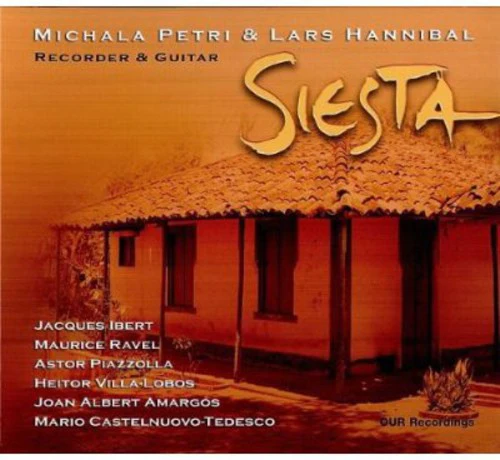
Siesta - Ibert, Ravel, Piazzolla, Etc / Petri, Hannibal
When I read the word “Siesta,” I picture a recumbent Mexican wearing a multicolored serape snoozing under his extravagantly brimmed sombrero. For Lars Hannibal, however, a siesta offers a break from work which doesn’t have to be spent sleeping. Instead, it’s a good time to listen to music. You certainly wouldn’t want to doze through this CD, as even in the familiar pieces the recorder’s woody rusticity shines a new light on the old tunes. Piazzolla’s Histoire du tango—a four-movement suite chronicling the evolution of tango in Argentina—expresses itself with humor, melancholy, and in the last movement, irony. Joan Albert Amargòs’s Tango català has a Spanish title, but I hear Brazil in its mood, melody, and harmony. After the guitar sets the scene, the recorder joins in, substituting for a sultry singer in a work “having the quiet sadness of many a Jazz ballad” (from Leo Black’s notes). Castelnuovo-Tedesco’s Sonatina is the work of a classicist in love with Spain; Ravel’s Pièce en forme de habanera sways to its endlessly seductive rhythm; and Entr’acte, Ibert’s swirling mini-travelogue, recalls the old cliché that some of the best Spanish music is by French composers. Three works by Villa-Lobos close the recital: Modinha (literally, little song), a lyrical, syncopated melody; Distribução de flores, a haunting tune (especially when played by the tenor recorder), with an unmistakable South American Indian sound; and the Cantilena from the well-loved Bachianas brasileiras No. 5. The recorder and guitar probably won’t displace the voice and cellos of the original in listeners’ affections, but the melody is as beautiful as ever, even if the recorder sometimes sounds a bit shrill. Overall, a very enjoyable disc that introduced me to some unfamiliar music while providing a fresh look at some perennials.
FANFARE: Robert Schulslaper
FANFARE: Robert Schulslaper
When I read the word “Siesta,” I picture a recumbent Mexican wearing a multicolored serape snoozing under his extravagantly brimmed sombrero. For Lars Hannibal, however, a siesta offers a break from work which doesn’t have to be spent sleeping. Instead, it’s a good time to listen to music. You certainly wouldn’t want to doze through this CD, as even in the familiar pieces the recorder’s woody rusticity shines a new light on the old tunes. Piazzolla’s Histoire du tango—a four-movement suite chronicling the evolution of tango in Argentina—expresses itself with humor, melancholy, and in the last movement, irony. Joan Albert Amargòs’s Tango català has a Spanish title, but I hear Brazil in its mood, melody, and harmony. After the guitar sets the scene, the recorder joins in, substituting for a sultry singer in a work “having the quiet sadness of many a Jazz ballad” (from Leo Black’s notes). Castelnuovo-Tedesco’s Sonatina is the work of a classicist in love with Spain; Ravel’s Pièce en forme de habanera sways to its endlessly seductive rhythm; and Entr’acte, Ibert’s swirling mini-travelogue, recalls the old cliché that some of the best Spanish music is by French composers. Three works by Villa-Lobos close the recital: Modinha (literally, little song), a lyrical, syncopated melody; Distribução de flores, a haunting tune (especially when played by the tenor recorder), with an unmistakable South American Indian sound; and the Cantilena from the well-loved Bachianas brasileiras No. 5. The recorder and guitar probably won’t displace the voice and cellos of the original in listeners’ affections, but the melody is as beautiful as ever, even if the recorder sometimes sounds a bit shrill. Overall, a very enjoyable disc that introduced me to some unfamiliar music while providing a fresh look at some perennials.
FANFARE: Robert Schulslaper
FANFARE: Robert Schulslaper
$5.25
Original: $14.99
-65%Siesta - Ibert, Ravel, Piazzolla, Etc / Petri, Hannibal—
$14.99
$5.25Description
When I read the word “Siesta,” I picture a recumbent Mexican wearing a multicolored serape snoozing under his extravagantly brimmed sombrero. For Lars Hannibal, however, a siesta offers a break from work which doesn’t have to be spent sleeping. Instead, it’s a good time to listen to music. You certainly wouldn’t want to doze through this CD, as even in the familiar pieces the recorder’s woody rusticity shines a new light on the old tunes. Piazzolla’s Histoire du tango—a four-movement suite chronicling the evolution of tango in Argentina—expresses itself with humor, melancholy, and in the last movement, irony. Joan Albert Amargòs’s Tango català has a Spanish title, but I hear Brazil in its mood, melody, and harmony. After the guitar sets the scene, the recorder joins in, substituting for a sultry singer in a work “having the quiet sadness of many a Jazz ballad” (from Leo Black’s notes). Castelnuovo-Tedesco’s Sonatina is the work of a classicist in love with Spain; Ravel’s Pièce en forme de habanera sways to its endlessly seductive rhythm; and Entr’acte, Ibert’s swirling mini-travelogue, recalls the old cliché that some of the best Spanish music is by French composers. Three works by Villa-Lobos close the recital: Modinha (literally, little song), a lyrical, syncopated melody; Distribução de flores, a haunting tune (especially when played by the tenor recorder), with an unmistakable South American Indian sound; and the Cantilena from the well-loved Bachianas brasileiras No. 5. The recorder and guitar probably won’t displace the voice and cellos of the original in listeners’ affections, but the melody is as beautiful as ever, even if the recorder sometimes sounds a bit shrill. Overall, a very enjoyable disc that introduced me to some unfamiliar music while providing a fresh look at some perennials.
FANFARE: Robert Schulslaper
FANFARE: Robert Schulslaper