🎉 Up to 70% Off Selected ItemsShop Sale

1 / 2
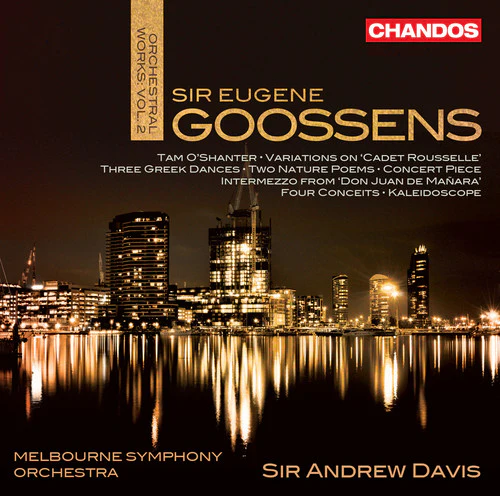
Goossens: Orchestral Works, Vol. 2 / Davis, Melbourne Symphony
GOOSSENS Kaleidoscope. Tam O’Shanter. Three Greek Dances. Concert Piece 1. Four Conceits. Variations on “Cadet Rouselle.” Two Nature Poems. Don Juan de Mañara: Intermezzo • Andrew Davis, cond; Melbourne SO; 1 Jeff Crellin (ob, Eh); 1 Marshall Maguire (hp); 1 Alannah Guthrie-Jones (hp) • CHANDOS 5119 (SACD: 74:16)
Chandos’s Goossens series began promisingly under Richard Hickox with a recording of the First Symphony and Phantasy Concerto for piano and orchestra, but stalled after the conductor’s unexpected death in November 2008. Andrew Davis has since taken over as the company’s house conductor of English music. Having given us fine recordings of Delius, Elgar, and Holst, he now turns his attention to Goossens in this second volume of the series. Unlike the first it concentrates on shorter pieces.
Eugene Goossens (1893-1962) came from a musical family; both his father and grandfather were conductors. He studied composition with Stanford, and as a conductor was mentored by Beecham. (Later he himself was mentor to Richard Bonynge.) Young Eugene played violin in Beecham’s Queens Hall Orchestra during the years of the First World War, and may well have been a part of that orchestra when they premiered Holst’s Planets in 1918. Certainly Goossens’s orchestral finesse recalls Holst’s masterpiece in respect of clarity and sonority. The short tone poem Tam O’Shanter is the earliest orchestral work in this collection: Vigorous and deftly scored, it predates Malcolm Arnold’s better-known overture of the same name by 36 years. The sprightly children’s suite Kaleidoscope (so reminiscent of the work of another composer/conductor, Gabriel Pierné) and the Four Conceits were originally written for piano in 1918 and orchestrated much later. The Three Greek Dances , the Nature Poems , the Variations on the French folk song “Cadet Rousselle,” and the Intermezzo from his opera Don Juan de Mañara all date from the decade 1927-1938 when Goossens was a resident conductor in America, first with the Eastman Orchestra, then from 1931 on as successor to Fritz Reiner in Cincinnati. The composer’s handling of orchestral forces is even more assured here. The effects he achieves in the second of the Nature Poems (entitled “Bacchanal”) are so striking it is hard to imagine this work started life as a piano piece. (In this, he recalls another major influence: Maurice Ravel.) Interestingly, the folk-song variations are one of those collaborative hybrids that turn up every so often in 20th-century music. Orchestrated by Goossens, who composed the finale, the piece also contains variations by Arnold Bax, Frank Bridge, and John Ireland.
The longest work here is the three-movement Concert Piece for oboe, two harps, and orchestra, lasting just under 22 minutes. It dates from 1957, a year after Goossens had returned to London in disgrace following a sex and pornography scandal in Australia. It could be that he wrote this work for his highly respected siblings Leon (oboist), Sidonie and Marie (harpists) in order to help salvage his reputation. The piece is mellow, especially in the Delian slow movement, and is notable for introducing quotations from other composers, such as Debussy and Richard Strauss in the finale. Shades of Berio’s Sinfonia.
Covering approximately 40 years, the program on this disc displays Goossens’s strengths: exquisite craftsmanship—especially in scoring—piquant but not ‘difficult’ harmony, and economy. What he lacks compared to several of his peers is a distinctive melodic profile, but that does not prevent an appreciation of this adroitly realized music. Three of these works have appeared in a three-CD set from ABC Australia, conducted by Vernon Handley with the West Australian Symphony Orchestra ( Tam O’Shanter and the Concert Piece ) and the Melbourne Symphony Orchestra ( Kaleidoscope ). Handley is livelier than Davis. Concert Piece in particular sounds like a stronger work in his hands. However, the magnificent Chandos sound trumps the perfectly acceptable 17-year-old Australian recordings. The Davis disc is in a class of its own in terms of sonics, and his excellent soloists Crellin, Maguire, and Guthrie-Jones in Concert Piece seem better attuned to 20th-century English style. (I can only report on the Chandos disc in regular stereo.) While the first release in this series contained works of greater significance, this follow-up is fully enjoyable in its own right. The Second Symphony should be next up.
FANFARE: Phillip Scott
GOOSSENS Kaleidoscope. Tam O’Shanter. Three Greek Dances. Concert Piece 1. Four Conceits. Variations on “Cadet Rouselle.” Two Nature Poems. Don Juan de Mañara: Intermezzo • Andrew Davis, cond; Melbourne SO; 1 Jeff Crellin (ob, Eh); 1 Marshall Maguire (hp); 1 Alannah Guthrie-Jones (hp) • CHANDOS 5119 (SACD: 74:16)
Chandos’s Goossens series began promisingly under Richard Hickox with a recording of the First Symphony and Phantasy Concerto for piano and orchestra, but stalled after the conductor’s unexpected death in November 2008. Andrew Davis has since taken over as the company’s house conductor of English music. Having given us fine recordings of Delius, Elgar, and Holst, he now turns his attention to Goossens in this second volume of the series. Unlike the first it concentrates on shorter pieces.
Eugene Goossens (1893-1962) came from a musical family; both his father and grandfather were conductors. He studied composition with Stanford, and as a conductor was mentored by Beecham. (Later he himself was mentor to Richard Bonynge.) Young Eugene played violin in Beecham’s Queens Hall Orchestra during the years of the First World War, and may well have been a part of that orchestra when they premiered Holst’s Planets in 1918. Certainly Goossens’s orchestral finesse recalls Holst’s masterpiece in respect of clarity and sonority. The short tone poem Tam O’Shanter is the earliest orchestral work in this collection: Vigorous and deftly scored, it predates Malcolm Arnold’s better-known overture of the same name by 36 years. The sprightly children’s suite Kaleidoscope (so reminiscent of the work of another composer/conductor, Gabriel Pierné) and the Four Conceits were originally written for piano in 1918 and orchestrated much later. The Three Greek Dances , the Nature Poems , the Variations on the French folk song “Cadet Rousselle,” and the Intermezzo from his opera Don Juan de Mañara all date from the decade 1927-1938 when Goossens was a resident conductor in America, first with the Eastman Orchestra, then from 1931 on as successor to Fritz Reiner in Cincinnati. The composer’s handling of orchestral forces is even more assured here. The effects he achieves in the second of the Nature Poems (entitled “Bacchanal”) are so striking it is hard to imagine this work started life as a piano piece. (In this, he recalls another major influence: Maurice Ravel.) Interestingly, the folk-song variations are one of those collaborative hybrids that turn up every so often in 20th-century music. Orchestrated by Goossens, who composed the finale, the piece also contains variations by Arnold Bax, Frank Bridge, and John Ireland.
The longest work here is the three-movement Concert Piece for oboe, two harps, and orchestra, lasting just under 22 minutes. It dates from 1957, a year after Goossens had returned to London in disgrace following a sex and pornography scandal in Australia. It could be that he wrote this work for his highly respected siblings Leon (oboist), Sidonie and Marie (harpists) in order to help salvage his reputation. The piece is mellow, especially in the Delian slow movement, and is notable for introducing quotations from other composers, such as Debussy and Richard Strauss in the finale. Shades of Berio’s Sinfonia.
Covering approximately 40 years, the program on this disc displays Goossens’s strengths: exquisite craftsmanship—especially in scoring—piquant but not ‘difficult’ harmony, and economy. What he lacks compared to several of his peers is a distinctive melodic profile, but that does not prevent an appreciation of this adroitly realized music. Three of these works have appeared in a three-CD set from ABC Australia, conducted by Vernon Handley with the West Australian Symphony Orchestra ( Tam O’Shanter and the Concert Piece ) and the Melbourne Symphony Orchestra ( Kaleidoscope ). Handley is livelier than Davis. Concert Piece in particular sounds like a stronger work in his hands. However, the magnificent Chandos sound trumps the perfectly acceptable 17-year-old Australian recordings. The Davis disc is in a class of its own in terms of sonics, and his excellent soloists Crellin, Maguire, and Guthrie-Jones in Concert Piece seem better attuned to 20th-century English style. (I can only report on the Chandos disc in regular stereo.) While the first release in this series contained works of greater significance, this follow-up is fully enjoyable in its own right. The Second Symphony should be next up.
FANFARE: Phillip Scott
$7.70
Original: $21.99
-65%Goossens: Orchestral Works, Vol. 2 / Davis, Melbourne Symphony—
$21.99
$7.70Description
GOOSSENS Kaleidoscope. Tam O’Shanter. Three Greek Dances. Concert Piece 1. Four Conceits. Variations on “Cadet Rouselle.” Two Nature Poems. Don Juan de Mañara: Intermezzo • Andrew Davis, cond; Melbourne SO; 1 Jeff Crellin (ob, Eh); 1 Marshall Maguire (hp); 1 Alannah Guthrie-Jones (hp) • CHANDOS 5119 (SACD: 74:16)
Chandos’s Goossens series began promisingly under Richard Hickox with a recording of the First Symphony and Phantasy Concerto for piano and orchestra, but stalled after the conductor’s unexpected death in November 2008. Andrew Davis has since taken over as the company’s house conductor of English music. Having given us fine recordings of Delius, Elgar, and Holst, he now turns his attention to Goossens in this second volume of the series. Unlike the first it concentrates on shorter pieces.
Eugene Goossens (1893-1962) came from a musical family; both his father and grandfather were conductors. He studied composition with Stanford, and as a conductor was mentored by Beecham. (Later he himself was mentor to Richard Bonynge.) Young Eugene played violin in Beecham’s Queens Hall Orchestra during the years of the First World War, and may well have been a part of that orchestra when they premiered Holst’s Planets in 1918. Certainly Goossens’s orchestral finesse recalls Holst’s masterpiece in respect of clarity and sonority. The short tone poem Tam O’Shanter is the earliest orchestral work in this collection: Vigorous and deftly scored, it predates Malcolm Arnold’s better-known overture of the same name by 36 years. The sprightly children’s suite Kaleidoscope (so reminiscent of the work of another composer/conductor, Gabriel Pierné) and the Four Conceits were originally written for piano in 1918 and orchestrated much later. The Three Greek Dances , the Nature Poems , the Variations on the French folk song “Cadet Rousselle,” and the Intermezzo from his opera Don Juan de Mañara all date from the decade 1927-1938 when Goossens was a resident conductor in America, first with the Eastman Orchestra, then from 1931 on as successor to Fritz Reiner in Cincinnati. The composer’s handling of orchestral forces is even more assured here. The effects he achieves in the second of the Nature Poems (entitled “Bacchanal”) are so striking it is hard to imagine this work started life as a piano piece. (In this, he recalls another major influence: Maurice Ravel.) Interestingly, the folk-song variations are one of those collaborative hybrids that turn up every so often in 20th-century music. Orchestrated by Goossens, who composed the finale, the piece also contains variations by Arnold Bax, Frank Bridge, and John Ireland.
The longest work here is the three-movement Concert Piece for oboe, two harps, and orchestra, lasting just under 22 minutes. It dates from 1957, a year after Goossens had returned to London in disgrace following a sex and pornography scandal in Australia. It could be that he wrote this work for his highly respected siblings Leon (oboist), Sidonie and Marie (harpists) in order to help salvage his reputation. The piece is mellow, especially in the Delian slow movement, and is notable for introducing quotations from other composers, such as Debussy and Richard Strauss in the finale. Shades of Berio’s Sinfonia.
Covering approximately 40 years, the program on this disc displays Goossens’s strengths: exquisite craftsmanship—especially in scoring—piquant but not ‘difficult’ harmony, and economy. What he lacks compared to several of his peers is a distinctive melodic profile, but that does not prevent an appreciation of this adroitly realized music. Three of these works have appeared in a three-CD set from ABC Australia, conducted by Vernon Handley with the West Australian Symphony Orchestra ( Tam O’Shanter and the Concert Piece ) and the Melbourne Symphony Orchestra ( Kaleidoscope ). Handley is livelier than Davis. Concert Piece in particular sounds like a stronger work in his hands. However, the magnificent Chandos sound trumps the perfectly acceptable 17-year-old Australian recordings. The Davis disc is in a class of its own in terms of sonics, and his excellent soloists Crellin, Maguire, and Guthrie-Jones in Concert Piece seem better attuned to 20th-century English style. (I can only report on the Chandos disc in regular stereo.) While the first release in this series contained works of greater significance, this follow-up is fully enjoyable in its own right. The Second Symphony should be next up.
FANFARE: Phillip Scott