🎉 Up to 70% Off Selected ItemsShop Sale

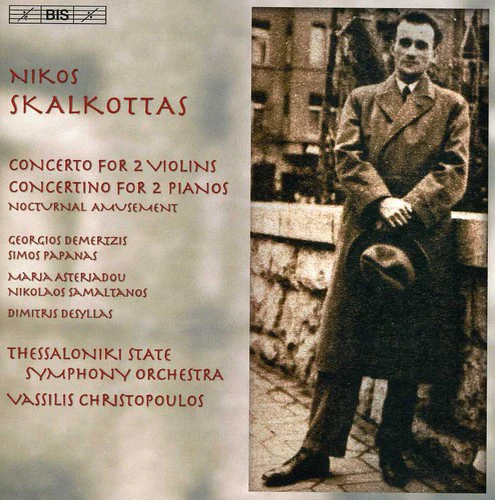
Skalkottas: Concertos For 2 Violins, Pianos / Christopoulos
SKALKOTTAS Concerto for 2 Violins (orch. Demertzis). Concertino for 2 Pianos. Characteristic Piece, “Nocturnal Amusement” 1 • Vassilis Christopoulos, cond; Georgios Demertzis (vn); Simos Papanas (vn); Maria Asteriadou (pn); Nikolaos Samaltanos (pn); Dimitris Desyllas (xyl); 1 Thessaloniki St SO • BIS 1554 (55:02)
BIS has lavished a great deal of attention on Nikos Skalkottas (1904–1949), a former student of Arnold Schoenberg, who, like Alban Berg, took dodecaphony in a somewhat different direction from that of Schoenberg’s or Anton Webern’s. Kostis Demertzis’s booklet notes describe Skalkottas’s efforts to combine the system with popular elements that would entertain its listeners. He did so, for sure, in his Concerto for Two Violins (an unorchestrated version of which appeared on BIS 1244), a piece from 1944 that he never completed (or heard performed) and that he apparently intended to finish after he had completed his Second Symphonic Suite in the last year of his life. The Concerto’s first movement integrates the two bustling violin parts into an orchestral web (not only that of Kostis Demertzis’s orchestration but that of the engineers) more in the manner of Bach’s Double Concerto than in that of, say, Mozart’s Sinfonia concertante for violin and viola. As did Berg’s Violin Concerto, Skalkottas’s slow movement incorporates a borrowed tonal melody, this one, according to the notes, a rebetiko by Vassilis Tsitsanis that Skalkottas had chromatically enhanced. This popular-style melody slinks, if not as suggestively, in the sultry manner of the Blues from Ravel’s Violin Sonata, though the outer, fast, movements have been influenced by, and pay tribute to, a popular idiom of a different kind—folk music. The Concerto is substantial in both length (almost 38 minutes in this performance) and in substance, despite its emphasis on accessibility and entertainment. While the ardent violin lines in the slow movement emerge, as do those in the outer movements, from sonorous, highly colored tuttis, the third movement returns to the whirlwind manner of the first, with the violins emerging now in bands of melody reminiscent of Corelli’s trio-sonata textures, and now in sharply articulated folk-inspired thematic statements. A brilliant cadenza about two-thirds of the way through the finale showcases the two violins’ virtuosity. The soloists play with great energy and élan in the outer movements and an appropriate sultriness in the slow one; Christopoulos and the Orchestra provide highly colorful, enthusiastic orchestral support.
If anything, the Concertino for Two Pianos (from 1935) sounds even lighter and chattier in its first movement, affecting a boulevardier’s breeziness (as did Poulenc’s) but couched in the rigorous procedures of serialism. Demertzis’s notes trace some of the tone-row manipulations, while the lighthearted style will—especially in this engaging performance by Maria Asteriadou and Nikolaos Samaltanos—tempt a willing listener’s ear away from those compositional elements.
The Characteristic Piece (from 1949), almost—almost—firmly tonal, serves as a sort of fireworks display that brings the program to a close in an intoxicating performance with all the carnival appeal of George H. Green’s Fluffy Ruffles . It’s like musical licorice, and it’s hard not to listen again several times.
Charles Warren Fox, the Eastman School’s protomusicologist, used to insist in his classes on the 20th century that dodecaphony didn’t necessarily imply any particular compositional style. Skalkottas’s music, placed beside that of Webern, seems to reinforce the point of view upon which Fox so vehemently (and disdainfully) insisted. In any case, even in an era in which serialism’s sun may be setting, Skalkottas’s music, for its energetic forging of a novel, syncretistic, idiom, should appeal to a new generation of listeners. Recommended.
FANFARE: Robert Maxham
SKALKOTTAS Concerto for 2 Violins (orch. Demertzis). Concertino for 2 Pianos. Characteristic Piece, “Nocturnal Amusement” 1 • Vassilis Christopoulos, cond; Georgios Demertzis (vn); Simos Papanas (vn); Maria Asteriadou (pn); Nikolaos Samaltanos (pn); Dimitris Desyllas (xyl); 1 Thessaloniki St SO • BIS 1554 (55:02)
BIS has lavished a great deal of attention on Nikos Skalkottas (1904–1949), a former student of Arnold Schoenberg, who, like Alban Berg, took dodecaphony in a somewhat different direction from that of Schoenberg’s or Anton Webern’s. Kostis Demertzis’s booklet notes describe Skalkottas’s efforts to combine the system with popular elements that would entertain its listeners. He did so, for sure, in his Concerto for Two Violins (an unorchestrated version of which appeared on BIS 1244), a piece from 1944 that he never completed (or heard performed) and that he apparently intended to finish after he had completed his Second Symphonic Suite in the last year of his life. The Concerto’s first movement integrates the two bustling violin parts into an orchestral web (not only that of Kostis Demertzis’s orchestration but that of the engineers) more in the manner of Bach’s Double Concerto than in that of, say, Mozart’s Sinfonia concertante for violin and viola. As did Berg’s Violin Concerto, Skalkottas’s slow movement incorporates a borrowed tonal melody, this one, according to the notes, a rebetiko by Vassilis Tsitsanis that Skalkottas had chromatically enhanced. This popular-style melody slinks, if not as suggestively, in the sultry manner of the Blues from Ravel’s Violin Sonata, though the outer, fast, movements have been influenced by, and pay tribute to, a popular idiom of a different kind—folk music. The Concerto is substantial in both length (almost 38 minutes in this performance) and in substance, despite its emphasis on accessibility and entertainment. While the ardent violin lines in the slow movement emerge, as do those in the outer movements, from sonorous, highly colored tuttis, the third movement returns to the whirlwind manner of the first, with the violins emerging now in bands of melody reminiscent of Corelli’s trio-sonata textures, and now in sharply articulated folk-inspired thematic statements. A brilliant cadenza about two-thirds of the way through the finale showcases the two violins’ virtuosity. The soloists play with great energy and élan in the outer movements and an appropriate sultriness in the slow one; Christopoulos and the Orchestra provide highly colorful, enthusiastic orchestral support.
If anything, the Concertino for Two Pianos (from 1935) sounds even lighter and chattier in its first movement, affecting a boulevardier’s breeziness (as did Poulenc’s) but couched in the rigorous procedures of serialism. Demertzis’s notes trace some of the tone-row manipulations, while the lighthearted style will—especially in this engaging performance by Maria Asteriadou and Nikolaos Samaltanos—tempt a willing listener’s ear away from those compositional elements.
The Characteristic Piece (from 1949), almost—almost—firmly tonal, serves as a sort of fireworks display that brings the program to a close in an intoxicating performance with all the carnival appeal of George H. Green’s Fluffy Ruffles . It’s like musical licorice, and it’s hard not to listen again several times.
Charles Warren Fox, the Eastman School’s protomusicologist, used to insist in his classes on the 20th century that dodecaphony didn’t necessarily imply any particular compositional style. Skalkottas’s music, placed beside that of Webern, seems to reinforce the point of view upon which Fox so vehemently (and disdainfully) insisted. In any case, even in an era in which serialism’s sun may be setting, Skalkottas’s music, for its energetic forging of a novel, syncretistic, idiom, should appeal to a new generation of listeners. Recommended.
FANFARE: Robert Maxham
$15.99
Skalkottas: Concertos For 2 Violins, Pianos / Christopoulos—
$15.99
Description
SKALKOTTAS Concerto for 2 Violins (orch. Demertzis). Concertino for 2 Pianos. Characteristic Piece, “Nocturnal Amusement” 1 • Vassilis Christopoulos, cond; Georgios Demertzis (vn); Simos Papanas (vn); Maria Asteriadou (pn); Nikolaos Samaltanos (pn); Dimitris Desyllas (xyl); 1 Thessaloniki St SO • BIS 1554 (55:02)
BIS has lavished a great deal of attention on Nikos Skalkottas (1904–1949), a former student of Arnold Schoenberg, who, like Alban Berg, took dodecaphony in a somewhat different direction from that of Schoenberg’s or Anton Webern’s. Kostis Demertzis’s booklet notes describe Skalkottas’s efforts to combine the system with popular elements that would entertain its listeners. He did so, for sure, in his Concerto for Two Violins (an unorchestrated version of which appeared on BIS 1244), a piece from 1944 that he never completed (or heard performed) and that he apparently intended to finish after he had completed his Second Symphonic Suite in the last year of his life. The Concerto’s first movement integrates the two bustling violin parts into an orchestral web (not only that of Kostis Demertzis’s orchestration but that of the engineers) more in the manner of Bach’s Double Concerto than in that of, say, Mozart’s Sinfonia concertante for violin and viola. As did Berg’s Violin Concerto, Skalkottas’s slow movement incorporates a borrowed tonal melody, this one, according to the notes, a rebetiko by Vassilis Tsitsanis that Skalkottas had chromatically enhanced. This popular-style melody slinks, if not as suggestively, in the sultry manner of the Blues from Ravel’s Violin Sonata, though the outer, fast, movements have been influenced by, and pay tribute to, a popular idiom of a different kind—folk music. The Concerto is substantial in both length (almost 38 minutes in this performance) and in substance, despite its emphasis on accessibility and entertainment. While the ardent violin lines in the slow movement emerge, as do those in the outer movements, from sonorous, highly colored tuttis, the third movement returns to the whirlwind manner of the first, with the violins emerging now in bands of melody reminiscent of Corelli’s trio-sonata textures, and now in sharply articulated folk-inspired thematic statements. A brilliant cadenza about two-thirds of the way through the finale showcases the two violins’ virtuosity. The soloists play with great energy and élan in the outer movements and an appropriate sultriness in the slow one; Christopoulos and the Orchestra provide highly colorful, enthusiastic orchestral support.
If anything, the Concertino for Two Pianos (from 1935) sounds even lighter and chattier in its first movement, affecting a boulevardier’s breeziness (as did Poulenc’s) but couched in the rigorous procedures of serialism. Demertzis’s notes trace some of the tone-row manipulations, while the lighthearted style will—especially in this engaging performance by Maria Asteriadou and Nikolaos Samaltanos—tempt a willing listener’s ear away from those compositional elements.
The Characteristic Piece (from 1949), almost—almost—firmly tonal, serves as a sort of fireworks display that brings the program to a close in an intoxicating performance with all the carnival appeal of George H. Green’s Fluffy Ruffles . It’s like musical licorice, and it’s hard not to listen again several times.
Charles Warren Fox, the Eastman School’s protomusicologist, used to insist in his classes on the 20th century that dodecaphony didn’t necessarily imply any particular compositional style. Skalkottas’s music, placed beside that of Webern, seems to reinforce the point of view upon which Fox so vehemently (and disdainfully) insisted. In any case, even in an era in which serialism’s sun may be setting, Skalkottas’s music, for its energetic forging of a novel, syncretistic, idiom, should appeal to a new generation of listeners. Recommended.
FANFARE: Robert Maxham