🎉 Up to 70% Off Selected ItemsShop Sale

1 / 2
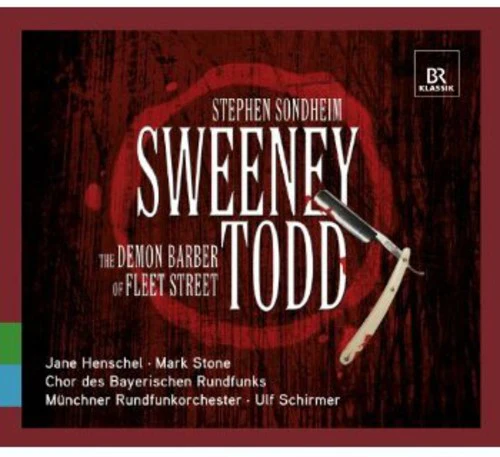
Sondheim: Sweeney Todd / Henschel, Stone, Schirmer
SONDHEIM Sweeney Todd • Ulf Schirmer, cond; Mark Stone ( Sweeney Todd ); Jane Henschel ( Mrs. Lovett ); Gregg Baker ( Anthony Hope ); Rebecca Bottone ( Johanna ); Jonathan Best ( Judge Turpin ); Adrian Dwyer ( Beadle Bamford ); Diana DiMarzio ( Beggar Woman ); Ronald Samm ( Pirelli ); Pascal Charbonneau ( Tobias ); Bavarian R Ch; Munich R O • BR 900316 (2 CDs: 123:59) Live: Munich 5/6/2012
Composer-librettist Stephen Sondheim maintains that Sweeney Todd is not an opera, and so does the annotator for the present release. Nevertheless, Sweeney Todd: The Demon Barber of Fleet Street (its full title), since it premiered on Broadway in 1979, has been revived by several opera companies, including the New York City Opera, the Houston Grand Opera, and the Chicago Lyric Opera. Why? Musically, it is highly sophisticated, and operatic voices are not wasted on it. Furthermore, with its larger-than-life dramatic themes, including mistaken identity, lust, vengeance, obsession, madness, and murder, how more operatic could a theatrical work be?
There have been several recordings of this work, including the unforgettable original cast recording on RCA with Len Cariou in the title role, and Angela Lansbury in the role of Mrs. Lovett, his cheerfully amoral partner in crime. That version will never be eclipsed, but each new recording adds a welcome new perspective. The one reviewed here, recorded in the Munich’s Prinzregententheater, is the most operatic yet, even more than the one with the New York Philharmonic which features singers such as Heidi Grant Murphy (Johanna), John Aler (Beadle Bamford), and Paul Plishka (Judge Turpin). This time around, we have legitimate operatic singers in all of the main roles; only DiMarzio appears not to be a “classical” musician per se. In other words, here we have an ensemble of acting singers, as opposed to singing actors such as Cariou, Lansbury, George Hearn, Patti LuPone, and Michael Cerveris, who all have made major contributions to this opera’s . . . I mean, musical’s performance history.
It turns out fairly well. I was immediately pulled in by Ulf Schirmer’s conducting, which is tense, taut, and stylish. In fact, you might not hear a better conducted Sweeney Todd anywhere. The Bavarian Radio Choir also adds much to the success of this performance. Although their diction is less clear than that of English-speaking ensembles who have recorded this music, their dramatic involvement is high, as is their musicianship.
This is an actual performance. Apparently the time, funds, or energy to correct the inevitable live lapses was unavailable, and thus we have oddities such as Henschel at one point rechristening Beadle Bamford as “Beadle Rumford.” A few memory lapses are covered professionally, but will leave those who know the show well asking, “What did (s)he just sing?” These issues are minor, though.
I’m more concerned about two other points. One is the lack of (black, very black) humor in this production. For example, I can’t understand why, in “A Little Priest,” the wonderfully uncomfortable pun about a meat pie made from a general (“With or without his privates?”) has been removed. This is a grim show, still there is much about it that can be very funny, and allowing it to be so makes the gore and horror even more effective. As the original Mrs. Lovett, Angela Lansbury was charming and endearing; she might bake you into a meat pie, but you couldn’t stay angry with her for long! Henschel can’t inspire that kind of affection, and she makes it clear that her murderous instincts were present even before opportunity allowed them to come out. The other thing that concerns me is the way in which some of the big dramatic moments are almost thrown away. Todd’s aborted murder of Judge Turpin (interrupted by Anthony’s untimely arrival) should be a big moment, but it isn’t. Similarly, soon after, in Todd’s “Epiphany,” we should feel his mind crack and his murderous rage insanely swell to encompass all of mankind, not just the Judge, but Mark Stone is not that fine an actor, the direction is too hurried, and one of the show’s most Brechtian moments doesn’t come off. The last segment of the show, with its string of murders and its Grand Guignol effects, moves forward jerkily, sometimes grinding to a halt, and sometimes not pausing long enough to make its points. On Broadway, Harold Prince would have fixed these miscalculations, but, at least as I am hearing them on CD, they were not addressed in Munich’s Prinzregententheater.
All of the singing itself is very fine. One curiosity is a baritone Anthony; Gregg Baker’s voice is darker than Mark Stone’s. Anthony is supposed to be an inexperienced sailor, newly arrived in London, and the early scenes between him and Todd feel strange, because the voice relationships have been inverted from the original production. I really missed hearing a tenor’s voice soar into “Johanna,” one of Sondheim’s most rapturous love songs. Also, the multinational cast presents a variety of accents. In 1979, Cariou had almost no accent at all, while Lansbury made the most of hers. Here, we have the reverse: a cockney Todd in Baker, and a Mrs. Lovett of no particular nationality or region in Henschel. Someday, there will be a production of this work in which everyone gets on the same page with dialects.
So, if you want an operatic Sweeney Todd , or a fresh look at it, this new recording will satisfy. It has many enjoyable moments, but a few unfortunate ones as well. If you do not know this show at all, however, the Broadway cast recording—still in print, thank goodness!—is the only place to begin. This show is one of the masterpieces of American musical theater, and absolutely needs to be heard.
FANFARE: Raymond Tuttle
SONDHEIM Sweeney Todd • Ulf Schirmer, cond; Mark Stone ( Sweeney Todd ); Jane Henschel ( Mrs. Lovett ); Gregg Baker ( Anthony Hope ); Rebecca Bottone ( Johanna ); Jonathan Best ( Judge Turpin ); Adrian Dwyer ( Beadle Bamford ); Diana DiMarzio ( Beggar Woman ); Ronald Samm ( Pirelli ); Pascal Charbonneau ( Tobias ); Bavarian R Ch; Munich R O • BR 900316 (2 CDs: 123:59) Live: Munich 5/6/2012
Composer-librettist Stephen Sondheim maintains that Sweeney Todd is not an opera, and so does the annotator for the present release. Nevertheless, Sweeney Todd: The Demon Barber of Fleet Street (its full title), since it premiered on Broadway in 1979, has been revived by several opera companies, including the New York City Opera, the Houston Grand Opera, and the Chicago Lyric Opera. Why? Musically, it is highly sophisticated, and operatic voices are not wasted on it. Furthermore, with its larger-than-life dramatic themes, including mistaken identity, lust, vengeance, obsession, madness, and murder, how more operatic could a theatrical work be?
There have been several recordings of this work, including the unforgettable original cast recording on RCA with Len Cariou in the title role, and Angela Lansbury in the role of Mrs. Lovett, his cheerfully amoral partner in crime. That version will never be eclipsed, but each new recording adds a welcome new perspective. The one reviewed here, recorded in the Munich’s Prinzregententheater, is the most operatic yet, even more than the one with the New York Philharmonic which features singers such as Heidi Grant Murphy (Johanna), John Aler (Beadle Bamford), and Paul Plishka (Judge Turpin). This time around, we have legitimate operatic singers in all of the main roles; only DiMarzio appears not to be a “classical” musician per se. In other words, here we have an ensemble of acting singers, as opposed to singing actors such as Cariou, Lansbury, George Hearn, Patti LuPone, and Michael Cerveris, who all have made major contributions to this opera’s . . . I mean, musical’s performance history.
It turns out fairly well. I was immediately pulled in by Ulf Schirmer’s conducting, which is tense, taut, and stylish. In fact, you might not hear a better conducted Sweeney Todd anywhere. The Bavarian Radio Choir also adds much to the success of this performance. Although their diction is less clear than that of English-speaking ensembles who have recorded this music, their dramatic involvement is high, as is their musicianship.
This is an actual performance. Apparently the time, funds, or energy to correct the inevitable live lapses was unavailable, and thus we have oddities such as Henschel at one point rechristening Beadle Bamford as “Beadle Rumford.” A few memory lapses are covered professionally, but will leave those who know the show well asking, “What did (s)he just sing?” These issues are minor, though.
I’m more concerned about two other points. One is the lack of (black, very black) humor in this production. For example, I can’t understand why, in “A Little Priest,” the wonderfully uncomfortable pun about a meat pie made from a general (“With or without his privates?”) has been removed. This is a grim show, still there is much about it that can be very funny, and allowing it to be so makes the gore and horror even more effective. As the original Mrs. Lovett, Angela Lansbury was charming and endearing; she might bake you into a meat pie, but you couldn’t stay angry with her for long! Henschel can’t inspire that kind of affection, and she makes it clear that her murderous instincts were present even before opportunity allowed them to come out. The other thing that concerns me is the way in which some of the big dramatic moments are almost thrown away. Todd’s aborted murder of Judge Turpin (interrupted by Anthony’s untimely arrival) should be a big moment, but it isn’t. Similarly, soon after, in Todd’s “Epiphany,” we should feel his mind crack and his murderous rage insanely swell to encompass all of mankind, not just the Judge, but Mark Stone is not that fine an actor, the direction is too hurried, and one of the show’s most Brechtian moments doesn’t come off. The last segment of the show, with its string of murders and its Grand Guignol effects, moves forward jerkily, sometimes grinding to a halt, and sometimes not pausing long enough to make its points. On Broadway, Harold Prince would have fixed these miscalculations, but, at least as I am hearing them on CD, they were not addressed in Munich’s Prinzregententheater.
All of the singing itself is very fine. One curiosity is a baritone Anthony; Gregg Baker’s voice is darker than Mark Stone’s. Anthony is supposed to be an inexperienced sailor, newly arrived in London, and the early scenes between him and Todd feel strange, because the voice relationships have been inverted from the original production. I really missed hearing a tenor’s voice soar into “Johanna,” one of Sondheim’s most rapturous love songs. Also, the multinational cast presents a variety of accents. In 1979, Cariou had almost no accent at all, while Lansbury made the most of hers. Here, we have the reverse: a cockney Todd in Baker, and a Mrs. Lovett of no particular nationality or region in Henschel. Someday, there will be a production of this work in which everyone gets on the same page with dialects.
So, if you want an operatic Sweeney Todd , or a fresh look at it, this new recording will satisfy. It has many enjoyable moments, but a few unfortunate ones as well. If you do not know this show at all, however, the Broadway cast recording—still in print, thank goodness!—is the only place to begin. This show is one of the masterpieces of American musical theater, and absolutely needs to be heard.
FANFARE: Raymond Tuttle
$10.50
Original: $29.99
-65%Sondheim: Sweeney Todd / Henschel, Stone, Schirmer—
$29.99
$10.50Description
SONDHEIM Sweeney Todd • Ulf Schirmer, cond; Mark Stone ( Sweeney Todd ); Jane Henschel ( Mrs. Lovett ); Gregg Baker ( Anthony Hope ); Rebecca Bottone ( Johanna ); Jonathan Best ( Judge Turpin ); Adrian Dwyer ( Beadle Bamford ); Diana DiMarzio ( Beggar Woman ); Ronald Samm ( Pirelli ); Pascal Charbonneau ( Tobias ); Bavarian R Ch; Munich R O • BR 900316 (2 CDs: 123:59) Live: Munich 5/6/2012
Composer-librettist Stephen Sondheim maintains that Sweeney Todd is not an opera, and so does the annotator for the present release. Nevertheless, Sweeney Todd: The Demon Barber of Fleet Street (its full title), since it premiered on Broadway in 1979, has been revived by several opera companies, including the New York City Opera, the Houston Grand Opera, and the Chicago Lyric Opera. Why? Musically, it is highly sophisticated, and operatic voices are not wasted on it. Furthermore, with its larger-than-life dramatic themes, including mistaken identity, lust, vengeance, obsession, madness, and murder, how more operatic could a theatrical work be?
There have been several recordings of this work, including the unforgettable original cast recording on RCA with Len Cariou in the title role, and Angela Lansbury in the role of Mrs. Lovett, his cheerfully amoral partner in crime. That version will never be eclipsed, but each new recording adds a welcome new perspective. The one reviewed here, recorded in the Munich’s Prinzregententheater, is the most operatic yet, even more than the one with the New York Philharmonic which features singers such as Heidi Grant Murphy (Johanna), John Aler (Beadle Bamford), and Paul Plishka (Judge Turpin). This time around, we have legitimate operatic singers in all of the main roles; only DiMarzio appears not to be a “classical” musician per se. In other words, here we have an ensemble of acting singers, as opposed to singing actors such as Cariou, Lansbury, George Hearn, Patti LuPone, and Michael Cerveris, who all have made major contributions to this opera’s . . . I mean, musical’s performance history.
It turns out fairly well. I was immediately pulled in by Ulf Schirmer’s conducting, which is tense, taut, and stylish. In fact, you might not hear a better conducted Sweeney Todd anywhere. The Bavarian Radio Choir also adds much to the success of this performance. Although their diction is less clear than that of English-speaking ensembles who have recorded this music, their dramatic involvement is high, as is their musicianship.
This is an actual performance. Apparently the time, funds, or energy to correct the inevitable live lapses was unavailable, and thus we have oddities such as Henschel at one point rechristening Beadle Bamford as “Beadle Rumford.” A few memory lapses are covered professionally, but will leave those who know the show well asking, “What did (s)he just sing?” These issues are minor, though.
I’m more concerned about two other points. One is the lack of (black, very black) humor in this production. For example, I can’t understand why, in “A Little Priest,” the wonderfully uncomfortable pun about a meat pie made from a general (“With or without his privates?”) has been removed. This is a grim show, still there is much about it that can be very funny, and allowing it to be so makes the gore and horror even more effective. As the original Mrs. Lovett, Angela Lansbury was charming and endearing; she might bake you into a meat pie, but you couldn’t stay angry with her for long! Henschel can’t inspire that kind of affection, and she makes it clear that her murderous instincts were present even before opportunity allowed them to come out. The other thing that concerns me is the way in which some of the big dramatic moments are almost thrown away. Todd’s aborted murder of Judge Turpin (interrupted by Anthony’s untimely arrival) should be a big moment, but it isn’t. Similarly, soon after, in Todd’s “Epiphany,” we should feel his mind crack and his murderous rage insanely swell to encompass all of mankind, not just the Judge, but Mark Stone is not that fine an actor, the direction is too hurried, and one of the show’s most Brechtian moments doesn’t come off. The last segment of the show, with its string of murders and its Grand Guignol effects, moves forward jerkily, sometimes grinding to a halt, and sometimes not pausing long enough to make its points. On Broadway, Harold Prince would have fixed these miscalculations, but, at least as I am hearing them on CD, they were not addressed in Munich’s Prinzregententheater.
All of the singing itself is very fine. One curiosity is a baritone Anthony; Gregg Baker’s voice is darker than Mark Stone’s. Anthony is supposed to be an inexperienced sailor, newly arrived in London, and the early scenes between him and Todd feel strange, because the voice relationships have been inverted from the original production. I really missed hearing a tenor’s voice soar into “Johanna,” one of Sondheim’s most rapturous love songs. Also, the multinational cast presents a variety of accents. In 1979, Cariou had almost no accent at all, while Lansbury made the most of hers. Here, we have the reverse: a cockney Todd in Baker, and a Mrs. Lovett of no particular nationality or region in Henschel. Someday, there will be a production of this work in which everyone gets on the same page with dialects.
So, if you want an operatic Sweeney Todd , or a fresh look at it, this new recording will satisfy. It has many enjoyable moments, but a few unfortunate ones as well. If you do not know this show at all, however, the Broadway cast recording—still in print, thank goodness!—is the only place to begin. This show is one of the masterpieces of American musical theater, and absolutely needs to be heard.
FANFARE: Raymond Tuttle