🎉 Up to 70% Off Selected ItemsShop Sale

1 / 2
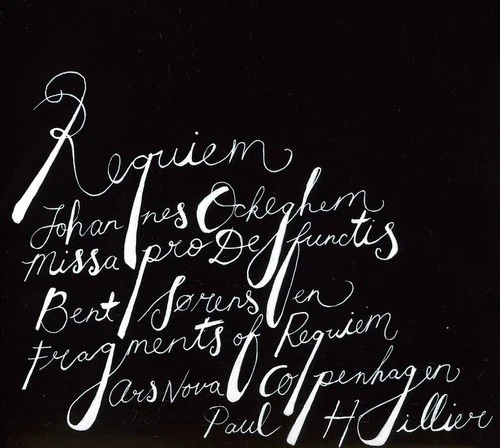
Sorensen, Ockeghem: Requiem / Hillier, Ars Nova Copenhagen
The 500 years that separate Renaissance master Johannes Ockeghem (c. 1410-97) and Danish composer Bent Sørensen (b. 1958) seem to disappear in this extraordinary Requiem which is a totality integrated both dramatically and musically; a work that unites the stylistic contrasts in a mode of expression that seems at once timeless and entirely present. The project has been initiated by conductor Paul Hillier and interpreted by his GRAMMY-winning ensemble Ars Nova Copenhagen.
R E V I E W:
Shoots straight into the soul and lingers long in the mind.
This is a fascinating and highly successful project. Without going into the kind of detail which the booklet notes give us, this is Johannes Ockeghem´s Missa pro defunctis, integrated with newly composed movements by Bengt Sørensen to create what is, if not an entirely new piece, certainly a very new and fresh way of connecting the new in the old, with the old in the new. This is an extension of Paul Hillier’s more frequent combining of contemporary with early music in his programming, and here he has brought in Bengt Sørensen to complete ‘the bits which are missing’ in Ockeghem’s work.
Ockeghem’s Missa is full of moments which can wrong-foot you into thinking that you are hearing something contemporary. Harmonic shifts and quasi-romantic melodic lines abound, and just listen to some of those startling female-only passages in the Kyrie. The Graduale flows from Sørensen’s Lacrimosa as if from the same fearlessly expressive source, and there are moments in the Offertorium which are truly overwhelming.
Sørensen’s contributions are idiomatically sensitive and integrate by way of atmosphere, but are by no means a soft-pedalled imitation of ancient style. The opening Responsorium has plenty of reassuring parallel intervals and open harmonies, but immediately alerts the ear to what is to come, with close harmonies and strange dissonances which have inner resolution, but no ultimate cadence. The central Recordare Jesu pie in the Sequentia is one of those impossibly melting creations which make your hairs stand up with some kind of prehensile spiritual angst. Separated by plainchant, the first two minutes of the following Lacrimosa is truly beautiful: a moment of suspended time where the tears fall, but never reach the ground. There are moments of restrained drama here and in the Benedictus, where vibrato is used as a textural effect, making the air itself ring like a Tibetan bowl. The entire Requiem cycle closes with Sørensen’s In Paradisum, is the most extensive and in some ways the most far reaching, as the booklet notes describe, “with cluster-like chordal effects that are thinned out, recondensed and break like waves against each other.”
All of the texts are printed in the booklet in Latin, English and Danish, revealing a contribution from Dylan Thomas in the Responsorium: Memento mei Deus: “Hourly I sigh,/for all things are leaf-like/and cloud-like. Flowerly I die/for all things are grief-like/and shroud-like.” There is a diagram at the back of the booklet which shows the position of singers and microphones, with a more conventional choir setting for the Ockeghem, and singers all around the venue for Sørensen’s work. In stereo this effect is not so very noticeable, though there are enough added dimensions and everything remains perfectly balanced. With a surround set-up the effect is quite magical. I searched high and low for the name of the church where this was recorded, but even un-named this is a perfect acoustic for such unaccompanied vocal scoring. This is one of those recordings for which you close your eyes and give yourself entirely over to a very rich musical experience indeed. Paul Hillier’s Ars Nova Copenhagen is a remarkable collection of vocalists for which this work is tailor-made, and the music is brought to life in a way which shoots straight into the soul and lingers long in the mind.
-- Dominy Clements, MusicWeb International
R E V I E W:
Shoots straight into the soul and lingers long in the mind.
This is a fascinating and highly successful project. Without going into the kind of detail which the booklet notes give us, this is Johannes Ockeghem´s Missa pro defunctis, integrated with newly composed movements by Bengt Sørensen to create what is, if not an entirely new piece, certainly a very new and fresh way of connecting the new in the old, with the old in the new. This is an extension of Paul Hillier’s more frequent combining of contemporary with early music in his programming, and here he has brought in Bengt Sørensen to complete ‘the bits which are missing’ in Ockeghem’s work.
Ockeghem’s Missa is full of moments which can wrong-foot you into thinking that you are hearing something contemporary. Harmonic shifts and quasi-romantic melodic lines abound, and just listen to some of those startling female-only passages in the Kyrie. The Graduale flows from Sørensen’s Lacrimosa as if from the same fearlessly expressive source, and there are moments in the Offertorium which are truly overwhelming.
Sørensen’s contributions are idiomatically sensitive and integrate by way of atmosphere, but are by no means a soft-pedalled imitation of ancient style. The opening Responsorium has plenty of reassuring parallel intervals and open harmonies, but immediately alerts the ear to what is to come, with close harmonies and strange dissonances which have inner resolution, but no ultimate cadence. The central Recordare Jesu pie in the Sequentia is one of those impossibly melting creations which make your hairs stand up with some kind of prehensile spiritual angst. Separated by plainchant, the first two minutes of the following Lacrimosa is truly beautiful: a moment of suspended time where the tears fall, but never reach the ground. There are moments of restrained drama here and in the Benedictus, where vibrato is used as a textural effect, making the air itself ring like a Tibetan bowl. The entire Requiem cycle closes with Sørensen’s In Paradisum, is the most extensive and in some ways the most far reaching, as the booklet notes describe, “with cluster-like chordal effects that are thinned out, recondensed and break like waves against each other.”
All of the texts are printed in the booklet in Latin, English and Danish, revealing a contribution from Dylan Thomas in the Responsorium: Memento mei Deus: “Hourly I sigh,/for all things are leaf-like/and cloud-like. Flowerly I die/for all things are grief-like/and shroud-like.” There is a diagram at the back of the booklet which shows the position of singers and microphones, with a more conventional choir setting for the Ockeghem, and singers all around the venue for Sørensen’s work. In stereo this effect is not so very noticeable, though there are enough added dimensions and everything remains perfectly balanced. With a surround set-up the effect is quite magical. I searched high and low for the name of the church where this was recorded, but even un-named this is a perfect acoustic for such unaccompanied vocal scoring. This is one of those recordings for which you close your eyes and give yourself entirely over to a very rich musical experience indeed. Paul Hillier’s Ars Nova Copenhagen is a remarkable collection of vocalists for which this work is tailor-made, and the music is brought to life in a way which shoots straight into the soul and lingers long in the mind.
-- Dominy Clements, MusicWeb International
The 500 years that separate Renaissance master Johannes Ockeghem (c. 1410-97) and Danish composer Bent Sørensen (b. 1958) seem to disappear in this extraordinary Requiem which is a totality integrated both dramatically and musically; a work that unites the stylistic contrasts in a mode of expression that seems at once timeless and entirely present. The project has been initiated by conductor Paul Hillier and interpreted by his GRAMMY-winning ensemble Ars Nova Copenhagen.
R E V I E W:
Shoots straight into the soul and lingers long in the mind.
This is a fascinating and highly successful project. Without going into the kind of detail which the booklet notes give us, this is Johannes Ockeghem´s Missa pro defunctis, integrated with newly composed movements by Bengt Sørensen to create what is, if not an entirely new piece, certainly a very new and fresh way of connecting the new in the old, with the old in the new. This is an extension of Paul Hillier’s more frequent combining of contemporary with early music in his programming, and here he has brought in Bengt Sørensen to complete ‘the bits which are missing’ in Ockeghem’s work.
Ockeghem’s Missa is full of moments which can wrong-foot you into thinking that you are hearing something contemporary. Harmonic shifts and quasi-romantic melodic lines abound, and just listen to some of those startling female-only passages in the Kyrie. The Graduale flows from Sørensen’s Lacrimosa as if from the same fearlessly expressive source, and there are moments in the Offertorium which are truly overwhelming.
Sørensen’s contributions are idiomatically sensitive and integrate by way of atmosphere, but are by no means a soft-pedalled imitation of ancient style. The opening Responsorium has plenty of reassuring parallel intervals and open harmonies, but immediately alerts the ear to what is to come, with close harmonies and strange dissonances which have inner resolution, but no ultimate cadence. The central Recordare Jesu pie in the Sequentia is one of those impossibly melting creations which make your hairs stand up with some kind of prehensile spiritual angst. Separated by plainchant, the first two minutes of the following Lacrimosa is truly beautiful: a moment of suspended time where the tears fall, but never reach the ground. There are moments of restrained drama here and in the Benedictus, where vibrato is used as a textural effect, making the air itself ring like a Tibetan bowl. The entire Requiem cycle closes with Sørensen’s In Paradisum, is the most extensive and in some ways the most far reaching, as the booklet notes describe, “with cluster-like chordal effects that are thinned out, recondensed and break like waves against each other.”
All of the texts are printed in the booklet in Latin, English and Danish, revealing a contribution from Dylan Thomas in the Responsorium: Memento mei Deus: “Hourly I sigh,/for all things are leaf-like/and cloud-like. Flowerly I die/for all things are grief-like/and shroud-like.” There is a diagram at the back of the booklet which shows the position of singers and microphones, with a more conventional choir setting for the Ockeghem, and singers all around the venue for Sørensen’s work. In stereo this effect is not so very noticeable, though there are enough added dimensions and everything remains perfectly balanced. With a surround set-up the effect is quite magical. I searched high and low for the name of the church where this was recorded, but even un-named this is a perfect acoustic for such unaccompanied vocal scoring. This is one of those recordings for which you close your eyes and give yourself entirely over to a very rich musical experience indeed. Paul Hillier’s Ars Nova Copenhagen is a remarkable collection of vocalists for which this work is tailor-made, and the music is brought to life in a way which shoots straight into the soul and lingers long in the mind.
-- Dominy Clements, MusicWeb International
R E V I E W:
Shoots straight into the soul and lingers long in the mind.
This is a fascinating and highly successful project. Without going into the kind of detail which the booklet notes give us, this is Johannes Ockeghem´s Missa pro defunctis, integrated with newly composed movements by Bengt Sørensen to create what is, if not an entirely new piece, certainly a very new and fresh way of connecting the new in the old, with the old in the new. This is an extension of Paul Hillier’s more frequent combining of contemporary with early music in his programming, and here he has brought in Bengt Sørensen to complete ‘the bits which are missing’ in Ockeghem’s work.
Ockeghem’s Missa is full of moments which can wrong-foot you into thinking that you are hearing something contemporary. Harmonic shifts and quasi-romantic melodic lines abound, and just listen to some of those startling female-only passages in the Kyrie. The Graduale flows from Sørensen’s Lacrimosa as if from the same fearlessly expressive source, and there are moments in the Offertorium which are truly overwhelming.
Sørensen’s contributions are idiomatically sensitive and integrate by way of atmosphere, but are by no means a soft-pedalled imitation of ancient style. The opening Responsorium has plenty of reassuring parallel intervals and open harmonies, but immediately alerts the ear to what is to come, with close harmonies and strange dissonances which have inner resolution, but no ultimate cadence. The central Recordare Jesu pie in the Sequentia is one of those impossibly melting creations which make your hairs stand up with some kind of prehensile spiritual angst. Separated by plainchant, the first two minutes of the following Lacrimosa is truly beautiful: a moment of suspended time where the tears fall, but never reach the ground. There are moments of restrained drama here and in the Benedictus, where vibrato is used as a textural effect, making the air itself ring like a Tibetan bowl. The entire Requiem cycle closes with Sørensen’s In Paradisum, is the most extensive and in some ways the most far reaching, as the booklet notes describe, “with cluster-like chordal effects that are thinned out, recondensed and break like waves against each other.”
All of the texts are printed in the booklet in Latin, English and Danish, revealing a contribution from Dylan Thomas in the Responsorium: Memento mei Deus: “Hourly I sigh,/for all things are leaf-like/and cloud-like. Flowerly I die/for all things are grief-like/and shroud-like.” There is a diagram at the back of the booklet which shows the position of singers and microphones, with a more conventional choir setting for the Ockeghem, and singers all around the venue for Sørensen’s work. In stereo this effect is not so very noticeable, though there are enough added dimensions and everything remains perfectly balanced. With a surround set-up the effect is quite magical. I searched high and low for the name of the church where this was recorded, but even un-named this is a perfect acoustic for such unaccompanied vocal scoring. This is one of those recordings for which you close your eyes and give yourself entirely over to a very rich musical experience indeed. Paul Hillier’s Ars Nova Copenhagen is a remarkable collection of vocalists for which this work is tailor-made, and the music is brought to life in a way which shoots straight into the soul and lingers long in the mind.
-- Dominy Clements, MusicWeb International
$4.90
Original: $13.99
-65%Sorensen, Ockeghem: Requiem / Hillier, Ars Nova Copenhagen—
$13.99
$4.90Description
The 500 years that separate Renaissance master Johannes Ockeghem (c. 1410-97) and Danish composer Bent Sørensen (b. 1958) seem to disappear in this extraordinary Requiem which is a totality integrated both dramatically and musically; a work that unites the stylistic contrasts in a mode of expression that seems at once timeless and entirely present. The project has been initiated by conductor Paul Hillier and interpreted by his GRAMMY-winning ensemble Ars Nova Copenhagen.
R E V I E W:
Shoots straight into the soul and lingers long in the mind.
This is a fascinating and highly successful project. Without going into the kind of detail which the booklet notes give us, this is Johannes Ockeghem´s Missa pro defunctis, integrated with newly composed movements by Bengt Sørensen to create what is, if not an entirely new piece, certainly a very new and fresh way of connecting the new in the old, with the old in the new. This is an extension of Paul Hillier’s more frequent combining of contemporary with early music in his programming, and here he has brought in Bengt Sørensen to complete ‘the bits which are missing’ in Ockeghem’s work.
Ockeghem’s Missa is full of moments which can wrong-foot you into thinking that you are hearing something contemporary. Harmonic shifts and quasi-romantic melodic lines abound, and just listen to some of those startling female-only passages in the Kyrie. The Graduale flows from Sørensen’s Lacrimosa as if from the same fearlessly expressive source, and there are moments in the Offertorium which are truly overwhelming.
Sørensen’s contributions are idiomatically sensitive and integrate by way of atmosphere, but are by no means a soft-pedalled imitation of ancient style. The opening Responsorium has plenty of reassuring parallel intervals and open harmonies, but immediately alerts the ear to what is to come, with close harmonies and strange dissonances which have inner resolution, but no ultimate cadence. The central Recordare Jesu pie in the Sequentia is one of those impossibly melting creations which make your hairs stand up with some kind of prehensile spiritual angst. Separated by plainchant, the first two minutes of the following Lacrimosa is truly beautiful: a moment of suspended time where the tears fall, but never reach the ground. There are moments of restrained drama here and in the Benedictus, where vibrato is used as a textural effect, making the air itself ring like a Tibetan bowl. The entire Requiem cycle closes with Sørensen’s In Paradisum, is the most extensive and in some ways the most far reaching, as the booklet notes describe, “with cluster-like chordal effects that are thinned out, recondensed and break like waves against each other.”
All of the texts are printed in the booklet in Latin, English and Danish, revealing a contribution from Dylan Thomas in the Responsorium: Memento mei Deus: “Hourly I sigh,/for all things are leaf-like/and cloud-like. Flowerly I die/for all things are grief-like/and shroud-like.” There is a diagram at the back of the booklet which shows the position of singers and microphones, with a more conventional choir setting for the Ockeghem, and singers all around the venue for Sørensen’s work. In stereo this effect is not so very noticeable, though there are enough added dimensions and everything remains perfectly balanced. With a surround set-up the effect is quite magical. I searched high and low for the name of the church where this was recorded, but even un-named this is a perfect acoustic for such unaccompanied vocal scoring. This is one of those recordings for which you close your eyes and give yourself entirely over to a very rich musical experience indeed. Paul Hillier’s Ars Nova Copenhagen is a remarkable collection of vocalists for which this work is tailor-made, and the music is brought to life in a way which shoots straight into the soul and lingers long in the mind.
-- Dominy Clements, MusicWeb International
R E V I E W:
Shoots straight into the soul and lingers long in the mind.
This is a fascinating and highly successful project. Without going into the kind of detail which the booklet notes give us, this is Johannes Ockeghem´s Missa pro defunctis, integrated with newly composed movements by Bengt Sørensen to create what is, if not an entirely new piece, certainly a very new and fresh way of connecting the new in the old, with the old in the new. This is an extension of Paul Hillier’s more frequent combining of contemporary with early music in his programming, and here he has brought in Bengt Sørensen to complete ‘the bits which are missing’ in Ockeghem’s work.
Ockeghem’s Missa is full of moments which can wrong-foot you into thinking that you are hearing something contemporary. Harmonic shifts and quasi-romantic melodic lines abound, and just listen to some of those startling female-only passages in the Kyrie. The Graduale flows from Sørensen’s Lacrimosa as if from the same fearlessly expressive source, and there are moments in the Offertorium which are truly overwhelming.
Sørensen’s contributions are idiomatically sensitive and integrate by way of atmosphere, but are by no means a soft-pedalled imitation of ancient style. The opening Responsorium has plenty of reassuring parallel intervals and open harmonies, but immediately alerts the ear to what is to come, with close harmonies and strange dissonances which have inner resolution, but no ultimate cadence. The central Recordare Jesu pie in the Sequentia is one of those impossibly melting creations which make your hairs stand up with some kind of prehensile spiritual angst. Separated by plainchant, the first two minutes of the following Lacrimosa is truly beautiful: a moment of suspended time where the tears fall, but never reach the ground. There are moments of restrained drama here and in the Benedictus, where vibrato is used as a textural effect, making the air itself ring like a Tibetan bowl. The entire Requiem cycle closes with Sørensen’s In Paradisum, is the most extensive and in some ways the most far reaching, as the booklet notes describe, “with cluster-like chordal effects that are thinned out, recondensed and break like waves against each other.”
All of the texts are printed in the booklet in Latin, English and Danish, revealing a contribution from Dylan Thomas in the Responsorium: Memento mei Deus: “Hourly I sigh,/for all things are leaf-like/and cloud-like. Flowerly I die/for all things are grief-like/and shroud-like.” There is a diagram at the back of the booklet which shows the position of singers and microphones, with a more conventional choir setting for the Ockeghem, and singers all around the venue for Sørensen’s work. In stereo this effect is not so very noticeable, though there are enough added dimensions and everything remains perfectly balanced. With a surround set-up the effect is quite magical. I searched high and low for the name of the church where this was recorded, but even un-named this is a perfect acoustic for such unaccompanied vocal scoring. This is one of those recordings for which you close your eyes and give yourself entirely over to a very rich musical experience indeed. Paul Hillier’s Ars Nova Copenhagen is a remarkable collection of vocalists for which this work is tailor-made, and the music is brought to life in a way which shoots straight into the soul and lingers long in the mind.
-- Dominy Clements, MusicWeb International