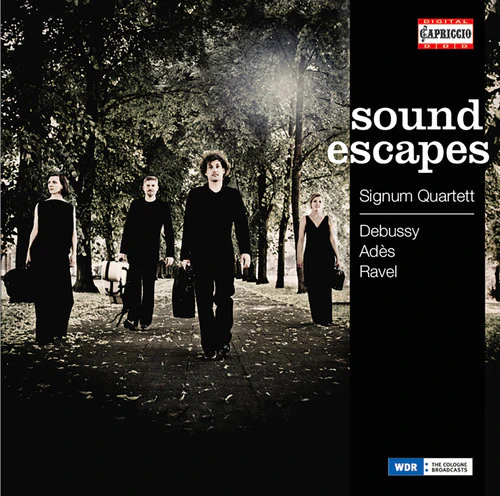
Sound Escapes
Claude Debussy’s music, as his String Quartet (1910) illustrates, reveals characteristics justifying the Impressionist painter comparison, creating landscapes of sound that can draw the listener into the middle of the picture. Maurice Ravel’s String Quartet (1903) had to be and was compared with Debussy’s. His musical diction – based on Debussy’s – prepared the way for French Modernism. Briton Thomas Adès (b. 1971) is capable of fusing traditional elements from music history, including existing composition references, with modern sound production into an individual, appealing style.
Claude Debussy’s music, as his String Quartet (1910) illustrates, reveals characteristics justifying the Impressionist painter comparison, creating landscapes of sound that can draw the listener into the middle of the picture. Maurice Ravel’s String Quartet (1903) had to be and was compared with Debussy’s. His musical diction – based on Debussy’s – prepared the way for French Modernism. Briton Thomas Adès (b. 1971) is capable of fusing traditional elements from music history, including existing composition references, with modern sound production into an individual, appealing style.
Original: $16.99
-65%$16.99
$5.95Description
Claude Debussy’s music, as his String Quartet (1910) illustrates, reveals characteristics justifying the Impressionist painter comparison, creating landscapes of sound that can draw the listener into the middle of the picture. Maurice Ravel’s String Quartet (1903) had to be and was compared with Debussy’s. His musical diction – based on Debussy’s – prepared the way for French Modernism. Briton Thomas Adès (b. 1971) is capable of fusing traditional elements from music history, including existing composition references, with modern sound production into an individual, appealing style.