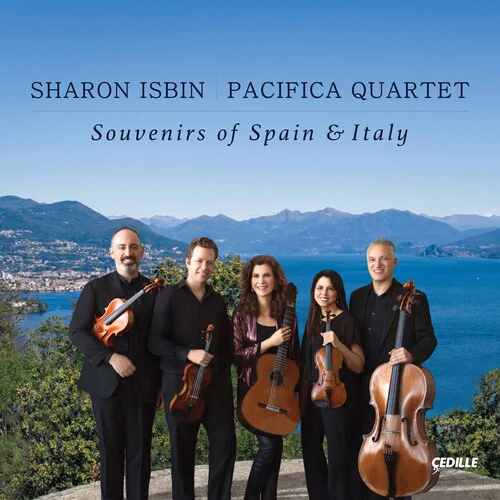
Souvenirs of Spain & Italy / Isbin, Pacifica Quartet
The Grammy Award-winning Pacifica Quartet and multiple Grammy-winning guitarist Sharon Isbin join forces for an uncommon album of music for strings and guitar from the Baroque to the mid-20th century. Souvenirs of Spain & Italy is the first joint recording by these renowned artists and marks Isbin’s Cedille Records debut. The program spotlights Italian-born composers influenced by Spanish idioms. Mario Castelnuovo-Tedesco’s Quintet for Guitar and String Quartet, Op. 143, is a seldom-heard gem demanding virtuosity from every player. Written for guitarist Andrés Segovia, it’s “an urbane work, rich in vibrant themes and dialogues among individual lines,” critic Allan Kozinn writes in the liner notes. Isbin and the Pacifica play Emilio Pujol’s guitar arrangement of Antonio Vivaldi’s lute Concerto in D Major, RV 93. Isbin’s guitar work in the dreamlike, meditative Largo movement features her own Baroque ornamentation. Luigi Boccherini’s Quintet for Guitar and String Quartet in D Major, G. 448, melds the emerging classical style of late 18th-century Vienna with hints of Spanish flamenco. Spanish composer Joaquín Turina’s string quartet movement, La Oración del Torero, Op. 34, evokes the fervor of a matador’s private prayer before entering the bullring.
REVIEWS:
At least since the days of lutes and viols composers and performers recognized and exploited the favorable combination of plucked and bowed strings. And yet we don’t often hear such a lineup these days; if we do it’s usually the same relatively small roster of works, most notably including the Vivaldi concerto heard on this recording, justly popular for its catchy, lively outer movements and beguiling (oft used, and abused) Largo. While the list of most commonly performed pieces may not be extensive, you may be surprised to learn, as I was, that the rather special genre highlighted on this program–guitar and string quartet–boasts more than 300 works, ranging from the 18th century to the present, by composers from Boccherini to Brouwer, Diamond to Dougherty. (I learned this from an article in the Spring 2019 issue of Classical Guitar magazine, which I recommend to anyone interested in this subject.)
The rest of the program assembled here, by an it-doesn’t-get-any-better-than-this group of musicians, constitutes an easy and engaging introduction to this repertoire, beginning with another favorite, Mario Castelnuovo-Tedesco’s Quintet Op. 143, written in 1950 for Andrés Segovia. Much of its popularity certainly stems from its knowing, skillful writing for this particular combination of instruments that showcases the guitar while also exploiting the textural, melodic, and harmonic possibilities of the string quartet, especially memorable in the affecting second movement, Andante mesto, which the composer declared to be his “favorite”. Nowhere is the guitarist’s voice more articulate or expressive as here, or in the following Scherzo.
Boccherini is another big name, and his D major quintet, like his many other “guitar” quintets, was fashioned from already existing, non-guitar chamber works. It’s a fine piece whose chief attraction is its–very attractive–final movement, appropriately titled “Fandango”, which is definitely a crowd-pleaser, enhanced by castanets and tambourine. While there’s no denying the sheer, easy pleasure of listening to the above-mentioned guitar/strings pieces, I found one of my favorites–next to the Castelnuovo-Tedesco slow movement and Boccherini Fandango–to be Turina’s 1925 work La oración del torero (The bullfighter’s prayer), originally written for a type of Spanish lute quartet, but later arranged by the composer (as heard here) for string quartet. It’s moody and gay and colorful and dramatic and eloquent–the sort of piece you would be grateful to hear in any string quartet recital. Who cares if it doesn’t remind you of a prayer, or a bullfighter: it’s an excellent piece.
Sharon Isbin needs no introduction to any classical guitar fan, or to anyone who’s paid more than casual attention to the classical music and performance scene since the 1980s. One of the world’s greatest advocates for her instrument, award-winner, teacher (founding director of the guitar department at Juilliard), pioneer in new repertoire, Isbin’s appearance here informs the music with an authority–enlivened by her unique ornamentation and occasional improvisatory licks–that elevates the performances far beyond the merely respectable or routine efforts of some of her very competent colleagues. And the Pacifica Quartet, commanding its own list of impressive achievements and honors, is a more than worthy partner. Perhaps we may even look forward to a further exploration of guitar/string quartet repertoire by these musicians? Brouwer? Daugherty? Miguel Bareilles? Gabriela Lena Frank? Thanks for this–and we’ll be watching.
– ClassicsToday (10/10; David Vernier)
This release on Chicago’s Cedille label features mostly well-worn pieces for guitar and ensemble; the ensemble here is the Pacifica String Quartet. The most familiar of all is the Vivaldi Guitar Concerto in D major, RV 93, heard here in an arrangement by Emilio Pujol and tinkered with by Isbin herself. Her execution here is flawless, and the effect is haunting. This is a treat for fans of Isbin, who’s doing more teaching than recording these days.
– All Music Guide (James Manheim)
The Grammy Award-winning Pacifica Quartet and multiple Grammy-winning guitarist Sharon Isbin join forces for an uncommon album of music for strings and guitar from the Baroque to the mid-20th century. Souvenirs of Spain & Italy is the first joint recording by these renowned artists and marks Isbin’s Cedille Records debut. The program spotlights Italian-born composers influenced by Spanish idioms. Mario Castelnuovo-Tedesco’s Quintet for Guitar and String Quartet, Op. 143, is a seldom-heard gem demanding virtuosity from every player. Written for guitarist Andrés Segovia, it’s “an urbane work, rich in vibrant themes and dialogues among individual lines,” critic Allan Kozinn writes in the liner notes. Isbin and the Pacifica play Emilio Pujol’s guitar arrangement of Antonio Vivaldi’s lute Concerto in D Major, RV 93. Isbin’s guitar work in the dreamlike, meditative Largo movement features her own Baroque ornamentation. Luigi Boccherini’s Quintet for Guitar and String Quartet in D Major, G. 448, melds the emerging classical style of late 18th-century Vienna with hints of Spanish flamenco. Spanish composer Joaquín Turina’s string quartet movement, La Oración del Torero, Op. 34, evokes the fervor of a matador’s private prayer before entering the bullring.
REVIEWS:
At least since the days of lutes and viols composers and performers recognized and exploited the favorable combination of plucked and bowed strings. And yet we don’t often hear such a lineup these days; if we do it’s usually the same relatively small roster of works, most notably including the Vivaldi concerto heard on this recording, justly popular for its catchy, lively outer movements and beguiling (oft used, and abused) Largo. While the list of most commonly performed pieces may not be extensive, you may be surprised to learn, as I was, that the rather special genre highlighted on this program–guitar and string quartet–boasts more than 300 works, ranging from the 18th century to the present, by composers from Boccherini to Brouwer, Diamond to Dougherty. (I learned this from an article in the Spring 2019 issue of Classical Guitar magazine, which I recommend to anyone interested in this subject.)
The rest of the program assembled here, by an it-doesn’t-get-any-better-than-this group of musicians, constitutes an easy and engaging introduction to this repertoire, beginning with another favorite, Mario Castelnuovo-Tedesco’s Quintet Op. 143, written in 1950 for Andrés Segovia. Much of its popularity certainly stems from its knowing, skillful writing for this particular combination of instruments that showcases the guitar while also exploiting the textural, melodic, and harmonic possibilities of the string quartet, especially memorable in the affecting second movement, Andante mesto, which the composer declared to be his “favorite”. Nowhere is the guitarist’s voice more articulate or expressive as here, or in the following Scherzo.
Boccherini is another big name, and his D major quintet, like his many other “guitar” quintets, was fashioned from already existing, non-guitar chamber works. It’s a fine piece whose chief attraction is its–very attractive–final movement, appropriately titled “Fandango”, which is definitely a crowd-pleaser, enhanced by castanets and tambourine. While there’s no denying the sheer, easy pleasure of listening to the above-mentioned guitar/strings pieces, I found one of my favorites–next to the Castelnuovo-Tedesco slow movement and Boccherini Fandango–to be Turina’s 1925 work La oración del torero (The bullfighter’s prayer), originally written for a type of Spanish lute quartet, but later arranged by the composer (as heard here) for string quartet. It’s moody and gay and colorful and dramatic and eloquent–the sort of piece you would be grateful to hear in any string quartet recital. Who cares if it doesn’t remind you of a prayer, or a bullfighter: it’s an excellent piece.
Sharon Isbin needs no introduction to any classical guitar fan, or to anyone who’s paid more than casual attention to the classical music and performance scene since the 1980s. One of the world’s greatest advocates for her instrument, award-winner, teacher (founding director of the guitar department at Juilliard), pioneer in new repertoire, Isbin’s appearance here informs the music with an authority–enlivened by her unique ornamentation and occasional improvisatory licks–that elevates the performances far beyond the merely respectable or routine efforts of some of her very competent colleagues. And the Pacifica Quartet, commanding its own list of impressive achievements and honors, is a more than worthy partner. Perhaps we may even look forward to a further exploration of guitar/string quartet repertoire by these musicians? Brouwer? Daugherty? Miguel Bareilles? Gabriela Lena Frank? Thanks for this–and we’ll be watching.
– ClassicsToday (10/10; David Vernier)
This release on Chicago’s Cedille label features mostly well-worn pieces for guitar and ensemble; the ensemble here is the Pacifica String Quartet. The most familiar of all is the Vivaldi Guitar Concerto in D major, RV 93, heard here in an arrangement by Emilio Pujol and tinkered with by Isbin herself. Her execution here is flawless, and the effect is haunting. This is a treat for fans of Isbin, who’s doing more teaching than recording these days.
– All Music Guide (James Manheim)
Original: $19.99
-65%$19.99
$7.00Description
The Grammy Award-winning Pacifica Quartet and multiple Grammy-winning guitarist Sharon Isbin join forces for an uncommon album of music for strings and guitar from the Baroque to the mid-20th century. Souvenirs of Spain & Italy is the first joint recording by these renowned artists and marks Isbin’s Cedille Records debut. The program spotlights Italian-born composers influenced by Spanish idioms. Mario Castelnuovo-Tedesco’s Quintet for Guitar and String Quartet, Op. 143, is a seldom-heard gem demanding virtuosity from every player. Written for guitarist Andrés Segovia, it’s “an urbane work, rich in vibrant themes and dialogues among individual lines,” critic Allan Kozinn writes in the liner notes. Isbin and the Pacifica play Emilio Pujol’s guitar arrangement of Antonio Vivaldi’s lute Concerto in D Major, RV 93. Isbin’s guitar work in the dreamlike, meditative Largo movement features her own Baroque ornamentation. Luigi Boccherini’s Quintet for Guitar and String Quartet in D Major, G. 448, melds the emerging classical style of late 18th-century Vienna with hints of Spanish flamenco. Spanish composer Joaquín Turina’s string quartet movement, La Oración del Torero, Op. 34, evokes the fervor of a matador’s private prayer before entering the bullring.
REVIEWS:
At least since the days of lutes and viols composers and performers recognized and exploited the favorable combination of plucked and bowed strings. And yet we don’t often hear such a lineup these days; if we do it’s usually the same relatively small roster of works, most notably including the Vivaldi concerto heard on this recording, justly popular for its catchy, lively outer movements and beguiling (oft used, and abused) Largo. While the list of most commonly performed pieces may not be extensive, you may be surprised to learn, as I was, that the rather special genre highlighted on this program–guitar and string quartet–boasts more than 300 works, ranging from the 18th century to the present, by composers from Boccherini to Brouwer, Diamond to Dougherty. (I learned this from an article in the Spring 2019 issue of Classical Guitar magazine, which I recommend to anyone interested in this subject.)
The rest of the program assembled here, by an it-doesn’t-get-any-better-than-this group of musicians, constitutes an easy and engaging introduction to this repertoire, beginning with another favorite, Mario Castelnuovo-Tedesco’s Quintet Op. 143, written in 1950 for Andrés Segovia. Much of its popularity certainly stems from its knowing, skillful writing for this particular combination of instruments that showcases the guitar while also exploiting the textural, melodic, and harmonic possibilities of the string quartet, especially memorable in the affecting second movement, Andante mesto, which the composer declared to be his “favorite”. Nowhere is the guitarist’s voice more articulate or expressive as here, or in the following Scherzo.
Boccherini is another big name, and his D major quintet, like his many other “guitar” quintets, was fashioned from already existing, non-guitar chamber works. It’s a fine piece whose chief attraction is its–very attractive–final movement, appropriately titled “Fandango”, which is definitely a crowd-pleaser, enhanced by castanets and tambourine. While there’s no denying the sheer, easy pleasure of listening to the above-mentioned guitar/strings pieces, I found one of my favorites–next to the Castelnuovo-Tedesco slow movement and Boccherini Fandango–to be Turina’s 1925 work La oración del torero (The bullfighter’s prayer), originally written for a type of Spanish lute quartet, but later arranged by the composer (as heard here) for string quartet. It’s moody and gay and colorful and dramatic and eloquent–the sort of piece you would be grateful to hear in any string quartet recital. Who cares if it doesn’t remind you of a prayer, or a bullfighter: it’s an excellent piece.
Sharon Isbin needs no introduction to any classical guitar fan, or to anyone who’s paid more than casual attention to the classical music and performance scene since the 1980s. One of the world’s greatest advocates for her instrument, award-winner, teacher (founding director of the guitar department at Juilliard), pioneer in new repertoire, Isbin’s appearance here informs the music with an authority–enlivened by her unique ornamentation and occasional improvisatory licks–that elevates the performances far beyond the merely respectable or routine efforts of some of her very competent colleagues. And the Pacifica Quartet, commanding its own list of impressive achievements and honors, is a more than worthy partner. Perhaps we may even look forward to a further exploration of guitar/string quartet repertoire by these musicians? Brouwer? Daugherty? Miguel Bareilles? Gabriela Lena Frank? Thanks for this–and we’ll be watching.
– ClassicsToday (10/10; David Vernier)
This release on Chicago’s Cedille label features mostly well-worn pieces for guitar and ensemble; the ensemble here is the Pacifica String Quartet. The most familiar of all is the Vivaldi Guitar Concerto in D major, RV 93, heard here in an arrangement by Emilio Pujol and tinkered with by Isbin herself. Her execution here is flawless, and the effect is haunting. This is a treat for fans of Isbin, who’s doing more teaching than recording these days.
– All Music Guide (James Manheim)