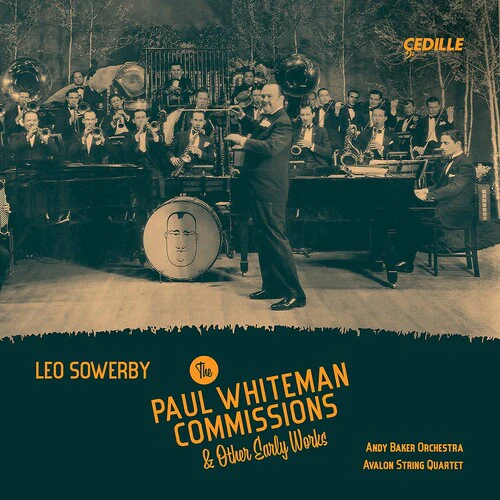
Sowerby: The Paul Whiteman Commissions & Other Early Works
This is a delightful, even astonishing release... A valuable missing piece in the early discourse between jazz and classical music.
Evoking the Roaring Twenties, Chicago composer Leo Sowerby’s engaging and ingenious Synconata (1924) and Symphony for Jazz Orchestra (“Monotony”) (1925), critically praised for their distinctive harmony, counterpoint, and humor, receive world-premiere recordings by Chicago bandleader-trombonist Andrew Baker and his Andy Baker Orchestra, making their Cedille Records debuts. Sowerby was among the leading young American classical composers commissioned by celebrity bandleader Paul Whiteman to create fresh repertoire for his landmark series of “symphonic jazz” concerts — a roster that also included George Gershwin, Ferde Grofé, and Zez Confrey. The same Jazz Age concerts that saw the premieres of Sowerby’s Synconata and Symphony for Jazz Orchestra also launched Gershwin’s Rhapsody in Blue into America’s consciousness. The program also includes Sowerby chamber works from the same period: his Serenade for String Quartet and the world-premiere recordings of his String Quartet in D minor and Tramping Tune for piano and strings, all performed by the Avalon String Quartet, an ensemble “prizing grace, charm and elegance” (WQXR Radio). Joining the Avalon in Tramping Tune are pianist Winston Choi, head of the piano program at Roosevelt University’s Chicago College of Performing Arts, and Alexander Hanna, principal double-bassist of the Chicago Symphony Orchestra. The album was recorded by the Grammy Award-winning team of producer James Ginsburg and engineer Bill Maylone.
REVIEWS:
This is a delightful, even astonishing release. It contains early works by Leo Sowerby, the most popular composer of church music in the 20th century USA. The two largest items here were composed for Paul Whiteman’s (of Rhapsody in Blue fame) jazz band. They are extraordinarily appealing. The first, called Synconata, is a single movement “overture” full of memorable ideas. It may not be as melodically distinctive as Gershwin, who was a great song-writer first and foremost, but it certainly passes the time entertainingly.
This is even more the case with the Symphony for Jazz Orchestra, given the eyebrow-raising title “Monotony” (!). Don’t worry. The music is anything but. The title comes from the original circumstances of its first performances, as a sort of theatrical art piece featuring a huge metronome front and center. Both of these scores had to be reconstructed by Andy Baker for the present disc, and he inspires his musicians to give loving, dedicated interpretations, captured in perfectly balanced, tactile sonics. Even without the other pieces on the disc–all but one world premieres–this would be worth acquiring.
However, the remaining items are much more than mere makeweights. Sowerby’s First String Quartet is a substantial work in three movements. The idiom is self-consciously “American,” full of modal, folk-like themes and zesty rhythms. Although the movements get longer as the work progresses, the music becomes increasingly lively and the entire structure, however unconventional, works extremely well. The Avalon String Quartet had to work just as hard as Any Baker to bring the piece to performance, but the effort was certainly worth it. The two additional works, Tramping Tune for quartet, piano and double bass, and the charmingly lyrical serenade for string quartet, round out this compelling and beautifully assembled collection. Truly a major discovery.
– ClassicsToday.com (10/10; David Hurwitz)
The “main event” here, so to speak, is Sowerby’s jazz symphony Monotony. This is an utterly fascinating piece, more classical than jazz despite its use of muted trumpets, banjo and the like, at least in structure. Sowerby builds the first movement around a little sliding chromatic figure played by the trombones in their low range, which is then transformed a bit and moved up to the saxophones as the music develops. Suddenly, a bright little clarinet tune pops up (probably played by Ross Gorman, Whiteman’s virtuoso clarinetist at the time who created the upward opening glissando in Rhapsody in Blue), before the strings and brass get in on the fun. Once again, the syncopations are much closer to ragtime than to real jazz of the era (for examples of this, listen to contemporary recordings by the New Orleans Rhythm Kings, King Oliver’s Creole Jazz Band and The Wolverines with Beiderbecke on cornet), but Sowerby’s composition skills kept him and the piece going.
Overall, this is a very interesting album. Kudos all around, to the performers for doing such a good job on the music as well as to Çedille Records for recording and releasing it. This is a valuable missing piece in the early discourse between jazz and classical music.
– The Art Music Lounge
This is a delightful, even astonishing release... A valuable missing piece in the early discourse between jazz and classical music.
Evoking the Roaring Twenties, Chicago composer Leo Sowerby’s engaging and ingenious Synconata (1924) and Symphony for Jazz Orchestra (“Monotony”) (1925), critically praised for their distinctive harmony, counterpoint, and humor, receive world-premiere recordings by Chicago bandleader-trombonist Andrew Baker and his Andy Baker Orchestra, making their Cedille Records debuts. Sowerby was among the leading young American classical composers commissioned by celebrity bandleader Paul Whiteman to create fresh repertoire for his landmark series of “symphonic jazz” concerts — a roster that also included George Gershwin, Ferde Grofé, and Zez Confrey. The same Jazz Age concerts that saw the premieres of Sowerby’s Synconata and Symphony for Jazz Orchestra also launched Gershwin’s Rhapsody in Blue into America’s consciousness. The program also includes Sowerby chamber works from the same period: his Serenade for String Quartet and the world-premiere recordings of his String Quartet in D minor and Tramping Tune for piano and strings, all performed by the Avalon String Quartet, an ensemble “prizing grace, charm and elegance” (WQXR Radio). Joining the Avalon in Tramping Tune are pianist Winston Choi, head of the piano program at Roosevelt University’s Chicago College of Performing Arts, and Alexander Hanna, principal double-bassist of the Chicago Symphony Orchestra. The album was recorded by the Grammy Award-winning team of producer James Ginsburg and engineer Bill Maylone.
REVIEWS:
This is a delightful, even astonishing release. It contains early works by Leo Sowerby, the most popular composer of church music in the 20th century USA. The two largest items here were composed for Paul Whiteman’s (of Rhapsody in Blue fame) jazz band. They are extraordinarily appealing. The first, called Synconata, is a single movement “overture” full of memorable ideas. It may not be as melodically distinctive as Gershwin, who was a great song-writer first and foremost, but it certainly passes the time entertainingly.
This is even more the case with the Symphony for Jazz Orchestra, given the eyebrow-raising title “Monotony” (!). Don’t worry. The music is anything but. The title comes from the original circumstances of its first performances, as a sort of theatrical art piece featuring a huge metronome front and center. Both of these scores had to be reconstructed by Andy Baker for the present disc, and he inspires his musicians to give loving, dedicated interpretations, captured in perfectly balanced, tactile sonics. Even without the other pieces on the disc–all but one world premieres–this would be worth acquiring.
However, the remaining items are much more than mere makeweights. Sowerby’s First String Quartet is a substantial work in three movements. The idiom is self-consciously “American,” full of modal, folk-like themes and zesty rhythms. Although the movements get longer as the work progresses, the music becomes increasingly lively and the entire structure, however unconventional, works extremely well. The Avalon String Quartet had to work just as hard as Any Baker to bring the piece to performance, but the effort was certainly worth it. The two additional works, Tramping Tune for quartet, piano and double bass, and the charmingly lyrical serenade for string quartet, round out this compelling and beautifully assembled collection. Truly a major discovery.
– ClassicsToday.com (10/10; David Hurwitz)
The “main event” here, so to speak, is Sowerby’s jazz symphony Monotony. This is an utterly fascinating piece, more classical than jazz despite its use of muted trumpets, banjo and the like, at least in structure. Sowerby builds the first movement around a little sliding chromatic figure played by the trombones in their low range, which is then transformed a bit and moved up to the saxophones as the music develops. Suddenly, a bright little clarinet tune pops up (probably played by Ross Gorman, Whiteman’s virtuoso clarinetist at the time who created the upward opening glissando in Rhapsody in Blue), before the strings and brass get in on the fun. Once again, the syncopations are much closer to ragtime than to real jazz of the era (for examples of this, listen to contemporary recordings by the New Orleans Rhythm Kings, King Oliver’s Creole Jazz Band and The Wolverines with Beiderbecke on cornet), but Sowerby’s composition skills kept him and the piece going.
Overall, this is a very interesting album. Kudos all around, to the performers for doing such a good job on the music as well as to Çedille Records for recording and releasing it. This is a valuable missing piece in the early discourse between jazz and classical music.
– The Art Music Lounge
Description
This is a delightful, even astonishing release... A valuable missing piece in the early discourse between jazz and classical music.
Evoking the Roaring Twenties, Chicago composer Leo Sowerby’s engaging and ingenious Synconata (1924) and Symphony for Jazz Orchestra (“Monotony”) (1925), critically praised for their distinctive harmony, counterpoint, and humor, receive world-premiere recordings by Chicago bandleader-trombonist Andrew Baker and his Andy Baker Orchestra, making their Cedille Records debuts. Sowerby was among the leading young American classical composers commissioned by celebrity bandleader Paul Whiteman to create fresh repertoire for his landmark series of “symphonic jazz” concerts — a roster that also included George Gershwin, Ferde Grofé, and Zez Confrey. The same Jazz Age concerts that saw the premieres of Sowerby’s Synconata and Symphony for Jazz Orchestra also launched Gershwin’s Rhapsody in Blue into America’s consciousness. The program also includes Sowerby chamber works from the same period: his Serenade for String Quartet and the world-premiere recordings of his String Quartet in D minor and Tramping Tune for piano and strings, all performed by the Avalon String Quartet, an ensemble “prizing grace, charm and elegance” (WQXR Radio). Joining the Avalon in Tramping Tune are pianist Winston Choi, head of the piano program at Roosevelt University’s Chicago College of Performing Arts, and Alexander Hanna, principal double-bassist of the Chicago Symphony Orchestra. The album was recorded by the Grammy Award-winning team of producer James Ginsburg and engineer Bill Maylone.
REVIEWS:
This is a delightful, even astonishing release. It contains early works by Leo Sowerby, the most popular composer of church music in the 20th century USA. The two largest items here were composed for Paul Whiteman’s (of Rhapsody in Blue fame) jazz band. They are extraordinarily appealing. The first, called Synconata, is a single movement “overture” full of memorable ideas. It may not be as melodically distinctive as Gershwin, who was a great song-writer first and foremost, but it certainly passes the time entertainingly.
This is even more the case with the Symphony for Jazz Orchestra, given the eyebrow-raising title “Monotony” (!). Don’t worry. The music is anything but. The title comes from the original circumstances of its first performances, as a sort of theatrical art piece featuring a huge metronome front and center. Both of these scores had to be reconstructed by Andy Baker for the present disc, and he inspires his musicians to give loving, dedicated interpretations, captured in perfectly balanced, tactile sonics. Even without the other pieces on the disc–all but one world premieres–this would be worth acquiring.
However, the remaining items are much more than mere makeweights. Sowerby’s First String Quartet is a substantial work in three movements. The idiom is self-consciously “American,” full of modal, folk-like themes and zesty rhythms. Although the movements get longer as the work progresses, the music becomes increasingly lively and the entire structure, however unconventional, works extremely well. The Avalon String Quartet had to work just as hard as Any Baker to bring the piece to performance, but the effort was certainly worth it. The two additional works, Tramping Tune for quartet, piano and double bass, and the charmingly lyrical serenade for string quartet, round out this compelling and beautifully assembled collection. Truly a major discovery.
– ClassicsToday.com (10/10; David Hurwitz)
The “main event” here, so to speak, is Sowerby’s jazz symphony Monotony. This is an utterly fascinating piece, more classical than jazz despite its use of muted trumpets, banjo and the like, at least in structure. Sowerby builds the first movement around a little sliding chromatic figure played by the trombones in their low range, which is then transformed a bit and moved up to the saxophones as the music develops. Suddenly, a bright little clarinet tune pops up (probably played by Ross Gorman, Whiteman’s virtuoso clarinetist at the time who created the upward opening glissando in Rhapsody in Blue), before the strings and brass get in on the fun. Once again, the syncopations are much closer to ragtime than to real jazz of the era (for examples of this, listen to contemporary recordings by the New Orleans Rhythm Kings, King Oliver’s Creole Jazz Band and The Wolverines with Beiderbecke on cornet), but Sowerby’s composition skills kept him and the piece going.
Overall, this is a very interesting album. Kudos all around, to the performers for doing such a good job on the music as well as to Çedille Records for recording and releasing it. This is a valuable missing piece in the early discourse between jazz and classical music.
– The Art Music Lounge