🎉 Up to 70% Off Selected ItemsShop Sale

1 / 2
Spiritual Resistance - Music From Theresienstadt
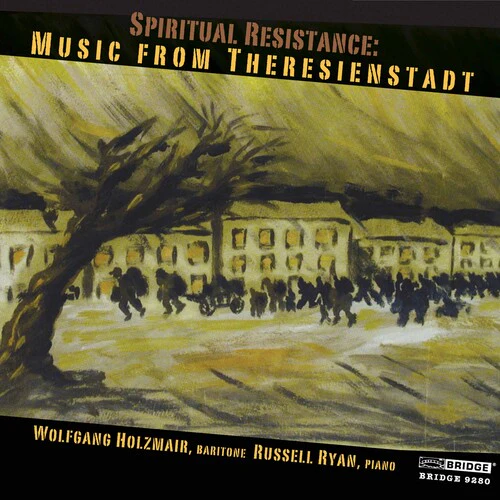
SPIRITUAL RESISTANCE—MUSIC FROM THERESIENSTADT • Wolfgang Holzmair (bar); 1 Russell Ryan (pn) • BRIDGE 9280 (75:08)
ULLMANN Der Mensch und sein Tag. Der müde Soldat. 3 Songs, op. 37. 1 K. BERMAN 6 Reminiscences. HAAS 4 Songs after Words of Chinese Poetry. 1 KLEIN 3 Songs. 1 Lullaby. Z. SCHUL What Never Was. 1 KRÁSA 5 Songs, op. 4. 1 I. WEBER I Wander through Theresienstadt 1
The music of the composers who were imprisoned at the Nazi concentration camp Theresienstadt (Terezín in Czech)—Viktor Ullmann, Gideon Klein, Pavel Haas, Hans Krása, and several others—tends to be programmed together in concerts and recordings. Since each composer produced music under uniquely horrible shared circumstances, it seems fair to link the pieces composed at Theresienstadt together, but on the other hand, it is worth getting to know their individual styles separately. In any case, it is almost impossible to listen to any of their songs without interpreting the choice of texts, if not the music, for clues as to the composers’ suffering.
Overall, there are few overt references to the Holocaust. Most of the texts are poetic or philosophical, and the music is most likely what these composers would have written in any circumstance. It was the act itself of composing that represented their remarkable self-assertion. The title of this recital by baritone Wolfgang Holzmair and pianist Russell Ryan, “Spritual Resistance,” refers to this and consists mostly of songs composed in Theresienstadt.
The program opens with Pavel Haas’s Four Songs after Words of Chinese Poetry , set to Czech texts with a recurring theme of yearning for home. His fellow composers at Terezín successfully urged Haas, who was severely depressed, to try to compose, and these songs comprise the few results. Somewhat like his teacher, Janá?ek, Haas liked to use compact motives made up of very close intervals. The piano part in particular often moves in a repetitive, crab-like fashion that communicates a feeling of being trapped. The four songs form a true cycle, and are given a strong and understanding performance by Holzmair and Ryan. Holzmair’s Czech is good, and he darkens his light baritone to suit the range and mood of the music. Haas’s songs were premiered at Terezín by Karel Berman, an inmate who survived and became a leading singer at Prague’s National Theater after the war. If there is such a thing as a definitive performance, Berman’s recording of the Four Songs , released in 1993 on Channel Classics, qualifies. He not only survived the war but his bass baritone voice proved to be exceptionally durable, still rich and resonant decades after his first performance of Haas’s songs.
Berman turned to composition only twice, and it might have been interesting if Holzmair had included his song cycle Rosebuds on this disc. His other composition, for solo piano, was published in 1993 with the complicated title: Suite “Reminiscences” 1938–45. It is a kind of musical diary that originally consisted of three musical impressions of Terezín. After the war, Berman added five other movements to create a fuller portrait of his life’s events. (The late Joža Karas, author of Music in Terezín , once told me that it was at his suggestion that Berman added these movements.)The suite moves in an emotional arc from its folk-like, lyrical opening movements (“Youth” and “Home”) toward greater dissonance and discord in the movements concerning Terezín and Berman’s near death. Pieces like “Auschwitz—Corpse Factory” and “Typhus at the Kauffering Concentration Camp” are the only music on the disc that makes direct reference to the Holocaust, but they are like faint pencil sketches that only hint at the horrors. The final movement, “New Life,” contains a polka and quotes earlier lyrical material. Pianist Russell Ryan performs movements from the suite interspersed between groups of songs, but he omits two of the suite’s movements, the first, “Youth,” and the seventh, “Alone, Alone,” its happiest and most despairing sections respectively. Christopher Hailey’s otherwise thorough liner notes fail to mention these omissions. Programming these pieces as a series of interludes between songs may work well in concert, but here it lessens the impact of Berman’s suite, as does Ryan’s understated playing, which has too little flexibility in some of the lyrical passages and provides too little drama in the disturbing ones.
Hans Krása is best known as the composer of the children’s opera Brundibar . His sophisticated Five Songs , op. 4, composed before his imprisonment, have imaginative melodic lines and nimble word-setting, especially in the final song, set to a text by the clever German poet Christian Morgenstern, and is engagingly sung by Holzmair. Viktor Ullmann’s Der Mensch und sein Tag is a cycle of 12 songs set to aphoristic German texts by Hans Günther Adler, a Terezín inmate who survived and preserved Ullmann’s manuscripts in England. The poetry is contemplative, and Ullmann excelled at composing lyrical melodies in a free, atonal style. Holzmair is at his very best in introspective material and he sings them with great sensitivity. The Three Songs , op. 37, by Ullmann were revised at Terezín, and employ marching music in a sardonic Mahlerian manner. Gideon Klein’s Three Songs , op. 1 (in Czech), were composed in 1940 prior to his imprisonment, and they were already the work of a skilled composer. Klein (1919–1945) was a child prodigy and considered the composer from the Terezín group most likely to have had a major career, had he lived. The songs inhabit the same harmonic, expressive world as the music of Alban Berg. Along with Ullmann’s Der müde Soldat , they represent the disc’s most adventurous music. Klein’s moving version of a Hebrew lullaby sets a simple folk song against troubled, complex harmony. The little-known Zikmund Schul is represented by one touching German song. Ilse Weber was a children’s author, not a composer, and Holzmair recites her poem Ich Wandre Durch Theresienstadt.
All of these songs are composed with considerable craft and inspiration and they repay repeated listening. Much of the material has almost never been recorded before, making this an extremely valuable release. At this stage of his career, Holzmair is a consummate Lieder singer with impeccable phrasing and German diction. He reminds me of Ernst Haefliger or Gerard Souzay, master singers who compensated for somewhat unlovely vocal quality at times with good breath control, fine legato, and overall musical intelligence.
Incidentally, Holzmair and Russell Ryan can be heard along with the exciting mezzo-soprano Hermine Haselböck on another recent Bridge release of songs by Schreker, and Haselböck is also featured on an excellent new Bridge CD of songs by Zemlinsky. Thanks to this fine American label for their commitment to making all of this obscure (and beautiful) German Lieder available in first-rate performances and excellent sound.
FANFARE: Paul Orgel
SPIRITUAL RESISTANCE—MUSIC FROM THERESIENSTADT • Wolfgang Holzmair (bar); 1 Russell Ryan (pn) • BRIDGE 9280 (75:08)
ULLMANN Der Mensch und sein Tag. Der müde Soldat. 3 Songs, op. 37. 1 K. BERMAN 6 Reminiscences. HAAS 4 Songs after Words of Chinese Poetry. 1 KLEIN 3 Songs. 1 Lullaby. Z. SCHUL What Never Was. 1 KRÁSA 5 Songs, op. 4. 1 I. WEBER I Wander through Theresienstadt 1
The music of the composers who were imprisoned at the Nazi concentration camp Theresienstadt (Terezín in Czech)—Viktor Ullmann, Gideon Klein, Pavel Haas, Hans Krása, and several others—tends to be programmed together in concerts and recordings. Since each composer produced music under uniquely horrible shared circumstances, it seems fair to link the pieces composed at Theresienstadt together, but on the other hand, it is worth getting to know their individual styles separately. In any case, it is almost impossible to listen to any of their songs without interpreting the choice of texts, if not the music, for clues as to the composers’ suffering.
Overall, there are few overt references to the Holocaust. Most of the texts are poetic or philosophical, and the music is most likely what these composers would have written in any circumstance. It was the act itself of composing that represented their remarkable self-assertion. The title of this recital by baritone Wolfgang Holzmair and pianist Russell Ryan, “Spritual Resistance,” refers to this and consists mostly of songs composed in Theresienstadt.
The program opens with Pavel Haas’s Four Songs after Words of Chinese Poetry , set to Czech texts with a recurring theme of yearning for home. His fellow composers at Terezín successfully urged Haas, who was severely depressed, to try to compose, and these songs comprise the few results. Somewhat like his teacher, Janá?ek, Haas liked to use compact motives made up of very close intervals. The piano part in particular often moves in a repetitive, crab-like fashion that communicates a feeling of being trapped. The four songs form a true cycle, and are given a strong and understanding performance by Holzmair and Ryan. Holzmair’s Czech is good, and he darkens his light baritone to suit the range and mood of the music. Haas’s songs were premiered at Terezín by Karel Berman, an inmate who survived and became a leading singer at Prague’s National Theater after the war. If there is such a thing as a definitive performance, Berman’s recording of the Four Songs , released in 1993 on Channel Classics, qualifies. He not only survived the war but his bass baritone voice proved to be exceptionally durable, still rich and resonant decades after his first performance of Haas’s songs.
Berman turned to composition only twice, and it might have been interesting if Holzmair had included his song cycle Rosebuds on this disc. His other composition, for solo piano, was published in 1993 with the complicated title: Suite “Reminiscences” 1938–45. It is a kind of musical diary that originally consisted of three musical impressions of Terezín. After the war, Berman added five other movements to create a fuller portrait of his life’s events. (The late Joža Karas, author of Music in Terezín , once told me that it was at his suggestion that Berman added these movements.)The suite moves in an emotional arc from its folk-like, lyrical opening movements (“Youth” and “Home”) toward greater dissonance and discord in the movements concerning Terezín and Berman’s near death. Pieces like “Auschwitz—Corpse Factory” and “Typhus at the Kauffering Concentration Camp” are the only music on the disc that makes direct reference to the Holocaust, but they are like faint pencil sketches that only hint at the horrors. The final movement, “New Life,” contains a polka and quotes earlier lyrical material. Pianist Russell Ryan performs movements from the suite interspersed between groups of songs, but he omits two of the suite’s movements, the first, “Youth,” and the seventh, “Alone, Alone,” its happiest and most despairing sections respectively. Christopher Hailey’s otherwise thorough liner notes fail to mention these omissions. Programming these pieces as a series of interludes between songs may work well in concert, but here it lessens the impact of Berman’s suite, as does Ryan’s understated playing, which has too little flexibility in some of the lyrical passages and provides too little drama in the disturbing ones.
Hans Krása is best known as the composer of the children’s opera Brundibar . His sophisticated Five Songs , op. 4, composed before his imprisonment, have imaginative melodic lines and nimble word-setting, especially in the final song, set to a text by the clever German poet Christian Morgenstern, and is engagingly sung by Holzmair. Viktor Ullmann’s Der Mensch und sein Tag is a cycle of 12 songs set to aphoristic German texts by Hans Günther Adler, a Terezín inmate who survived and preserved Ullmann’s manuscripts in England. The poetry is contemplative, and Ullmann excelled at composing lyrical melodies in a free, atonal style. Holzmair is at his very best in introspective material and he sings them with great sensitivity. The Three Songs , op. 37, by Ullmann were revised at Terezín, and employ marching music in a sardonic Mahlerian manner. Gideon Klein’s Three Songs , op. 1 (in Czech), were composed in 1940 prior to his imprisonment, and they were already the work of a skilled composer. Klein (1919–1945) was a child prodigy and considered the composer from the Terezín group most likely to have had a major career, had he lived. The songs inhabit the same harmonic, expressive world as the music of Alban Berg. Along with Ullmann’s Der müde Soldat , they represent the disc’s most adventurous music. Klein’s moving version of a Hebrew lullaby sets a simple folk song against troubled, complex harmony. The little-known Zikmund Schul is represented by one touching German song. Ilse Weber was a children’s author, not a composer, and Holzmair recites her poem Ich Wandre Durch Theresienstadt.
All of these songs are composed with considerable craft and inspiration and they repay repeated listening. Much of the material has almost never been recorded before, making this an extremely valuable release. At this stage of his career, Holzmair is a consummate Lieder singer with impeccable phrasing and German diction. He reminds me of Ernst Haefliger or Gerard Souzay, master singers who compensated for somewhat unlovely vocal quality at times with good breath control, fine legato, and overall musical intelligence.
Incidentally, Holzmair and Russell Ryan can be heard along with the exciting mezzo-soprano Hermine Haselböck on another recent Bridge release of songs by Schreker, and Haselböck is also featured on an excellent new Bridge CD of songs by Zemlinsky. Thanks to this fine American label for their commitment to making all of this obscure (and beautiful) German Lieder available in first-rate performances and excellent sound.
FANFARE: Paul Orgel
$6.65
Original: $18.99
-65%Spiritual Resistance - Music From Theresienstadt—
$18.99
$6.65Description
SPIRITUAL RESISTANCE—MUSIC FROM THERESIENSTADT • Wolfgang Holzmair (bar); 1 Russell Ryan (pn) • BRIDGE 9280 (75:08)
ULLMANN Der Mensch und sein Tag. Der müde Soldat. 3 Songs, op. 37. 1 K. BERMAN 6 Reminiscences. HAAS 4 Songs after Words of Chinese Poetry. 1 KLEIN 3 Songs. 1 Lullaby. Z. SCHUL What Never Was. 1 KRÁSA 5 Songs, op. 4. 1 I. WEBER I Wander through Theresienstadt 1
The music of the composers who were imprisoned at the Nazi concentration camp Theresienstadt (Terezín in Czech)—Viktor Ullmann, Gideon Klein, Pavel Haas, Hans Krása, and several others—tends to be programmed together in concerts and recordings. Since each composer produced music under uniquely horrible shared circumstances, it seems fair to link the pieces composed at Theresienstadt together, but on the other hand, it is worth getting to know their individual styles separately. In any case, it is almost impossible to listen to any of their songs without interpreting the choice of texts, if not the music, for clues as to the composers’ suffering.
Overall, there are few overt references to the Holocaust. Most of the texts are poetic or philosophical, and the music is most likely what these composers would have written in any circumstance. It was the act itself of composing that represented their remarkable self-assertion. The title of this recital by baritone Wolfgang Holzmair and pianist Russell Ryan, “Spritual Resistance,” refers to this and consists mostly of songs composed in Theresienstadt.
The program opens with Pavel Haas’s Four Songs after Words of Chinese Poetry , set to Czech texts with a recurring theme of yearning for home. His fellow composers at Terezín successfully urged Haas, who was severely depressed, to try to compose, and these songs comprise the few results. Somewhat like his teacher, Janá?ek, Haas liked to use compact motives made up of very close intervals. The piano part in particular often moves in a repetitive, crab-like fashion that communicates a feeling of being trapped. The four songs form a true cycle, and are given a strong and understanding performance by Holzmair and Ryan. Holzmair’s Czech is good, and he darkens his light baritone to suit the range and mood of the music. Haas’s songs were premiered at Terezín by Karel Berman, an inmate who survived and became a leading singer at Prague’s National Theater after the war. If there is such a thing as a definitive performance, Berman’s recording of the Four Songs , released in 1993 on Channel Classics, qualifies. He not only survived the war but his bass baritone voice proved to be exceptionally durable, still rich and resonant decades after his first performance of Haas’s songs.
Berman turned to composition only twice, and it might have been interesting if Holzmair had included his song cycle Rosebuds on this disc. His other composition, for solo piano, was published in 1993 with the complicated title: Suite “Reminiscences” 1938–45. It is a kind of musical diary that originally consisted of three musical impressions of Terezín. After the war, Berman added five other movements to create a fuller portrait of his life’s events. (The late Joža Karas, author of Music in Terezín , once told me that it was at his suggestion that Berman added these movements.)The suite moves in an emotional arc from its folk-like, lyrical opening movements (“Youth” and “Home”) toward greater dissonance and discord in the movements concerning Terezín and Berman’s near death. Pieces like “Auschwitz—Corpse Factory” and “Typhus at the Kauffering Concentration Camp” are the only music on the disc that makes direct reference to the Holocaust, but they are like faint pencil sketches that only hint at the horrors. The final movement, “New Life,” contains a polka and quotes earlier lyrical material. Pianist Russell Ryan performs movements from the suite interspersed between groups of songs, but he omits two of the suite’s movements, the first, “Youth,” and the seventh, “Alone, Alone,” its happiest and most despairing sections respectively. Christopher Hailey’s otherwise thorough liner notes fail to mention these omissions. Programming these pieces as a series of interludes between songs may work well in concert, but here it lessens the impact of Berman’s suite, as does Ryan’s understated playing, which has too little flexibility in some of the lyrical passages and provides too little drama in the disturbing ones.
Hans Krása is best known as the composer of the children’s opera Brundibar . His sophisticated Five Songs , op. 4, composed before his imprisonment, have imaginative melodic lines and nimble word-setting, especially in the final song, set to a text by the clever German poet Christian Morgenstern, and is engagingly sung by Holzmair. Viktor Ullmann’s Der Mensch und sein Tag is a cycle of 12 songs set to aphoristic German texts by Hans Günther Adler, a Terezín inmate who survived and preserved Ullmann’s manuscripts in England. The poetry is contemplative, and Ullmann excelled at composing lyrical melodies in a free, atonal style. Holzmair is at his very best in introspective material and he sings them with great sensitivity. The Three Songs , op. 37, by Ullmann were revised at Terezín, and employ marching music in a sardonic Mahlerian manner. Gideon Klein’s Three Songs , op. 1 (in Czech), were composed in 1940 prior to his imprisonment, and they were already the work of a skilled composer. Klein (1919–1945) was a child prodigy and considered the composer from the Terezín group most likely to have had a major career, had he lived. The songs inhabit the same harmonic, expressive world as the music of Alban Berg. Along with Ullmann’s Der müde Soldat , they represent the disc’s most adventurous music. Klein’s moving version of a Hebrew lullaby sets a simple folk song against troubled, complex harmony. The little-known Zikmund Schul is represented by one touching German song. Ilse Weber was a children’s author, not a composer, and Holzmair recites her poem Ich Wandre Durch Theresienstadt.
All of these songs are composed with considerable craft and inspiration and they repay repeated listening. Much of the material has almost never been recorded before, making this an extremely valuable release. At this stage of his career, Holzmair is a consummate Lieder singer with impeccable phrasing and German diction. He reminds me of Ernst Haefliger or Gerard Souzay, master singers who compensated for somewhat unlovely vocal quality at times with good breath control, fine legato, and overall musical intelligence.
Incidentally, Holzmair and Russell Ryan can be heard along with the exciting mezzo-soprano Hermine Haselböck on another recent Bridge release of songs by Schreker, and Haselböck is also featured on an excellent new Bridge CD of songs by Zemlinsky. Thanks to this fine American label for their commitment to making all of this obscure (and beautiful) German Lieder available in first-rate performances and excellent sound.
FANFARE: Paul Orgel






















