🎉 Up to 70% Off Selected ItemsShop Sale

1 / 2
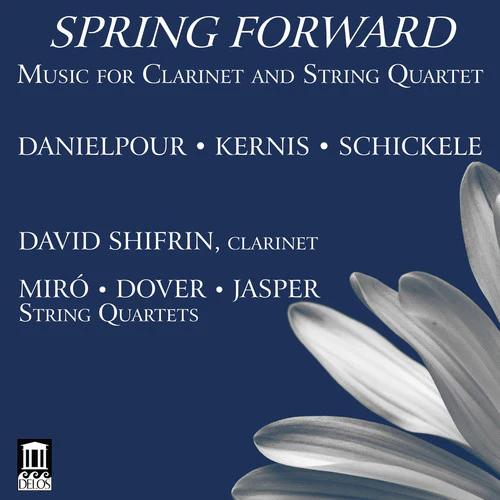
Spring Forward - Music for Clarinet and String Quartet / Shifrin
Spring Forward, the delightful title work by multi-talented Peter Schickele, is a gift to the composer/ humorist’s many worldwide fans. This touching Suite represents a culmination of sorts “after a lifetime of entering sketches for such a piece into my notebooks,” Schickele writes in his entertaining program notes. Richard Danielpour’s moving Clarinet Quintet (“The Last Jew in Hamadan”) was composed with Danielpour’s memories of his childhood in Iran in mind. (The members of his family who escaped the country were the lucky ones.) Aaron Jay Kernis’ intriguing Perpetual Chaconne reflects his fascination with the variety of approaches composers have used to develop and vary their ideas over the ages.
-----
REVIEW:
It was a surprise to learn that Peter Schickele was 79 when he wrote Spring Forward. It sounds very much what you would expect from a young composer, so Schickele is obviously still young at heart. He is also a humourist, and that also shows in this truly magical and delightful quintet.
The quintet is in five movements, each an absolute delight. Once you know about Schickele’s humourist side, you can see where the fun he injects into the composition comes from. He is clearly a worthy successor to both Gerard Hoffnung and Victor Borge.
Richard Danielpour is an extremely thoughtful tunesmith with some truly original ideas. This quintet is no exception, with its intriguing subtitle The Last Jew in Hamadan. Hamadan is a town in Iran where the composer’s father and maternal grandfather were born. It once had a sizeable Jewish population, and is in fact the biblical city of Esther. But over time that population has shrunk so much that once — on reading in the New York Times that there were but 13 Jews still living there — Richard Danielpour realised that there would soon be none at all left. Hence his telling title.
There is a sad and fragile beauty in this music that is infectious, along with a sense of regret that things have changed so much for the worse since 1979. The music peters out as if all energy has been lost.
Aaron Jay Kernis's quintet begins lyrically enough but soon becomes full of nervous energy and restlessness, which slows down when the theme seems to have become worn out. It then gathers a new momentum. Its lyricism returns for much of this second period but eventually the fractious nature resumes. The theme appears as a fragmented entity which then once again seems to run out of steam in the quintet’s closing minutes, and the work fades away to a whispered ending. I wish my musical understanding was sufficient to discuss the technical side but I can say that I enjoyed it, and always applaud composers who continue to explore new ways of expression.
All three quintets are performed by three extremely talented ensembles. The unifying element is David Shifrin as clarinettist. This hugely experienced performer rises to every challenge in these three quite different works, and everyone involved in the entire project deserves accolades for their performances. This is a disc that challenges the listener to give the closest attention to the music but pays off in a rewarding experience of three composers all of whom have produced thoroughly engaging and contrasting works.
– MusicWeb International (Steve Arloff)
-----
REVIEW:
It was a surprise to learn that Peter Schickele was 79 when he wrote Spring Forward. It sounds very much what you would expect from a young composer, so Schickele is obviously still young at heart. He is also a humourist, and that also shows in this truly magical and delightful quintet.
The quintet is in five movements, each an absolute delight. Once you know about Schickele’s humourist side, you can see where the fun he injects into the composition comes from. He is clearly a worthy successor to both Gerard Hoffnung and Victor Borge.
Richard Danielpour is an extremely thoughtful tunesmith with some truly original ideas. This quintet is no exception, with its intriguing subtitle The Last Jew in Hamadan. Hamadan is a town in Iran where the composer’s father and maternal grandfather were born. It once had a sizeable Jewish population, and is in fact the biblical city of Esther. But over time that population has shrunk so much that once — on reading in the New York Times that there were but 13 Jews still living there — Richard Danielpour realised that there would soon be none at all left. Hence his telling title.
There is a sad and fragile beauty in this music that is infectious, along with a sense of regret that things have changed so much for the worse since 1979. The music peters out as if all energy has been lost.
Aaron Jay Kernis's quintet begins lyrically enough but soon becomes full of nervous energy and restlessness, which slows down when the theme seems to have become worn out. It then gathers a new momentum. Its lyricism returns for much of this second period but eventually the fractious nature resumes. The theme appears as a fragmented entity which then once again seems to run out of steam in the quintet’s closing minutes, and the work fades away to a whispered ending. I wish my musical understanding was sufficient to discuss the technical side but I can say that I enjoyed it, and always applaud composers who continue to explore new ways of expression.
All three quintets are performed by three extremely talented ensembles. The unifying element is David Shifrin as clarinettist. This hugely experienced performer rises to every challenge in these three quite different works, and everyone involved in the entire project deserves accolades for their performances. This is a disc that challenges the listener to give the closest attention to the music but pays off in a rewarding experience of three composers all of whom have produced thoroughly engaging and contrasting works.
– MusicWeb International (Steve Arloff)
Spring Forward, the delightful title work by multi-talented Peter Schickele, is a gift to the composer/ humorist’s many worldwide fans. This touching Suite represents a culmination of sorts “after a lifetime of entering sketches for such a piece into my notebooks,” Schickele writes in his entertaining program notes. Richard Danielpour’s moving Clarinet Quintet (“The Last Jew in Hamadan”) was composed with Danielpour’s memories of his childhood in Iran in mind. (The members of his family who escaped the country were the lucky ones.) Aaron Jay Kernis’ intriguing Perpetual Chaconne reflects his fascination with the variety of approaches composers have used to develop and vary their ideas over the ages.
-----
REVIEW:
It was a surprise to learn that Peter Schickele was 79 when he wrote Spring Forward. It sounds very much what you would expect from a young composer, so Schickele is obviously still young at heart. He is also a humourist, and that also shows in this truly magical and delightful quintet.
The quintet is in five movements, each an absolute delight. Once you know about Schickele’s humourist side, you can see where the fun he injects into the composition comes from. He is clearly a worthy successor to both Gerard Hoffnung and Victor Borge.
Richard Danielpour is an extremely thoughtful tunesmith with some truly original ideas. This quintet is no exception, with its intriguing subtitle The Last Jew in Hamadan. Hamadan is a town in Iran where the composer’s father and maternal grandfather were born. It once had a sizeable Jewish population, and is in fact the biblical city of Esther. But over time that population has shrunk so much that once — on reading in the New York Times that there were but 13 Jews still living there — Richard Danielpour realised that there would soon be none at all left. Hence his telling title.
There is a sad and fragile beauty in this music that is infectious, along with a sense of regret that things have changed so much for the worse since 1979. The music peters out as if all energy has been lost.
Aaron Jay Kernis's quintet begins lyrically enough but soon becomes full of nervous energy and restlessness, which slows down when the theme seems to have become worn out. It then gathers a new momentum. Its lyricism returns for much of this second period but eventually the fractious nature resumes. The theme appears as a fragmented entity which then once again seems to run out of steam in the quintet’s closing minutes, and the work fades away to a whispered ending. I wish my musical understanding was sufficient to discuss the technical side but I can say that I enjoyed it, and always applaud composers who continue to explore new ways of expression.
All three quintets are performed by three extremely talented ensembles. The unifying element is David Shifrin as clarinettist. This hugely experienced performer rises to every challenge in these three quite different works, and everyone involved in the entire project deserves accolades for their performances. This is a disc that challenges the listener to give the closest attention to the music but pays off in a rewarding experience of three composers all of whom have produced thoroughly engaging and contrasting works.
– MusicWeb International (Steve Arloff)
-----
REVIEW:
It was a surprise to learn that Peter Schickele was 79 when he wrote Spring Forward. It sounds very much what you would expect from a young composer, so Schickele is obviously still young at heart. He is also a humourist, and that also shows in this truly magical and delightful quintet.
The quintet is in five movements, each an absolute delight. Once you know about Schickele’s humourist side, you can see where the fun he injects into the composition comes from. He is clearly a worthy successor to both Gerard Hoffnung and Victor Borge.
Richard Danielpour is an extremely thoughtful tunesmith with some truly original ideas. This quintet is no exception, with its intriguing subtitle The Last Jew in Hamadan. Hamadan is a town in Iran where the composer’s father and maternal grandfather were born. It once had a sizeable Jewish population, and is in fact the biblical city of Esther. But over time that population has shrunk so much that once — on reading in the New York Times that there were but 13 Jews still living there — Richard Danielpour realised that there would soon be none at all left. Hence his telling title.
There is a sad and fragile beauty in this music that is infectious, along with a sense of regret that things have changed so much for the worse since 1979. The music peters out as if all energy has been lost.
Aaron Jay Kernis's quintet begins lyrically enough but soon becomes full of nervous energy and restlessness, which slows down when the theme seems to have become worn out. It then gathers a new momentum. Its lyricism returns for much of this second period but eventually the fractious nature resumes. The theme appears as a fragmented entity which then once again seems to run out of steam in the quintet’s closing minutes, and the work fades away to a whispered ending. I wish my musical understanding was sufficient to discuss the technical side but I can say that I enjoyed it, and always applaud composers who continue to explore new ways of expression.
All three quintets are performed by three extremely talented ensembles. The unifying element is David Shifrin as clarinettist. This hugely experienced performer rises to every challenge in these three quite different works, and everyone involved in the entire project deserves accolades for their performances. This is a disc that challenges the listener to give the closest attention to the music but pays off in a rewarding experience of three composers all of whom have produced thoroughly engaging and contrasting works.
– MusicWeb International (Steve Arloff)
$5.25
Original: $14.99
-65%Spring Forward - Music for Clarinet and String Quartet / Shifrin—
$14.99
$5.25Description
Spring Forward, the delightful title work by multi-talented Peter Schickele, is a gift to the composer/ humorist’s many worldwide fans. This touching Suite represents a culmination of sorts “after a lifetime of entering sketches for such a piece into my notebooks,” Schickele writes in his entertaining program notes. Richard Danielpour’s moving Clarinet Quintet (“The Last Jew in Hamadan”) was composed with Danielpour’s memories of his childhood in Iran in mind. (The members of his family who escaped the country were the lucky ones.) Aaron Jay Kernis’ intriguing Perpetual Chaconne reflects his fascination with the variety of approaches composers have used to develop and vary their ideas over the ages.
-----
REVIEW:
It was a surprise to learn that Peter Schickele was 79 when he wrote Spring Forward. It sounds very much what you would expect from a young composer, so Schickele is obviously still young at heart. He is also a humourist, and that also shows in this truly magical and delightful quintet.
The quintet is in five movements, each an absolute delight. Once you know about Schickele’s humourist side, you can see where the fun he injects into the composition comes from. He is clearly a worthy successor to both Gerard Hoffnung and Victor Borge.
Richard Danielpour is an extremely thoughtful tunesmith with some truly original ideas. This quintet is no exception, with its intriguing subtitle The Last Jew in Hamadan. Hamadan is a town in Iran where the composer’s father and maternal grandfather were born. It once had a sizeable Jewish population, and is in fact the biblical city of Esther. But over time that population has shrunk so much that once — on reading in the New York Times that there were but 13 Jews still living there — Richard Danielpour realised that there would soon be none at all left. Hence his telling title.
There is a sad and fragile beauty in this music that is infectious, along with a sense of regret that things have changed so much for the worse since 1979. The music peters out as if all energy has been lost.
Aaron Jay Kernis's quintet begins lyrically enough but soon becomes full of nervous energy and restlessness, which slows down when the theme seems to have become worn out. It then gathers a new momentum. Its lyricism returns for much of this second period but eventually the fractious nature resumes. The theme appears as a fragmented entity which then once again seems to run out of steam in the quintet’s closing minutes, and the work fades away to a whispered ending. I wish my musical understanding was sufficient to discuss the technical side but I can say that I enjoyed it, and always applaud composers who continue to explore new ways of expression.
All three quintets are performed by three extremely talented ensembles. The unifying element is David Shifrin as clarinettist. This hugely experienced performer rises to every challenge in these three quite different works, and everyone involved in the entire project deserves accolades for their performances. This is a disc that challenges the listener to give the closest attention to the music but pays off in a rewarding experience of three composers all of whom have produced thoroughly engaging and contrasting works.
– MusicWeb International (Steve Arloff)
-----
REVIEW:
It was a surprise to learn that Peter Schickele was 79 when he wrote Spring Forward. It sounds very much what you would expect from a young composer, so Schickele is obviously still young at heart. He is also a humourist, and that also shows in this truly magical and delightful quintet.
The quintet is in five movements, each an absolute delight. Once you know about Schickele’s humourist side, you can see where the fun he injects into the composition comes from. He is clearly a worthy successor to both Gerard Hoffnung and Victor Borge.
Richard Danielpour is an extremely thoughtful tunesmith with some truly original ideas. This quintet is no exception, with its intriguing subtitle The Last Jew in Hamadan. Hamadan is a town in Iran where the composer’s father and maternal grandfather were born. It once had a sizeable Jewish population, and is in fact the biblical city of Esther. But over time that population has shrunk so much that once — on reading in the New York Times that there were but 13 Jews still living there — Richard Danielpour realised that there would soon be none at all left. Hence his telling title.
There is a sad and fragile beauty in this music that is infectious, along with a sense of regret that things have changed so much for the worse since 1979. The music peters out as if all energy has been lost.
Aaron Jay Kernis's quintet begins lyrically enough but soon becomes full of nervous energy and restlessness, which slows down when the theme seems to have become worn out. It then gathers a new momentum. Its lyricism returns for much of this second period but eventually the fractious nature resumes. The theme appears as a fragmented entity which then once again seems to run out of steam in the quintet’s closing minutes, and the work fades away to a whispered ending. I wish my musical understanding was sufficient to discuss the technical side but I can say that I enjoyed it, and always applaud composers who continue to explore new ways of expression.
All three quintets are performed by three extremely talented ensembles. The unifying element is David Shifrin as clarinettist. This hugely experienced performer rises to every challenge in these three quite different works, and everyone involved in the entire project deserves accolades for their performances. This is a disc that challenges the listener to give the closest attention to the music but pays off in a rewarding experience of three composers all of whom have produced thoroughly engaging and contrasting works.
– MusicWeb International (Steve Arloff)