🎉 Up to 70% Off Selected ItemsShop Sale

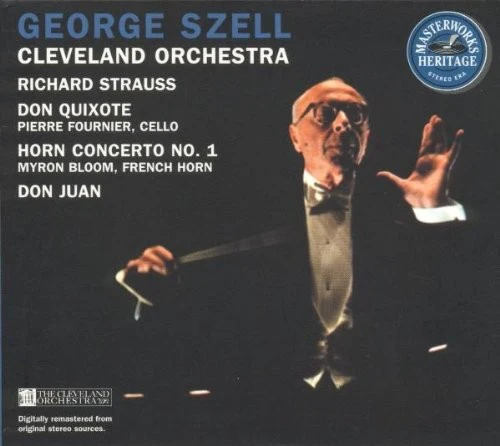
Strauss: Don Quixote, Horn Concerto No 1, Don Juan / Fournier, Bloom, Szell
Just how masterly Szell was as a Straussian is demonstrated in all three of these items, recorded in 1960 and 1961. By then Szell had built the Cleveland Orchestra into what was regularly described very fairly — as the finest in America. These performances with a slight reservation over the hectic opening of Don Juan bear out not just what tautness and precision of ensemble the orchestra were achieving, but the thrusting emotional intensity. Szell as a person was one of the most daunting of conductors, chilling anyone around him; he certainly had musical fires within him, a point I never doubted in the conversations I had with him in his last years. I am glad that the One of the century's great cellists, Pierre Fournier, in Don Quixote accompanied by George Szell Photo 11 m 1' booklet-note includes memories from the horn player, Myron Bloom, bearing out what feelings there were behind the chilly facade.
Bloom, one of the greatest of American horn players, promoted by Szell to be first horn in Cleveland in 1955, a year after he joined the orchestra, is also very well celebrated here. I was sorry when after Szell's death and Maazel's succession, he was persuaded to go to the Orchestre de Paris to sort out their horn section, for he made far too few solo recordings, and in Cleveland he might have made many more. This one of the Horn Concerto No. 1 is marvellous at bringing out the enormous range of dynamic and tone colour Bloom had at his command. In the outer movements lightness and agility are wonderfully contrasted with heroic power, and in the central slow movement the impact of the braying.fortissinio in the middle section is all the greater when set against such gentle poetry in the outer sections.
The other artist here celebrated is of course the cellist, Pierre Fournier, who made this version of Don Quixote several years before recording it with Karajan in Berlin for DG. The contrasts are fascinating, for against my expectation Fournier is freer in his rubato with Szell, who prefers more flowing speeds than Karajan, making this a noble portrait, the more intense for not being so expansive. The opening of Don Juan, as I said, is hectic in its pursuit of brilliance, but very quickly Szell finds the same combination of opulence and urgency that marks the rest of the disc. A most welcome historic reissue, very well transferred, with sound both warm and detailed.
-- Edward Greenfield, Gramophone [2/1998]
Bloom, one of the greatest of American horn players, promoted by Szell to be first horn in Cleveland in 1955, a year after he joined the orchestra, is also very well celebrated here. I was sorry when after Szell's death and Maazel's succession, he was persuaded to go to the Orchestre de Paris to sort out their horn section, for he made far too few solo recordings, and in Cleveland he might have made many more. This one of the Horn Concerto No. 1 is marvellous at bringing out the enormous range of dynamic and tone colour Bloom had at his command. In the outer movements lightness and agility are wonderfully contrasted with heroic power, and in the central slow movement the impact of the braying.fortissinio in the middle section is all the greater when set against such gentle poetry in the outer sections.
The other artist here celebrated is of course the cellist, Pierre Fournier, who made this version of Don Quixote several years before recording it with Karajan in Berlin for DG. The contrasts are fascinating, for against my expectation Fournier is freer in his rubato with Szell, who prefers more flowing speeds than Karajan, making this a noble portrait, the more intense for not being so expansive. The opening of Don Juan, as I said, is hectic in its pursuit of brilliance, but very quickly Szell finds the same combination of opulence and urgency that marks the rest of the disc. A most welcome historic reissue, very well transferred, with sound both warm and detailed.
-- Edward Greenfield, Gramophone [2/1998]
Just how masterly Szell was as a Straussian is demonstrated in all three of these items, recorded in 1960 and 1961. By then Szell had built the Cleveland Orchestra into what was regularly described very fairly — as the finest in America. These performances with a slight reservation over the hectic opening of Don Juan bear out not just what tautness and precision of ensemble the orchestra were achieving, but the thrusting emotional intensity. Szell as a person was one of the most daunting of conductors, chilling anyone around him; he certainly had musical fires within him, a point I never doubted in the conversations I had with him in his last years. I am glad that the One of the century's great cellists, Pierre Fournier, in Don Quixote accompanied by George Szell Photo 11 m 1' booklet-note includes memories from the horn player, Myron Bloom, bearing out what feelings there were behind the chilly facade.
Bloom, one of the greatest of American horn players, promoted by Szell to be first horn in Cleveland in 1955, a year after he joined the orchestra, is also very well celebrated here. I was sorry when after Szell's death and Maazel's succession, he was persuaded to go to the Orchestre de Paris to sort out their horn section, for he made far too few solo recordings, and in Cleveland he might have made many more. This one of the Horn Concerto No. 1 is marvellous at bringing out the enormous range of dynamic and tone colour Bloom had at his command. In the outer movements lightness and agility are wonderfully contrasted with heroic power, and in the central slow movement the impact of the braying.fortissinio in the middle section is all the greater when set against such gentle poetry in the outer sections.
The other artist here celebrated is of course the cellist, Pierre Fournier, who made this version of Don Quixote several years before recording it with Karajan in Berlin for DG. The contrasts are fascinating, for against my expectation Fournier is freer in his rubato with Szell, who prefers more flowing speeds than Karajan, making this a noble portrait, the more intense for not being so expansive. The opening of Don Juan, as I said, is hectic in its pursuit of brilliance, but very quickly Szell finds the same combination of opulence and urgency that marks the rest of the disc. A most welcome historic reissue, very well transferred, with sound both warm and detailed.
-- Edward Greenfield, Gramophone [2/1998]
Bloom, one of the greatest of American horn players, promoted by Szell to be first horn in Cleveland in 1955, a year after he joined the orchestra, is also very well celebrated here. I was sorry when after Szell's death and Maazel's succession, he was persuaded to go to the Orchestre de Paris to sort out their horn section, for he made far too few solo recordings, and in Cleveland he might have made many more. This one of the Horn Concerto No. 1 is marvellous at bringing out the enormous range of dynamic and tone colour Bloom had at his command. In the outer movements lightness and agility are wonderfully contrasted with heroic power, and in the central slow movement the impact of the braying.fortissinio in the middle section is all the greater when set against such gentle poetry in the outer sections.
The other artist here celebrated is of course the cellist, Pierre Fournier, who made this version of Don Quixote several years before recording it with Karajan in Berlin for DG. The contrasts are fascinating, for against my expectation Fournier is freer in his rubato with Szell, who prefers more flowing speeds than Karajan, making this a noble portrait, the more intense for not being so expansive. The opening of Don Juan, as I said, is hectic in its pursuit of brilliance, but very quickly Szell finds the same combination of opulence and urgency that marks the rest of the disc. A most welcome historic reissue, very well transferred, with sound both warm and detailed.
-- Edward Greenfield, Gramophone [2/1998]
$4.90
Original: $13.99
-65%Strauss: Don Quixote, Horn Concerto No 1, Don Juan / Fournier, Bloom, Szell—
$13.99
$4.90Description
Just how masterly Szell was as a Straussian is demonstrated in all three of these items, recorded in 1960 and 1961. By then Szell had built the Cleveland Orchestra into what was regularly described very fairly — as the finest in America. These performances with a slight reservation over the hectic opening of Don Juan bear out not just what tautness and precision of ensemble the orchestra were achieving, but the thrusting emotional intensity. Szell as a person was one of the most daunting of conductors, chilling anyone around him; he certainly had musical fires within him, a point I never doubted in the conversations I had with him in his last years. I am glad that the One of the century's great cellists, Pierre Fournier, in Don Quixote accompanied by George Szell Photo 11 m 1' booklet-note includes memories from the horn player, Myron Bloom, bearing out what feelings there were behind the chilly facade.
Bloom, one of the greatest of American horn players, promoted by Szell to be first horn in Cleveland in 1955, a year after he joined the orchestra, is also very well celebrated here. I was sorry when after Szell's death and Maazel's succession, he was persuaded to go to the Orchestre de Paris to sort out their horn section, for he made far too few solo recordings, and in Cleveland he might have made many more. This one of the Horn Concerto No. 1 is marvellous at bringing out the enormous range of dynamic and tone colour Bloom had at his command. In the outer movements lightness and agility are wonderfully contrasted with heroic power, and in the central slow movement the impact of the braying.fortissinio in the middle section is all the greater when set against such gentle poetry in the outer sections.
The other artist here celebrated is of course the cellist, Pierre Fournier, who made this version of Don Quixote several years before recording it with Karajan in Berlin for DG. The contrasts are fascinating, for against my expectation Fournier is freer in his rubato with Szell, who prefers more flowing speeds than Karajan, making this a noble portrait, the more intense for not being so expansive. The opening of Don Juan, as I said, is hectic in its pursuit of brilliance, but very quickly Szell finds the same combination of opulence and urgency that marks the rest of the disc. A most welcome historic reissue, very well transferred, with sound both warm and detailed.
-- Edward Greenfield, Gramophone [2/1998]
Bloom, one of the greatest of American horn players, promoted by Szell to be first horn in Cleveland in 1955, a year after he joined the orchestra, is also very well celebrated here. I was sorry when after Szell's death and Maazel's succession, he was persuaded to go to the Orchestre de Paris to sort out their horn section, for he made far too few solo recordings, and in Cleveland he might have made many more. This one of the Horn Concerto No. 1 is marvellous at bringing out the enormous range of dynamic and tone colour Bloom had at his command. In the outer movements lightness and agility are wonderfully contrasted with heroic power, and in the central slow movement the impact of the braying.fortissinio in the middle section is all the greater when set against such gentle poetry in the outer sections.
The other artist here celebrated is of course the cellist, Pierre Fournier, who made this version of Don Quixote several years before recording it with Karajan in Berlin for DG. The contrasts are fascinating, for against my expectation Fournier is freer in his rubato with Szell, who prefers more flowing speeds than Karajan, making this a noble portrait, the more intense for not being so expansive. The opening of Don Juan, as I said, is hectic in its pursuit of brilliance, but very quickly Szell finds the same combination of opulence and urgency that marks the rest of the disc. A most welcome historic reissue, very well transferred, with sound both warm and detailed.
-- Edward Greenfield, Gramophone [2/1998]