🎉 Up to 70% Off Selected ItemsShop Sale

1 / 2
Strauss: Serenade Op 7, Symphony For Winds; Dvorak / Meyer
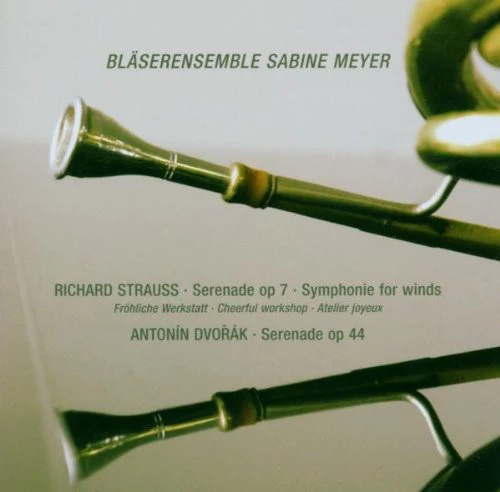
R. STRAUSS Serenade for Winds. Symphonie for Winds. DVO?ÁK Serenade for Winds • Sabine Meyer Wind Ens • CAVI-MUSIC 553014 (70:14)
In the relatively insular world of classical music for wind ensemble, Mozart’s Serenade No. 10, “Gran Partita” is the towering colossus that profoundly influenced nearly all of the similar works that followed, though it must be stated that the literature for combinations of wind instruments is certainly limited. This is not a phenomenon on the level of the effect of Wagner’s Tristan und Isolde on virtually every subsequent composer who was forced to deal with it in one way or another. The three pieces on this CD are important pillars of the wind-ensemble literature of the 19th and early 20th centuries. The music of Strauss and Dvo?ák reflects the influence of Mozart, but in their own highly personal and individual ways. The Strauss pieces essentially apply bookends to his career. The Serenade, op. 7, written at the age of 16, displays the expected rich, romantic, harmonic textures and a flowing melodic line, but there are also hints of Mozart’s “Gran Partita.” Strauss was apparently not completely satisfied with the scoring of his youthful Serenade for four horns and nine other wind instruments. Following the completion of his last opera Capriccio , he returned to the wind ensemble near the end of his life and produced the unconventionally large-scaled Symphonie for Wind Instruments (also known as “Cheerful Workshops”). It is elaborately scored for 12 winds, in addition to the same four horns utilized in his youthful Serenade . The Symphonie explores many of the brilliant and characteristic wind effects that appeared in many of his major orchestral works and operas throughout his career.
Dvo?ák’s well-known Serenade is filled with references to various Bohemian dances, but the influence of Mozart is also there. This is especially apparent in the Andante, where he ingeniously metamorphoses the melodic contours and bass line of the Adagio from the “Gran Partita” into something that is all his own, as an apparent homage to Mozart. The Sabine Meyer Wind Ensemble plays the music nearly flawlessly in an affectionate but low-key sort of way. The effect is augmented by sound that is quite different from the Eastman Wind Ensemble’s demonstration recording that includes Mozart’s “Gran Partita” and Strauss’s early Serenade . As expected, Mercury gives us analytical clarity with an up front aural perspective that clearly emphasizes the subtle timbral nuances and colorations of the different wind combinations. This approach also presents a lot of clicking and clacking that will be annoying to some listeners.
This Cavi-Music CD is recorded with a more distant mid-hall perspective in what sounds like a larger hall with a darker tonal color. The instruments sound more congealed and at times slightly muffled, but there is little or no audible clicking. I prefer the Mercury approach because of its tonal and timbral accuracy, immediacy, and presence, but that is also a matter of taste. The response of many listeners to what is undoubtedly great wind music, played excellently, will be about sonority. The sound of a wind ensemble is definitely not everyone’s cup of tea. If you like it, you will undoubtedly enjoy this well-chosen and well-performed concert.
FANFARE: Arthur Lintgen
R. STRAUSS Serenade for Winds. Symphonie for Winds. DVO?ÁK Serenade for Winds • Sabine Meyer Wind Ens • CAVI-MUSIC 553014 (70:14)
In the relatively insular world of classical music for wind ensemble, Mozart’s Serenade No. 10, “Gran Partita” is the towering colossus that profoundly influenced nearly all of the similar works that followed, though it must be stated that the literature for combinations of wind instruments is certainly limited. This is not a phenomenon on the level of the effect of Wagner’s Tristan und Isolde on virtually every subsequent composer who was forced to deal with it in one way or another. The three pieces on this CD are important pillars of the wind-ensemble literature of the 19th and early 20th centuries. The music of Strauss and Dvo?ák reflects the influence of Mozart, but in their own highly personal and individual ways. The Strauss pieces essentially apply bookends to his career. The Serenade, op. 7, written at the age of 16, displays the expected rich, romantic, harmonic textures and a flowing melodic line, but there are also hints of Mozart’s “Gran Partita.” Strauss was apparently not completely satisfied with the scoring of his youthful Serenade for four horns and nine other wind instruments. Following the completion of his last opera Capriccio , he returned to the wind ensemble near the end of his life and produced the unconventionally large-scaled Symphonie for Wind Instruments (also known as “Cheerful Workshops”). It is elaborately scored for 12 winds, in addition to the same four horns utilized in his youthful Serenade . The Symphonie explores many of the brilliant and characteristic wind effects that appeared in many of his major orchestral works and operas throughout his career.
Dvo?ák’s well-known Serenade is filled with references to various Bohemian dances, but the influence of Mozart is also there. This is especially apparent in the Andante, where he ingeniously metamorphoses the melodic contours and bass line of the Adagio from the “Gran Partita” into something that is all his own, as an apparent homage to Mozart. The Sabine Meyer Wind Ensemble plays the music nearly flawlessly in an affectionate but low-key sort of way. The effect is augmented by sound that is quite different from the Eastman Wind Ensemble’s demonstration recording that includes Mozart’s “Gran Partita” and Strauss’s early Serenade . As expected, Mercury gives us analytical clarity with an up front aural perspective that clearly emphasizes the subtle timbral nuances and colorations of the different wind combinations. This approach also presents a lot of clicking and clacking that will be annoying to some listeners.
This Cavi-Music CD is recorded with a more distant mid-hall perspective in what sounds like a larger hall with a darker tonal color. The instruments sound more congealed and at times slightly muffled, but there is little or no audible clicking. I prefer the Mercury approach because of its tonal and timbral accuracy, immediacy, and presence, but that is also a matter of taste. The response of many listeners to what is undoubtedly great wind music, played excellently, will be about sonority. The sound of a wind ensemble is definitely not everyone’s cup of tea. If you like it, you will undoubtedly enjoy this well-chosen and well-performed concert.
FANFARE: Arthur Lintgen
$5.25
Original: $14.99
-65%Strauss: Serenade Op 7, Symphony For Winds; Dvorak / Meyer—
$14.99
$5.25Description
R. STRAUSS Serenade for Winds. Symphonie for Winds. DVO?ÁK Serenade for Winds • Sabine Meyer Wind Ens • CAVI-MUSIC 553014 (70:14)
In the relatively insular world of classical music for wind ensemble, Mozart’s Serenade No. 10, “Gran Partita” is the towering colossus that profoundly influenced nearly all of the similar works that followed, though it must be stated that the literature for combinations of wind instruments is certainly limited. This is not a phenomenon on the level of the effect of Wagner’s Tristan und Isolde on virtually every subsequent composer who was forced to deal with it in one way or another. The three pieces on this CD are important pillars of the wind-ensemble literature of the 19th and early 20th centuries. The music of Strauss and Dvo?ák reflects the influence of Mozart, but in their own highly personal and individual ways. The Strauss pieces essentially apply bookends to his career. The Serenade, op. 7, written at the age of 16, displays the expected rich, romantic, harmonic textures and a flowing melodic line, but there are also hints of Mozart’s “Gran Partita.” Strauss was apparently not completely satisfied with the scoring of his youthful Serenade for four horns and nine other wind instruments. Following the completion of his last opera Capriccio , he returned to the wind ensemble near the end of his life and produced the unconventionally large-scaled Symphonie for Wind Instruments (also known as “Cheerful Workshops”). It is elaborately scored for 12 winds, in addition to the same four horns utilized in his youthful Serenade . The Symphonie explores many of the brilliant and characteristic wind effects that appeared in many of his major orchestral works and operas throughout his career.
Dvo?ák’s well-known Serenade is filled with references to various Bohemian dances, but the influence of Mozart is also there. This is especially apparent in the Andante, where he ingeniously metamorphoses the melodic contours and bass line of the Adagio from the “Gran Partita” into something that is all his own, as an apparent homage to Mozart. The Sabine Meyer Wind Ensemble plays the music nearly flawlessly in an affectionate but low-key sort of way. The effect is augmented by sound that is quite different from the Eastman Wind Ensemble’s demonstration recording that includes Mozart’s “Gran Partita” and Strauss’s early Serenade . As expected, Mercury gives us analytical clarity with an up front aural perspective that clearly emphasizes the subtle timbral nuances and colorations of the different wind combinations. This approach also presents a lot of clicking and clacking that will be annoying to some listeners.
This Cavi-Music CD is recorded with a more distant mid-hall perspective in what sounds like a larger hall with a darker tonal color. The instruments sound more congealed and at times slightly muffled, but there is little or no audible clicking. I prefer the Mercury approach because of its tonal and timbral accuracy, immediacy, and presence, but that is also a matter of taste. The response of many listeners to what is undoubtedly great wind music, played excellently, will be about sonority. The sound of a wind ensemble is definitely not everyone’s cup of tea. If you like it, you will undoubtedly enjoy this well-chosen and well-performed concert.
FANFARE: Arthur Lintgen