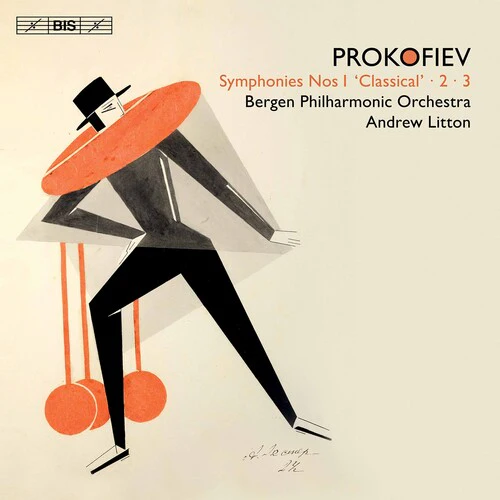
Prokofiev: Symphonies Nos. 1-3 / Litton, Bergen Philharmonic
As a composer Sergei Prokofiev was so versatile that audiences never quite knew what to expect. As a strategy, this could misfire but with his first symphony he got things just right. He once described what he had wanted to achieve: ‘If Haydn had lived into this era he would have kept his own style while absorbing things from what was new in music. That’s the kind of symphony I wanted to write...’ The ‘Classical’ symphony has been a true classic since its first performance in 1918 and is one of the few genuinely witty pieces in the twentieth-century orchestral repertory. A few months after the performance, Prokofiev left Russia for the USA where he remained for some years before settling in Paris in 1923. It was here that he composed the Second Symphony, now with the aim to be as up-to-date as possible. The first audience in 1925 was more bewildered than enthusiastic, however, and Prokofiev himself came to have doubts, wondering whether in this symphony ‘made out of iron and steel’ he’d overdone the rough counterpoint and density of texture. He now returned to a project he had been working on for several years – the opera The Fiery Angel. In 1928, when he began to think that no opera house would take it up, Prokofiev decided to reuse the music and found that ‘the material unexpectedly packed itself up into a four-movement symphony’ – his Third, characterized by an overwhelming sense of anxiety and tension. The present disc is the fourth and last in a symphony cycle which has earned the Bergen Philharmonic Orchestra and Andrew Litton critical acclaim worldwide.
REVIEW:
This disc represents one heck of a deal–86 minutes of first-class Prokofiev courtesy of BIS, Andrew Litton and the Bergen Philharmonic. The “Classical” Symphony receives a performance in which nothing–and I mean NOTHING–gets taken for granted. Litton adopts a leisurely tempo for the opening movement, allowing sufficient time for each delectable instrumental detail to register. The entire performance sounds like chamber music writ large. At this stage in his career, Litton’s conducting has become more heavily inflected, sometimes to the point of mannerism. You can hear this approach most clearly in the Gavotte, but never (in this case) to the point of excess–and the finale is probably the most pointed and characterful version currently available. If you think you know this music cold, think again. You’ve got to hear this.
The Second and Third Symphonies both belong to Prokofiev’s “gnarly” phase, but I think they’re much better than their reputation leads us to believe. At least in these performances, Litton uncovers a world of color and nuance, never mind an abundance of melody sometimes concealed beneath and within the music’s hard-edged exterior. The Second Symphony’s concluding variation movement, for example, contains an entire population of captivating vignettes, and each one springs vividly to life. Similarly, Litton and the Bergen players beautifully declog the dense textures in the Third Symphony’s outer movements while still leaving the music plenty of room to shock. This work, in particular, has been very lucky on disc in the digital era, with superb versions from Järvi, Chailly, and above all, Muti; but this newcomer certainly belongs in their company.
In sum these performances, engineered with warmth, clarity and impact, rank with best best; and having all three symphonies on a single disc makes this release something of a bargain as well–even at full price.
– ClassicsToday.com (10/10; David Hurwitz)
As a composer Sergei Prokofiev was so versatile that audiences never quite knew what to expect. As a strategy, this could misfire but with his first symphony he got things just right. He once described what he had wanted to achieve: ‘If Haydn had lived into this era he would have kept his own style while absorbing things from what was new in music. That’s the kind of symphony I wanted to write...’ The ‘Classical’ symphony has been a true classic since its first performance in 1918 and is one of the few genuinely witty pieces in the twentieth-century orchestral repertory. A few months after the performance, Prokofiev left Russia for the USA where he remained for some years before settling in Paris in 1923. It was here that he composed the Second Symphony, now with the aim to be as up-to-date as possible. The first audience in 1925 was more bewildered than enthusiastic, however, and Prokofiev himself came to have doubts, wondering whether in this symphony ‘made out of iron and steel’ he’d overdone the rough counterpoint and density of texture. He now returned to a project he had been working on for several years – the opera The Fiery Angel. In 1928, when he began to think that no opera house would take it up, Prokofiev decided to reuse the music and found that ‘the material unexpectedly packed itself up into a four-movement symphony’ – his Third, characterized by an overwhelming sense of anxiety and tension. The present disc is the fourth and last in a symphony cycle which has earned the Bergen Philharmonic Orchestra and Andrew Litton critical acclaim worldwide.
REVIEW:
This disc represents one heck of a deal–86 minutes of first-class Prokofiev courtesy of BIS, Andrew Litton and the Bergen Philharmonic. The “Classical” Symphony receives a performance in which nothing–and I mean NOTHING–gets taken for granted. Litton adopts a leisurely tempo for the opening movement, allowing sufficient time for each delectable instrumental detail to register. The entire performance sounds like chamber music writ large. At this stage in his career, Litton’s conducting has become more heavily inflected, sometimes to the point of mannerism. You can hear this approach most clearly in the Gavotte, but never (in this case) to the point of excess–and the finale is probably the most pointed and characterful version currently available. If you think you know this music cold, think again. You’ve got to hear this.
The Second and Third Symphonies both belong to Prokofiev’s “gnarly” phase, but I think they’re much better than their reputation leads us to believe. At least in these performances, Litton uncovers a world of color and nuance, never mind an abundance of melody sometimes concealed beneath and within the music’s hard-edged exterior. The Second Symphony’s concluding variation movement, for example, contains an entire population of captivating vignettes, and each one springs vividly to life. Similarly, Litton and the Bergen players beautifully declog the dense textures in the Third Symphony’s outer movements while still leaving the music plenty of room to shock. This work, in particular, has been very lucky on disc in the digital era, with superb versions from Järvi, Chailly, and above all, Muti; but this newcomer certainly belongs in their company.
In sum these performances, engineered with warmth, clarity and impact, rank with best best; and having all three symphonies on a single disc makes this release something of a bargain as well–even at full price.
– ClassicsToday.com (10/10; David Hurwitz)
Description
As a composer Sergei Prokofiev was so versatile that audiences never quite knew what to expect. As a strategy, this could misfire but with his first symphony he got things just right. He once described what he had wanted to achieve: ‘If Haydn had lived into this era he would have kept his own style while absorbing things from what was new in music. That’s the kind of symphony I wanted to write...’ The ‘Classical’ symphony has been a true classic since its first performance in 1918 and is one of the few genuinely witty pieces in the twentieth-century orchestral repertory. A few months after the performance, Prokofiev left Russia for the USA where he remained for some years before settling in Paris in 1923. It was here that he composed the Second Symphony, now with the aim to be as up-to-date as possible. The first audience in 1925 was more bewildered than enthusiastic, however, and Prokofiev himself came to have doubts, wondering whether in this symphony ‘made out of iron and steel’ he’d overdone the rough counterpoint and density of texture. He now returned to a project he had been working on for several years – the opera The Fiery Angel. In 1928, when he began to think that no opera house would take it up, Prokofiev decided to reuse the music and found that ‘the material unexpectedly packed itself up into a four-movement symphony’ – his Third, characterized by an overwhelming sense of anxiety and tension. The present disc is the fourth and last in a symphony cycle which has earned the Bergen Philharmonic Orchestra and Andrew Litton critical acclaim worldwide.
REVIEW:
This disc represents one heck of a deal–86 minutes of first-class Prokofiev courtesy of BIS, Andrew Litton and the Bergen Philharmonic. The “Classical” Symphony receives a performance in which nothing–and I mean NOTHING–gets taken for granted. Litton adopts a leisurely tempo for the opening movement, allowing sufficient time for each delectable instrumental detail to register. The entire performance sounds like chamber music writ large. At this stage in his career, Litton’s conducting has become more heavily inflected, sometimes to the point of mannerism. You can hear this approach most clearly in the Gavotte, but never (in this case) to the point of excess–and the finale is probably the most pointed and characterful version currently available. If you think you know this music cold, think again. You’ve got to hear this.
The Second and Third Symphonies both belong to Prokofiev’s “gnarly” phase, but I think they’re much better than their reputation leads us to believe. At least in these performances, Litton uncovers a world of color and nuance, never mind an abundance of melody sometimes concealed beneath and within the music’s hard-edged exterior. The Second Symphony’s concluding variation movement, for example, contains an entire population of captivating vignettes, and each one springs vividly to life. Similarly, Litton and the Bergen players beautifully declog the dense textures in the Third Symphony’s outer movements while still leaving the music plenty of room to shock. This work, in particular, has been very lucky on disc in the digital era, with superb versions from Järvi, Chailly, and above all, Muti; but this newcomer certainly belongs in their company.
In sum these performances, engineered with warmth, clarity and impact, rank with best best; and having all three symphonies on a single disc makes this release something of a bargain as well–even at full price.
– ClassicsToday.com (10/10; David Hurwitz)