🎉 Up to 70% Off Selected ItemsShop Sale

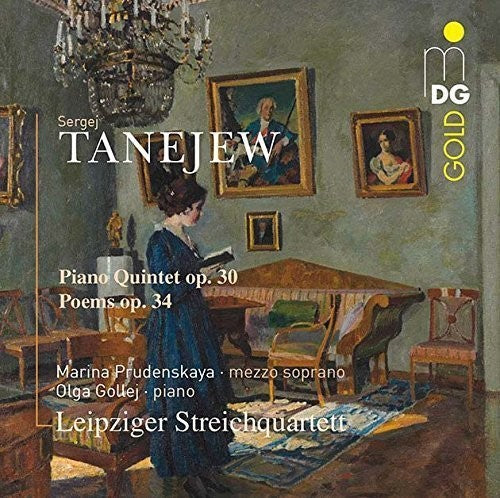
Taneyev: Piano Quintet, Op. 30 & Poems, Op. 34 / Prudenskaya, Gollej, Leipzig Quartet
Sergei Taneyev's Piano Quintet, op. 30 is as passionate as you could wish; it's a huge piece, lasting nearly 50 minutes. The first movement alone lasts nearly twenty. The idiom is late-Romantic, owing something to Brahms but to my mind it is much closer to César Franck, as it is as passionate a work as Franck’s piano quintet. A sombre, very chromatic opening leads to an anguished allegro. The themes are good. The piano writing is very rich, almost in concertante style, often in opposition to the strings as a group. The first movement is long and strenuous but varied in texture and with moments of relief. It builds to a tremendous climax at the beginning of the recapitulation with a pounding bass in the piano while the strings cry out over it. There is a stretto coda full of dark imaginings.
The scherzo is lighter in mood, featuring a theme of repeated notes. In contrast to the first movement the players here have to be light on their feet. The trio section is slower and features long, winding lines in the strings while the piano writing is less full, almost Mendelssohnian. We return to the opening music, if anything even faster than before.
The slow movement begins with a powerful theme in the bass which turns out to be that of a passacaglia, repeating under a melody which gradually takes shape above it, increasingly decorated. Apparently this is the first passacaglia in Russian music; it is certainly impressive.
The finale features a vivid theme in jagged rhythms and another with a soaring lyrical line. After a good deal of strenuous writing there is a very quiet passage. We return to more energetic writing before the close, with restless modulations suggesting a search for a conclusion which finally arrives with an evocation of the pealing of bells.
The coupling is a song-cycle, Taneyev’s last, which sets poems by Jakov Polonski (1819-1898) who is apparently highly regarded in Russia. These songs all deal with love, but my appreciation was hindered by the fact that they are sung in Russian, while the booklet gives them only in German, with neither the original Russian nor an English translation. While Olga Gollej does sterling work on the piano both here and in the quintet, Marina Prudenskaya, basically an operatic mezzo, indeed a Wagnerian, seems to have some difficulty fining her voice down to the scale needed for songs with piano. There is also a slight edge to her voice and a certain unsteadiness.
There are no such reservations about the performance of the Piano Quintet. The Leipzig String Quartet is a well established group who apply themselves to Taneyev’s work with enthusiasm. The recording maintains a good balance between the piano and the strings, in an acoustic suggestive of a small concert hall. There are now several other versions of this work to choose from; however, if you want the songs, this is currently the only available recording, which might sway the balance for some listeners.
– MusicWeb International (Stephen Barber)
The scherzo is lighter in mood, featuring a theme of repeated notes. In contrast to the first movement the players here have to be light on their feet. The trio section is slower and features long, winding lines in the strings while the piano writing is less full, almost Mendelssohnian. We return to the opening music, if anything even faster than before.
The slow movement begins with a powerful theme in the bass which turns out to be that of a passacaglia, repeating under a melody which gradually takes shape above it, increasingly decorated. Apparently this is the first passacaglia in Russian music; it is certainly impressive.
The finale features a vivid theme in jagged rhythms and another with a soaring lyrical line. After a good deal of strenuous writing there is a very quiet passage. We return to more energetic writing before the close, with restless modulations suggesting a search for a conclusion which finally arrives with an evocation of the pealing of bells.
The coupling is a song-cycle, Taneyev’s last, which sets poems by Jakov Polonski (1819-1898) who is apparently highly regarded in Russia. These songs all deal with love, but my appreciation was hindered by the fact that they are sung in Russian, while the booklet gives them only in German, with neither the original Russian nor an English translation. While Olga Gollej does sterling work on the piano both here and in the quintet, Marina Prudenskaya, basically an operatic mezzo, indeed a Wagnerian, seems to have some difficulty fining her voice down to the scale needed for songs with piano. There is also a slight edge to her voice and a certain unsteadiness.
There are no such reservations about the performance of the Piano Quintet. The Leipzig String Quartet is a well established group who apply themselves to Taneyev’s work with enthusiasm. The recording maintains a good balance between the piano and the strings, in an acoustic suggestive of a small concert hall. There are now several other versions of this work to choose from; however, if you want the songs, this is currently the only available recording, which might sway the balance for some listeners.
– MusicWeb International (Stephen Barber)
Sergei Taneyev's Piano Quintet, op. 30 is as passionate as you could wish; it's a huge piece, lasting nearly 50 minutes. The first movement alone lasts nearly twenty. The idiom is late-Romantic, owing something to Brahms but to my mind it is much closer to César Franck, as it is as passionate a work as Franck’s piano quintet. A sombre, very chromatic opening leads to an anguished allegro. The themes are good. The piano writing is very rich, almost in concertante style, often in opposition to the strings as a group. The first movement is long and strenuous but varied in texture and with moments of relief. It builds to a tremendous climax at the beginning of the recapitulation with a pounding bass in the piano while the strings cry out over it. There is a stretto coda full of dark imaginings.
The scherzo is lighter in mood, featuring a theme of repeated notes. In contrast to the first movement the players here have to be light on their feet. The trio section is slower and features long, winding lines in the strings while the piano writing is less full, almost Mendelssohnian. We return to the opening music, if anything even faster than before.
The slow movement begins with a powerful theme in the bass which turns out to be that of a passacaglia, repeating under a melody which gradually takes shape above it, increasingly decorated. Apparently this is the first passacaglia in Russian music; it is certainly impressive.
The finale features a vivid theme in jagged rhythms and another with a soaring lyrical line. After a good deal of strenuous writing there is a very quiet passage. We return to more energetic writing before the close, with restless modulations suggesting a search for a conclusion which finally arrives with an evocation of the pealing of bells.
The coupling is a song-cycle, Taneyev’s last, which sets poems by Jakov Polonski (1819-1898) who is apparently highly regarded in Russia. These songs all deal with love, but my appreciation was hindered by the fact that they are sung in Russian, while the booklet gives them only in German, with neither the original Russian nor an English translation. While Olga Gollej does sterling work on the piano both here and in the quintet, Marina Prudenskaya, basically an operatic mezzo, indeed a Wagnerian, seems to have some difficulty fining her voice down to the scale needed for songs with piano. There is also a slight edge to her voice and a certain unsteadiness.
There are no such reservations about the performance of the Piano Quintet. The Leipzig String Quartet is a well established group who apply themselves to Taneyev’s work with enthusiasm. The recording maintains a good balance between the piano and the strings, in an acoustic suggestive of a small concert hall. There are now several other versions of this work to choose from; however, if you want the songs, this is currently the only available recording, which might sway the balance for some listeners.
– MusicWeb International (Stephen Barber)
The scherzo is lighter in mood, featuring a theme of repeated notes. In contrast to the first movement the players here have to be light on their feet. The trio section is slower and features long, winding lines in the strings while the piano writing is less full, almost Mendelssohnian. We return to the opening music, if anything even faster than before.
The slow movement begins with a powerful theme in the bass which turns out to be that of a passacaglia, repeating under a melody which gradually takes shape above it, increasingly decorated. Apparently this is the first passacaglia in Russian music; it is certainly impressive.
The finale features a vivid theme in jagged rhythms and another with a soaring lyrical line. After a good deal of strenuous writing there is a very quiet passage. We return to more energetic writing before the close, with restless modulations suggesting a search for a conclusion which finally arrives with an evocation of the pealing of bells.
The coupling is a song-cycle, Taneyev’s last, which sets poems by Jakov Polonski (1819-1898) who is apparently highly regarded in Russia. These songs all deal with love, but my appreciation was hindered by the fact that they are sung in Russian, while the booklet gives them only in German, with neither the original Russian nor an English translation. While Olga Gollej does sterling work on the piano both here and in the quintet, Marina Prudenskaya, basically an operatic mezzo, indeed a Wagnerian, seems to have some difficulty fining her voice down to the scale needed for songs with piano. There is also a slight edge to her voice and a certain unsteadiness.
There are no such reservations about the performance of the Piano Quintet. The Leipzig String Quartet is a well established group who apply themselves to Taneyev’s work with enthusiasm. The recording maintains a good balance between the piano and the strings, in an acoustic suggestive of a small concert hall. There are now several other versions of this work to choose from; however, if you want the songs, this is currently the only available recording, which might sway the balance for some listeners.
– MusicWeb International (Stephen Barber)
$8.40
Original: $23.99
-65%Taneyev: Piano Quintet, Op. 30 & Poems, Op. 34 / Prudenskaya, Gollej, Leipzig Quartet—
$23.99
$8.40Description
Sergei Taneyev's Piano Quintet, op. 30 is as passionate as you could wish; it's a huge piece, lasting nearly 50 minutes. The first movement alone lasts nearly twenty. The idiom is late-Romantic, owing something to Brahms but to my mind it is much closer to César Franck, as it is as passionate a work as Franck’s piano quintet. A sombre, very chromatic opening leads to an anguished allegro. The themes are good. The piano writing is very rich, almost in concertante style, often in opposition to the strings as a group. The first movement is long and strenuous but varied in texture and with moments of relief. It builds to a tremendous climax at the beginning of the recapitulation with a pounding bass in the piano while the strings cry out over it. There is a stretto coda full of dark imaginings.
The scherzo is lighter in mood, featuring a theme of repeated notes. In contrast to the first movement the players here have to be light on their feet. The trio section is slower and features long, winding lines in the strings while the piano writing is less full, almost Mendelssohnian. We return to the opening music, if anything even faster than before.
The slow movement begins with a powerful theme in the bass which turns out to be that of a passacaglia, repeating under a melody which gradually takes shape above it, increasingly decorated. Apparently this is the first passacaglia in Russian music; it is certainly impressive.
The finale features a vivid theme in jagged rhythms and another with a soaring lyrical line. After a good deal of strenuous writing there is a very quiet passage. We return to more energetic writing before the close, with restless modulations suggesting a search for a conclusion which finally arrives with an evocation of the pealing of bells.
The coupling is a song-cycle, Taneyev’s last, which sets poems by Jakov Polonski (1819-1898) who is apparently highly regarded in Russia. These songs all deal with love, but my appreciation was hindered by the fact that they are sung in Russian, while the booklet gives them only in German, with neither the original Russian nor an English translation. While Olga Gollej does sterling work on the piano both here and in the quintet, Marina Prudenskaya, basically an operatic mezzo, indeed a Wagnerian, seems to have some difficulty fining her voice down to the scale needed for songs with piano. There is also a slight edge to her voice and a certain unsteadiness.
There are no such reservations about the performance of the Piano Quintet. The Leipzig String Quartet is a well established group who apply themselves to Taneyev’s work with enthusiasm. The recording maintains a good balance between the piano and the strings, in an acoustic suggestive of a small concert hall. There are now several other versions of this work to choose from; however, if you want the songs, this is currently the only available recording, which might sway the balance for some listeners.
– MusicWeb International (Stephen Barber)
The scherzo is lighter in mood, featuring a theme of repeated notes. In contrast to the first movement the players here have to be light on their feet. The trio section is slower and features long, winding lines in the strings while the piano writing is less full, almost Mendelssohnian. We return to the opening music, if anything even faster than before.
The slow movement begins with a powerful theme in the bass which turns out to be that of a passacaglia, repeating under a melody which gradually takes shape above it, increasingly decorated. Apparently this is the first passacaglia in Russian music; it is certainly impressive.
The finale features a vivid theme in jagged rhythms and another with a soaring lyrical line. After a good deal of strenuous writing there is a very quiet passage. We return to more energetic writing before the close, with restless modulations suggesting a search for a conclusion which finally arrives with an evocation of the pealing of bells.
The coupling is a song-cycle, Taneyev’s last, which sets poems by Jakov Polonski (1819-1898) who is apparently highly regarded in Russia. These songs all deal with love, but my appreciation was hindered by the fact that they are sung in Russian, while the booklet gives them only in German, with neither the original Russian nor an English translation. While Olga Gollej does sterling work on the piano both here and in the quintet, Marina Prudenskaya, basically an operatic mezzo, indeed a Wagnerian, seems to have some difficulty fining her voice down to the scale needed for songs with piano. There is also a slight edge to her voice and a certain unsteadiness.
There are no such reservations about the performance of the Piano Quintet. The Leipzig String Quartet is a well established group who apply themselves to Taneyev’s work with enthusiasm. The recording maintains a good balance between the piano and the strings, in an acoustic suggestive of a small concert hall. There are now several other versions of this work to choose from; however, if you want the songs, this is currently the only available recording, which might sway the balance for some listeners.
– MusicWeb International (Stephen Barber)






















