🎉 Up to 70% Off Selected ItemsShop Sale

1 / 2
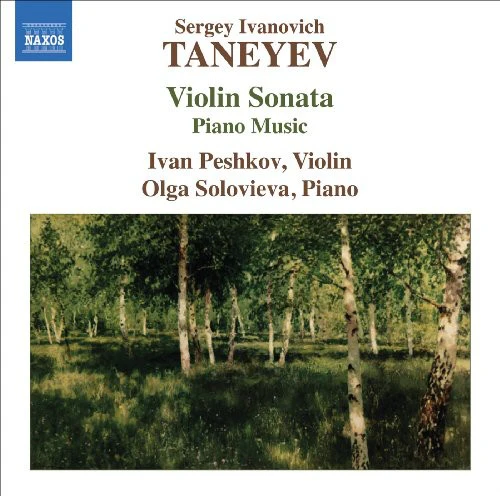
Taneyev: Violin Sonata, Piano Music / Olga Solovieva, Et Al
TANEYEV Violin Sonata in a. 1 Theme and Variations in C. Repose. Scherzos: in d; in g; in e?; in C; in F. Prelude in F. Quadrille. Andantino semplice. Prelude and Fugue in g?, op. 29. Romance, op. 26/6 (arr. Feigin) 1 • Olga Solovieva (pn); Ivan Peshkov (vn) 1 • NAXOS 8.557804 (72:41)
After several decades in the wilderness, Sergey Ivanovich Taneyev (1856–1915) is enjoying somewhat of a comeback, with a number of recent recordings introducing him anew to audiences that may have known his name but have heard little of his music. With Nikolai Rubinstein as his piano teacher and Tchaikovsky as his instructor in composition, Taneyev graduated from the Moscow Conservatory with honors. He made his concert debut in Moscow in 1875 playing Brahms’s D-Minor Concerto, and the following year he toured Russia as accompanist to the great violinist Leopold Auer.
Unfortunately for Taneyev, a dyed-in-the-wool musical conservative who distinguished himself as a performing artist in the works of Bach, Mozart, and Beethoven, and who, as a composer, cast his countenance ever further West and further back than Tchaikovsky, becoming an expert in the techniques of 15th-century vocal polyphony and 16th-century counterpoint, he ran afoul of his Russian nationalist contemporaries. No love was lost between them. Taneyev was disdainful of the “Mighty Handful,” publicly reproaching Balakirev, calling Borodin “a clever dilettante,” and remarking that Mussorgsky made him laugh. He was a bit more deferential towards Rimsky-Korsakov, respecting the composer of Scheherazade for his serious study of counterpoint.
Taneyev’s personality and outlook are perhaps a bit easier to understand when one realizes that he was, in his own mind, anyway, an unfairly untitled aristocrat. Coming from a wealthy family, he enjoyed the resources to pursue his interests in science, history, mathematics, and philosophy. Traveling extensively, he rubbed elbows with literary figures such as Zola and Flaubert, and with musical celebrities such as Franck and Saint-Saëns. Taneyev’s attitude towards the progressive composers and modern music of his day was not dissimilar from that of his older but longer-lived French contemporary, Saint-Saëns; both abhorred what they saw as unschooled, undisciplined dilettantism in any field of endeavor, but especially in music and the arts. When Tchaikovsky left his position at the Moscow Conservatory in 1878, Taneyev replaced him; during his tenure there, Scriabin, Rachmaninoff, Gliere, and Medtner, among others, benefitted from Taneyev’s teaching, though each went his own way once out from under his influence.
The five scherzos for solo piano on this CD, written between 1874 and 1875, are asterisked as being world premiere recordings. And grateful we should be to pianist Olga Solovieva and Naxos for outing them, for they are gem-like beauties, which, in melodic and harmonic vocabulary, are heavily indebted, according to note author Anastasia Belina, to Schumann and Tchaikovsky.
The major work on the program, Taneyev’s 1911 A-Minor Violin Sonata, carries the subtitle, “Of medium difficulty.” The piece was new to me, though there is another recent recording of it listed on the Northern Flowers label. Melodically, as well as in the close exchanges and echoing back and forth of material, the writing bears resemblances to the op. 12 violin sonatas of Beethoven, not surprising, given Taneyev’s Classical leanings and his touring with Auer. Based on the hearing of it—I don’t have the score—I’m fairly confident in saying that the piece is technically easier to play than the Beethoven sonatas. Filled with charming melodies for the violin and delightful effects in the piano part, Taneyev’s Sonata would make a wonderful work for any moderately advanced violin student.
Though Naxos is not claiming premiere recording status for the C-Major Theme and Variations, this is the only current listing I find for it. The piece is a student work dated 1874. Taneyev was 18 at the time and still under Tchaikovsky’s supervision. According to Belina’s note, Taneyev’s exercise was heavily influenced by Tchaikovsky’s “Thème original et variations,” the concluding number in his Six Pieces for Piano , op. 19, which appeared in 1873, the year before Taneyev wrote his work. Evidence in support of Belina’s contention comes in the form of a theme Taneyev borrowed from the finale of Tchaikovsky’s Second String Quartet as a counter-melody in the second variation. The transmigration from Tchaikovsky’s Quartet to Taneyev’s Variations must have happened at the speed of light, for both works were written at virtually the same time.
Of the remaining pieces on the disc for solo piano, the Quadrille is the most interesting and the longest at almost eight minutes. Careful listening reveals that Taneyev did not use the title flippantly or fancifully. He was too much of a stickler for correctitude. Technically and formally, a quadrille is an ancient and very complex dance that became all the rage, alongside the waltz craze, in 19th-century Vienna. If written according to the Viennese form, which Taneyev’s is, the dance is comprised of six sections: (1) an open rondo-form, the “Pantalon,” in 2/4 or 6/8 time; (2) the “Été,” always in 2/4; (3) the “Poule,” a closed rondo form, always in 6/8; (4) the “Trénis,” a mirrored binary form (A-B-B-A); (5) the “Pastourelle,” a modified rondo, always in 2/4; and (6) “Finale,” a double ternary form (AA-BB-AA) in 2/4 time in which each statement of the theme is eight bars in length. It’s fascinating to listen to the precision with which Taneyev adheres to the formal scheme in his whirligig Quadrille.
Finally, there is the Romance adapted for violin and piano from the composer’s song cycle, Immortelles . The appearance of the right-hand piano’s notes on the page is alleged to resemble the stalactites of the song’s title, “Stalaktitï.” While there is a static “dripping-tears” character to the piece, I wouldn’t put too much stock in the analogy, especially if you, like me, associate stalactites with the freakish icicle-like formations found in cold limestone caves. Taneyev’s Romance may be tearful, even sentimental, but it’s heartwarming in the same way that the fourth in the set of Dvo?ák’s Four Romantic Pieces , op. 75, is. In fact, Taneyev’s Romance bears a striking resemblance to the Dvo?ák.
This is a thoroughly winning disc. The more of Taneyev’s music I hear, the more I think he has been undeservedly eclipsed by the very dilettantes he despised. He wasn’t a Russian nationalist in the mold of the “Mighty Handful,” but his music may actually be better crafted than theirs; and, to me at least, it’s more appealing than that of some of his more renowned students. Ivan Peshkov is wonderful in the two violin works, and Olga Solovieva, as both soloist and accompanist, is one of the best advocates Taneyev has. Urgently recommended.
FANFARE: Jerry Dubins
TANEYEV Violin Sonata in a. 1 Theme and Variations in C. Repose. Scherzos: in d; in g; in e?; in C; in F. Prelude in F. Quadrille. Andantino semplice. Prelude and Fugue in g?, op. 29. Romance, op. 26/6 (arr. Feigin) 1 • Olga Solovieva (pn); Ivan Peshkov (vn) 1 • NAXOS 8.557804 (72:41)
After several decades in the wilderness, Sergey Ivanovich Taneyev (1856–1915) is enjoying somewhat of a comeback, with a number of recent recordings introducing him anew to audiences that may have known his name but have heard little of his music. With Nikolai Rubinstein as his piano teacher and Tchaikovsky as his instructor in composition, Taneyev graduated from the Moscow Conservatory with honors. He made his concert debut in Moscow in 1875 playing Brahms’s D-Minor Concerto, and the following year he toured Russia as accompanist to the great violinist Leopold Auer.
Unfortunately for Taneyev, a dyed-in-the-wool musical conservative who distinguished himself as a performing artist in the works of Bach, Mozart, and Beethoven, and who, as a composer, cast his countenance ever further West and further back than Tchaikovsky, becoming an expert in the techniques of 15th-century vocal polyphony and 16th-century counterpoint, he ran afoul of his Russian nationalist contemporaries. No love was lost between them. Taneyev was disdainful of the “Mighty Handful,” publicly reproaching Balakirev, calling Borodin “a clever dilettante,” and remarking that Mussorgsky made him laugh. He was a bit more deferential towards Rimsky-Korsakov, respecting the composer of Scheherazade for his serious study of counterpoint.
Taneyev’s personality and outlook are perhaps a bit easier to understand when one realizes that he was, in his own mind, anyway, an unfairly untitled aristocrat. Coming from a wealthy family, he enjoyed the resources to pursue his interests in science, history, mathematics, and philosophy. Traveling extensively, he rubbed elbows with literary figures such as Zola and Flaubert, and with musical celebrities such as Franck and Saint-Saëns. Taneyev’s attitude towards the progressive composers and modern music of his day was not dissimilar from that of his older but longer-lived French contemporary, Saint-Saëns; both abhorred what they saw as unschooled, undisciplined dilettantism in any field of endeavor, but especially in music and the arts. When Tchaikovsky left his position at the Moscow Conservatory in 1878, Taneyev replaced him; during his tenure there, Scriabin, Rachmaninoff, Gliere, and Medtner, among others, benefitted from Taneyev’s teaching, though each went his own way once out from under his influence.
The five scherzos for solo piano on this CD, written between 1874 and 1875, are asterisked as being world premiere recordings. And grateful we should be to pianist Olga Solovieva and Naxos for outing them, for they are gem-like beauties, which, in melodic and harmonic vocabulary, are heavily indebted, according to note author Anastasia Belina, to Schumann and Tchaikovsky.
The major work on the program, Taneyev’s 1911 A-Minor Violin Sonata, carries the subtitle, “Of medium difficulty.” The piece was new to me, though there is another recent recording of it listed on the Northern Flowers label. Melodically, as well as in the close exchanges and echoing back and forth of material, the writing bears resemblances to the op. 12 violin sonatas of Beethoven, not surprising, given Taneyev’s Classical leanings and his touring with Auer. Based on the hearing of it—I don’t have the score—I’m fairly confident in saying that the piece is technically easier to play than the Beethoven sonatas. Filled with charming melodies for the violin and delightful effects in the piano part, Taneyev’s Sonata would make a wonderful work for any moderately advanced violin student.
Though Naxos is not claiming premiere recording status for the C-Major Theme and Variations, this is the only current listing I find for it. The piece is a student work dated 1874. Taneyev was 18 at the time and still under Tchaikovsky’s supervision. According to Belina’s note, Taneyev’s exercise was heavily influenced by Tchaikovsky’s “Thème original et variations,” the concluding number in his Six Pieces for Piano , op. 19, which appeared in 1873, the year before Taneyev wrote his work. Evidence in support of Belina’s contention comes in the form of a theme Taneyev borrowed from the finale of Tchaikovsky’s Second String Quartet as a counter-melody in the second variation. The transmigration from Tchaikovsky’s Quartet to Taneyev’s Variations must have happened at the speed of light, for both works were written at virtually the same time.
Of the remaining pieces on the disc for solo piano, the Quadrille is the most interesting and the longest at almost eight minutes. Careful listening reveals that Taneyev did not use the title flippantly or fancifully. He was too much of a stickler for correctitude. Technically and formally, a quadrille is an ancient and very complex dance that became all the rage, alongside the waltz craze, in 19th-century Vienna. If written according to the Viennese form, which Taneyev’s is, the dance is comprised of six sections: (1) an open rondo-form, the “Pantalon,” in 2/4 or 6/8 time; (2) the “Été,” always in 2/4; (3) the “Poule,” a closed rondo form, always in 6/8; (4) the “Trénis,” a mirrored binary form (A-B-B-A); (5) the “Pastourelle,” a modified rondo, always in 2/4; and (6) “Finale,” a double ternary form (AA-BB-AA) in 2/4 time in which each statement of the theme is eight bars in length. It’s fascinating to listen to the precision with which Taneyev adheres to the formal scheme in his whirligig Quadrille.
Finally, there is the Romance adapted for violin and piano from the composer’s song cycle, Immortelles . The appearance of the right-hand piano’s notes on the page is alleged to resemble the stalactites of the song’s title, “Stalaktitï.” While there is a static “dripping-tears” character to the piece, I wouldn’t put too much stock in the analogy, especially if you, like me, associate stalactites with the freakish icicle-like formations found in cold limestone caves. Taneyev’s Romance may be tearful, even sentimental, but it’s heartwarming in the same way that the fourth in the set of Dvo?ák’s Four Romantic Pieces , op. 75, is. In fact, Taneyev’s Romance bears a striking resemblance to the Dvo?ák.
This is a thoroughly winning disc. The more of Taneyev’s music I hear, the more I think he has been undeservedly eclipsed by the very dilettantes he despised. He wasn’t a Russian nationalist in the mold of the “Mighty Handful,” but his music may actually be better crafted than theirs; and, to me at least, it’s more appealing than that of some of his more renowned students. Ivan Peshkov is wonderful in the two violin works, and Olga Solovieva, as both soloist and accompanist, is one of the best advocates Taneyev has. Urgently recommended.
FANFARE: Jerry Dubins
$7.00
Original: $19.99
-65%Taneyev: Violin Sonata, Piano Music / Olga Solovieva, Et Al—
$19.99
$7.00Description
TANEYEV Violin Sonata in a. 1 Theme and Variations in C. Repose. Scherzos: in d; in g; in e?; in C; in F. Prelude in F. Quadrille. Andantino semplice. Prelude and Fugue in g?, op. 29. Romance, op. 26/6 (arr. Feigin) 1 • Olga Solovieva (pn); Ivan Peshkov (vn) 1 • NAXOS 8.557804 (72:41)
After several decades in the wilderness, Sergey Ivanovich Taneyev (1856–1915) is enjoying somewhat of a comeback, with a number of recent recordings introducing him anew to audiences that may have known his name but have heard little of his music. With Nikolai Rubinstein as his piano teacher and Tchaikovsky as his instructor in composition, Taneyev graduated from the Moscow Conservatory with honors. He made his concert debut in Moscow in 1875 playing Brahms’s D-Minor Concerto, and the following year he toured Russia as accompanist to the great violinist Leopold Auer.
Unfortunately for Taneyev, a dyed-in-the-wool musical conservative who distinguished himself as a performing artist in the works of Bach, Mozart, and Beethoven, and who, as a composer, cast his countenance ever further West and further back than Tchaikovsky, becoming an expert in the techniques of 15th-century vocal polyphony and 16th-century counterpoint, he ran afoul of his Russian nationalist contemporaries. No love was lost between them. Taneyev was disdainful of the “Mighty Handful,” publicly reproaching Balakirev, calling Borodin “a clever dilettante,” and remarking that Mussorgsky made him laugh. He was a bit more deferential towards Rimsky-Korsakov, respecting the composer of Scheherazade for his serious study of counterpoint.
Taneyev’s personality and outlook are perhaps a bit easier to understand when one realizes that he was, in his own mind, anyway, an unfairly untitled aristocrat. Coming from a wealthy family, he enjoyed the resources to pursue his interests in science, history, mathematics, and philosophy. Traveling extensively, he rubbed elbows with literary figures such as Zola and Flaubert, and with musical celebrities such as Franck and Saint-Saëns. Taneyev’s attitude towards the progressive composers and modern music of his day was not dissimilar from that of his older but longer-lived French contemporary, Saint-Saëns; both abhorred what they saw as unschooled, undisciplined dilettantism in any field of endeavor, but especially in music and the arts. When Tchaikovsky left his position at the Moscow Conservatory in 1878, Taneyev replaced him; during his tenure there, Scriabin, Rachmaninoff, Gliere, and Medtner, among others, benefitted from Taneyev’s teaching, though each went his own way once out from under his influence.
The five scherzos for solo piano on this CD, written between 1874 and 1875, are asterisked as being world premiere recordings. And grateful we should be to pianist Olga Solovieva and Naxos for outing them, for they are gem-like beauties, which, in melodic and harmonic vocabulary, are heavily indebted, according to note author Anastasia Belina, to Schumann and Tchaikovsky.
The major work on the program, Taneyev’s 1911 A-Minor Violin Sonata, carries the subtitle, “Of medium difficulty.” The piece was new to me, though there is another recent recording of it listed on the Northern Flowers label. Melodically, as well as in the close exchanges and echoing back and forth of material, the writing bears resemblances to the op. 12 violin sonatas of Beethoven, not surprising, given Taneyev’s Classical leanings and his touring with Auer. Based on the hearing of it—I don’t have the score—I’m fairly confident in saying that the piece is technically easier to play than the Beethoven sonatas. Filled with charming melodies for the violin and delightful effects in the piano part, Taneyev’s Sonata would make a wonderful work for any moderately advanced violin student.
Though Naxos is not claiming premiere recording status for the C-Major Theme and Variations, this is the only current listing I find for it. The piece is a student work dated 1874. Taneyev was 18 at the time and still under Tchaikovsky’s supervision. According to Belina’s note, Taneyev’s exercise was heavily influenced by Tchaikovsky’s “Thème original et variations,” the concluding number in his Six Pieces for Piano , op. 19, which appeared in 1873, the year before Taneyev wrote his work. Evidence in support of Belina’s contention comes in the form of a theme Taneyev borrowed from the finale of Tchaikovsky’s Second String Quartet as a counter-melody in the second variation. The transmigration from Tchaikovsky’s Quartet to Taneyev’s Variations must have happened at the speed of light, for both works were written at virtually the same time.
Of the remaining pieces on the disc for solo piano, the Quadrille is the most interesting and the longest at almost eight minutes. Careful listening reveals that Taneyev did not use the title flippantly or fancifully. He was too much of a stickler for correctitude. Technically and formally, a quadrille is an ancient and very complex dance that became all the rage, alongside the waltz craze, in 19th-century Vienna. If written according to the Viennese form, which Taneyev’s is, the dance is comprised of six sections: (1) an open rondo-form, the “Pantalon,” in 2/4 or 6/8 time; (2) the “Été,” always in 2/4; (3) the “Poule,” a closed rondo form, always in 6/8; (4) the “Trénis,” a mirrored binary form (A-B-B-A); (5) the “Pastourelle,” a modified rondo, always in 2/4; and (6) “Finale,” a double ternary form (AA-BB-AA) in 2/4 time in which each statement of the theme is eight bars in length. It’s fascinating to listen to the precision with which Taneyev adheres to the formal scheme in his whirligig Quadrille.
Finally, there is the Romance adapted for violin and piano from the composer’s song cycle, Immortelles . The appearance of the right-hand piano’s notes on the page is alleged to resemble the stalactites of the song’s title, “Stalaktitï.” While there is a static “dripping-tears” character to the piece, I wouldn’t put too much stock in the analogy, especially if you, like me, associate stalactites with the freakish icicle-like formations found in cold limestone caves. Taneyev’s Romance may be tearful, even sentimental, but it’s heartwarming in the same way that the fourth in the set of Dvo?ák’s Four Romantic Pieces , op. 75, is. In fact, Taneyev’s Romance bears a striking resemblance to the Dvo?ák.
This is a thoroughly winning disc. The more of Taneyev’s music I hear, the more I think he has been undeservedly eclipsed by the very dilettantes he despised. He wasn’t a Russian nationalist in the mold of the “Mighty Handful,” but his music may actually be better crafted than theirs; and, to me at least, it’s more appealing than that of some of his more renowned students. Ivan Peshkov is wonderful in the two violin works, and Olga Solovieva, as both soloist and accompanist, is one of the best advocates Taneyev has. Urgently recommended.
FANFARE: Jerry Dubins