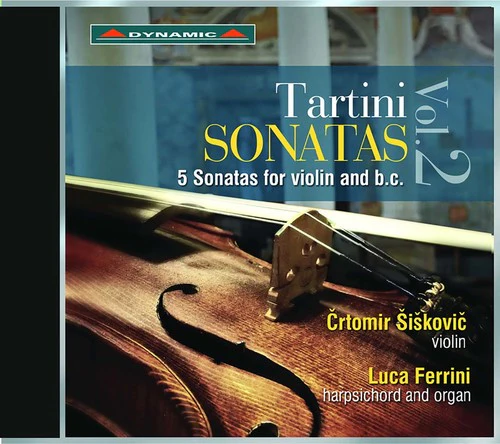
Tartini Sonatas, Vol. 2: 5 Sonatas for Violin and B.C. / Siskovic, Ferrini
A perpetuator of Corelli’s style, but endowed with a more passionate nature and a more refined technique, Tartini fully embodies the musical taste of the 18th century, according to which “music ought to be expressive and not merely ornamented, insignificant and artificial”, thus truly earning the title of “master of the nations”. The works of the present release embrace an arc of almost thirty years, spanning from the 1730s (Sonata No. 45) to the 1760s (Sonata No. 40). All of them have initial themes that are easily remembered because of some peculiar traits and of the incisiveness of their motives, the apex of expressiveness being in the slow movement. The Allegros that follow, often passionately vigorous, are dominated by vivid colours and very interesting rhythmic and harmonic variety, and permeated by refined technique.
A perpetuator of Corelli’s style, but endowed with a more passionate nature and a more refined technique, Tartini fully embodies the musical taste of the 18th century, according to which “music ought to be expressive and not merely ornamented, insignificant and artificial”, thus truly earning the title of “master of the nations”. The works of the present release embrace an arc of almost thirty years, spanning from the 1730s (Sonata No. 45) to the 1760s (Sonata No. 40). All of them have initial themes that are easily remembered because of some peculiar traits and of the incisiveness of their motives, the apex of expressiveness being in the slow movement. The Allegros that follow, often passionately vigorous, are dominated by vivid colours and very interesting rhythmic and harmonic variety, and permeated by refined technique.
Description
A perpetuator of Corelli’s style, but endowed with a more passionate nature and a more refined technique, Tartini fully embodies the musical taste of the 18th century, according to which “music ought to be expressive and not merely ornamented, insignificant and artificial”, thus truly earning the title of “master of the nations”. The works of the present release embrace an arc of almost thirty years, spanning from the 1730s (Sonata No. 45) to the 1760s (Sonata No. 40). All of them have initial themes that are easily remembered because of some peculiar traits and of the incisiveness of their motives, the apex of expressiveness being in the slow movement. The Allegros that follow, often passionately vigorous, are dominated by vivid colours and very interesting rhythmic and harmonic variety, and permeated by refined technique.