🎉 Up to 70% Off Selected ItemsShop Sale

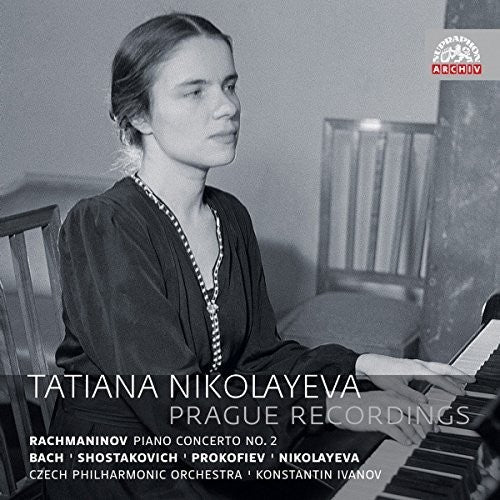
Tatiana Nikolayeva: Prague Recordings
There are few countries that can match Russia in terms of having produced as many outstanding musicians, especially pianists; Tatiana Nikolayeva was one member of what has become known as the Russian Piano School which along with her includes Sviatoslav Richter, Emil Gilels and many others and that tradition continues right down to today’s representatives with no apparent sign of any let up, thank goodness! Raw talent coupled with a dedicated singl- minded sense of purpose drove these artists to dominate the very pinnacle of peerless pianism. In 1951, aged 27, Tatiana Nikolayeva visited Prague and made the earliest of these recordings, several of which appear on CD for the first time. She had already caused a considerable stir in Czechoslovakia’s capital on previous visits, which included her first in 1947 when she came second at a competition organised as part of the First World Festival of Youth and Students. That was the same year she completed her conservatory studies when she astounded her examiners by including all 48 of Bach’s preludes and fugues from his Well Tempered-Clavier for her final performance test. In Leipzig in July 1950 during that town’s Bachfest, organised to mark the 200th anniversary of Bach’s death that work became a turning point in her career as she offered the judges the opportunity to call for her to play whichever they asked for on the spot; on the jury that awarded her first prize was none other than Dmitry Shostakovich! At the festival’s closing concert when Bach’s concerto for three pianos was to be performed Maria Yudina (1899-1970), who was to have been at the second piano, had injured a finger and couldn’t play so her place was taken by Shostakovich, himself an outstanding pianist, and from that moment on Nikolayeva’s acquaintance with the composer developed into a friendship that would last right up until Shostakovich’s death in 1975. It is a measure of Shostakovich’s respect and admiration for Tatiana Nikolayeva that he not only dedicated his cycle of 24 preludes and fugues to her but consulted with her over them, including many of her suggestions and observations in the work and, of course, it was she that gave its première in Leningrad in December 1952.
It was fascinating to read in the booklet that she had such a phenomenal memory that she never took any sheet music with her on tours, relying instead on that memory for her performances. The digital mastering from the original tapes by Jan Lži?a? has done wonders with the inevitable clicks and pops one might expect from these recordings, some of which were made over 65 years ago, though obviously the solo works come off best as the orchestral sound betrays its age more readily. That said her playing in the Rachmaninov piano concerto is as convincing as any I have ever heard despite the (to my ears) rather sluggish orchestral accompaniment. Her playing comes over as completely natural, without the least suggestion of artifice. The first of the solo works is Prokofiev’s 3rd piano sonata ‘From old notebooks’ and despite the rather brittle sound caused, I think, by a little too much treble, it is a solid performance that demonstrates her capacity for bringing out the contrast between the stormy and the subtle. Next come three pieces by Nikolayeva herself revealing a less well-known or appreciated side of her, that of composer. Her Three concert etudes, op13 show a real talent; how much music she wrote I must confess I don’t know but on the evidence here what she did compose is clearly worth exploring. It shows the influence of Prokofiev with complex rhythms and dense textures as opposed to the lighter and more romantic touch of Rachmaninov.
Opening disc 2, we are treated to three of the Shostakovich 24 Preludes and fugues which, as mentioned above, were dedicated to her and for which she was closely consulted. You would expect Shostakovich to know what he was doing with his dedication and consultations and her performance shows how well-founded his opinion was as she plays the pieces as naturally as if they were her own. In an interview she characterised the 15th prelude and fugue in D flat major as “...so fierce and lively, like a whirlpool. And in that quiet forest, (in Ruza outside Moscow at an artists’ retreat) when I heard that stormy whirlpool I went into wild rapture”. That certainly comes over in her playing. Conductor Kurt Sanderling told Tatiana that in his opinion the preludes and fugues were Shostakovich’s intimate diary and when she objected “Why not his string quartets and symphonies”, he replied no, this work for it is “an intimate diary of Shostakovich, kept for himself, that brings happiness to all of us”. How true Sanderling’s observation was and how wonderful to listen to these works with that thought in mind.
She then turns to Bach, her great love and for which playing she is rightly renowned. First up is the Fantasia in C minor, BWV 816 and her luminous playing is revealed to its highest degree, and shines through despite the sound appearing to be a little distant. Even better is her earlier recording of Bach’s French Suite no.5 in G major, BWV 816. This is a remarkable recording in terms of playing and sound which belies its age of 66 years. She plays these again as if she owned them; just listen to the Courante and its following Sarabande and marvel at the contrast she creates, injecting excitement and refinement in equal degrees and after the gentleness of the Sarabande the Gavotte and Bourrée revert to the thrill of a headlong race as notes tumble out in a great rush; utterly thrilling. Altogether a fabulous 15 ½ minutes of pianistic brilliance finishing with a breathtakingly fast Gigue.
Closing the two-disc set is another marvellous example of Nikolayeva’s technical skills, which were coupled with an innate sensitivity: her 1952 recording of Bach’s Chromatic fantasia & fugue in D minor, BWV 903 which, along with the Prokofiev, her own concert etudes, the Shostakovich and the Bach fantasia, is the first time the recording has appeared on CD. It is further proof that she was one of the greatest ever interpreters of Bach’s keyboard works. It is not enough simply to love them since all pianists who include them in their repertoire surely do, rather it is a total understanding of how they work and an ability to reveal their intrinsic humanity which she had and which is rare in my listening experience. This set is a must-have for all lovers of solo piano music and admirers of the consummate art of Tatiana Nikolayeva, a true original.
– MusicWeb International (Steve Arloff)
It was fascinating to read in the booklet that she had such a phenomenal memory that she never took any sheet music with her on tours, relying instead on that memory for her performances. The digital mastering from the original tapes by Jan Lži?a? has done wonders with the inevitable clicks and pops one might expect from these recordings, some of which were made over 65 years ago, though obviously the solo works come off best as the orchestral sound betrays its age more readily. That said her playing in the Rachmaninov piano concerto is as convincing as any I have ever heard despite the (to my ears) rather sluggish orchestral accompaniment. Her playing comes over as completely natural, without the least suggestion of artifice. The first of the solo works is Prokofiev’s 3rd piano sonata ‘From old notebooks’ and despite the rather brittle sound caused, I think, by a little too much treble, it is a solid performance that demonstrates her capacity for bringing out the contrast between the stormy and the subtle. Next come three pieces by Nikolayeva herself revealing a less well-known or appreciated side of her, that of composer. Her Three concert etudes, op13 show a real talent; how much music she wrote I must confess I don’t know but on the evidence here what she did compose is clearly worth exploring. It shows the influence of Prokofiev with complex rhythms and dense textures as opposed to the lighter and more romantic touch of Rachmaninov.
Opening disc 2, we are treated to three of the Shostakovich 24 Preludes and fugues which, as mentioned above, were dedicated to her and for which she was closely consulted. You would expect Shostakovich to know what he was doing with his dedication and consultations and her performance shows how well-founded his opinion was as she plays the pieces as naturally as if they were her own. In an interview she characterised the 15th prelude and fugue in D flat major as “...so fierce and lively, like a whirlpool. And in that quiet forest, (in Ruza outside Moscow at an artists’ retreat) when I heard that stormy whirlpool I went into wild rapture”. That certainly comes over in her playing. Conductor Kurt Sanderling told Tatiana that in his opinion the preludes and fugues were Shostakovich’s intimate diary and when she objected “Why not his string quartets and symphonies”, he replied no, this work for it is “an intimate diary of Shostakovich, kept for himself, that brings happiness to all of us”. How true Sanderling’s observation was and how wonderful to listen to these works with that thought in mind.
She then turns to Bach, her great love and for which playing she is rightly renowned. First up is the Fantasia in C minor, BWV 816 and her luminous playing is revealed to its highest degree, and shines through despite the sound appearing to be a little distant. Even better is her earlier recording of Bach’s French Suite no.5 in G major, BWV 816. This is a remarkable recording in terms of playing and sound which belies its age of 66 years. She plays these again as if she owned them; just listen to the Courante and its following Sarabande and marvel at the contrast she creates, injecting excitement and refinement in equal degrees and after the gentleness of the Sarabande the Gavotte and Bourrée revert to the thrill of a headlong race as notes tumble out in a great rush; utterly thrilling. Altogether a fabulous 15 ½ minutes of pianistic brilliance finishing with a breathtakingly fast Gigue.
Closing the two-disc set is another marvellous example of Nikolayeva’s technical skills, which were coupled with an innate sensitivity: her 1952 recording of Bach’s Chromatic fantasia & fugue in D minor, BWV 903 which, along with the Prokofiev, her own concert etudes, the Shostakovich and the Bach fantasia, is the first time the recording has appeared on CD. It is further proof that she was one of the greatest ever interpreters of Bach’s keyboard works. It is not enough simply to love them since all pianists who include them in their repertoire surely do, rather it is a total understanding of how they work and an ability to reveal their intrinsic humanity which she had and which is rare in my listening experience. This set is a must-have for all lovers of solo piano music and admirers of the consummate art of Tatiana Nikolayeva, a true original.
– MusicWeb International (Steve Arloff)
There are few countries that can match Russia in terms of having produced as many outstanding musicians, especially pianists; Tatiana Nikolayeva was one member of what has become known as the Russian Piano School which along with her includes Sviatoslav Richter, Emil Gilels and many others and that tradition continues right down to today’s representatives with no apparent sign of any let up, thank goodness! Raw talent coupled with a dedicated singl- minded sense of purpose drove these artists to dominate the very pinnacle of peerless pianism. In 1951, aged 27, Tatiana Nikolayeva visited Prague and made the earliest of these recordings, several of which appear on CD for the first time. She had already caused a considerable stir in Czechoslovakia’s capital on previous visits, which included her first in 1947 when she came second at a competition organised as part of the First World Festival of Youth and Students. That was the same year she completed her conservatory studies when she astounded her examiners by including all 48 of Bach’s preludes and fugues from his Well Tempered-Clavier for her final performance test. In Leipzig in July 1950 during that town’s Bachfest, organised to mark the 200th anniversary of Bach’s death that work became a turning point in her career as she offered the judges the opportunity to call for her to play whichever they asked for on the spot; on the jury that awarded her first prize was none other than Dmitry Shostakovich! At the festival’s closing concert when Bach’s concerto for three pianos was to be performed Maria Yudina (1899-1970), who was to have been at the second piano, had injured a finger and couldn’t play so her place was taken by Shostakovich, himself an outstanding pianist, and from that moment on Nikolayeva’s acquaintance with the composer developed into a friendship that would last right up until Shostakovich’s death in 1975. It is a measure of Shostakovich’s respect and admiration for Tatiana Nikolayeva that he not only dedicated his cycle of 24 preludes and fugues to her but consulted with her over them, including many of her suggestions and observations in the work and, of course, it was she that gave its première in Leningrad in December 1952.
It was fascinating to read in the booklet that she had such a phenomenal memory that she never took any sheet music with her on tours, relying instead on that memory for her performances. The digital mastering from the original tapes by Jan Lži?a? has done wonders with the inevitable clicks and pops one might expect from these recordings, some of which were made over 65 years ago, though obviously the solo works come off best as the orchestral sound betrays its age more readily. That said her playing in the Rachmaninov piano concerto is as convincing as any I have ever heard despite the (to my ears) rather sluggish orchestral accompaniment. Her playing comes over as completely natural, without the least suggestion of artifice. The first of the solo works is Prokofiev’s 3rd piano sonata ‘From old notebooks’ and despite the rather brittle sound caused, I think, by a little too much treble, it is a solid performance that demonstrates her capacity for bringing out the contrast between the stormy and the subtle. Next come three pieces by Nikolayeva herself revealing a less well-known or appreciated side of her, that of composer. Her Three concert etudes, op13 show a real talent; how much music she wrote I must confess I don’t know but on the evidence here what she did compose is clearly worth exploring. It shows the influence of Prokofiev with complex rhythms and dense textures as opposed to the lighter and more romantic touch of Rachmaninov.
Opening disc 2, we are treated to three of the Shostakovich 24 Preludes and fugues which, as mentioned above, were dedicated to her and for which she was closely consulted. You would expect Shostakovich to know what he was doing with his dedication and consultations and her performance shows how well-founded his opinion was as she plays the pieces as naturally as if they were her own. In an interview she characterised the 15th prelude and fugue in D flat major as “...so fierce and lively, like a whirlpool. And in that quiet forest, (in Ruza outside Moscow at an artists’ retreat) when I heard that stormy whirlpool I went into wild rapture”. That certainly comes over in her playing. Conductor Kurt Sanderling told Tatiana that in his opinion the preludes and fugues were Shostakovich’s intimate diary and when she objected “Why not his string quartets and symphonies”, he replied no, this work for it is “an intimate diary of Shostakovich, kept for himself, that brings happiness to all of us”. How true Sanderling’s observation was and how wonderful to listen to these works with that thought in mind.
She then turns to Bach, her great love and for which playing she is rightly renowned. First up is the Fantasia in C minor, BWV 816 and her luminous playing is revealed to its highest degree, and shines through despite the sound appearing to be a little distant. Even better is her earlier recording of Bach’s French Suite no.5 in G major, BWV 816. This is a remarkable recording in terms of playing and sound which belies its age of 66 years. She plays these again as if she owned them; just listen to the Courante and its following Sarabande and marvel at the contrast she creates, injecting excitement and refinement in equal degrees and after the gentleness of the Sarabande the Gavotte and Bourrée revert to the thrill of a headlong race as notes tumble out in a great rush; utterly thrilling. Altogether a fabulous 15 ½ minutes of pianistic brilliance finishing with a breathtakingly fast Gigue.
Closing the two-disc set is another marvellous example of Nikolayeva’s technical skills, which were coupled with an innate sensitivity: her 1952 recording of Bach’s Chromatic fantasia & fugue in D minor, BWV 903 which, along with the Prokofiev, her own concert etudes, the Shostakovich and the Bach fantasia, is the first time the recording has appeared on CD. It is further proof that she was one of the greatest ever interpreters of Bach’s keyboard works. It is not enough simply to love them since all pianists who include them in their repertoire surely do, rather it is a total understanding of how they work and an ability to reveal their intrinsic humanity which she had and which is rare in my listening experience. This set is a must-have for all lovers of solo piano music and admirers of the consummate art of Tatiana Nikolayeva, a true original.
– MusicWeb International (Steve Arloff)
It was fascinating to read in the booklet that she had such a phenomenal memory that she never took any sheet music with her on tours, relying instead on that memory for her performances. The digital mastering from the original tapes by Jan Lži?a? has done wonders with the inevitable clicks and pops one might expect from these recordings, some of which were made over 65 years ago, though obviously the solo works come off best as the orchestral sound betrays its age more readily. That said her playing in the Rachmaninov piano concerto is as convincing as any I have ever heard despite the (to my ears) rather sluggish orchestral accompaniment. Her playing comes over as completely natural, without the least suggestion of artifice. The first of the solo works is Prokofiev’s 3rd piano sonata ‘From old notebooks’ and despite the rather brittle sound caused, I think, by a little too much treble, it is a solid performance that demonstrates her capacity for bringing out the contrast between the stormy and the subtle. Next come three pieces by Nikolayeva herself revealing a less well-known or appreciated side of her, that of composer. Her Three concert etudes, op13 show a real talent; how much music she wrote I must confess I don’t know but on the evidence here what she did compose is clearly worth exploring. It shows the influence of Prokofiev with complex rhythms and dense textures as opposed to the lighter and more romantic touch of Rachmaninov.
Opening disc 2, we are treated to three of the Shostakovich 24 Preludes and fugues which, as mentioned above, were dedicated to her and for which she was closely consulted. You would expect Shostakovich to know what he was doing with his dedication and consultations and her performance shows how well-founded his opinion was as she plays the pieces as naturally as if they were her own. In an interview she characterised the 15th prelude and fugue in D flat major as “...so fierce and lively, like a whirlpool. And in that quiet forest, (in Ruza outside Moscow at an artists’ retreat) when I heard that stormy whirlpool I went into wild rapture”. That certainly comes over in her playing. Conductor Kurt Sanderling told Tatiana that in his opinion the preludes and fugues were Shostakovich’s intimate diary and when she objected “Why not his string quartets and symphonies”, he replied no, this work for it is “an intimate diary of Shostakovich, kept for himself, that brings happiness to all of us”. How true Sanderling’s observation was and how wonderful to listen to these works with that thought in mind.
She then turns to Bach, her great love and for which playing she is rightly renowned. First up is the Fantasia in C minor, BWV 816 and her luminous playing is revealed to its highest degree, and shines through despite the sound appearing to be a little distant. Even better is her earlier recording of Bach’s French Suite no.5 in G major, BWV 816. This is a remarkable recording in terms of playing and sound which belies its age of 66 years. She plays these again as if she owned them; just listen to the Courante and its following Sarabande and marvel at the contrast she creates, injecting excitement and refinement in equal degrees and after the gentleness of the Sarabande the Gavotte and Bourrée revert to the thrill of a headlong race as notes tumble out in a great rush; utterly thrilling. Altogether a fabulous 15 ½ minutes of pianistic brilliance finishing with a breathtakingly fast Gigue.
Closing the two-disc set is another marvellous example of Nikolayeva’s technical skills, which were coupled with an innate sensitivity: her 1952 recording of Bach’s Chromatic fantasia & fugue in D minor, BWV 903 which, along with the Prokofiev, her own concert etudes, the Shostakovich and the Bach fantasia, is the first time the recording has appeared on CD. It is further proof that she was one of the greatest ever interpreters of Bach’s keyboard works. It is not enough simply to love them since all pianists who include them in their repertoire surely do, rather it is a total understanding of how they work and an ability to reveal their intrinsic humanity which she had and which is rare in my listening experience. This set is a must-have for all lovers of solo piano music and admirers of the consummate art of Tatiana Nikolayeva, a true original.
– MusicWeb International (Steve Arloff)
$25.99
Tatiana Nikolayeva: Prague Recordings—
$25.99
Description
There are few countries that can match Russia in terms of having produced as many outstanding musicians, especially pianists; Tatiana Nikolayeva was one member of what has become known as the Russian Piano School which along with her includes Sviatoslav Richter, Emil Gilels and many others and that tradition continues right down to today’s representatives with no apparent sign of any let up, thank goodness! Raw talent coupled with a dedicated singl- minded sense of purpose drove these artists to dominate the very pinnacle of peerless pianism. In 1951, aged 27, Tatiana Nikolayeva visited Prague and made the earliest of these recordings, several of which appear on CD for the first time. She had already caused a considerable stir in Czechoslovakia’s capital on previous visits, which included her first in 1947 when she came second at a competition organised as part of the First World Festival of Youth and Students. That was the same year she completed her conservatory studies when she astounded her examiners by including all 48 of Bach’s preludes and fugues from his Well Tempered-Clavier for her final performance test. In Leipzig in July 1950 during that town’s Bachfest, organised to mark the 200th anniversary of Bach’s death that work became a turning point in her career as she offered the judges the opportunity to call for her to play whichever they asked for on the spot; on the jury that awarded her first prize was none other than Dmitry Shostakovich! At the festival’s closing concert when Bach’s concerto for three pianos was to be performed Maria Yudina (1899-1970), who was to have been at the second piano, had injured a finger and couldn’t play so her place was taken by Shostakovich, himself an outstanding pianist, and from that moment on Nikolayeva’s acquaintance with the composer developed into a friendship that would last right up until Shostakovich’s death in 1975. It is a measure of Shostakovich’s respect and admiration for Tatiana Nikolayeva that he not only dedicated his cycle of 24 preludes and fugues to her but consulted with her over them, including many of her suggestions and observations in the work and, of course, it was she that gave its première in Leningrad in December 1952.
It was fascinating to read in the booklet that she had such a phenomenal memory that she never took any sheet music with her on tours, relying instead on that memory for her performances. The digital mastering from the original tapes by Jan Lži?a? has done wonders with the inevitable clicks and pops one might expect from these recordings, some of which were made over 65 years ago, though obviously the solo works come off best as the orchestral sound betrays its age more readily. That said her playing in the Rachmaninov piano concerto is as convincing as any I have ever heard despite the (to my ears) rather sluggish orchestral accompaniment. Her playing comes over as completely natural, without the least suggestion of artifice. The first of the solo works is Prokofiev’s 3rd piano sonata ‘From old notebooks’ and despite the rather brittle sound caused, I think, by a little too much treble, it is a solid performance that demonstrates her capacity for bringing out the contrast between the stormy and the subtle. Next come three pieces by Nikolayeva herself revealing a less well-known or appreciated side of her, that of composer. Her Three concert etudes, op13 show a real talent; how much music she wrote I must confess I don’t know but on the evidence here what she did compose is clearly worth exploring. It shows the influence of Prokofiev with complex rhythms and dense textures as opposed to the lighter and more romantic touch of Rachmaninov.
Opening disc 2, we are treated to three of the Shostakovich 24 Preludes and fugues which, as mentioned above, were dedicated to her and for which she was closely consulted. You would expect Shostakovich to know what he was doing with his dedication and consultations and her performance shows how well-founded his opinion was as she plays the pieces as naturally as if they were her own. In an interview she characterised the 15th prelude and fugue in D flat major as “...so fierce and lively, like a whirlpool. And in that quiet forest, (in Ruza outside Moscow at an artists’ retreat) when I heard that stormy whirlpool I went into wild rapture”. That certainly comes over in her playing. Conductor Kurt Sanderling told Tatiana that in his opinion the preludes and fugues were Shostakovich’s intimate diary and when she objected “Why not his string quartets and symphonies”, he replied no, this work for it is “an intimate diary of Shostakovich, kept for himself, that brings happiness to all of us”. How true Sanderling’s observation was and how wonderful to listen to these works with that thought in mind.
She then turns to Bach, her great love and for which playing she is rightly renowned. First up is the Fantasia in C minor, BWV 816 and her luminous playing is revealed to its highest degree, and shines through despite the sound appearing to be a little distant. Even better is her earlier recording of Bach’s French Suite no.5 in G major, BWV 816. This is a remarkable recording in terms of playing and sound which belies its age of 66 years. She plays these again as if she owned them; just listen to the Courante and its following Sarabande and marvel at the contrast she creates, injecting excitement and refinement in equal degrees and after the gentleness of the Sarabande the Gavotte and Bourrée revert to the thrill of a headlong race as notes tumble out in a great rush; utterly thrilling. Altogether a fabulous 15 ½ minutes of pianistic brilliance finishing with a breathtakingly fast Gigue.
Closing the two-disc set is another marvellous example of Nikolayeva’s technical skills, which were coupled with an innate sensitivity: her 1952 recording of Bach’s Chromatic fantasia & fugue in D minor, BWV 903 which, along with the Prokofiev, her own concert etudes, the Shostakovich and the Bach fantasia, is the first time the recording has appeared on CD. It is further proof that she was one of the greatest ever interpreters of Bach’s keyboard works. It is not enough simply to love them since all pianists who include them in their repertoire surely do, rather it is a total understanding of how they work and an ability to reveal their intrinsic humanity which she had and which is rare in my listening experience. This set is a must-have for all lovers of solo piano music and admirers of the consummate art of Tatiana Nikolayeva, a true original.
– MusicWeb International (Steve Arloff)
It was fascinating to read in the booklet that she had such a phenomenal memory that she never took any sheet music with her on tours, relying instead on that memory for her performances. The digital mastering from the original tapes by Jan Lži?a? has done wonders with the inevitable clicks and pops one might expect from these recordings, some of which were made over 65 years ago, though obviously the solo works come off best as the orchestral sound betrays its age more readily. That said her playing in the Rachmaninov piano concerto is as convincing as any I have ever heard despite the (to my ears) rather sluggish orchestral accompaniment. Her playing comes over as completely natural, without the least suggestion of artifice. The first of the solo works is Prokofiev’s 3rd piano sonata ‘From old notebooks’ and despite the rather brittle sound caused, I think, by a little too much treble, it is a solid performance that demonstrates her capacity for bringing out the contrast between the stormy and the subtle. Next come three pieces by Nikolayeva herself revealing a less well-known or appreciated side of her, that of composer. Her Three concert etudes, op13 show a real talent; how much music she wrote I must confess I don’t know but on the evidence here what she did compose is clearly worth exploring. It shows the influence of Prokofiev with complex rhythms and dense textures as opposed to the lighter and more romantic touch of Rachmaninov.
Opening disc 2, we are treated to three of the Shostakovich 24 Preludes and fugues which, as mentioned above, were dedicated to her and for which she was closely consulted. You would expect Shostakovich to know what he was doing with his dedication and consultations and her performance shows how well-founded his opinion was as she plays the pieces as naturally as if they were her own. In an interview she characterised the 15th prelude and fugue in D flat major as “...so fierce and lively, like a whirlpool. And in that quiet forest, (in Ruza outside Moscow at an artists’ retreat) when I heard that stormy whirlpool I went into wild rapture”. That certainly comes over in her playing. Conductor Kurt Sanderling told Tatiana that in his opinion the preludes and fugues were Shostakovich’s intimate diary and when she objected “Why not his string quartets and symphonies”, he replied no, this work for it is “an intimate diary of Shostakovich, kept for himself, that brings happiness to all of us”. How true Sanderling’s observation was and how wonderful to listen to these works with that thought in mind.
She then turns to Bach, her great love and for which playing she is rightly renowned. First up is the Fantasia in C minor, BWV 816 and her luminous playing is revealed to its highest degree, and shines through despite the sound appearing to be a little distant. Even better is her earlier recording of Bach’s French Suite no.5 in G major, BWV 816. This is a remarkable recording in terms of playing and sound which belies its age of 66 years. She plays these again as if she owned them; just listen to the Courante and its following Sarabande and marvel at the contrast she creates, injecting excitement and refinement in equal degrees and after the gentleness of the Sarabande the Gavotte and Bourrée revert to the thrill of a headlong race as notes tumble out in a great rush; utterly thrilling. Altogether a fabulous 15 ½ minutes of pianistic brilliance finishing with a breathtakingly fast Gigue.
Closing the two-disc set is another marvellous example of Nikolayeva’s technical skills, which were coupled with an innate sensitivity: her 1952 recording of Bach’s Chromatic fantasia & fugue in D minor, BWV 903 which, along with the Prokofiev, her own concert etudes, the Shostakovich and the Bach fantasia, is the first time the recording has appeared on CD. It is further proof that she was one of the greatest ever interpreters of Bach’s keyboard works. It is not enough simply to love them since all pianists who include them in their repertoire surely do, rather it is a total understanding of how they work and an ability to reveal their intrinsic humanity which she had and which is rare in my listening experience. This set is a must-have for all lovers of solo piano music and admirers of the consummate art of Tatiana Nikolayeva, a true original.
– MusicWeb International (Steve Arloff)