🎉 Up to 70% Off Selected ItemsShop Sale

1 / 2
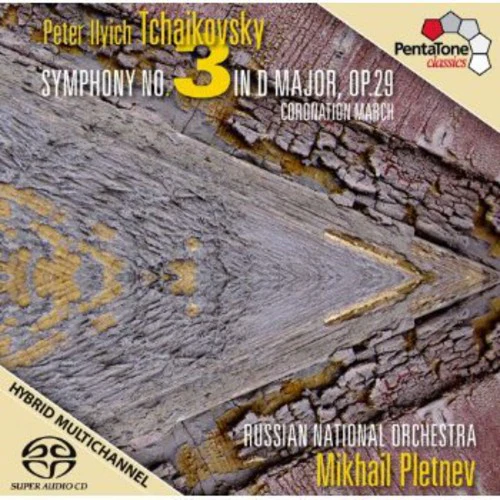
Tchaikovsky: Symphony No 3 / Pletnev, Russian NO
With the Symphony No. 3, popularly referred to as the “Polish,” Mikhail Pletnev here completes his second cycle of the composer’s symphonies with the Russian National Orchestra. An earlier cycle dating from the 1990s with the same orchestra is still readily available on Deutsche Grammophon. Pletnev’s new cycle has much to recommend it. For starters, it’s all of a piece, by which I mean all six symphonies are performed by the same forces, for the same label (PentaTone), and they’re all in multichannel SACD format. As is true of most cycles, Pletnev’s is uneven. I raved about the conductor’s “Pathétique” in 35:3 and, having depleted my repertoire of adjectival superlatives on it, I was hard-pressed to express my even stronger endorsement of his “Little Russian” (No. 2) in 36:2. But my recommendations came with a caution that Pletnev’s approach to Tchaikovsky was super-charged and hyper-romantic.
Subjected to the scrutiny of others, not all of Pletnev’s releases in this new cycle have received unstinting praise. Colleague Boyd Pomeroy wondered if the conductor’s Fourth wasn’t too refined in a Karajanesque manner, while Peter J. Rabinowitz generally approved of Pletnev’s Fifth but noted some balance problems and a trace of the old Soviet vibrato. And even yours truly, after waxing ecstatic over Pletnev’s “Pathétique,” was not entirely convinced by the conductor’s follow-up “Winter Daydreams” (No. 1) in 35:6.
With this No. 3, we have the final curtain call for Pletnev’s PentaTone cycle and, as cycles go, I’d have to give this one an overall outstanding rating. Personally, I can’t get too excited about Tchaikovsky’s Third Symphony. As I said in my review of Pletnev’s Second, between the Second and Third, it’s a tossup as to which is the weakest of Tchaikovsky’s six numbered symphonies. The Third Symphony was composed in fairly short order between June and August 1875, and there’s little evidence that Tchaikovsky fretted over it or kept tweaking it as he did with his First Symphony. For the neurotic and generally insecure composer, it seems that he was satisfied with the completed score and called it done. His only complaint was that the first performance could have gone better had there been more rehearsals. The work is unique among Tchaikovsky’s symphonies in that it’s the only one in five movements, and, unless one counts the composer’s abandoned Seventh Symphony in E?-Major, it’s the only one among the standard six that’s in a major key. It seems I’m not alone in my opinion of the work. Critical commentary has been mixed at best. Musicologist David Brown rated the Third, “the most inconsistent and least satisfactory of the symphonies and badly flawed” ( Tchaikovsky: The Crisis Years, 1874–1878 , and Tchaikovsky: The Final Years, 1855–1893 ). And to that I would add the least consequential.
If the score is one you find appealing, I can think of no better proponent of it than Pletnev. As with all previous releases in this cycle, Pletnev has the Russian National Orchestra playing in top form, and he finds many felicities in the piece, like the coquettish wind asides in the Alla tedesca movement that delight the ear and give Tchaikovsky’s note-spinning a serenade-like gracefulness.
The Coronation March that fills out the disc—or, to give its full title, Festival Coronation March —is one of those potboiler pieces composers are often called upon to provide for political events or ceremonies of state. In this case, the ceremony was the coronation of Tsar Alexander III in 1883. Tchaikovsky received the commission to write the piece from Moscow’s mayor—it was more of an order than it was an offer—while he was in Paris working on his opera Mazeppa , and he was royally roiled, writing to Nadezhda von Meck, “My plans have been upset by two unexpected and very burdensome tasks foisted upon me. The city of Moscow has commissioned from me a ceremonial march to be played at the festivities which are to be organized for the Sovereign at the Sokol’nikii. Hardly had I managed to reconcile myself to the thought that I must tear myself away from the opera for the march, when suddenly I received a letter from the festival committee about a cantata. Both works, especially the cantata, have to be ready very soon, a prospect which fills me with dread.” If he’d put as much time and effort into working on the assignments as he did kvetching to von Meck about them, he might have produced something more worthy of his reputation. Still, in the end, Tchaikovsky seems to have thought highly enough of his march to make a piano transcription of it. Shades of the 1812 Overture come to mind, but without the cannon, carillon, or La Marseillaise , and all condensed down to less than seven minutes. It’s not very good, but at least it’s loud.
FANFARE: Jerry Dubins
Subjected to the scrutiny of others, not all of Pletnev’s releases in this new cycle have received unstinting praise. Colleague Boyd Pomeroy wondered if the conductor’s Fourth wasn’t too refined in a Karajanesque manner, while Peter J. Rabinowitz generally approved of Pletnev’s Fifth but noted some balance problems and a trace of the old Soviet vibrato. And even yours truly, after waxing ecstatic over Pletnev’s “Pathétique,” was not entirely convinced by the conductor’s follow-up “Winter Daydreams” (No. 1) in 35:6.
With this No. 3, we have the final curtain call for Pletnev’s PentaTone cycle and, as cycles go, I’d have to give this one an overall outstanding rating. Personally, I can’t get too excited about Tchaikovsky’s Third Symphony. As I said in my review of Pletnev’s Second, between the Second and Third, it’s a tossup as to which is the weakest of Tchaikovsky’s six numbered symphonies. The Third Symphony was composed in fairly short order between June and August 1875, and there’s little evidence that Tchaikovsky fretted over it or kept tweaking it as he did with his First Symphony. For the neurotic and generally insecure composer, it seems that he was satisfied with the completed score and called it done. His only complaint was that the first performance could have gone better had there been more rehearsals. The work is unique among Tchaikovsky’s symphonies in that it’s the only one in five movements, and, unless one counts the composer’s abandoned Seventh Symphony in E?-Major, it’s the only one among the standard six that’s in a major key. It seems I’m not alone in my opinion of the work. Critical commentary has been mixed at best. Musicologist David Brown rated the Third, “the most inconsistent and least satisfactory of the symphonies and badly flawed” ( Tchaikovsky: The Crisis Years, 1874–1878 , and Tchaikovsky: The Final Years, 1855–1893 ). And to that I would add the least consequential.
If the score is one you find appealing, I can think of no better proponent of it than Pletnev. As with all previous releases in this cycle, Pletnev has the Russian National Orchestra playing in top form, and he finds many felicities in the piece, like the coquettish wind asides in the Alla tedesca movement that delight the ear and give Tchaikovsky’s note-spinning a serenade-like gracefulness.
The Coronation March that fills out the disc—or, to give its full title, Festival Coronation March —is one of those potboiler pieces composers are often called upon to provide for political events or ceremonies of state. In this case, the ceremony was the coronation of Tsar Alexander III in 1883. Tchaikovsky received the commission to write the piece from Moscow’s mayor—it was more of an order than it was an offer—while he was in Paris working on his opera Mazeppa , and he was royally roiled, writing to Nadezhda von Meck, “My plans have been upset by two unexpected and very burdensome tasks foisted upon me. The city of Moscow has commissioned from me a ceremonial march to be played at the festivities which are to be organized for the Sovereign at the Sokol’nikii. Hardly had I managed to reconcile myself to the thought that I must tear myself away from the opera for the march, when suddenly I received a letter from the festival committee about a cantata. Both works, especially the cantata, have to be ready very soon, a prospect which fills me with dread.” If he’d put as much time and effort into working on the assignments as he did kvetching to von Meck about them, he might have produced something more worthy of his reputation. Still, in the end, Tchaikovsky seems to have thought highly enough of his march to make a piano transcription of it. Shades of the 1812 Overture come to mind, but without the cannon, carillon, or La Marseillaise , and all condensed down to less than seven minutes. It’s not very good, but at least it’s loud.
FANFARE: Jerry Dubins
With the Symphony No. 3, popularly referred to as the “Polish,” Mikhail Pletnev here completes his second cycle of the composer’s symphonies with the Russian National Orchestra. An earlier cycle dating from the 1990s with the same orchestra is still readily available on Deutsche Grammophon. Pletnev’s new cycle has much to recommend it. For starters, it’s all of a piece, by which I mean all six symphonies are performed by the same forces, for the same label (PentaTone), and they’re all in multichannel SACD format. As is true of most cycles, Pletnev’s is uneven. I raved about the conductor’s “Pathétique” in 35:3 and, having depleted my repertoire of adjectival superlatives on it, I was hard-pressed to express my even stronger endorsement of his “Little Russian” (No. 2) in 36:2. But my recommendations came with a caution that Pletnev’s approach to Tchaikovsky was super-charged and hyper-romantic.
Subjected to the scrutiny of others, not all of Pletnev’s releases in this new cycle have received unstinting praise. Colleague Boyd Pomeroy wondered if the conductor’s Fourth wasn’t too refined in a Karajanesque manner, while Peter J. Rabinowitz generally approved of Pletnev’s Fifth but noted some balance problems and a trace of the old Soviet vibrato. And even yours truly, after waxing ecstatic over Pletnev’s “Pathétique,” was not entirely convinced by the conductor’s follow-up “Winter Daydreams” (No. 1) in 35:6.
With this No. 3, we have the final curtain call for Pletnev’s PentaTone cycle and, as cycles go, I’d have to give this one an overall outstanding rating. Personally, I can’t get too excited about Tchaikovsky’s Third Symphony. As I said in my review of Pletnev’s Second, between the Second and Third, it’s a tossup as to which is the weakest of Tchaikovsky’s six numbered symphonies. The Third Symphony was composed in fairly short order between June and August 1875, and there’s little evidence that Tchaikovsky fretted over it or kept tweaking it as he did with his First Symphony. For the neurotic and generally insecure composer, it seems that he was satisfied with the completed score and called it done. His only complaint was that the first performance could have gone better had there been more rehearsals. The work is unique among Tchaikovsky’s symphonies in that it’s the only one in five movements, and, unless one counts the composer’s abandoned Seventh Symphony in E?-Major, it’s the only one among the standard six that’s in a major key. It seems I’m not alone in my opinion of the work. Critical commentary has been mixed at best. Musicologist David Brown rated the Third, “the most inconsistent and least satisfactory of the symphonies and badly flawed” ( Tchaikovsky: The Crisis Years, 1874–1878 , and Tchaikovsky: The Final Years, 1855–1893 ). And to that I would add the least consequential.
If the score is one you find appealing, I can think of no better proponent of it than Pletnev. As with all previous releases in this cycle, Pletnev has the Russian National Orchestra playing in top form, and he finds many felicities in the piece, like the coquettish wind asides in the Alla tedesca movement that delight the ear and give Tchaikovsky’s note-spinning a serenade-like gracefulness.
The Coronation March that fills out the disc—or, to give its full title, Festival Coronation March —is one of those potboiler pieces composers are often called upon to provide for political events or ceremonies of state. In this case, the ceremony was the coronation of Tsar Alexander III in 1883. Tchaikovsky received the commission to write the piece from Moscow’s mayor—it was more of an order than it was an offer—while he was in Paris working on his opera Mazeppa , and he was royally roiled, writing to Nadezhda von Meck, “My plans have been upset by two unexpected and very burdensome tasks foisted upon me. The city of Moscow has commissioned from me a ceremonial march to be played at the festivities which are to be organized for the Sovereign at the Sokol’nikii. Hardly had I managed to reconcile myself to the thought that I must tear myself away from the opera for the march, when suddenly I received a letter from the festival committee about a cantata. Both works, especially the cantata, have to be ready very soon, a prospect which fills me with dread.” If he’d put as much time and effort into working on the assignments as he did kvetching to von Meck about them, he might have produced something more worthy of his reputation. Still, in the end, Tchaikovsky seems to have thought highly enough of his march to make a piano transcription of it. Shades of the 1812 Overture come to mind, but without the cannon, carillon, or La Marseillaise , and all condensed down to less than seven minutes. It’s not very good, but at least it’s loud.
FANFARE: Jerry Dubins
Subjected to the scrutiny of others, not all of Pletnev’s releases in this new cycle have received unstinting praise. Colleague Boyd Pomeroy wondered if the conductor’s Fourth wasn’t too refined in a Karajanesque manner, while Peter J. Rabinowitz generally approved of Pletnev’s Fifth but noted some balance problems and a trace of the old Soviet vibrato. And even yours truly, after waxing ecstatic over Pletnev’s “Pathétique,” was not entirely convinced by the conductor’s follow-up “Winter Daydreams” (No. 1) in 35:6.
With this No. 3, we have the final curtain call for Pletnev’s PentaTone cycle and, as cycles go, I’d have to give this one an overall outstanding rating. Personally, I can’t get too excited about Tchaikovsky’s Third Symphony. As I said in my review of Pletnev’s Second, between the Second and Third, it’s a tossup as to which is the weakest of Tchaikovsky’s six numbered symphonies. The Third Symphony was composed in fairly short order between June and August 1875, and there’s little evidence that Tchaikovsky fretted over it or kept tweaking it as he did with his First Symphony. For the neurotic and generally insecure composer, it seems that he was satisfied with the completed score and called it done. His only complaint was that the first performance could have gone better had there been more rehearsals. The work is unique among Tchaikovsky’s symphonies in that it’s the only one in five movements, and, unless one counts the composer’s abandoned Seventh Symphony in E?-Major, it’s the only one among the standard six that’s in a major key. It seems I’m not alone in my opinion of the work. Critical commentary has been mixed at best. Musicologist David Brown rated the Third, “the most inconsistent and least satisfactory of the symphonies and badly flawed” ( Tchaikovsky: The Crisis Years, 1874–1878 , and Tchaikovsky: The Final Years, 1855–1893 ). And to that I would add the least consequential.
If the score is one you find appealing, I can think of no better proponent of it than Pletnev. As with all previous releases in this cycle, Pletnev has the Russian National Orchestra playing in top form, and he finds many felicities in the piece, like the coquettish wind asides in the Alla tedesca movement that delight the ear and give Tchaikovsky’s note-spinning a serenade-like gracefulness.
The Coronation March that fills out the disc—or, to give its full title, Festival Coronation March —is one of those potboiler pieces composers are often called upon to provide for political events or ceremonies of state. In this case, the ceremony was the coronation of Tsar Alexander III in 1883. Tchaikovsky received the commission to write the piece from Moscow’s mayor—it was more of an order than it was an offer—while he was in Paris working on his opera Mazeppa , and he was royally roiled, writing to Nadezhda von Meck, “My plans have been upset by two unexpected and very burdensome tasks foisted upon me. The city of Moscow has commissioned from me a ceremonial march to be played at the festivities which are to be organized for the Sovereign at the Sokol’nikii. Hardly had I managed to reconcile myself to the thought that I must tear myself away from the opera for the march, when suddenly I received a letter from the festival committee about a cantata. Both works, especially the cantata, have to be ready very soon, a prospect which fills me with dread.” If he’d put as much time and effort into working on the assignments as he did kvetching to von Meck about them, he might have produced something more worthy of his reputation. Still, in the end, Tchaikovsky seems to have thought highly enough of his march to make a piano transcription of it. Shades of the 1812 Overture come to mind, but without the cannon, carillon, or La Marseillaise , and all condensed down to less than seven minutes. It’s not very good, but at least it’s loud.
FANFARE: Jerry Dubins
$7.70
Original: $21.99
-65%Tchaikovsky: Symphony No 3 / Pletnev, Russian NO—
$21.99
$7.70Description
With the Symphony No. 3, popularly referred to as the “Polish,” Mikhail Pletnev here completes his second cycle of the composer’s symphonies with the Russian National Orchestra. An earlier cycle dating from the 1990s with the same orchestra is still readily available on Deutsche Grammophon. Pletnev’s new cycle has much to recommend it. For starters, it’s all of a piece, by which I mean all six symphonies are performed by the same forces, for the same label (PentaTone), and they’re all in multichannel SACD format. As is true of most cycles, Pletnev’s is uneven. I raved about the conductor’s “Pathétique” in 35:3 and, having depleted my repertoire of adjectival superlatives on it, I was hard-pressed to express my even stronger endorsement of his “Little Russian” (No. 2) in 36:2. But my recommendations came with a caution that Pletnev’s approach to Tchaikovsky was super-charged and hyper-romantic.
Subjected to the scrutiny of others, not all of Pletnev’s releases in this new cycle have received unstinting praise. Colleague Boyd Pomeroy wondered if the conductor’s Fourth wasn’t too refined in a Karajanesque manner, while Peter J. Rabinowitz generally approved of Pletnev’s Fifth but noted some balance problems and a trace of the old Soviet vibrato. And even yours truly, after waxing ecstatic over Pletnev’s “Pathétique,” was not entirely convinced by the conductor’s follow-up “Winter Daydreams” (No. 1) in 35:6.
With this No. 3, we have the final curtain call for Pletnev’s PentaTone cycle and, as cycles go, I’d have to give this one an overall outstanding rating. Personally, I can’t get too excited about Tchaikovsky’s Third Symphony. As I said in my review of Pletnev’s Second, between the Second and Third, it’s a tossup as to which is the weakest of Tchaikovsky’s six numbered symphonies. The Third Symphony was composed in fairly short order between June and August 1875, and there’s little evidence that Tchaikovsky fretted over it or kept tweaking it as he did with his First Symphony. For the neurotic and generally insecure composer, it seems that he was satisfied with the completed score and called it done. His only complaint was that the first performance could have gone better had there been more rehearsals. The work is unique among Tchaikovsky’s symphonies in that it’s the only one in five movements, and, unless one counts the composer’s abandoned Seventh Symphony in E?-Major, it’s the only one among the standard six that’s in a major key. It seems I’m not alone in my opinion of the work. Critical commentary has been mixed at best. Musicologist David Brown rated the Third, “the most inconsistent and least satisfactory of the symphonies and badly flawed” ( Tchaikovsky: The Crisis Years, 1874–1878 , and Tchaikovsky: The Final Years, 1855–1893 ). And to that I would add the least consequential.
If the score is one you find appealing, I can think of no better proponent of it than Pletnev. As with all previous releases in this cycle, Pletnev has the Russian National Orchestra playing in top form, and he finds many felicities in the piece, like the coquettish wind asides in the Alla tedesca movement that delight the ear and give Tchaikovsky’s note-spinning a serenade-like gracefulness.
The Coronation March that fills out the disc—or, to give its full title, Festival Coronation March —is one of those potboiler pieces composers are often called upon to provide for political events or ceremonies of state. In this case, the ceremony was the coronation of Tsar Alexander III in 1883. Tchaikovsky received the commission to write the piece from Moscow’s mayor—it was more of an order than it was an offer—while he was in Paris working on his opera Mazeppa , and he was royally roiled, writing to Nadezhda von Meck, “My plans have been upset by two unexpected and very burdensome tasks foisted upon me. The city of Moscow has commissioned from me a ceremonial march to be played at the festivities which are to be organized for the Sovereign at the Sokol’nikii. Hardly had I managed to reconcile myself to the thought that I must tear myself away from the opera for the march, when suddenly I received a letter from the festival committee about a cantata. Both works, especially the cantata, have to be ready very soon, a prospect which fills me with dread.” If he’d put as much time and effort into working on the assignments as he did kvetching to von Meck about them, he might have produced something more worthy of his reputation. Still, in the end, Tchaikovsky seems to have thought highly enough of his march to make a piano transcription of it. Shades of the 1812 Overture come to mind, but without the cannon, carillon, or La Marseillaise , and all condensed down to less than seven minutes. It’s not very good, but at least it’s loud.
FANFARE: Jerry Dubins
Subjected to the scrutiny of others, not all of Pletnev’s releases in this new cycle have received unstinting praise. Colleague Boyd Pomeroy wondered if the conductor’s Fourth wasn’t too refined in a Karajanesque manner, while Peter J. Rabinowitz generally approved of Pletnev’s Fifth but noted some balance problems and a trace of the old Soviet vibrato. And even yours truly, after waxing ecstatic over Pletnev’s “Pathétique,” was not entirely convinced by the conductor’s follow-up “Winter Daydreams” (No. 1) in 35:6.
With this No. 3, we have the final curtain call for Pletnev’s PentaTone cycle and, as cycles go, I’d have to give this one an overall outstanding rating. Personally, I can’t get too excited about Tchaikovsky’s Third Symphony. As I said in my review of Pletnev’s Second, between the Second and Third, it’s a tossup as to which is the weakest of Tchaikovsky’s six numbered symphonies. The Third Symphony was composed in fairly short order between June and August 1875, and there’s little evidence that Tchaikovsky fretted over it or kept tweaking it as he did with his First Symphony. For the neurotic and generally insecure composer, it seems that he was satisfied with the completed score and called it done. His only complaint was that the first performance could have gone better had there been more rehearsals. The work is unique among Tchaikovsky’s symphonies in that it’s the only one in five movements, and, unless one counts the composer’s abandoned Seventh Symphony in E?-Major, it’s the only one among the standard six that’s in a major key. It seems I’m not alone in my opinion of the work. Critical commentary has been mixed at best. Musicologist David Brown rated the Third, “the most inconsistent and least satisfactory of the symphonies and badly flawed” ( Tchaikovsky: The Crisis Years, 1874–1878 , and Tchaikovsky: The Final Years, 1855–1893 ). And to that I would add the least consequential.
If the score is one you find appealing, I can think of no better proponent of it than Pletnev. As with all previous releases in this cycle, Pletnev has the Russian National Orchestra playing in top form, and he finds many felicities in the piece, like the coquettish wind asides in the Alla tedesca movement that delight the ear and give Tchaikovsky’s note-spinning a serenade-like gracefulness.
The Coronation March that fills out the disc—or, to give its full title, Festival Coronation March —is one of those potboiler pieces composers are often called upon to provide for political events or ceremonies of state. In this case, the ceremony was the coronation of Tsar Alexander III in 1883. Tchaikovsky received the commission to write the piece from Moscow’s mayor—it was more of an order than it was an offer—while he was in Paris working on his opera Mazeppa , and he was royally roiled, writing to Nadezhda von Meck, “My plans have been upset by two unexpected and very burdensome tasks foisted upon me. The city of Moscow has commissioned from me a ceremonial march to be played at the festivities which are to be organized for the Sovereign at the Sokol’nikii. Hardly had I managed to reconcile myself to the thought that I must tear myself away from the opera for the march, when suddenly I received a letter from the festival committee about a cantata. Both works, especially the cantata, have to be ready very soon, a prospect which fills me with dread.” If he’d put as much time and effort into working on the assignments as he did kvetching to von Meck about them, he might have produced something more worthy of his reputation. Still, in the end, Tchaikovsky seems to have thought highly enough of his march to make a piano transcription of it. Shades of the 1812 Overture come to mind, but without the cannon, carillon, or La Marseillaise , and all condensed down to less than seven minutes. It’s not very good, but at least it’s loud.
FANFARE: Jerry Dubins