🎉 Up to 70% Off Selected ItemsShop Sale

1 / 2
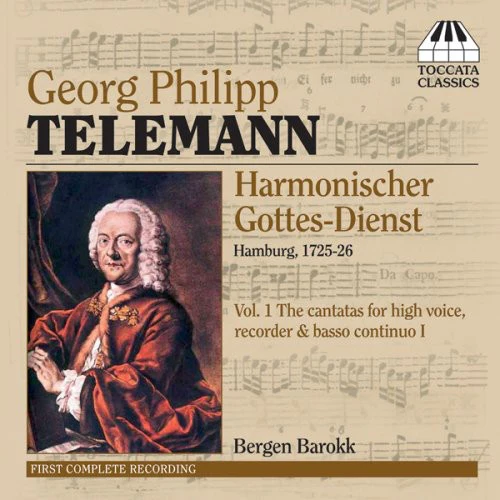
Telemann: Harmonischer Gottes-Dienst Vol 1 / Bergen Barokk
This is an issue of considerable potential significance, the opening installment in what is planned as a complete recording of Telemann’s 1725/26 Harmonischer Gottes-Dienst, the first integral cycle of church cantatas for the liturgical year ever published. Ever the astute self-publicist, Telemann had first announced in the Hamburg press plans to publish a cycle of cantatas as early as 1723, but the late delivery of the texts by the poet, Pastor Michael Brandenburg, forced Telemann to turn to a new cycle, Harmonischer Gottes-Dienst. For this, he sought the help of various poets, but in the end employed texts that were mostly the work of a young Hamburg writer, Arnold Wilckens, who based them largely on the Epistle for the day.
Planned more with domestic than church use in mind, the 72 cantatas are chamber works scored for a single voice, an obbligato instrument (specified with characteristic pragmatism by the composer as “a violin, or oboe, or flute, or recorder”), and continuo. The earliest cantatas of the cycle, sold by subscription, were ready by the end of 1725, in time for the issue of the first in the cycle, the cantata for New Year’s Day. Numerous reprints and the number of published copies still extant testify to the success of the venture, a success that was doubtless responsible for Telemann issuing a second collection in 1731–32.
The first six cantatas to be issued in Toccata’s new series are all for high voice, and cover a wide range of the liturgical year. The claim that four cantatas (TWV 1:941, TWV 1:730, TWV 1:1502, and TWV 1:96) are first recordings is untrue, the first three being available in current recordings. Toccata has also got in a mess with their TWV numbering, giving Hemmet den Eifer the number of In gering (wrongly listed as TWV1:549) instead of its correct number, TWV1:730. Hemmet den Eifer is also erroneously listed on the cover as being for the First Sunday after Epiphany rather than the Fourth, although the booklet gets it right. Not an auspicious start for an ambitious series.
The form of each cantata is the same: opening and closing da capo arias framing a lengthy plain (or secco) recitative. The use of rhetorical gesture is a feature of the cantatas, either in obvious mimetic ways such as the graphic shakes on the word “regen” (“trembling”) in the opening aria of TWV1:1040, or with greater musical subtlety when the music of TWV 1: 1502’s first aria becomes disjointed to illustrate the impotence of mortal wisdom “to gain complete perfection.” Hemmet den Eifer starts in strikingly bold fashion with an aria demanding “Stifle your eagerness/banish revenge,” but the most dramatic music here is to be found in “Du bist verflucht” (“You are accursed”), the opening aria of TWV1:213 for the Fourth Sunday of Lent. Here a turbulent accompaniment underpins a colorfully declamatory text, the “voice of terror” inspiring a headlong chromatic descent in the voice, fearfully dogged by the recorder.
Mona Julsrud’s account of these six cantatas is generally very satisfying. She is a bright, agile soprano with a good technique that gets her around ornaments with ease, phrases musically, and sings with clarity and good diction. But on the debit side, the voice lacks distinctive color, and there’s a tendency for upper notes to sound “hooty.” She is well supported by the members of Bergen Barokk, although it might have provided greater interest had at least one of Telemann’s alternative obbligato instruments been employed rather than using a recorder throughout. Other than the solecisms noted above, the presentation is good, with a slipcase that includes the disc, and an informative 60-page booklet that deserves full credit for printing the relevant biblical text before each cantata. Good sound. Overall, this is a promising, if not perfect start to a project one wishes every success.
FANFARE: Brian Robins
Planned more with domestic than church use in mind, the 72 cantatas are chamber works scored for a single voice, an obbligato instrument (specified with characteristic pragmatism by the composer as “a violin, or oboe, or flute, or recorder”), and continuo. The earliest cantatas of the cycle, sold by subscription, were ready by the end of 1725, in time for the issue of the first in the cycle, the cantata for New Year’s Day. Numerous reprints and the number of published copies still extant testify to the success of the venture, a success that was doubtless responsible for Telemann issuing a second collection in 1731–32.
The first six cantatas to be issued in Toccata’s new series are all for high voice, and cover a wide range of the liturgical year. The claim that four cantatas (TWV 1:941, TWV 1:730, TWV 1:1502, and TWV 1:96) are first recordings is untrue, the first three being available in current recordings. Toccata has also got in a mess with their TWV numbering, giving Hemmet den Eifer the number of In gering (wrongly listed as TWV1:549) instead of its correct number, TWV1:730. Hemmet den Eifer is also erroneously listed on the cover as being for the First Sunday after Epiphany rather than the Fourth, although the booklet gets it right. Not an auspicious start for an ambitious series.
The form of each cantata is the same: opening and closing da capo arias framing a lengthy plain (or secco) recitative. The use of rhetorical gesture is a feature of the cantatas, either in obvious mimetic ways such as the graphic shakes on the word “regen” (“trembling”) in the opening aria of TWV1:1040, or with greater musical subtlety when the music of TWV 1: 1502’s first aria becomes disjointed to illustrate the impotence of mortal wisdom “to gain complete perfection.” Hemmet den Eifer starts in strikingly bold fashion with an aria demanding “Stifle your eagerness/banish revenge,” but the most dramatic music here is to be found in “Du bist verflucht” (“You are accursed”), the opening aria of TWV1:213 for the Fourth Sunday of Lent. Here a turbulent accompaniment underpins a colorfully declamatory text, the “voice of terror” inspiring a headlong chromatic descent in the voice, fearfully dogged by the recorder.
Mona Julsrud’s account of these six cantatas is generally very satisfying. She is a bright, agile soprano with a good technique that gets her around ornaments with ease, phrases musically, and sings with clarity and good diction. But on the debit side, the voice lacks distinctive color, and there’s a tendency for upper notes to sound “hooty.” She is well supported by the members of Bergen Barokk, although it might have provided greater interest had at least one of Telemann’s alternative obbligato instruments been employed rather than using a recorder throughout. Other than the solecisms noted above, the presentation is good, with a slipcase that includes the disc, and an informative 60-page booklet that deserves full credit for printing the relevant biblical text before each cantata. Good sound. Overall, this is a promising, if not perfect start to a project one wishes every success.
FANFARE: Brian Robins
This is an issue of considerable potential significance, the opening installment in what is planned as a complete recording of Telemann’s 1725/26 Harmonischer Gottes-Dienst, the first integral cycle of church cantatas for the liturgical year ever published. Ever the astute self-publicist, Telemann had first announced in the Hamburg press plans to publish a cycle of cantatas as early as 1723, but the late delivery of the texts by the poet, Pastor Michael Brandenburg, forced Telemann to turn to a new cycle, Harmonischer Gottes-Dienst. For this, he sought the help of various poets, but in the end employed texts that were mostly the work of a young Hamburg writer, Arnold Wilckens, who based them largely on the Epistle for the day.
Planned more with domestic than church use in mind, the 72 cantatas are chamber works scored for a single voice, an obbligato instrument (specified with characteristic pragmatism by the composer as “a violin, or oboe, or flute, or recorder”), and continuo. The earliest cantatas of the cycle, sold by subscription, were ready by the end of 1725, in time for the issue of the first in the cycle, the cantata for New Year’s Day. Numerous reprints and the number of published copies still extant testify to the success of the venture, a success that was doubtless responsible for Telemann issuing a second collection in 1731–32.
The first six cantatas to be issued in Toccata’s new series are all for high voice, and cover a wide range of the liturgical year. The claim that four cantatas (TWV 1:941, TWV 1:730, TWV 1:1502, and TWV 1:96) are first recordings is untrue, the first three being available in current recordings. Toccata has also got in a mess with their TWV numbering, giving Hemmet den Eifer the number of In gering (wrongly listed as TWV1:549) instead of its correct number, TWV1:730. Hemmet den Eifer is also erroneously listed on the cover as being for the First Sunday after Epiphany rather than the Fourth, although the booklet gets it right. Not an auspicious start for an ambitious series.
The form of each cantata is the same: opening and closing da capo arias framing a lengthy plain (or secco) recitative. The use of rhetorical gesture is a feature of the cantatas, either in obvious mimetic ways such as the graphic shakes on the word “regen” (“trembling”) in the opening aria of TWV1:1040, or with greater musical subtlety when the music of TWV 1: 1502’s first aria becomes disjointed to illustrate the impotence of mortal wisdom “to gain complete perfection.” Hemmet den Eifer starts in strikingly bold fashion with an aria demanding “Stifle your eagerness/banish revenge,” but the most dramatic music here is to be found in “Du bist verflucht” (“You are accursed”), the opening aria of TWV1:213 for the Fourth Sunday of Lent. Here a turbulent accompaniment underpins a colorfully declamatory text, the “voice of terror” inspiring a headlong chromatic descent in the voice, fearfully dogged by the recorder.
Mona Julsrud’s account of these six cantatas is generally very satisfying. She is a bright, agile soprano with a good technique that gets her around ornaments with ease, phrases musically, and sings with clarity and good diction. But on the debit side, the voice lacks distinctive color, and there’s a tendency for upper notes to sound “hooty.” She is well supported by the members of Bergen Barokk, although it might have provided greater interest had at least one of Telemann’s alternative obbligato instruments been employed rather than using a recorder throughout. Other than the solecisms noted above, the presentation is good, with a slipcase that includes the disc, and an informative 60-page booklet that deserves full credit for printing the relevant biblical text before each cantata. Good sound. Overall, this is a promising, if not perfect start to a project one wishes every success.
FANFARE: Brian Robins
Planned more with domestic than church use in mind, the 72 cantatas are chamber works scored for a single voice, an obbligato instrument (specified with characteristic pragmatism by the composer as “a violin, or oboe, or flute, or recorder”), and continuo. The earliest cantatas of the cycle, sold by subscription, were ready by the end of 1725, in time for the issue of the first in the cycle, the cantata for New Year’s Day. Numerous reprints and the number of published copies still extant testify to the success of the venture, a success that was doubtless responsible for Telemann issuing a second collection in 1731–32.
The first six cantatas to be issued in Toccata’s new series are all for high voice, and cover a wide range of the liturgical year. The claim that four cantatas (TWV 1:941, TWV 1:730, TWV 1:1502, and TWV 1:96) are first recordings is untrue, the first three being available in current recordings. Toccata has also got in a mess with their TWV numbering, giving Hemmet den Eifer the number of In gering (wrongly listed as TWV1:549) instead of its correct number, TWV1:730. Hemmet den Eifer is also erroneously listed on the cover as being for the First Sunday after Epiphany rather than the Fourth, although the booklet gets it right. Not an auspicious start for an ambitious series.
The form of each cantata is the same: opening and closing da capo arias framing a lengthy plain (or secco) recitative. The use of rhetorical gesture is a feature of the cantatas, either in obvious mimetic ways such as the graphic shakes on the word “regen” (“trembling”) in the opening aria of TWV1:1040, or with greater musical subtlety when the music of TWV 1: 1502’s first aria becomes disjointed to illustrate the impotence of mortal wisdom “to gain complete perfection.” Hemmet den Eifer starts in strikingly bold fashion with an aria demanding “Stifle your eagerness/banish revenge,” but the most dramatic music here is to be found in “Du bist verflucht” (“You are accursed”), the opening aria of TWV1:213 for the Fourth Sunday of Lent. Here a turbulent accompaniment underpins a colorfully declamatory text, the “voice of terror” inspiring a headlong chromatic descent in the voice, fearfully dogged by the recorder.
Mona Julsrud’s account of these six cantatas is generally very satisfying. She is a bright, agile soprano with a good technique that gets her around ornaments with ease, phrases musically, and sings with clarity and good diction. But on the debit side, the voice lacks distinctive color, and there’s a tendency for upper notes to sound “hooty.” She is well supported by the members of Bergen Barokk, although it might have provided greater interest had at least one of Telemann’s alternative obbligato instruments been employed rather than using a recorder throughout. Other than the solecisms noted above, the presentation is good, with a slipcase that includes the disc, and an informative 60-page booklet that deserves full credit for printing the relevant biblical text before each cantata. Good sound. Overall, this is a promising, if not perfect start to a project one wishes every success.
FANFARE: Brian Robins
$7.35
Original: $20.99
-65%Telemann: Harmonischer Gottes-Dienst Vol 1 / Bergen Barokk—
$20.99
$7.35Description
This is an issue of considerable potential significance, the opening installment in what is planned as a complete recording of Telemann’s 1725/26 Harmonischer Gottes-Dienst, the first integral cycle of church cantatas for the liturgical year ever published. Ever the astute self-publicist, Telemann had first announced in the Hamburg press plans to publish a cycle of cantatas as early as 1723, but the late delivery of the texts by the poet, Pastor Michael Brandenburg, forced Telemann to turn to a new cycle, Harmonischer Gottes-Dienst. For this, he sought the help of various poets, but in the end employed texts that were mostly the work of a young Hamburg writer, Arnold Wilckens, who based them largely on the Epistle for the day.
Planned more with domestic than church use in mind, the 72 cantatas are chamber works scored for a single voice, an obbligato instrument (specified with characteristic pragmatism by the composer as “a violin, or oboe, or flute, or recorder”), and continuo. The earliest cantatas of the cycle, sold by subscription, were ready by the end of 1725, in time for the issue of the first in the cycle, the cantata for New Year’s Day. Numerous reprints and the number of published copies still extant testify to the success of the venture, a success that was doubtless responsible for Telemann issuing a second collection in 1731–32.
The first six cantatas to be issued in Toccata’s new series are all for high voice, and cover a wide range of the liturgical year. The claim that four cantatas (TWV 1:941, TWV 1:730, TWV 1:1502, and TWV 1:96) are first recordings is untrue, the first three being available in current recordings. Toccata has also got in a mess with their TWV numbering, giving Hemmet den Eifer the number of In gering (wrongly listed as TWV1:549) instead of its correct number, TWV1:730. Hemmet den Eifer is also erroneously listed on the cover as being for the First Sunday after Epiphany rather than the Fourth, although the booklet gets it right. Not an auspicious start for an ambitious series.
The form of each cantata is the same: opening and closing da capo arias framing a lengthy plain (or secco) recitative. The use of rhetorical gesture is a feature of the cantatas, either in obvious mimetic ways such as the graphic shakes on the word “regen” (“trembling”) in the opening aria of TWV1:1040, or with greater musical subtlety when the music of TWV 1: 1502’s first aria becomes disjointed to illustrate the impotence of mortal wisdom “to gain complete perfection.” Hemmet den Eifer starts in strikingly bold fashion with an aria demanding “Stifle your eagerness/banish revenge,” but the most dramatic music here is to be found in “Du bist verflucht” (“You are accursed”), the opening aria of TWV1:213 for the Fourth Sunday of Lent. Here a turbulent accompaniment underpins a colorfully declamatory text, the “voice of terror” inspiring a headlong chromatic descent in the voice, fearfully dogged by the recorder.
Mona Julsrud’s account of these six cantatas is generally very satisfying. She is a bright, agile soprano with a good technique that gets her around ornaments with ease, phrases musically, and sings with clarity and good diction. But on the debit side, the voice lacks distinctive color, and there’s a tendency for upper notes to sound “hooty.” She is well supported by the members of Bergen Barokk, although it might have provided greater interest had at least one of Telemann’s alternative obbligato instruments been employed rather than using a recorder throughout. Other than the solecisms noted above, the presentation is good, with a slipcase that includes the disc, and an informative 60-page booklet that deserves full credit for printing the relevant biblical text before each cantata. Good sound. Overall, this is a promising, if not perfect start to a project one wishes every success.
FANFARE: Brian Robins
Planned more with domestic than church use in mind, the 72 cantatas are chamber works scored for a single voice, an obbligato instrument (specified with characteristic pragmatism by the composer as “a violin, or oboe, or flute, or recorder”), and continuo. The earliest cantatas of the cycle, sold by subscription, were ready by the end of 1725, in time for the issue of the first in the cycle, the cantata for New Year’s Day. Numerous reprints and the number of published copies still extant testify to the success of the venture, a success that was doubtless responsible for Telemann issuing a second collection in 1731–32.
The first six cantatas to be issued in Toccata’s new series are all for high voice, and cover a wide range of the liturgical year. The claim that four cantatas (TWV 1:941, TWV 1:730, TWV 1:1502, and TWV 1:96) are first recordings is untrue, the first three being available in current recordings. Toccata has also got in a mess with their TWV numbering, giving Hemmet den Eifer the number of In gering (wrongly listed as TWV1:549) instead of its correct number, TWV1:730. Hemmet den Eifer is also erroneously listed on the cover as being for the First Sunday after Epiphany rather than the Fourth, although the booklet gets it right. Not an auspicious start for an ambitious series.
The form of each cantata is the same: opening and closing da capo arias framing a lengthy plain (or secco) recitative. The use of rhetorical gesture is a feature of the cantatas, either in obvious mimetic ways such as the graphic shakes on the word “regen” (“trembling”) in the opening aria of TWV1:1040, or with greater musical subtlety when the music of TWV 1: 1502’s first aria becomes disjointed to illustrate the impotence of mortal wisdom “to gain complete perfection.” Hemmet den Eifer starts in strikingly bold fashion with an aria demanding “Stifle your eagerness/banish revenge,” but the most dramatic music here is to be found in “Du bist verflucht” (“You are accursed”), the opening aria of TWV1:213 for the Fourth Sunday of Lent. Here a turbulent accompaniment underpins a colorfully declamatory text, the “voice of terror” inspiring a headlong chromatic descent in the voice, fearfully dogged by the recorder.
Mona Julsrud’s account of these six cantatas is generally very satisfying. She is a bright, agile soprano with a good technique that gets her around ornaments with ease, phrases musically, and sings with clarity and good diction. But on the debit side, the voice lacks distinctive color, and there’s a tendency for upper notes to sound “hooty.” She is well supported by the members of Bergen Barokk, although it might have provided greater interest had at least one of Telemann’s alternative obbligato instruments been employed rather than using a recorder throughout. Other than the solecisms noted above, the presentation is good, with a slipcase that includes the disc, and an informative 60-page booklet that deserves full credit for printing the relevant biblical text before each cantata. Good sound. Overall, this is a promising, if not perfect start to a project one wishes every success.
FANFARE: Brian Robins