🎉 Up to 70% Off Selected ItemsShop Sale

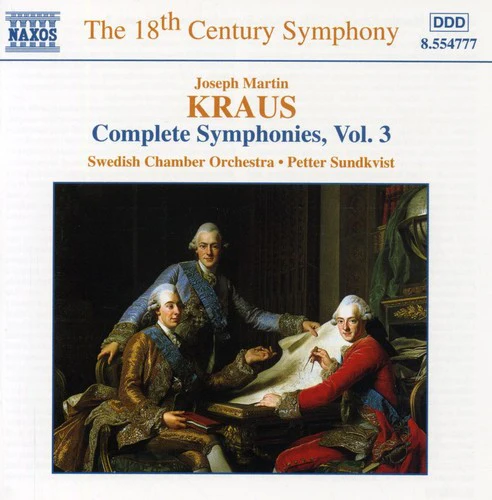
The 18th Century Symphony - Kraus: Symphonies Vol 3
Any composer dubbed by Haydn as "one of the greatest geniuses I have met" deserves serious attention. One such was German-born Joseph Martin Kraus. Born the same year as Mozart (1756), Kraus survived him by a year, dying of tuberculosis at age 36. Remarkably, despite having lived in Sweden for less than eight years, he was befriended by King Gustavus III and became the country's greatest 18th century composer. That reputation is gaining wider endorsement today through a pioneering Kraus series on Naxos, of which this is the latest installment. The performers, as before, are the Swedish Chamber Orchestra under Petter Sundkvist, who continue to give exemplary readings of these remarkable if obscure late Classical symphonies.
Though the C-sharp minor and E minor works that open and close this program fully reflect the tastes and semantics of their era, the Symphony in C minor, subtitled "Symphonie funèbre", is an astonishing discovery. Written in April, 1792, following the assassination of Gustav III (the event inspired operas by Verdi and Auber and its political repercussions were felt throughout Europe), this is one of the most extraordinary musical valedictions to pre-date Beethoven's Eroica. All four movements are somber and slow-moving, and the use of timpani, solemn brass, and muted strings seem uncomfortably alien to a work of the period. This is an exceptionally fine account; Sundkvist's orchestra plays magnificently under his watchful direction, and the solo cello and horn in the chorale section of the finale sound suitably eloquent.
This disc also includes Kraus’ Overture in D minor (according to Haydn's friend Fredrik Silverstolpe, Swedish ambassador to Vienna, it was performed by mixed wind band at Good Friday services in Stockholm for many years) in its original instrumentation, the outcome of detailed reconstruction of Kraus' original manuscripts. Another surprise is the C # minor 'Sinfonia da camera'; the second section of its minuet is simply the first part played backwards (a trick Haydn himself tried on occasion)! As with previous releases, the Swedish Chamber Orchestra and Sundkvist, offer spirited and polished orchestral playing and a bright-well-balanced recording. Highly recommended.
--Michael Jameson, ClassicsToday.com
Though the C-sharp minor and E minor works that open and close this program fully reflect the tastes and semantics of their era, the Symphony in C minor, subtitled "Symphonie funèbre", is an astonishing discovery. Written in April, 1792, following the assassination of Gustav III (the event inspired operas by Verdi and Auber and its political repercussions were felt throughout Europe), this is one of the most extraordinary musical valedictions to pre-date Beethoven's Eroica. All four movements are somber and slow-moving, and the use of timpani, solemn brass, and muted strings seem uncomfortably alien to a work of the period. This is an exceptionally fine account; Sundkvist's orchestra plays magnificently under his watchful direction, and the solo cello and horn in the chorale section of the finale sound suitably eloquent.
This disc also includes Kraus’ Overture in D minor (according to Haydn's friend Fredrik Silverstolpe, Swedish ambassador to Vienna, it was performed by mixed wind band at Good Friday services in Stockholm for many years) in its original instrumentation, the outcome of detailed reconstruction of Kraus' original manuscripts. Another surprise is the C # minor 'Sinfonia da camera'; the second section of its minuet is simply the first part played backwards (a trick Haydn himself tried on occasion)! As with previous releases, the Swedish Chamber Orchestra and Sundkvist, offer spirited and polished orchestral playing and a bright-well-balanced recording. Highly recommended.
--Michael Jameson, ClassicsToday.com
Any composer dubbed by Haydn as "one of the greatest geniuses I have met" deserves serious attention. One such was German-born Joseph Martin Kraus. Born the same year as Mozart (1756), Kraus survived him by a year, dying of tuberculosis at age 36. Remarkably, despite having lived in Sweden for less than eight years, he was befriended by King Gustavus III and became the country's greatest 18th century composer. That reputation is gaining wider endorsement today through a pioneering Kraus series on Naxos, of which this is the latest installment. The performers, as before, are the Swedish Chamber Orchestra under Petter Sundkvist, who continue to give exemplary readings of these remarkable if obscure late Classical symphonies.
Though the C-sharp minor and E minor works that open and close this program fully reflect the tastes and semantics of their era, the Symphony in C minor, subtitled "Symphonie funèbre", is an astonishing discovery. Written in April, 1792, following the assassination of Gustav III (the event inspired operas by Verdi and Auber and its political repercussions were felt throughout Europe), this is one of the most extraordinary musical valedictions to pre-date Beethoven's Eroica. All four movements are somber and slow-moving, and the use of timpani, solemn brass, and muted strings seem uncomfortably alien to a work of the period. This is an exceptionally fine account; Sundkvist's orchestra plays magnificently under his watchful direction, and the solo cello and horn in the chorale section of the finale sound suitably eloquent.
This disc also includes Kraus’ Overture in D minor (according to Haydn's friend Fredrik Silverstolpe, Swedish ambassador to Vienna, it was performed by mixed wind band at Good Friday services in Stockholm for many years) in its original instrumentation, the outcome of detailed reconstruction of Kraus' original manuscripts. Another surprise is the C # minor 'Sinfonia da camera'; the second section of its minuet is simply the first part played backwards (a trick Haydn himself tried on occasion)! As with previous releases, the Swedish Chamber Orchestra and Sundkvist, offer spirited and polished orchestral playing and a bright-well-balanced recording. Highly recommended.
--Michael Jameson, ClassicsToday.com
Though the C-sharp minor and E minor works that open and close this program fully reflect the tastes and semantics of their era, the Symphony in C minor, subtitled "Symphonie funèbre", is an astonishing discovery. Written in April, 1792, following the assassination of Gustav III (the event inspired operas by Verdi and Auber and its political repercussions were felt throughout Europe), this is one of the most extraordinary musical valedictions to pre-date Beethoven's Eroica. All four movements are somber and slow-moving, and the use of timpani, solemn brass, and muted strings seem uncomfortably alien to a work of the period. This is an exceptionally fine account; Sundkvist's orchestra plays magnificently under his watchful direction, and the solo cello and horn in the chorale section of the finale sound suitably eloquent.
This disc also includes Kraus’ Overture in D minor (according to Haydn's friend Fredrik Silverstolpe, Swedish ambassador to Vienna, it was performed by mixed wind band at Good Friday services in Stockholm for many years) in its original instrumentation, the outcome of detailed reconstruction of Kraus' original manuscripts. Another surprise is the C # minor 'Sinfonia da camera'; the second section of its minuet is simply the first part played backwards (a trick Haydn himself tried on occasion)! As with previous releases, the Swedish Chamber Orchestra and Sundkvist, offer spirited and polished orchestral playing and a bright-well-balanced recording. Highly recommended.
--Michael Jameson, ClassicsToday.com
$7.00
Original: $19.99
-65%The 18th Century Symphony - Kraus: Symphonies Vol 3—
$19.99
$7.00Description
Any composer dubbed by Haydn as "one of the greatest geniuses I have met" deserves serious attention. One such was German-born Joseph Martin Kraus. Born the same year as Mozart (1756), Kraus survived him by a year, dying of tuberculosis at age 36. Remarkably, despite having lived in Sweden for less than eight years, he was befriended by King Gustavus III and became the country's greatest 18th century composer. That reputation is gaining wider endorsement today through a pioneering Kraus series on Naxos, of which this is the latest installment. The performers, as before, are the Swedish Chamber Orchestra under Petter Sundkvist, who continue to give exemplary readings of these remarkable if obscure late Classical symphonies.
Though the C-sharp minor and E minor works that open and close this program fully reflect the tastes and semantics of their era, the Symphony in C minor, subtitled "Symphonie funèbre", is an astonishing discovery. Written in April, 1792, following the assassination of Gustav III (the event inspired operas by Verdi and Auber and its political repercussions were felt throughout Europe), this is one of the most extraordinary musical valedictions to pre-date Beethoven's Eroica. All four movements are somber and slow-moving, and the use of timpani, solemn brass, and muted strings seem uncomfortably alien to a work of the period. This is an exceptionally fine account; Sundkvist's orchestra plays magnificently under his watchful direction, and the solo cello and horn in the chorale section of the finale sound suitably eloquent.
This disc also includes Kraus’ Overture in D minor (according to Haydn's friend Fredrik Silverstolpe, Swedish ambassador to Vienna, it was performed by mixed wind band at Good Friday services in Stockholm for many years) in its original instrumentation, the outcome of detailed reconstruction of Kraus' original manuscripts. Another surprise is the C # minor 'Sinfonia da camera'; the second section of its minuet is simply the first part played backwards (a trick Haydn himself tried on occasion)! As with previous releases, the Swedish Chamber Orchestra and Sundkvist, offer spirited and polished orchestral playing and a bright-well-balanced recording. Highly recommended.
--Michael Jameson, ClassicsToday.com
Though the C-sharp minor and E minor works that open and close this program fully reflect the tastes and semantics of their era, the Symphony in C minor, subtitled "Symphonie funèbre", is an astonishing discovery. Written in April, 1792, following the assassination of Gustav III (the event inspired operas by Verdi and Auber and its political repercussions were felt throughout Europe), this is one of the most extraordinary musical valedictions to pre-date Beethoven's Eroica. All four movements are somber and slow-moving, and the use of timpani, solemn brass, and muted strings seem uncomfortably alien to a work of the period. This is an exceptionally fine account; Sundkvist's orchestra plays magnificently under his watchful direction, and the solo cello and horn in the chorale section of the finale sound suitably eloquent.
This disc also includes Kraus’ Overture in D minor (according to Haydn's friend Fredrik Silverstolpe, Swedish ambassador to Vienna, it was performed by mixed wind band at Good Friday services in Stockholm for many years) in its original instrumentation, the outcome of detailed reconstruction of Kraus' original manuscripts. Another surprise is the C # minor 'Sinfonia da camera'; the second section of its minuet is simply the first part played backwards (a trick Haydn himself tried on occasion)! As with previous releases, the Swedish Chamber Orchestra and Sundkvist, offer spirited and polished orchestral playing and a bright-well-balanced recording. Highly recommended.
--Michael Jameson, ClassicsToday.com