🎉 Up to 70% Off Selected ItemsShop Sale

1 / 2
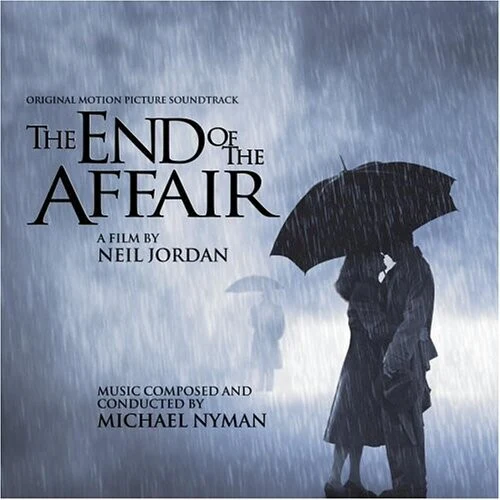
The End Of The Affair - Original Soundtrack
A while ago, when commenting on Michael Nyman's "The Piano," I spoke (or pontificated, rather) to some colleagues regarding my dismay over Nyman's 'art.' I mention guilty pleasures on occasion, but a greater potential irrationality of criticism is the personal determination of whether one should praise certain scores or composers for daring to be abstract, or lambaste them for not getting their points across. I have done both, with disliked emphasis on the latter, when listening to Nyman's compositions. It is with "The End of the Affair," performed by the Michael Nyman Orchestra, that I realize I ought to place my views firmly, diplomatically in the middle.
The music really depends on how the listener feels, as opposed to being the sort of film score that alters how he feels. Reliant on the mood and the focus of attention, the score delights as confidently as it bores. It stands precariously on the divide between art and self-importance. Its incessant, top heavy strings play ad nauseam -- will they never end? -- but the themes they play indulge in the attention. It is exceedingly predictable, just as a fair deal of minimalist music is. And compared to the film scores of minimalist Philip Glass it is neither technically brilliant nor dramatically solid. It is challenging primarily to the amplitude of one's attempt to fall in love with its tedium. Cinematic evolution gets thrown out of the window for a beginning, middle, and end that are practically unidentifiable from one another. As I am not a huge supporter of the minimalist music movement I may be missing some key thought, others may see this score far differently, but to my ears it reaches a point of despotic annoyance. Call me unfashionable. Yet I cannot help praising "The End of the Affair" for its abstract grandeur. The scope, though minimal, gets the most out of the repeating elements, and the cues, taken individually as small concert works rather than part of a theatrical whole, become fascinating essays in contemporary classical music. Nyman has an unconventional way with counterpoint (and lack thereof) that is lush and thoroughly amazing, and the themes are memorable and inhabit the soundscape aggressively well. When these ideas stick out from the common backdrop, it is mesmerizing.
What fascinates me most personally is that this is one of the few soundtracks I know of featuring such a strong dichotomy... I am not sure I appreciate it...
-- Jeffrey Wheeler, MusicWeb International
The music really depends on how the listener feels, as opposed to being the sort of film score that alters how he feels. Reliant on the mood and the focus of attention, the score delights as confidently as it bores. It stands precariously on the divide between art and self-importance. Its incessant, top heavy strings play ad nauseam -- will they never end? -- but the themes they play indulge in the attention. It is exceedingly predictable, just as a fair deal of minimalist music is. And compared to the film scores of minimalist Philip Glass it is neither technically brilliant nor dramatically solid. It is challenging primarily to the amplitude of one's attempt to fall in love with its tedium. Cinematic evolution gets thrown out of the window for a beginning, middle, and end that are practically unidentifiable from one another. As I am not a huge supporter of the minimalist music movement I may be missing some key thought, others may see this score far differently, but to my ears it reaches a point of despotic annoyance. Call me unfashionable. Yet I cannot help praising "The End of the Affair" for its abstract grandeur. The scope, though minimal, gets the most out of the repeating elements, and the cues, taken individually as small concert works rather than part of a theatrical whole, become fascinating essays in contemporary classical music. Nyman has an unconventional way with counterpoint (and lack thereof) that is lush and thoroughly amazing, and the themes are memorable and inhabit the soundscape aggressively well. When these ideas stick out from the common backdrop, it is mesmerizing.
What fascinates me most personally is that this is one of the few soundtracks I know of featuring such a strong dichotomy... I am not sure I appreciate it...
-- Jeffrey Wheeler, MusicWeb International
A while ago, when commenting on Michael Nyman's "The Piano," I spoke (or pontificated, rather) to some colleagues regarding my dismay over Nyman's 'art.' I mention guilty pleasures on occasion, but a greater potential irrationality of criticism is the personal determination of whether one should praise certain scores or composers for daring to be abstract, or lambaste them for not getting their points across. I have done both, with disliked emphasis on the latter, when listening to Nyman's compositions. It is with "The End of the Affair," performed by the Michael Nyman Orchestra, that I realize I ought to place my views firmly, diplomatically in the middle.
The music really depends on how the listener feels, as opposed to being the sort of film score that alters how he feels. Reliant on the mood and the focus of attention, the score delights as confidently as it bores. It stands precariously on the divide between art and self-importance. Its incessant, top heavy strings play ad nauseam -- will they never end? -- but the themes they play indulge in the attention. It is exceedingly predictable, just as a fair deal of minimalist music is. And compared to the film scores of minimalist Philip Glass it is neither technically brilliant nor dramatically solid. It is challenging primarily to the amplitude of one's attempt to fall in love with its tedium. Cinematic evolution gets thrown out of the window for a beginning, middle, and end that are practically unidentifiable from one another. As I am not a huge supporter of the minimalist music movement I may be missing some key thought, others may see this score far differently, but to my ears it reaches a point of despotic annoyance. Call me unfashionable. Yet I cannot help praising "The End of the Affair" for its abstract grandeur. The scope, though minimal, gets the most out of the repeating elements, and the cues, taken individually as small concert works rather than part of a theatrical whole, become fascinating essays in contemporary classical music. Nyman has an unconventional way with counterpoint (and lack thereof) that is lush and thoroughly amazing, and the themes are memorable and inhabit the soundscape aggressively well. When these ideas stick out from the common backdrop, it is mesmerizing.
What fascinates me most personally is that this is one of the few soundtracks I know of featuring such a strong dichotomy... I am not sure I appreciate it...
-- Jeffrey Wheeler, MusicWeb International
The music really depends on how the listener feels, as opposed to being the sort of film score that alters how he feels. Reliant on the mood and the focus of attention, the score delights as confidently as it bores. It stands precariously on the divide between art and self-importance. Its incessant, top heavy strings play ad nauseam -- will they never end? -- but the themes they play indulge in the attention. It is exceedingly predictable, just as a fair deal of minimalist music is. And compared to the film scores of minimalist Philip Glass it is neither technically brilliant nor dramatically solid. It is challenging primarily to the amplitude of one's attempt to fall in love with its tedium. Cinematic evolution gets thrown out of the window for a beginning, middle, and end that are practically unidentifiable from one another. As I am not a huge supporter of the minimalist music movement I may be missing some key thought, others may see this score far differently, but to my ears it reaches a point of despotic annoyance. Call me unfashionable. Yet I cannot help praising "The End of the Affair" for its abstract grandeur. The scope, though minimal, gets the most out of the repeating elements, and the cues, taken individually as small concert works rather than part of a theatrical whole, become fascinating essays in contemporary classical music. Nyman has an unconventional way with counterpoint (and lack thereof) that is lush and thoroughly amazing, and the themes are memorable and inhabit the soundscape aggressively well. When these ideas stick out from the common backdrop, it is mesmerizing.
What fascinates me most personally is that this is one of the few soundtracks I know of featuring such a strong dichotomy... I am not sure I appreciate it...
-- Jeffrey Wheeler, MusicWeb International
$13.99
The End Of The Affair - Original Soundtrack—
$13.99
Description
A while ago, when commenting on Michael Nyman's "The Piano," I spoke (or pontificated, rather) to some colleagues regarding my dismay over Nyman's 'art.' I mention guilty pleasures on occasion, but a greater potential irrationality of criticism is the personal determination of whether one should praise certain scores or composers for daring to be abstract, or lambaste them for not getting their points across. I have done both, with disliked emphasis on the latter, when listening to Nyman's compositions. It is with "The End of the Affair," performed by the Michael Nyman Orchestra, that I realize I ought to place my views firmly, diplomatically in the middle.
The music really depends on how the listener feels, as opposed to being the sort of film score that alters how he feels. Reliant on the mood and the focus of attention, the score delights as confidently as it bores. It stands precariously on the divide between art and self-importance. Its incessant, top heavy strings play ad nauseam -- will they never end? -- but the themes they play indulge in the attention. It is exceedingly predictable, just as a fair deal of minimalist music is. And compared to the film scores of minimalist Philip Glass it is neither technically brilliant nor dramatically solid. It is challenging primarily to the amplitude of one's attempt to fall in love with its tedium. Cinematic evolution gets thrown out of the window for a beginning, middle, and end that are practically unidentifiable from one another. As I am not a huge supporter of the minimalist music movement I may be missing some key thought, others may see this score far differently, but to my ears it reaches a point of despotic annoyance. Call me unfashionable. Yet I cannot help praising "The End of the Affair" for its abstract grandeur. The scope, though minimal, gets the most out of the repeating elements, and the cues, taken individually as small concert works rather than part of a theatrical whole, become fascinating essays in contemporary classical music. Nyman has an unconventional way with counterpoint (and lack thereof) that is lush and thoroughly amazing, and the themes are memorable and inhabit the soundscape aggressively well. When these ideas stick out from the common backdrop, it is mesmerizing.
What fascinates me most personally is that this is one of the few soundtracks I know of featuring such a strong dichotomy... I am not sure I appreciate it...
-- Jeffrey Wheeler, MusicWeb International
The music really depends on how the listener feels, as opposed to being the sort of film score that alters how he feels. Reliant on the mood and the focus of attention, the score delights as confidently as it bores. It stands precariously on the divide between art and self-importance. Its incessant, top heavy strings play ad nauseam -- will they never end? -- but the themes they play indulge in the attention. It is exceedingly predictable, just as a fair deal of minimalist music is. And compared to the film scores of minimalist Philip Glass it is neither technically brilliant nor dramatically solid. It is challenging primarily to the amplitude of one's attempt to fall in love with its tedium. Cinematic evolution gets thrown out of the window for a beginning, middle, and end that are practically unidentifiable from one another. As I am not a huge supporter of the minimalist music movement I may be missing some key thought, others may see this score far differently, but to my ears it reaches a point of despotic annoyance. Call me unfashionable. Yet I cannot help praising "The End of the Affair" for its abstract grandeur. The scope, though minimal, gets the most out of the repeating elements, and the cues, taken individually as small concert works rather than part of a theatrical whole, become fascinating essays in contemporary classical music. Nyman has an unconventional way with counterpoint (and lack thereof) that is lush and thoroughly amazing, and the themes are memorable and inhabit the soundscape aggressively well. When these ideas stick out from the common backdrop, it is mesmerizing.
What fascinates me most personally is that this is one of the few soundtracks I know of featuring such a strong dichotomy... I am not sure I appreciate it...
-- Jeffrey Wheeler, MusicWeb International