🎉 Up to 70% Off Selected ItemsShop Sale

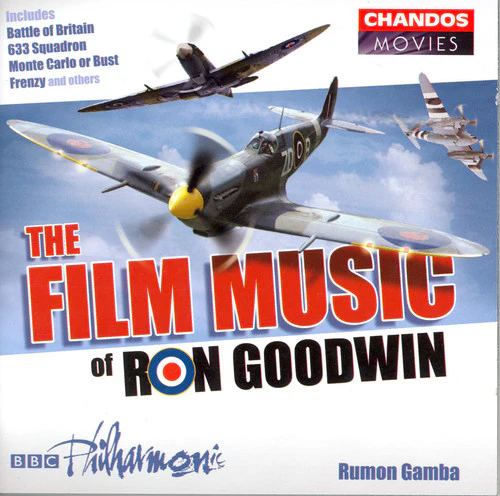
The Film Music Of Ron Goodwin / Gamba, BBC Philharmonic
Now that Chandos, in its extensive and irreplaceable film music series, has dealt with composers from Vaughan Williams to Nino Rota who first made their reputations in the classical concert field, with Ron Goodwin (1925–2003), they pay tribute to a musician who, in the early 1950s, quickly emerged from the pop music world with such fetching instrumental novelties as Swingin’ Sweethearts (known as Lingering Lovers in England) and similar cute numbers that became briefly ubiquitous on both sides of the Atlantic. (Incidentally Chandos should have provided some background commentary on Goodwin’s evolution in the accompanying booklet.)
This program offers a wide-ranging cross section of Goodwin’s work on several successful films as well as a few obscure but very appealing themes from minor films. Opening with the main theme to a 1963 war adventure—633 Squadron—we recognize Goodwin’s knack for taking very simple motifs of a generically fanfare-like or tocsin-like nature—sometimes celebratory, at others minatory—and turning them into striking variants that stick firmly in the memory. The main theme from the top-drawer World War II thriller—Where Eagles Dare—is another excellent example of this exceptional skill of creating an imposing charge of tension and foreboding through a monothematic manipulation of a basic percussion-lanced idea. Operation Crossbow and Force Ten from Navarone also fall into this category.
But Goodwin had another puckish side to his chameleon-like personality: an ability to throw together a mélange of thematic snippets drawn from all kinds of easily recognizable and pigeonholed ethnic and nationalistic sources—as in the rollicking roundelays from Those Magnificent Men in Their Flying Machines and Monte Carlo or Bust. The Miss Marple theme exemplifies Goodwin’s ability to establish and enhance a uniquely quirky character in just a few measures similar to the late John Addison’s inimitable theme for Murder She Wrote. Some of Goodwin’s themes have such unusual appeal that they can be adapted to other collective uses, as in the case of the main theme from The Trap, a lesser film noir, which later became known as “The London Marathon Theme.” Goodwin’s facility with more lyrically romantic material is evident in Lancelot and Guinevere, Of Human Bondage, and Beauty and the Beast, while a suite from Clash of Loyalties exploits more-exotic terrain quite colorfully.
Finally, we have here for the first time anywhere some lovely and sensually expressive melodies, such as the main themes from Deadly Stranger, Whirlpool, and Submarine X-1. About the only examples here that come across as somewhat derivatively generic are the London Theme from Hitchcock’s Frenzy and the suite from Battle of Britain, for which the too-slow-writing William Walton was preparing a truly exciting score but was replaced at the last minute by the more facile Goodwin.
This inherently positive, cheerful, and good-humored music reflects the beloved Goodwin’s own personality and is given a rousing and thrilling send-off by Rumon Gamba and the BBC Philharmonic. A real treat for all lovers of “light.”
Paul A. Snook, FANFARE
This program offers a wide-ranging cross section of Goodwin’s work on several successful films as well as a few obscure but very appealing themes from minor films. Opening with the main theme to a 1963 war adventure—633 Squadron—we recognize Goodwin’s knack for taking very simple motifs of a generically fanfare-like or tocsin-like nature—sometimes celebratory, at others minatory—and turning them into striking variants that stick firmly in the memory. The main theme from the top-drawer World War II thriller—Where Eagles Dare—is another excellent example of this exceptional skill of creating an imposing charge of tension and foreboding through a monothematic manipulation of a basic percussion-lanced idea. Operation Crossbow and Force Ten from Navarone also fall into this category.
But Goodwin had another puckish side to his chameleon-like personality: an ability to throw together a mélange of thematic snippets drawn from all kinds of easily recognizable and pigeonholed ethnic and nationalistic sources—as in the rollicking roundelays from Those Magnificent Men in Their Flying Machines and Monte Carlo or Bust. The Miss Marple theme exemplifies Goodwin’s ability to establish and enhance a uniquely quirky character in just a few measures similar to the late John Addison’s inimitable theme for Murder She Wrote. Some of Goodwin’s themes have such unusual appeal that they can be adapted to other collective uses, as in the case of the main theme from The Trap, a lesser film noir, which later became known as “The London Marathon Theme.” Goodwin’s facility with more lyrically romantic material is evident in Lancelot and Guinevere, Of Human Bondage, and Beauty and the Beast, while a suite from Clash of Loyalties exploits more-exotic terrain quite colorfully.
Finally, we have here for the first time anywhere some lovely and sensually expressive melodies, such as the main themes from Deadly Stranger, Whirlpool, and Submarine X-1. About the only examples here that come across as somewhat derivatively generic are the London Theme from Hitchcock’s Frenzy and the suite from Battle of Britain, for which the too-slow-writing William Walton was preparing a truly exciting score but was replaced at the last minute by the more facile Goodwin.
This inherently positive, cheerful, and good-humored music reflects the beloved Goodwin’s own personality and is given a rousing and thrilling send-off by Rumon Gamba and the BBC Philharmonic. A real treat for all lovers of “light.”
Paul A. Snook, FANFARE
Now that Chandos, in its extensive and irreplaceable film music series, has dealt with composers from Vaughan Williams to Nino Rota who first made their reputations in the classical concert field, with Ron Goodwin (1925–2003), they pay tribute to a musician who, in the early 1950s, quickly emerged from the pop music world with such fetching instrumental novelties as Swingin’ Sweethearts (known as Lingering Lovers in England) and similar cute numbers that became briefly ubiquitous on both sides of the Atlantic. (Incidentally Chandos should have provided some background commentary on Goodwin’s evolution in the accompanying booklet.)
This program offers a wide-ranging cross section of Goodwin’s work on several successful films as well as a few obscure but very appealing themes from minor films. Opening with the main theme to a 1963 war adventure—633 Squadron—we recognize Goodwin’s knack for taking very simple motifs of a generically fanfare-like or tocsin-like nature—sometimes celebratory, at others minatory—and turning them into striking variants that stick firmly in the memory. The main theme from the top-drawer World War II thriller—Where Eagles Dare—is another excellent example of this exceptional skill of creating an imposing charge of tension and foreboding through a monothematic manipulation of a basic percussion-lanced idea. Operation Crossbow and Force Ten from Navarone also fall into this category.
But Goodwin had another puckish side to his chameleon-like personality: an ability to throw together a mélange of thematic snippets drawn from all kinds of easily recognizable and pigeonholed ethnic and nationalistic sources—as in the rollicking roundelays from Those Magnificent Men in Their Flying Machines and Monte Carlo or Bust. The Miss Marple theme exemplifies Goodwin’s ability to establish and enhance a uniquely quirky character in just a few measures similar to the late John Addison’s inimitable theme for Murder She Wrote. Some of Goodwin’s themes have such unusual appeal that they can be adapted to other collective uses, as in the case of the main theme from The Trap, a lesser film noir, which later became known as “The London Marathon Theme.” Goodwin’s facility with more lyrically romantic material is evident in Lancelot and Guinevere, Of Human Bondage, and Beauty and the Beast, while a suite from Clash of Loyalties exploits more-exotic terrain quite colorfully.
Finally, we have here for the first time anywhere some lovely and sensually expressive melodies, such as the main themes from Deadly Stranger, Whirlpool, and Submarine X-1. About the only examples here that come across as somewhat derivatively generic are the London Theme from Hitchcock’s Frenzy and the suite from Battle of Britain, for which the too-slow-writing William Walton was preparing a truly exciting score but was replaced at the last minute by the more facile Goodwin.
This inherently positive, cheerful, and good-humored music reflects the beloved Goodwin’s own personality and is given a rousing and thrilling send-off by Rumon Gamba and the BBC Philharmonic. A real treat for all lovers of “light.”
Paul A. Snook, FANFARE
This program offers a wide-ranging cross section of Goodwin’s work on several successful films as well as a few obscure but very appealing themes from minor films. Opening with the main theme to a 1963 war adventure—633 Squadron—we recognize Goodwin’s knack for taking very simple motifs of a generically fanfare-like or tocsin-like nature—sometimes celebratory, at others minatory—and turning them into striking variants that stick firmly in the memory. The main theme from the top-drawer World War II thriller—Where Eagles Dare—is another excellent example of this exceptional skill of creating an imposing charge of tension and foreboding through a monothematic manipulation of a basic percussion-lanced idea. Operation Crossbow and Force Ten from Navarone also fall into this category.
But Goodwin had another puckish side to his chameleon-like personality: an ability to throw together a mélange of thematic snippets drawn from all kinds of easily recognizable and pigeonholed ethnic and nationalistic sources—as in the rollicking roundelays from Those Magnificent Men in Their Flying Machines and Monte Carlo or Bust. The Miss Marple theme exemplifies Goodwin’s ability to establish and enhance a uniquely quirky character in just a few measures similar to the late John Addison’s inimitable theme for Murder She Wrote. Some of Goodwin’s themes have such unusual appeal that they can be adapted to other collective uses, as in the case of the main theme from The Trap, a lesser film noir, which later became known as “The London Marathon Theme.” Goodwin’s facility with more lyrically romantic material is evident in Lancelot and Guinevere, Of Human Bondage, and Beauty and the Beast, while a suite from Clash of Loyalties exploits more-exotic terrain quite colorfully.
Finally, we have here for the first time anywhere some lovely and sensually expressive melodies, such as the main themes from Deadly Stranger, Whirlpool, and Submarine X-1. About the only examples here that come across as somewhat derivatively generic are the London Theme from Hitchcock’s Frenzy and the suite from Battle of Britain, for which the too-slow-writing William Walton was preparing a truly exciting score but was replaced at the last minute by the more facile Goodwin.
This inherently positive, cheerful, and good-humored music reflects the beloved Goodwin’s own personality and is given a rousing and thrilling send-off by Rumon Gamba and the BBC Philharmonic. A real treat for all lovers of “light.”
Paul A. Snook, FANFARE
$21.99
The Film Music Of Ron Goodwin / Gamba, BBC Philharmonic—
$21.99
Description
Now that Chandos, in its extensive and irreplaceable film music series, has dealt with composers from Vaughan Williams to Nino Rota who first made their reputations in the classical concert field, with Ron Goodwin (1925–2003), they pay tribute to a musician who, in the early 1950s, quickly emerged from the pop music world with such fetching instrumental novelties as Swingin’ Sweethearts (known as Lingering Lovers in England) and similar cute numbers that became briefly ubiquitous on both sides of the Atlantic. (Incidentally Chandos should have provided some background commentary on Goodwin’s evolution in the accompanying booklet.)
This program offers a wide-ranging cross section of Goodwin’s work on several successful films as well as a few obscure but very appealing themes from minor films. Opening with the main theme to a 1963 war adventure—633 Squadron—we recognize Goodwin’s knack for taking very simple motifs of a generically fanfare-like or tocsin-like nature—sometimes celebratory, at others minatory—and turning them into striking variants that stick firmly in the memory. The main theme from the top-drawer World War II thriller—Where Eagles Dare—is another excellent example of this exceptional skill of creating an imposing charge of tension and foreboding through a monothematic manipulation of a basic percussion-lanced idea. Operation Crossbow and Force Ten from Navarone also fall into this category.
But Goodwin had another puckish side to his chameleon-like personality: an ability to throw together a mélange of thematic snippets drawn from all kinds of easily recognizable and pigeonholed ethnic and nationalistic sources—as in the rollicking roundelays from Those Magnificent Men in Their Flying Machines and Monte Carlo or Bust. The Miss Marple theme exemplifies Goodwin’s ability to establish and enhance a uniquely quirky character in just a few measures similar to the late John Addison’s inimitable theme for Murder She Wrote. Some of Goodwin’s themes have such unusual appeal that they can be adapted to other collective uses, as in the case of the main theme from The Trap, a lesser film noir, which later became known as “The London Marathon Theme.” Goodwin’s facility with more lyrically romantic material is evident in Lancelot and Guinevere, Of Human Bondage, and Beauty and the Beast, while a suite from Clash of Loyalties exploits more-exotic terrain quite colorfully.
Finally, we have here for the first time anywhere some lovely and sensually expressive melodies, such as the main themes from Deadly Stranger, Whirlpool, and Submarine X-1. About the only examples here that come across as somewhat derivatively generic are the London Theme from Hitchcock’s Frenzy and the suite from Battle of Britain, for which the too-slow-writing William Walton was preparing a truly exciting score but was replaced at the last minute by the more facile Goodwin.
This inherently positive, cheerful, and good-humored music reflects the beloved Goodwin’s own personality and is given a rousing and thrilling send-off by Rumon Gamba and the BBC Philharmonic. A real treat for all lovers of “light.”
Paul A. Snook, FANFARE
This program offers a wide-ranging cross section of Goodwin’s work on several successful films as well as a few obscure but very appealing themes from minor films. Opening with the main theme to a 1963 war adventure—633 Squadron—we recognize Goodwin’s knack for taking very simple motifs of a generically fanfare-like or tocsin-like nature—sometimes celebratory, at others minatory—and turning them into striking variants that stick firmly in the memory. The main theme from the top-drawer World War II thriller—Where Eagles Dare—is another excellent example of this exceptional skill of creating an imposing charge of tension and foreboding through a monothematic manipulation of a basic percussion-lanced idea. Operation Crossbow and Force Ten from Navarone also fall into this category.
But Goodwin had another puckish side to his chameleon-like personality: an ability to throw together a mélange of thematic snippets drawn from all kinds of easily recognizable and pigeonholed ethnic and nationalistic sources—as in the rollicking roundelays from Those Magnificent Men in Their Flying Machines and Monte Carlo or Bust. The Miss Marple theme exemplifies Goodwin’s ability to establish and enhance a uniquely quirky character in just a few measures similar to the late John Addison’s inimitable theme for Murder She Wrote. Some of Goodwin’s themes have such unusual appeal that they can be adapted to other collective uses, as in the case of the main theme from The Trap, a lesser film noir, which later became known as “The London Marathon Theme.” Goodwin’s facility with more lyrically romantic material is evident in Lancelot and Guinevere, Of Human Bondage, and Beauty and the Beast, while a suite from Clash of Loyalties exploits more-exotic terrain quite colorfully.
Finally, we have here for the first time anywhere some lovely and sensually expressive melodies, such as the main themes from Deadly Stranger, Whirlpool, and Submarine X-1. About the only examples here that come across as somewhat derivatively generic are the London Theme from Hitchcock’s Frenzy and the suite from Battle of Britain, for which the too-slow-writing William Walton was preparing a truly exciting score but was replaced at the last minute by the more facile Goodwin.
This inherently positive, cheerful, and good-humored music reflects the beloved Goodwin’s own personality and is given a rousing and thrilling send-off by Rumon Gamba and the BBC Philharmonic. A real treat for all lovers of “light.”
Paul A. Snook, FANFARE