🎉 Up to 70% Off Selected ItemsShop Sale

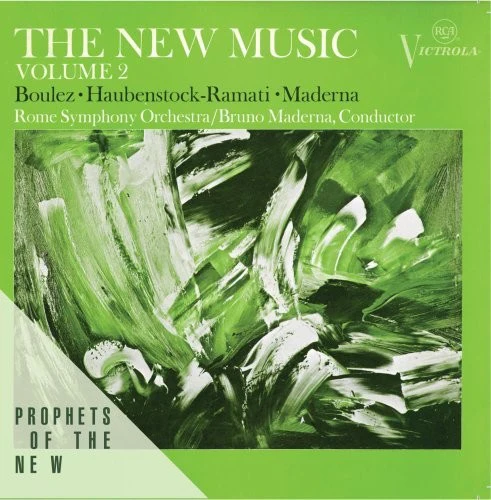
The New Music Vol 2 - Boulez, Haubenstock-Ramati, Maderna / Rome Symphony Orchestra
The term “modern music” no longer suffices to describe the latest expressions of recent avant-garde composers. Modern music still means the music that came after Debussy and Strauss. It is Stravinsky and Ravel, Hindemith and Falla; it is Bartok, Prokofiev, Britten and Malipiero. Modern music is the breakdown of tonality and traditional harmony and the development of the twelve-tone system by the masters of the Viennese school – Schoenberg, Berg and Webern – and the spreading of this method in every country since the war. Modern music is still Dallapiccola and Petrassi, and the ready listener has little by little grown accustomed to all these expressions – the more recent ones (those relating to the relinquishing of traditional tonality) with somewhat greater difficulty.
But the works of those composers who have come to the fore since Hiroshima seems to cut away violently from this pattern, as difficult as its acceptance had proved to be. So, for them the term “new music” is most appropriate.
The evolution which has led to today’s baffling results is governed by an inner logic. Once the use of the twelve-tone “series” was firmly established, the desire quite naturally arose to extend this serialization process to the other “parameters” of music, that is, to subject its rhythmic, timbral and dynamic aspects to the same laws governing the disposition of the pitch of the notes.
“Structuring” (the organization of musical material) by means of total serialization of parameters was the first step the new music took beyond Webern. This extension of the serialization process to all parameters brought about a heightening of interest and investigation into the qualities and components of sound. The increased concern for this “tone color” and other hitherto unstructured aspects of sound and the diminishing interest in pitch as the primary structural element made it necessary to alter traditional listening habits. Where pitch distribution had been the primary expressive unit, now the other parameters took on equal or greater importance.
The new music, like all other forms of contemporary art, may or may not be liked, but its consistency cannot be questioned. There is an inner logic which has determined the various phases described above and which is already creating others in more and more rapid succession. They must not be taken as gratuitous and unrestrained expressions of individual extravagance.
-- from the liner notes by Massimo Mila
But the works of those composers who have come to the fore since Hiroshima seems to cut away violently from this pattern, as difficult as its acceptance had proved to be. So, for them the term “new music” is most appropriate.
The evolution which has led to today’s baffling results is governed by an inner logic. Once the use of the twelve-tone “series” was firmly established, the desire quite naturally arose to extend this serialization process to the other “parameters” of music, that is, to subject its rhythmic, timbral and dynamic aspects to the same laws governing the disposition of the pitch of the notes.
“Structuring” (the organization of musical material) by means of total serialization of parameters was the first step the new music took beyond Webern. This extension of the serialization process to all parameters brought about a heightening of interest and investigation into the qualities and components of sound. The increased concern for this “tone color” and other hitherto unstructured aspects of sound and the diminishing interest in pitch as the primary structural element made it necessary to alter traditional listening habits. Where pitch distribution had been the primary expressive unit, now the other parameters took on equal or greater importance.
The new music, like all other forms of contemporary art, may or may not be liked, but its consistency cannot be questioned. There is an inner logic which has determined the various phases described above and which is already creating others in more and more rapid succession. They must not be taken as gratuitous and unrestrained expressions of individual extravagance.
-- from the liner notes by Massimo Mila
The term “modern music” no longer suffices to describe the latest expressions of recent avant-garde composers. Modern music still means the music that came after Debussy and Strauss. It is Stravinsky and Ravel, Hindemith and Falla; it is Bartok, Prokofiev, Britten and Malipiero. Modern music is the breakdown of tonality and traditional harmony and the development of the twelve-tone system by the masters of the Viennese school – Schoenberg, Berg and Webern – and the spreading of this method in every country since the war. Modern music is still Dallapiccola and Petrassi, and the ready listener has little by little grown accustomed to all these expressions – the more recent ones (those relating to the relinquishing of traditional tonality) with somewhat greater difficulty.
But the works of those composers who have come to the fore since Hiroshima seems to cut away violently from this pattern, as difficult as its acceptance had proved to be. So, for them the term “new music” is most appropriate.
The evolution which has led to today’s baffling results is governed by an inner logic. Once the use of the twelve-tone “series” was firmly established, the desire quite naturally arose to extend this serialization process to the other “parameters” of music, that is, to subject its rhythmic, timbral and dynamic aspects to the same laws governing the disposition of the pitch of the notes.
“Structuring” (the organization of musical material) by means of total serialization of parameters was the first step the new music took beyond Webern. This extension of the serialization process to all parameters brought about a heightening of interest and investigation into the qualities and components of sound. The increased concern for this “tone color” and other hitherto unstructured aspects of sound and the diminishing interest in pitch as the primary structural element made it necessary to alter traditional listening habits. Where pitch distribution had been the primary expressive unit, now the other parameters took on equal or greater importance.
The new music, like all other forms of contemporary art, may or may not be liked, but its consistency cannot be questioned. There is an inner logic which has determined the various phases described above and which is already creating others in more and more rapid succession. They must not be taken as gratuitous and unrestrained expressions of individual extravagance.
-- from the liner notes by Massimo Mila
But the works of those composers who have come to the fore since Hiroshima seems to cut away violently from this pattern, as difficult as its acceptance had proved to be. So, for them the term “new music” is most appropriate.
The evolution which has led to today’s baffling results is governed by an inner logic. Once the use of the twelve-tone “series” was firmly established, the desire quite naturally arose to extend this serialization process to the other “parameters” of music, that is, to subject its rhythmic, timbral and dynamic aspects to the same laws governing the disposition of the pitch of the notes.
“Structuring” (the organization of musical material) by means of total serialization of parameters was the first step the new music took beyond Webern. This extension of the serialization process to all parameters brought about a heightening of interest and investigation into the qualities and components of sound. The increased concern for this “tone color” and other hitherto unstructured aspects of sound and the diminishing interest in pitch as the primary structural element made it necessary to alter traditional listening habits. Where pitch distribution had been the primary expressive unit, now the other parameters took on equal or greater importance.
The new music, like all other forms of contemporary art, may or may not be liked, but its consistency cannot be questioned. There is an inner logic which has determined the various phases described above and which is already creating others in more and more rapid succession. They must not be taken as gratuitous and unrestrained expressions of individual extravagance.
-- from the liner notes by Massimo Mila
$4.90
Original: $13.99
-65%The New Music Vol 2 - Boulez, Haubenstock-Ramati, Maderna / Rome Symphony Orchestra—
$13.99
$4.90Description
The term “modern music” no longer suffices to describe the latest expressions of recent avant-garde composers. Modern music still means the music that came after Debussy and Strauss. It is Stravinsky and Ravel, Hindemith and Falla; it is Bartok, Prokofiev, Britten and Malipiero. Modern music is the breakdown of tonality and traditional harmony and the development of the twelve-tone system by the masters of the Viennese school – Schoenberg, Berg and Webern – and the spreading of this method in every country since the war. Modern music is still Dallapiccola and Petrassi, and the ready listener has little by little grown accustomed to all these expressions – the more recent ones (those relating to the relinquishing of traditional tonality) with somewhat greater difficulty.
But the works of those composers who have come to the fore since Hiroshima seems to cut away violently from this pattern, as difficult as its acceptance had proved to be. So, for them the term “new music” is most appropriate.
The evolution which has led to today’s baffling results is governed by an inner logic. Once the use of the twelve-tone “series” was firmly established, the desire quite naturally arose to extend this serialization process to the other “parameters” of music, that is, to subject its rhythmic, timbral and dynamic aspects to the same laws governing the disposition of the pitch of the notes.
“Structuring” (the organization of musical material) by means of total serialization of parameters was the first step the new music took beyond Webern. This extension of the serialization process to all parameters brought about a heightening of interest and investigation into the qualities and components of sound. The increased concern for this “tone color” and other hitherto unstructured aspects of sound and the diminishing interest in pitch as the primary structural element made it necessary to alter traditional listening habits. Where pitch distribution had been the primary expressive unit, now the other parameters took on equal or greater importance.
The new music, like all other forms of contemporary art, may or may not be liked, but its consistency cannot be questioned. There is an inner logic which has determined the various phases described above and which is already creating others in more and more rapid succession. They must not be taken as gratuitous and unrestrained expressions of individual extravagance.
-- from the liner notes by Massimo Mila
But the works of those composers who have come to the fore since Hiroshima seems to cut away violently from this pattern, as difficult as its acceptance had proved to be. So, for them the term “new music” is most appropriate.
The evolution which has led to today’s baffling results is governed by an inner logic. Once the use of the twelve-tone “series” was firmly established, the desire quite naturally arose to extend this serialization process to the other “parameters” of music, that is, to subject its rhythmic, timbral and dynamic aspects to the same laws governing the disposition of the pitch of the notes.
“Structuring” (the organization of musical material) by means of total serialization of parameters was the first step the new music took beyond Webern. This extension of the serialization process to all parameters brought about a heightening of interest and investigation into the qualities and components of sound. The increased concern for this “tone color” and other hitherto unstructured aspects of sound and the diminishing interest in pitch as the primary structural element made it necessary to alter traditional listening habits. Where pitch distribution had been the primary expressive unit, now the other parameters took on equal or greater importance.
The new music, like all other forms of contemporary art, may or may not be liked, but its consistency cannot be questioned. There is an inner logic which has determined the various phases described above and which is already creating others in more and more rapid succession. They must not be taken as gratuitous and unrestrained expressions of individual extravagance.
-- from the liner notes by Massimo Mila