🎉 Up to 70% Off Selected ItemsShop Sale

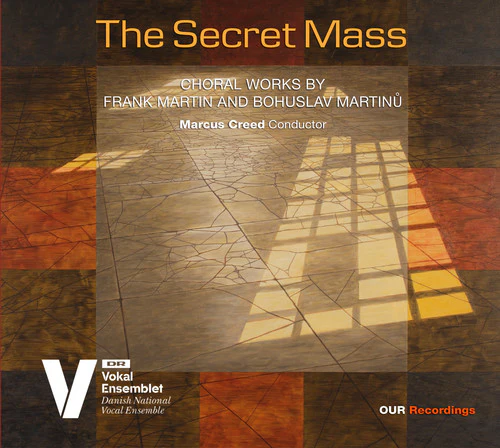
The Secret Mass / Creed, Danish National Vocal Ensemble

It’s easy to hear the opening of Frank Martin’s Mass and think–Vaughan Williams, as in his own setting for a cappella double choir, composed in the early 1920s, just a year or two before Martin’s work. Not to say there’s any direct connection, but that beginning Kyrie chant-like theme and the gradual addition of voices strikes a more than casual note (or notes) of similarity. It’s interesting, that’s all, but as in the Vaughan Williams, it definitively marks the stylistic sensibility of the whole work. And it’s a beautiful and eminently moving work, not heard often enough (nor is the Vaughan Williams, for that matter). The disc’s title refers to the fact that Martin kept his Mass from performance–or even from view–for more than 40 years after its composition in 1922.
But of course, Martin is not Vaughan Williams, and very quickly we realize that the similar musical setup is taking us into an entirely different world–harmonically for sure, but also in its more immediate, dramatic expression of the text, all the while remaining firmly in a tonal context–albeit a more adventurous one. The comparison is useful, as it so strikingly shows how two contemporaries differently–completely differently–treated the same material, with the same performing forces (also observable in the two composer’s settings of the Shakespeare/Ariel song, “Full fathom five”).
You might think it was just a clever gimmick to juxtapose Martin and Martinu–close contemporaries (Martin was 10 years older) with closely similar last names, who just happen to have composed sets of a cappella choral songs–but actually their music is quite compatible and the programming proves to be not a gimmick at all, but a happy association. It’s interesting to compare how these two composers, subject to the influences of their similar time yet quite different circumstances, approached the setting of secular choral works–texts from Shakespeare’s The Tempest, in the case of Martin, and Czech folksong in the case of Martinu. The former texts are fairly familiar, but the Czech songs are, at least in English translation, almost strange in their depiction of Mary, her (instantly, fully functional) child, her dreams (an apple tree sprouting from her heart), her encounters with angels, and her fierce protection from highwaymen of a painting by St. Luke. But the music in both cases is superb–often challenging, but always easy on the ears and compelling, invigorating, inspiriting.
You’ll be sure to go back just to listen again to Martin’s depictions of the bonging bells (Full fathom five) and burling bees (Where the bee sucks…), not to mention return visits to Martinu’s Our Lady’s Breakfast (you have to hear it). You also have to hear Martinu’s Romance from the Dandelions–another one of those very particular old-world, romantic, folktale-like stories of hopeless love and sacrifice, of a young woman and her long-lost soldier/lover–a hard-to-classify setting of a Czech poem for a cappella choir and solo soprano–unusual and oddly affecting.
The singing is exceptional–this choir, as we’ve heard on earlier recordings, is one of the world’s finest, and here the singers are constantly challenged with prickly technical details and are offered many chances–perfectly realized–to deliver those ringing, resonant harmonic gestures that all choral singers live for. Their Czech pronunciation/enunciation is, how shall we say it, rather “soft”–the delicious richness of those special consonants tends to be rounded off–and unfortunately the translations, attempting to be poetic rather than literal, are often just corny. The English and Czech are printed on completely separate pages in the booklet (which otherwise contains very informative and well-written notes), which is useless if you’re trying to follow along. But, as you’ve gathered from the rest of this review–it ultimately doesn’t matter. This is a lovely recording of worthy music–great music, in the case of the Mass–in performances that are as good as you will hear anywhere.
– ClassicsToday (David Vernier)
It’s easy to hear the opening of Frank Martin’s Mass and think–Vaughan Williams, as in his own setting for a cappella double choir, composed in the early 1920s, just a year or two before Martin’s work. Not to say there’s any direct connection, but that beginning Kyrie chant-like theme and the gradual addition of voices strikes a more than casual note (or notes) of similarity. It’s interesting, that’s all, but as in the Vaughan Williams, it definitively marks the stylistic sensibility of the whole work. And it’s a beautiful and eminently moving work, not heard often enough (nor is the Vaughan Williams, for that matter). The disc’s title refers to the fact that Martin kept his Mass from performance–or even from view–for more than 40 years after its composition in 1922.
But of course, Martin is not Vaughan Williams, and very quickly we realize that the similar musical setup is taking us into an entirely different world–harmonically for sure, but also in its more immediate, dramatic expression of the text, all the while remaining firmly in a tonal context–albeit a more adventurous one. The comparison is useful, as it so strikingly shows how two contemporaries differently–completely differently–treated the same material, with the same performing forces (also observable in the two composer’s settings of the Shakespeare/Ariel song, “Full fathom five”).
You might think it was just a clever gimmick to juxtapose Martin and Martinu–close contemporaries (Martin was 10 years older) with closely similar last names, who just happen to have composed sets of a cappella choral songs–but actually their music is quite compatible and the programming proves to be not a gimmick at all, but a happy association. It’s interesting to compare how these two composers, subject to the influences of their similar time yet quite different circumstances, approached the setting of secular choral works–texts from Shakespeare’s The Tempest, in the case of Martin, and Czech folksong in the case of Martinu. The former texts are fairly familiar, but the Czech songs are, at least in English translation, almost strange in their depiction of Mary, her (instantly, fully functional) child, her dreams (an apple tree sprouting from her heart), her encounters with angels, and her fierce protection from highwaymen of a painting by St. Luke. But the music in both cases is superb–often challenging, but always easy on the ears and compelling, invigorating, inspiriting.
You’ll be sure to go back just to listen again to Martin’s depictions of the bonging bells (Full fathom five) and burling bees (Where the bee sucks…), not to mention return visits to Martinu’s Our Lady’s Breakfast (you have to hear it). You also have to hear Martinu’s Romance from the Dandelions–another one of those very particular old-world, romantic, folktale-like stories of hopeless love and sacrifice, of a young woman and her long-lost soldier/lover–a hard-to-classify setting of a Czech poem for a cappella choir and solo soprano–unusual and oddly affecting.
The singing is exceptional–this choir, as we’ve heard on earlier recordings, is one of the world’s finest, and here the singers are constantly challenged with prickly technical details and are offered many chances–perfectly realized–to deliver those ringing, resonant harmonic gestures that all choral singers live for. Their Czech pronunciation/enunciation is, how shall we say it, rather “soft”–the delicious richness of those special consonants tends to be rounded off–and unfortunately the translations, attempting to be poetic rather than literal, are often just corny. The English and Czech are printed on completely separate pages in the booklet (which otherwise contains very informative and well-written notes), which is useless if you’re trying to follow along. But, as you’ve gathered from the rest of this review–it ultimately doesn’t matter. This is a lovely recording of worthy music–great music, in the case of the Mass–in performances that are as good as you will hear anywhere.
– ClassicsToday (David Vernier)
$23.99
The Secret Mass / Creed, Danish National Vocal Ensemble—
$23.99
Description
It’s easy to hear the opening of Frank Martin’s Mass and think–Vaughan Williams, as in his own setting for a cappella double choir, composed in the early 1920s, just a year or two before Martin’s work. Not to say there’s any direct connection, but that beginning Kyrie chant-like theme and the gradual addition of voices strikes a more than casual note (or notes) of similarity. It’s interesting, that’s all, but as in the Vaughan Williams, it definitively marks the stylistic sensibility of the whole work. And it’s a beautiful and eminently moving work, not heard often enough (nor is the Vaughan Williams, for that matter). The disc’s title refers to the fact that Martin kept his Mass from performance–or even from view–for more than 40 years after its composition in 1922.
But of course, Martin is not Vaughan Williams, and very quickly we realize that the similar musical setup is taking us into an entirely different world–harmonically for sure, but also in its more immediate, dramatic expression of the text, all the while remaining firmly in a tonal context–albeit a more adventurous one. The comparison is useful, as it so strikingly shows how two contemporaries differently–completely differently–treated the same material, with the same performing forces (also observable in the two composer’s settings of the Shakespeare/Ariel song, “Full fathom five”).
You might think it was just a clever gimmick to juxtapose Martin and Martinu–close contemporaries (Martin was 10 years older) with closely similar last names, who just happen to have composed sets of a cappella choral songs–but actually their music is quite compatible and the programming proves to be not a gimmick at all, but a happy association. It’s interesting to compare how these two composers, subject to the influences of their similar time yet quite different circumstances, approached the setting of secular choral works–texts from Shakespeare’s The Tempest, in the case of Martin, and Czech folksong in the case of Martinu. The former texts are fairly familiar, but the Czech songs are, at least in English translation, almost strange in their depiction of Mary, her (instantly, fully functional) child, her dreams (an apple tree sprouting from her heart), her encounters with angels, and her fierce protection from highwaymen of a painting by St. Luke. But the music in both cases is superb–often challenging, but always easy on the ears and compelling, invigorating, inspiriting.
You’ll be sure to go back just to listen again to Martin’s depictions of the bonging bells (Full fathom five) and burling bees (Where the bee sucks…), not to mention return visits to Martinu’s Our Lady’s Breakfast (you have to hear it). You also have to hear Martinu’s Romance from the Dandelions–another one of those very particular old-world, romantic, folktale-like stories of hopeless love and sacrifice, of a young woman and her long-lost soldier/lover–a hard-to-classify setting of a Czech poem for a cappella choir and solo soprano–unusual and oddly affecting.
The singing is exceptional–this choir, as we’ve heard on earlier recordings, is one of the world’s finest, and here the singers are constantly challenged with prickly technical details and are offered many chances–perfectly realized–to deliver those ringing, resonant harmonic gestures that all choral singers live for. Their Czech pronunciation/enunciation is, how shall we say it, rather “soft”–the delicious richness of those special consonants tends to be rounded off–and unfortunately the translations, attempting to be poetic rather than literal, are often just corny. The English and Czech are printed on completely separate pages in the booklet (which otherwise contains very informative and well-written notes), which is useless if you’re trying to follow along. But, as you’ve gathered from the rest of this review–it ultimately doesn’t matter. This is a lovely recording of worthy music–great music, in the case of the Mass–in performances that are as good as you will hear anywhere.
– ClassicsToday (David Vernier)