🎉 Up to 70% Off Selected ItemsShop Sale

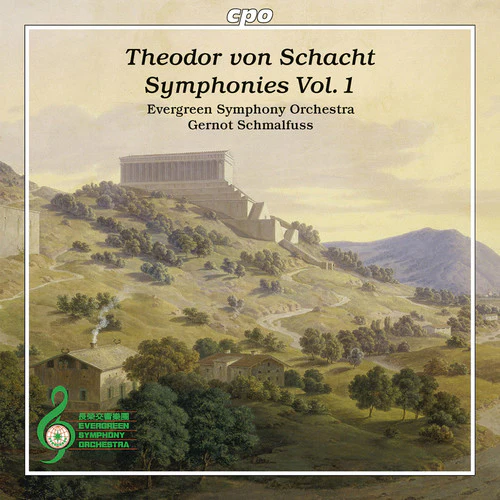
Theodor Von Schacht: Symphonies, Vol. 1
SCHACHT Symphonies: in C; in E?; in E?, “Echo” • Gernot Schmalfuss, cond; Evergreen SO • CPO 777 737-2 (79:33)
CPO’s liner notes for this release are typically long, but surprisingly focused entirely on music-making in the Perpetual Diet of Regensburg. Nothing about Schacht, and none of the musical analysis CPO typically offers. The latter is most surprising, given that two of the works on this record are truly imaginative examples of the Haydn symphony’s further development.
Let’s start with a brief note about the composer. Theodor von Schacht (1748–1823) was a pupil in Stuttgart of Jomelli, between 1766 and 1771. His subsequent career centered almost entirely around Regensburg: appointed musical intendant and creator of the Court’s Italian Opera in 1774, of its German Singspiel company in 1778, and of a renewed Italian Opera in 1784. He became musical director of the Court’s orchestra in 1786. Schacht was well regarded both at home and abroad, and decided in 1805 to try his luck in Vienna. There his sacred music proved very popular—popular enough, at any rate, for Napoleon in 1809 to commission six solemn Masses from Schacht. He moved to Württemberg in 1812, and back to Regensburg in 1819. I’ve found no indication as to when he was ennobled and acquired his von, but presumably it was achieved either from Prince Karl Anselm during Schacht’s first lengthy stay in Regensberg, or from Austria’s Archduke Rudolf, who gave Schacht his protection while the latter was in Vienna. (Rudolf was a great patron of Beethoven, and received many dedications from the latter. Yes, including the so-called “Archduke” Trio.)
The symphonies are remarkably inventive. While presenting a Haydn-like synthesis of Italian, German, and French traits, they display a richer chromatic harmonic and thematic vocabulary. (The Regensburg rulers had family ties with the Esterháza, and there was a lively exchange of musical materials over decades. One symphony of Schacht’s was actually credited for a while to Haydn.) The Andante of his Sinfonia in C jumps at one point directly from a passage in F Major to one in A? Major; and the trio in the same Sinfonia’s minuet explores a modulating chain from its home key of C Major—by way of delicately handled solo and paired winds—through B Minor, A Major, A? Minor, E? Major, D Major, etc. The effect in retrospect is Schubertian, and not merely here, for short bursts of wide-ranging harmonic progression occur in most of his movements. This isn’t to suggest that Schubert was influenced by Schacht, but that the latter was a composer with an ear to the latest musical developments, and the skill to capitalize on them in ingenious ways.
If these works are typical of his symphonic output, then Schacht, like Haydn, had a love of the theme and variations form. Both the undated symphonies on this album (the sinfonias in C Major and E? Major; the Sinfonia con Eco in E? Major is credited to 1775, and sounds earlier than the others) employ this for their slow movements. He not only varies the entire theme, but suddenly expands short motivic sections of it, either after a fashion that extends the theme when it returns, or moves it in an entirely new direction. Once again like Haydn, his rondo finales play games with meter, accent, rhythm, postponed cadences, false final cadences, and sudden expressive, harmonic shifts. Grove I notes that Schacht’s instrumental music was less notable for its contrapuntal interest, but in fact his two- and three-part writing is often striking, made more so by his sensitive orchestration. I shouldn’t be surprised if these works begin to make their ways into concerts.
Gernot Schmalfuss doesn’t lack energy, nor the Evergreen SO of Taiwan lack precision, discipline, and color. I would have preferred more attention spent on phrasing in the warmer galant material—Schacht has a gift for ravishing bel canto melody, which he rightly rations for a few special moments—and Schmalfuss takes the Andante movement of the C-Major Symphony at 114 bpm, which vitiates some of the composer’s sensuous writing. But overall, these are good readings, especially tight in the bustling finales, with careful attention paid to dynamics. CPO’s engineering is less distant than in some of their releases, and does a good job of catching Schacht’s bright, frequently shifting orchestral palette.
As charming as Weber’s symphonies, Schacht’s are considerably more substantial than his. And since this is labeled “volume one,” we can look forward to future installments. Meanwhile, don’t miss this.
FANFARE: Barry Brenesal
SCHACHT Symphonies: in C; in E?; in E?, “Echo” • Gernot Schmalfuss, cond; Evergreen SO • CPO 777 737-2 (79:33)
CPO’s liner notes for this release are typically long, but surprisingly focused entirely on music-making in the Perpetual Diet of Regensburg. Nothing about Schacht, and none of the musical analysis CPO typically offers. The latter is most surprising, given that two of the works on this record are truly imaginative examples of the Haydn symphony’s further development.
Let’s start with a brief note about the composer. Theodor von Schacht (1748–1823) was a pupil in Stuttgart of Jomelli, between 1766 and 1771. His subsequent career centered almost entirely around Regensburg: appointed musical intendant and creator of the Court’s Italian Opera in 1774, of its German Singspiel company in 1778, and of a renewed Italian Opera in 1784. He became musical director of the Court’s orchestra in 1786. Schacht was well regarded both at home and abroad, and decided in 1805 to try his luck in Vienna. There his sacred music proved very popular—popular enough, at any rate, for Napoleon in 1809 to commission six solemn Masses from Schacht. He moved to Württemberg in 1812, and back to Regensburg in 1819. I’ve found no indication as to when he was ennobled and acquired his von, but presumably it was achieved either from Prince Karl Anselm during Schacht’s first lengthy stay in Regensberg, or from Austria’s Archduke Rudolf, who gave Schacht his protection while the latter was in Vienna. (Rudolf was a great patron of Beethoven, and received many dedications from the latter. Yes, including the so-called “Archduke” Trio.)
The symphonies are remarkably inventive. While presenting a Haydn-like synthesis of Italian, German, and French traits, they display a richer chromatic harmonic and thematic vocabulary. (The Regensburg rulers had family ties with the Esterháza, and there was a lively exchange of musical materials over decades. One symphony of Schacht’s was actually credited for a while to Haydn.) The Andante of his Sinfonia in C jumps at one point directly from a passage in F Major to one in A? Major; and the trio in the same Sinfonia’s minuet explores a modulating chain from its home key of C Major—by way of delicately handled solo and paired winds—through B Minor, A Major, A? Minor, E? Major, D Major, etc. The effect in retrospect is Schubertian, and not merely here, for short bursts of wide-ranging harmonic progression occur in most of his movements. This isn’t to suggest that Schubert was influenced by Schacht, but that the latter was a composer with an ear to the latest musical developments, and the skill to capitalize on them in ingenious ways.
If these works are typical of his symphonic output, then Schacht, like Haydn, had a love of the theme and variations form. Both the undated symphonies on this album (the sinfonias in C Major and E? Major; the Sinfonia con Eco in E? Major is credited to 1775, and sounds earlier than the others) employ this for their slow movements. He not only varies the entire theme, but suddenly expands short motivic sections of it, either after a fashion that extends the theme when it returns, or moves it in an entirely new direction. Once again like Haydn, his rondo finales play games with meter, accent, rhythm, postponed cadences, false final cadences, and sudden expressive, harmonic shifts. Grove I notes that Schacht’s instrumental music was less notable for its contrapuntal interest, but in fact his two- and three-part writing is often striking, made more so by his sensitive orchestration. I shouldn’t be surprised if these works begin to make their ways into concerts.
Gernot Schmalfuss doesn’t lack energy, nor the Evergreen SO of Taiwan lack precision, discipline, and color. I would have preferred more attention spent on phrasing in the warmer galant material—Schacht has a gift for ravishing bel canto melody, which he rightly rations for a few special moments—and Schmalfuss takes the Andante movement of the C-Major Symphony at 114 bpm, which vitiates some of the composer’s sensuous writing. But overall, these are good readings, especially tight in the bustling finales, with careful attention paid to dynamics. CPO’s engineering is less distant than in some of their releases, and does a good job of catching Schacht’s bright, frequently shifting orchestral palette.
As charming as Weber’s symphonies, Schacht’s are considerably more substantial than his. And since this is labeled “volume one,” we can look forward to future installments. Meanwhile, don’t miss this.
FANFARE: Barry Brenesal
$6.65
Original: $18.99
-65%Theodor Von Schacht: Symphonies, Vol. 1—
$18.99
$6.65Description
SCHACHT Symphonies: in C; in E?; in E?, “Echo” • Gernot Schmalfuss, cond; Evergreen SO • CPO 777 737-2 (79:33)
CPO’s liner notes for this release are typically long, but surprisingly focused entirely on music-making in the Perpetual Diet of Regensburg. Nothing about Schacht, and none of the musical analysis CPO typically offers. The latter is most surprising, given that two of the works on this record are truly imaginative examples of the Haydn symphony’s further development.
Let’s start with a brief note about the composer. Theodor von Schacht (1748–1823) was a pupil in Stuttgart of Jomelli, between 1766 and 1771. His subsequent career centered almost entirely around Regensburg: appointed musical intendant and creator of the Court’s Italian Opera in 1774, of its German Singspiel company in 1778, and of a renewed Italian Opera in 1784. He became musical director of the Court’s orchestra in 1786. Schacht was well regarded both at home and abroad, and decided in 1805 to try his luck in Vienna. There his sacred music proved very popular—popular enough, at any rate, for Napoleon in 1809 to commission six solemn Masses from Schacht. He moved to Württemberg in 1812, and back to Regensburg in 1819. I’ve found no indication as to when he was ennobled and acquired his von, but presumably it was achieved either from Prince Karl Anselm during Schacht’s first lengthy stay in Regensberg, or from Austria’s Archduke Rudolf, who gave Schacht his protection while the latter was in Vienna. (Rudolf was a great patron of Beethoven, and received many dedications from the latter. Yes, including the so-called “Archduke” Trio.)
The symphonies are remarkably inventive. While presenting a Haydn-like synthesis of Italian, German, and French traits, they display a richer chromatic harmonic and thematic vocabulary. (The Regensburg rulers had family ties with the Esterháza, and there was a lively exchange of musical materials over decades. One symphony of Schacht’s was actually credited for a while to Haydn.) The Andante of his Sinfonia in C jumps at one point directly from a passage in F Major to one in A? Major; and the trio in the same Sinfonia’s minuet explores a modulating chain from its home key of C Major—by way of delicately handled solo and paired winds—through B Minor, A Major, A? Minor, E? Major, D Major, etc. The effect in retrospect is Schubertian, and not merely here, for short bursts of wide-ranging harmonic progression occur in most of his movements. This isn’t to suggest that Schubert was influenced by Schacht, but that the latter was a composer with an ear to the latest musical developments, and the skill to capitalize on them in ingenious ways.
If these works are typical of his symphonic output, then Schacht, like Haydn, had a love of the theme and variations form. Both the undated symphonies on this album (the sinfonias in C Major and E? Major; the Sinfonia con Eco in E? Major is credited to 1775, and sounds earlier than the others) employ this for their slow movements. He not only varies the entire theme, but suddenly expands short motivic sections of it, either after a fashion that extends the theme when it returns, or moves it in an entirely new direction. Once again like Haydn, his rondo finales play games with meter, accent, rhythm, postponed cadences, false final cadences, and sudden expressive, harmonic shifts. Grove I notes that Schacht’s instrumental music was less notable for its contrapuntal interest, but in fact his two- and three-part writing is often striking, made more so by his sensitive orchestration. I shouldn’t be surprised if these works begin to make their ways into concerts.
Gernot Schmalfuss doesn’t lack energy, nor the Evergreen SO of Taiwan lack precision, discipline, and color. I would have preferred more attention spent on phrasing in the warmer galant material—Schacht has a gift for ravishing bel canto melody, which he rightly rations for a few special moments—and Schmalfuss takes the Andante movement of the C-Major Symphony at 114 bpm, which vitiates some of the composer’s sensuous writing. But overall, these are good readings, especially tight in the bustling finales, with careful attention paid to dynamics. CPO’s engineering is less distant than in some of their releases, and does a good job of catching Schacht’s bright, frequently shifting orchestral palette.
As charming as Weber’s symphonies, Schacht’s are considerably more substantial than his. And since this is labeled “volume one,” we can look forward to future installments. Meanwhile, don’t miss this.
FANFARE: Barry Brenesal