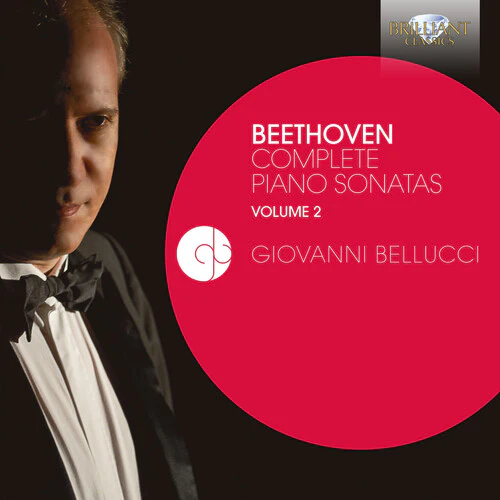
Beethoven: Complete Piano Sonatas, Vol. 2 / Giovanni Bellucci
The second volume of Giovanni Bellucci’s Beethoven cycle for Brilliant Classics takes the listener on a journey of six eventful years, from Op.22 of 1800 to the ‘Appassionata’ Sonata of 1806. During that time Beethoven established himself as Vienna’s pre-eminent pianist-composer. He came to regard Op.22 as the best of his ‘early’ sonatas but a sea-change in the deepening of his expression is already evident in the piano-writing of Op.26, with its funeral march ‘in memory of a hero’. There follow the remarkable formal innovations of the Op.27 pair – No.2 immortally inscribed on the popular imagination as the ‘Moonlight’ – and then the smooth, undulating rhythms of the ‘Pastorale’ Op.28. The trio of Op.31 sonatas present a study in contrasts, from the graceful profile of No.1 in G major to the sound and fury of the ‘Tempest’ No.2 and then the hectic momentum of No.3, presaging the concision of works at the end of his ‘middle’ period such as the ‘Serioso’ Quartet and the Eighth Symphony. The proportions of the two-movement Op.54 are even more tautly circumscribed, before the reach of Beethoven’s expressive range for his instrument expands to hitherto undreamt heights in the ‘Waldstein’ Op.53 and the ‘Appassionata’ Op.57. Giovanni Bellucci is among the most strikingly individual of modern pianists. Described by Italian critic Piero Rattalino as ‘a force of nature, vast and palpitating’, he cultivates an old-fashioned richness of piano timbre while still attending to the letter as well as the spirit of Beethoven’s scores. According to Le Monde, ‘he takes us back to the Golden Age of the Piano’. His recordings have been showered with prizes such as Diapason d’Or, Choc, Editor’s Choice in Gramophone, CD Maestro etc.
The second volume of Giovanni Bellucci’s Beethoven cycle for Brilliant Classics takes the listener on a journey of six eventful years, from Op.22 of 1800 to the ‘Appassionata’ Sonata of 1806. During that time Beethoven established himself as Vienna’s pre-eminent pianist-composer. He came to regard Op.22 as the best of his ‘early’ sonatas but a sea-change in the deepening of his expression is already evident in the piano-writing of Op.26, with its funeral march ‘in memory of a hero’. There follow the remarkable formal innovations of the Op.27 pair – No.2 immortally inscribed on the popular imagination as the ‘Moonlight’ – and then the smooth, undulating rhythms of the ‘Pastorale’ Op.28. The trio of Op.31 sonatas present a study in contrasts, from the graceful profile of No.1 in G major to the sound and fury of the ‘Tempest’ No.2 and then the hectic momentum of No.3, presaging the concision of works at the end of his ‘middle’ period such as the ‘Serioso’ Quartet and the Eighth Symphony. The proportions of the two-movement Op.54 are even more tautly circumscribed, before the reach of Beethoven’s expressive range for his instrument expands to hitherto undreamt heights in the ‘Waldstein’ Op.53 and the ‘Appassionata’ Op.57. Giovanni Bellucci is among the most strikingly individual of modern pianists. Described by Italian critic Piero Rattalino as ‘a force of nature, vast and palpitating’, he cultivates an old-fashioned richness of piano timbre while still attending to the letter as well as the spirit of Beethoven’s scores. According to Le Monde, ‘he takes us back to the Golden Age of the Piano’. His recordings have been showered with prizes such as Diapason d’Or, Choc, Editor’s Choice in Gramophone, CD Maestro etc.
Original: $16.99
-65%$16.99
$5.95Description
The second volume of Giovanni Bellucci’s Beethoven cycle for Brilliant Classics takes the listener on a journey of six eventful years, from Op.22 of 1800 to the ‘Appassionata’ Sonata of 1806. During that time Beethoven established himself as Vienna’s pre-eminent pianist-composer. He came to regard Op.22 as the best of his ‘early’ sonatas but a sea-change in the deepening of his expression is already evident in the piano-writing of Op.26, with its funeral march ‘in memory of a hero’. There follow the remarkable formal innovations of the Op.27 pair – No.2 immortally inscribed on the popular imagination as the ‘Moonlight’ – and then the smooth, undulating rhythms of the ‘Pastorale’ Op.28. The trio of Op.31 sonatas present a study in contrasts, from the graceful profile of No.1 in G major to the sound and fury of the ‘Tempest’ No.2 and then the hectic momentum of No.3, presaging the concision of works at the end of his ‘middle’ period such as the ‘Serioso’ Quartet and the Eighth Symphony. The proportions of the two-movement Op.54 are even more tautly circumscribed, before the reach of Beethoven’s expressive range for his instrument expands to hitherto undreamt heights in the ‘Waldstein’ Op.53 and the ‘Appassionata’ Op.57. Giovanni Bellucci is among the most strikingly individual of modern pianists. Described by Italian critic Piero Rattalino as ‘a force of nature, vast and palpitating’, he cultivates an old-fashioned richness of piano timbre while still attending to the letter as well as the spirit of Beethoven’s scores. According to Le Monde, ‘he takes us back to the Golden Age of the Piano’. His recordings have been showered with prizes such as Diapason d’Or, Choc, Editor’s Choice in Gramophone, CD Maestro etc.