🎉 Up to 70% Off Selected ItemsShop Sale

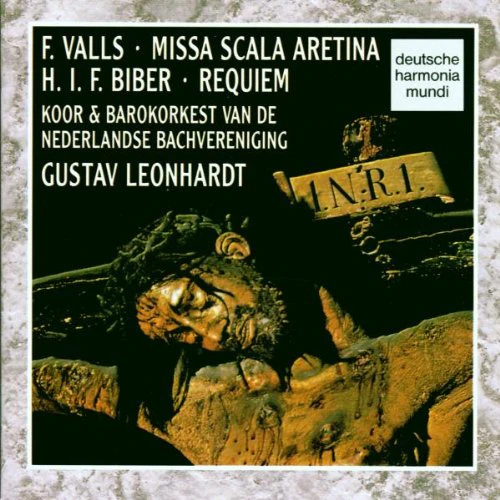
Valls: Missa Scala Aretina; Biber: Requiem / Leonhardt
Gustav Leonhardt has chosen here two works of outstanding originality. From 1696 Fransisco Valls was choirmaster at Barcelona Cathedral, retiring from the post in 1726. His Missa Scala Aretina was composed in 1702 for performance in the Cathedral but became something of a cause celebre further afield on account of a breach of strict harmonic etiquette in the Gloria. Fellow musicians were scandalized by Valls's use of an unprepared dissonance and the composer was eventually obliged to defend himself in his theoretical treatise, Mapa armonico. The Mass is a richly scored piece disposed into four distinct sound bodies or choirs. One of these contains the solo voices (soprano, alto, tenor), two others are larger vocal ensembles of different sizes while the fourth is instrumental, consisting of strings with additional oboes, trumpets and a colourful continuo group including harp. Leonhardt brings a vital sense of occasion to the performance, injecting it with passion and evidently revelling in its rich and varied sonorities. But he is not always sufficiently well supported by the Netherlands Bach Society Choir which turns in rather rough and not always ready singing. But even so there is a spontaneity which makes considerable appeal and one is left with the feeling, by no means unwelcome, that this is foremost a performance and only secondarily a recording.
Biber's F minor Requiem was written exactly a decade earlier than Valls's Mass. It is one of two such surviving works from his pen and here receives its second recording; the earlier one, by Nikolaus Harnoncourt was made in 1967 and has long been unavailable (Telefunken, 3/70). The very flatness of this minor key at once points-up the striking contrast which exists between this melancholy work and its more robust, extrovert Spanish companion on disc. Biber's fervent Requiem falls into five main sections, an Introit and Kyrie, Dies irae, Offer-torium, Sanctus and, lastly Agnus Dei and Communion. The ''Dies irae'' is the most extended of these and allows for several beautifully wrought passages for the soloists (SSATB). But the ''Offertorium'' is hardly less expressive and here Biber makes an additional contrast by casting the movement in C minor; his lean and despairing harmonies are especially arresting in this section conjuring up vivid images of man's frail condition and mortality. Leonhardt is similarly responsive to text and music as he was in the Valls, but Biber occupies stylistic territory closer to home. There is a fluency in the performance of the Requiem which is perhaps less evident in the Missa Scala Aretina, and the singers too, seem more secure.
In short, this is a fascinating disc containing pieces of starkly contrasting outlook. The Valls is full of little, and not so little, harmonic surprises which tease the senses, the Biber a contemplative, profound work of dark and serene beauty. Recorded sound is appropriately spacious and the booklet contains an informative essay with texts and translations.'
-- Nicholas Anderson, Gramophone [8/1993]
Biber's F minor Requiem was written exactly a decade earlier than Valls's Mass. It is one of two such surviving works from his pen and here receives its second recording; the earlier one, by Nikolaus Harnoncourt was made in 1967 and has long been unavailable (Telefunken, 3/70). The very flatness of this minor key at once points-up the striking contrast which exists between this melancholy work and its more robust, extrovert Spanish companion on disc. Biber's fervent Requiem falls into five main sections, an Introit and Kyrie, Dies irae, Offer-torium, Sanctus and, lastly Agnus Dei and Communion. The ''Dies irae'' is the most extended of these and allows for several beautifully wrought passages for the soloists (SSATB). But the ''Offertorium'' is hardly less expressive and here Biber makes an additional contrast by casting the movement in C minor; his lean and despairing harmonies are especially arresting in this section conjuring up vivid images of man's frail condition and mortality. Leonhardt is similarly responsive to text and music as he was in the Valls, but Biber occupies stylistic territory closer to home. There is a fluency in the performance of the Requiem which is perhaps less evident in the Missa Scala Aretina, and the singers too, seem more secure.
In short, this is a fascinating disc containing pieces of starkly contrasting outlook. The Valls is full of little, and not so little, harmonic surprises which tease the senses, the Biber a contemplative, profound work of dark and serene beauty. Recorded sound is appropriately spacious and the booklet contains an informative essay with texts and translations.'
-- Nicholas Anderson, Gramophone [8/1993]
Gustav Leonhardt has chosen here two works of outstanding originality. From 1696 Fransisco Valls was choirmaster at Barcelona Cathedral, retiring from the post in 1726. His Missa Scala Aretina was composed in 1702 for performance in the Cathedral but became something of a cause celebre further afield on account of a breach of strict harmonic etiquette in the Gloria. Fellow musicians were scandalized by Valls's use of an unprepared dissonance and the composer was eventually obliged to defend himself in his theoretical treatise, Mapa armonico. The Mass is a richly scored piece disposed into four distinct sound bodies or choirs. One of these contains the solo voices (soprano, alto, tenor), two others are larger vocal ensembles of different sizes while the fourth is instrumental, consisting of strings with additional oboes, trumpets and a colourful continuo group including harp. Leonhardt brings a vital sense of occasion to the performance, injecting it with passion and evidently revelling in its rich and varied sonorities. But he is not always sufficiently well supported by the Netherlands Bach Society Choir which turns in rather rough and not always ready singing. But even so there is a spontaneity which makes considerable appeal and one is left with the feeling, by no means unwelcome, that this is foremost a performance and only secondarily a recording.
Biber's F minor Requiem was written exactly a decade earlier than Valls's Mass. It is one of two such surviving works from his pen and here receives its second recording; the earlier one, by Nikolaus Harnoncourt was made in 1967 and has long been unavailable (Telefunken, 3/70). The very flatness of this minor key at once points-up the striking contrast which exists between this melancholy work and its more robust, extrovert Spanish companion on disc. Biber's fervent Requiem falls into five main sections, an Introit and Kyrie, Dies irae, Offer-torium, Sanctus and, lastly Agnus Dei and Communion. The ''Dies irae'' is the most extended of these and allows for several beautifully wrought passages for the soloists (SSATB). But the ''Offertorium'' is hardly less expressive and here Biber makes an additional contrast by casting the movement in C minor; his lean and despairing harmonies are especially arresting in this section conjuring up vivid images of man's frail condition and mortality. Leonhardt is similarly responsive to text and music as he was in the Valls, but Biber occupies stylistic territory closer to home. There is a fluency in the performance of the Requiem which is perhaps less evident in the Missa Scala Aretina, and the singers too, seem more secure.
In short, this is a fascinating disc containing pieces of starkly contrasting outlook. The Valls is full of little, and not so little, harmonic surprises which tease the senses, the Biber a contemplative, profound work of dark and serene beauty. Recorded sound is appropriately spacious and the booklet contains an informative essay with texts and translations.'
-- Nicholas Anderson, Gramophone [8/1993]
Biber's F minor Requiem was written exactly a decade earlier than Valls's Mass. It is one of two such surviving works from his pen and here receives its second recording; the earlier one, by Nikolaus Harnoncourt was made in 1967 and has long been unavailable (Telefunken, 3/70). The very flatness of this minor key at once points-up the striking contrast which exists between this melancholy work and its more robust, extrovert Spanish companion on disc. Biber's fervent Requiem falls into five main sections, an Introit and Kyrie, Dies irae, Offer-torium, Sanctus and, lastly Agnus Dei and Communion. The ''Dies irae'' is the most extended of these and allows for several beautifully wrought passages for the soloists (SSATB). But the ''Offertorium'' is hardly less expressive and here Biber makes an additional contrast by casting the movement in C minor; his lean and despairing harmonies are especially arresting in this section conjuring up vivid images of man's frail condition and mortality. Leonhardt is similarly responsive to text and music as he was in the Valls, but Biber occupies stylistic territory closer to home. There is a fluency in the performance of the Requiem which is perhaps less evident in the Missa Scala Aretina, and the singers too, seem more secure.
In short, this is a fascinating disc containing pieces of starkly contrasting outlook. The Valls is full of little, and not so little, harmonic surprises which tease the senses, the Biber a contemplative, profound work of dark and serene beauty. Recorded sound is appropriately spacious and the booklet contains an informative essay with texts and translations.'
-- Nicholas Anderson, Gramophone [8/1993]
$6.30
Original: $17.99
-65%Valls: Missa Scala Aretina; Biber: Requiem / Leonhardt—
$17.99
$6.30Description
Gustav Leonhardt has chosen here two works of outstanding originality. From 1696 Fransisco Valls was choirmaster at Barcelona Cathedral, retiring from the post in 1726. His Missa Scala Aretina was composed in 1702 for performance in the Cathedral but became something of a cause celebre further afield on account of a breach of strict harmonic etiquette in the Gloria. Fellow musicians were scandalized by Valls's use of an unprepared dissonance and the composer was eventually obliged to defend himself in his theoretical treatise, Mapa armonico. The Mass is a richly scored piece disposed into four distinct sound bodies or choirs. One of these contains the solo voices (soprano, alto, tenor), two others are larger vocal ensembles of different sizes while the fourth is instrumental, consisting of strings with additional oboes, trumpets and a colourful continuo group including harp. Leonhardt brings a vital sense of occasion to the performance, injecting it with passion and evidently revelling in its rich and varied sonorities. But he is not always sufficiently well supported by the Netherlands Bach Society Choir which turns in rather rough and not always ready singing. But even so there is a spontaneity which makes considerable appeal and one is left with the feeling, by no means unwelcome, that this is foremost a performance and only secondarily a recording.
Biber's F minor Requiem was written exactly a decade earlier than Valls's Mass. It is one of two such surviving works from his pen and here receives its second recording; the earlier one, by Nikolaus Harnoncourt was made in 1967 and has long been unavailable (Telefunken, 3/70). The very flatness of this minor key at once points-up the striking contrast which exists between this melancholy work and its more robust, extrovert Spanish companion on disc. Biber's fervent Requiem falls into five main sections, an Introit and Kyrie, Dies irae, Offer-torium, Sanctus and, lastly Agnus Dei and Communion. The ''Dies irae'' is the most extended of these and allows for several beautifully wrought passages for the soloists (SSATB). But the ''Offertorium'' is hardly less expressive and here Biber makes an additional contrast by casting the movement in C minor; his lean and despairing harmonies are especially arresting in this section conjuring up vivid images of man's frail condition and mortality. Leonhardt is similarly responsive to text and music as he was in the Valls, but Biber occupies stylistic territory closer to home. There is a fluency in the performance of the Requiem which is perhaps less evident in the Missa Scala Aretina, and the singers too, seem more secure.
In short, this is a fascinating disc containing pieces of starkly contrasting outlook. The Valls is full of little, and not so little, harmonic surprises which tease the senses, the Biber a contemplative, profound work of dark and serene beauty. Recorded sound is appropriately spacious and the booklet contains an informative essay with texts and translations.'
-- Nicholas Anderson, Gramophone [8/1993]
Biber's F minor Requiem was written exactly a decade earlier than Valls's Mass. It is one of two such surviving works from his pen and here receives its second recording; the earlier one, by Nikolaus Harnoncourt was made in 1967 and has long been unavailable (Telefunken, 3/70). The very flatness of this minor key at once points-up the striking contrast which exists between this melancholy work and its more robust, extrovert Spanish companion on disc. Biber's fervent Requiem falls into five main sections, an Introit and Kyrie, Dies irae, Offer-torium, Sanctus and, lastly Agnus Dei and Communion. The ''Dies irae'' is the most extended of these and allows for several beautifully wrought passages for the soloists (SSATB). But the ''Offertorium'' is hardly less expressive and here Biber makes an additional contrast by casting the movement in C minor; his lean and despairing harmonies are especially arresting in this section conjuring up vivid images of man's frail condition and mortality. Leonhardt is similarly responsive to text and music as he was in the Valls, but Biber occupies stylistic territory closer to home. There is a fluency in the performance of the Requiem which is perhaps less evident in the Missa Scala Aretina, and the singers too, seem more secure.
In short, this is a fascinating disc containing pieces of starkly contrasting outlook. The Valls is full of little, and not so little, harmonic surprises which tease the senses, the Biber a contemplative, profound work of dark and serene beauty. Recorded sound is appropriately spacious and the booklet contains an informative essay with texts and translations.'
-- Nicholas Anderson, Gramophone [8/1993]