🎉 Up to 70% Off Selected ItemsShop Sale

1 / 2
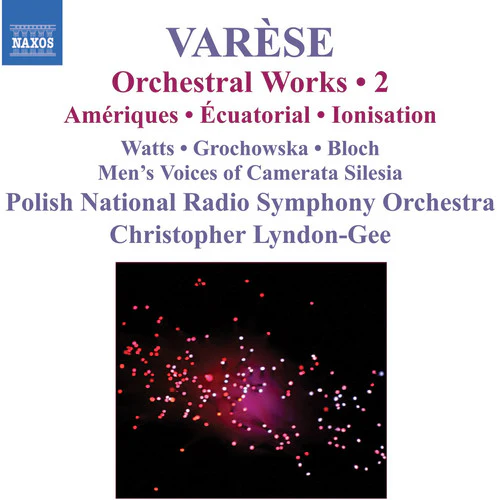
Varèse: Orchestral Works Vol 2
This recording of Amèriques is unique in that it uses the original version for 155 players. Following the piece with the revised score in hand turns out to be quite a trip as Varèse made a great many changes, too many to go into here. Listeners familiar with the revised version will notice many new colors in the original, including the frequent presence of offstage brass, major shifts in dynamics, lots of altered percussion, and a totally different ending. The music leading up to that exotic "belly dance" in the woodwinds has been completely recomposed in spots, and the piece generally is less continuous, more kaleidoscopic. Varèse left us so little music that I hesitate to come down strongly in favor of one version over the other--it's great to have both--though if forced to choose it seems to me that the revised ending is even more exciting, its overall impression more powerful despite the slightly smaller forces required.
Certainly it would be difficult to find a more effective champion of this juggernaut of a piece than Christopher Lyndon-Gee. In his Rochberg recordings, also for Naxos, he has demonstrated am impressive ability to control large forces and shape complex textures in a way that always sounds purposeful and expressive. So it is here, not just in Amèriques, but also in Ecuatorial, Nocturnal, and above all Ionisation, which sounds amazingly nuanced, even dance-like in this interpretation. No matter how freaky Varèse gets (and in Ecuatorial especially the answer is "very"), Lyndon-Gee never seems to be trading expressivity and naturalness for mere precision; accuracy is a given, not an end in itself. The remaining works on the disc include Varèse's earliest surviving piece, the song Un grand sommeil noir, very nicely sung by Elizabeth Watts, as well as a notably pure, limpid version of Density 21.5, one of the 20th-century's masterpieces for solo flute.
As with many other Naxos releases from Poland (including Antoni Wit's largely excellent series of recordings), the engineering is warmly vivid within an ample acoustic that perhaps diffuses the impact of the brass and percussion just a bit, if never troublingly. Certainly it gives a good idea of the huge forces required for Amèriques. The men's voices of the Camerata Silesia also come off as just a bit tame and "choir-like" for the primal music of Ecuatorial, but in all ways that matter significantly, this is an outstanding release, and one of self-evident importance to Varèse admirers.
--David Hurwitz, ClassicsToday.com
Certainly it would be difficult to find a more effective champion of this juggernaut of a piece than Christopher Lyndon-Gee. In his Rochberg recordings, also for Naxos, he has demonstrated am impressive ability to control large forces and shape complex textures in a way that always sounds purposeful and expressive. So it is here, not just in Amèriques, but also in Ecuatorial, Nocturnal, and above all Ionisation, which sounds amazingly nuanced, even dance-like in this interpretation. No matter how freaky Varèse gets (and in Ecuatorial especially the answer is "very"), Lyndon-Gee never seems to be trading expressivity and naturalness for mere precision; accuracy is a given, not an end in itself. The remaining works on the disc include Varèse's earliest surviving piece, the song Un grand sommeil noir, very nicely sung by Elizabeth Watts, as well as a notably pure, limpid version of Density 21.5, one of the 20th-century's masterpieces for solo flute.
As with many other Naxos releases from Poland (including Antoni Wit's largely excellent series of recordings), the engineering is warmly vivid within an ample acoustic that perhaps diffuses the impact of the brass and percussion just a bit, if never troublingly. Certainly it gives a good idea of the huge forces required for Amèriques. The men's voices of the Camerata Silesia also come off as just a bit tame and "choir-like" for the primal music of Ecuatorial, but in all ways that matter significantly, this is an outstanding release, and one of self-evident importance to Varèse admirers.
--David Hurwitz, ClassicsToday.com
This recording of Amèriques is unique in that it uses the original version for 155 players. Following the piece with the revised score in hand turns out to be quite a trip as Varèse made a great many changes, too many to go into here. Listeners familiar with the revised version will notice many new colors in the original, including the frequent presence of offstage brass, major shifts in dynamics, lots of altered percussion, and a totally different ending. The music leading up to that exotic "belly dance" in the woodwinds has been completely recomposed in spots, and the piece generally is less continuous, more kaleidoscopic. Varèse left us so little music that I hesitate to come down strongly in favor of one version over the other--it's great to have both--though if forced to choose it seems to me that the revised ending is even more exciting, its overall impression more powerful despite the slightly smaller forces required.
Certainly it would be difficult to find a more effective champion of this juggernaut of a piece than Christopher Lyndon-Gee. In his Rochberg recordings, also for Naxos, he has demonstrated am impressive ability to control large forces and shape complex textures in a way that always sounds purposeful and expressive. So it is here, not just in Amèriques, but also in Ecuatorial, Nocturnal, and above all Ionisation, which sounds amazingly nuanced, even dance-like in this interpretation. No matter how freaky Varèse gets (and in Ecuatorial especially the answer is "very"), Lyndon-Gee never seems to be trading expressivity and naturalness for mere precision; accuracy is a given, not an end in itself. The remaining works on the disc include Varèse's earliest surviving piece, the song Un grand sommeil noir, very nicely sung by Elizabeth Watts, as well as a notably pure, limpid version of Density 21.5, one of the 20th-century's masterpieces for solo flute.
As with many other Naxos releases from Poland (including Antoni Wit's largely excellent series of recordings), the engineering is warmly vivid within an ample acoustic that perhaps diffuses the impact of the brass and percussion just a bit, if never troublingly. Certainly it gives a good idea of the huge forces required for Amèriques. The men's voices of the Camerata Silesia also come off as just a bit tame and "choir-like" for the primal music of Ecuatorial, but in all ways that matter significantly, this is an outstanding release, and one of self-evident importance to Varèse admirers.
--David Hurwitz, ClassicsToday.com
Certainly it would be difficult to find a more effective champion of this juggernaut of a piece than Christopher Lyndon-Gee. In his Rochberg recordings, also for Naxos, he has demonstrated am impressive ability to control large forces and shape complex textures in a way that always sounds purposeful and expressive. So it is here, not just in Amèriques, but also in Ecuatorial, Nocturnal, and above all Ionisation, which sounds amazingly nuanced, even dance-like in this interpretation. No matter how freaky Varèse gets (and in Ecuatorial especially the answer is "very"), Lyndon-Gee never seems to be trading expressivity and naturalness for mere precision; accuracy is a given, not an end in itself. The remaining works on the disc include Varèse's earliest surviving piece, the song Un grand sommeil noir, very nicely sung by Elizabeth Watts, as well as a notably pure, limpid version of Density 21.5, one of the 20th-century's masterpieces for solo flute.
As with many other Naxos releases from Poland (including Antoni Wit's largely excellent series of recordings), the engineering is warmly vivid within an ample acoustic that perhaps diffuses the impact of the brass and percussion just a bit, if never troublingly. Certainly it gives a good idea of the huge forces required for Amèriques. The men's voices of the Camerata Silesia also come off as just a bit tame and "choir-like" for the primal music of Ecuatorial, but in all ways that matter significantly, this is an outstanding release, and one of self-evident importance to Varèse admirers.
--David Hurwitz, ClassicsToday.com
$19.99
Varèse: Orchestral Works Vol 2—
$19.99
Description
This recording of Amèriques is unique in that it uses the original version for 155 players. Following the piece with the revised score in hand turns out to be quite a trip as Varèse made a great many changes, too many to go into here. Listeners familiar with the revised version will notice many new colors in the original, including the frequent presence of offstage brass, major shifts in dynamics, lots of altered percussion, and a totally different ending. The music leading up to that exotic "belly dance" in the woodwinds has been completely recomposed in spots, and the piece generally is less continuous, more kaleidoscopic. Varèse left us so little music that I hesitate to come down strongly in favor of one version over the other--it's great to have both--though if forced to choose it seems to me that the revised ending is even more exciting, its overall impression more powerful despite the slightly smaller forces required.
Certainly it would be difficult to find a more effective champion of this juggernaut of a piece than Christopher Lyndon-Gee. In his Rochberg recordings, also for Naxos, he has demonstrated am impressive ability to control large forces and shape complex textures in a way that always sounds purposeful and expressive. So it is here, not just in Amèriques, but also in Ecuatorial, Nocturnal, and above all Ionisation, which sounds amazingly nuanced, even dance-like in this interpretation. No matter how freaky Varèse gets (and in Ecuatorial especially the answer is "very"), Lyndon-Gee never seems to be trading expressivity and naturalness for mere precision; accuracy is a given, not an end in itself. The remaining works on the disc include Varèse's earliest surviving piece, the song Un grand sommeil noir, very nicely sung by Elizabeth Watts, as well as a notably pure, limpid version of Density 21.5, one of the 20th-century's masterpieces for solo flute.
As with many other Naxos releases from Poland (including Antoni Wit's largely excellent series of recordings), the engineering is warmly vivid within an ample acoustic that perhaps diffuses the impact of the brass and percussion just a bit, if never troublingly. Certainly it gives a good idea of the huge forces required for Amèriques. The men's voices of the Camerata Silesia also come off as just a bit tame and "choir-like" for the primal music of Ecuatorial, but in all ways that matter significantly, this is an outstanding release, and one of self-evident importance to Varèse admirers.
--David Hurwitz, ClassicsToday.com
Certainly it would be difficult to find a more effective champion of this juggernaut of a piece than Christopher Lyndon-Gee. In his Rochberg recordings, also for Naxos, he has demonstrated am impressive ability to control large forces and shape complex textures in a way that always sounds purposeful and expressive. So it is here, not just in Amèriques, but also in Ecuatorial, Nocturnal, and above all Ionisation, which sounds amazingly nuanced, even dance-like in this interpretation. No matter how freaky Varèse gets (and in Ecuatorial especially the answer is "very"), Lyndon-Gee never seems to be trading expressivity and naturalness for mere precision; accuracy is a given, not an end in itself. The remaining works on the disc include Varèse's earliest surviving piece, the song Un grand sommeil noir, very nicely sung by Elizabeth Watts, as well as a notably pure, limpid version of Density 21.5, one of the 20th-century's masterpieces for solo flute.
As with many other Naxos releases from Poland (including Antoni Wit's largely excellent series of recordings), the engineering is warmly vivid within an ample acoustic that perhaps diffuses the impact of the brass and percussion just a bit, if never troublingly. Certainly it gives a good idea of the huge forces required for Amèriques. The men's voices of the Camerata Silesia also come off as just a bit tame and "choir-like" for the primal music of Ecuatorial, but in all ways that matter significantly, this is an outstanding release, and one of self-evident importance to Varèse admirers.
--David Hurwitz, ClassicsToday.com