🎉 Up to 70% Off Selected ItemsShop Sale

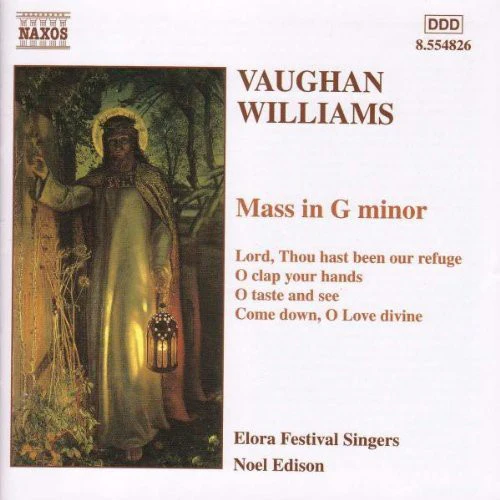
Vaughan Williams: Mass In G, Choral Music / Edison, Et Al
This is a first rate collection of some of Vaughan Williams' best choral works, both a cappella and with organ accompaniment. Fans of this composer definitely will want to have this disc, whose main attraction is the rarely recorded Mass in G minor. Why this stark and very moving work has received such scant attention on disc is a mystery, but it remains a unique and timeless masterpiece whose bold, bare harmonies and unadorned, chant-like melodies invoke the atmosphere of ancient worship while serving as a kind of musical embodiment of the imposing cathedral structures and spaces in which that worship took place. A good performance of this piece for a cappella double choir and a quartet of soloists first demands excellent singers and an ensemble that's well-balanced and especially solid on the bass end. The nature of the writing, including modal melodies and harmony, parallel fifths, and wide-spaced voicings, gives even the best choirs "intonational" fits; pacing is extremely important in order to keep key, dense-textured sections from bogging down.
None of these challenges proves troublesome at all for the Elora Festival Singers, which during the past 20 years has become one of Canada's--and the world's--finest choirs. Director Noel Edison obviously cares about balances and clarity of line, and also shows concern for his singers (and listeners) by maintaining sensible, effective tempos. However, in one significant place, the crucial, final Agnus Dei movement, I found Edison's tempo just too fast to allow the layers of vocal lines to build sufficient tension and create the energy to achieve the intended, truly powerful climax. Nevertheless, you never get the sense that Edison gets any less than he asks for, especially since the other works on the program are performed with equal intensity and technical confidence. (In the mass, he's also got a terrific quartet of soloists, who not only deliver the notes and maintain the mood in their individual passages, but also make a well-matched ensemble.) It's a real treat to hear the motets sung so well (just listen to that lovely opening to Lord, Thou hast been our refuge, and to the shimmering, jazzy dissonances in the Prayer to the Father of Heaven), and the setting of the beautiful hymn Come down, O Love divine (Down Ampney) makes an appropriate close, a tribute to this composer's immeasurable contribution to the English hymn repertoire. Placing O vos omnes immediately before the mass allows us to easily hear the similarities between these two compositions, written around the same time.
Now, for the slightly bad news: the recording levels make trouble for full enjoyment of these inherently full-bodied, rich-textured works. True, the acoustics of Toronto's illustrious Church of St. Mary Magdalene are somewhat tricky to tame, but if you adjust the volume high enough to comfortably hear softer passages--the beginning of the motet Lord, Thou hast been our refuge, for instance--the louder sections (the entrance of the organ and the work's conclusion), are just too loud. This is true for the mass as well; it seems that the engineers decided that a more distant listening perspective was preferable to a closer one that would have posed its own balance problems. Nevertheless, I eventually was able to find a satisfying middle ground that my ears quickly adjusted to, allowing me to put aside my sonic concerns enough to devote several more hours to this one disc. And I will certainly return to it again, because the performances are that good.
--David Vernier, ClassicsToday.com
None of these challenges proves troublesome at all for the Elora Festival Singers, which during the past 20 years has become one of Canada's--and the world's--finest choirs. Director Noel Edison obviously cares about balances and clarity of line, and also shows concern for his singers (and listeners) by maintaining sensible, effective tempos. However, in one significant place, the crucial, final Agnus Dei movement, I found Edison's tempo just too fast to allow the layers of vocal lines to build sufficient tension and create the energy to achieve the intended, truly powerful climax. Nevertheless, you never get the sense that Edison gets any less than he asks for, especially since the other works on the program are performed with equal intensity and technical confidence. (In the mass, he's also got a terrific quartet of soloists, who not only deliver the notes and maintain the mood in their individual passages, but also make a well-matched ensemble.) It's a real treat to hear the motets sung so well (just listen to that lovely opening to Lord, Thou hast been our refuge, and to the shimmering, jazzy dissonances in the Prayer to the Father of Heaven), and the setting of the beautiful hymn Come down, O Love divine (Down Ampney) makes an appropriate close, a tribute to this composer's immeasurable contribution to the English hymn repertoire. Placing O vos omnes immediately before the mass allows us to easily hear the similarities between these two compositions, written around the same time.
Now, for the slightly bad news: the recording levels make trouble for full enjoyment of these inherently full-bodied, rich-textured works. True, the acoustics of Toronto's illustrious Church of St. Mary Magdalene are somewhat tricky to tame, but if you adjust the volume high enough to comfortably hear softer passages--the beginning of the motet Lord, Thou hast been our refuge, for instance--the louder sections (the entrance of the organ and the work's conclusion), are just too loud. This is true for the mass as well; it seems that the engineers decided that a more distant listening perspective was preferable to a closer one that would have posed its own balance problems. Nevertheless, I eventually was able to find a satisfying middle ground that my ears quickly adjusted to, allowing me to put aside my sonic concerns enough to devote several more hours to this one disc. And I will certainly return to it again, because the performances are that good.
--David Vernier, ClassicsToday.com
This is a first rate collection of some of Vaughan Williams' best choral works, both a cappella and with organ accompaniment. Fans of this composer definitely will want to have this disc, whose main attraction is the rarely recorded Mass in G minor. Why this stark and very moving work has received such scant attention on disc is a mystery, but it remains a unique and timeless masterpiece whose bold, bare harmonies and unadorned, chant-like melodies invoke the atmosphere of ancient worship while serving as a kind of musical embodiment of the imposing cathedral structures and spaces in which that worship took place. A good performance of this piece for a cappella double choir and a quartet of soloists first demands excellent singers and an ensemble that's well-balanced and especially solid on the bass end. The nature of the writing, including modal melodies and harmony, parallel fifths, and wide-spaced voicings, gives even the best choirs "intonational" fits; pacing is extremely important in order to keep key, dense-textured sections from bogging down.
None of these challenges proves troublesome at all for the Elora Festival Singers, which during the past 20 years has become one of Canada's--and the world's--finest choirs. Director Noel Edison obviously cares about balances and clarity of line, and also shows concern for his singers (and listeners) by maintaining sensible, effective tempos. However, in one significant place, the crucial, final Agnus Dei movement, I found Edison's tempo just too fast to allow the layers of vocal lines to build sufficient tension and create the energy to achieve the intended, truly powerful climax. Nevertheless, you never get the sense that Edison gets any less than he asks for, especially since the other works on the program are performed with equal intensity and technical confidence. (In the mass, he's also got a terrific quartet of soloists, who not only deliver the notes and maintain the mood in their individual passages, but also make a well-matched ensemble.) It's a real treat to hear the motets sung so well (just listen to that lovely opening to Lord, Thou hast been our refuge, and to the shimmering, jazzy dissonances in the Prayer to the Father of Heaven), and the setting of the beautiful hymn Come down, O Love divine (Down Ampney) makes an appropriate close, a tribute to this composer's immeasurable contribution to the English hymn repertoire. Placing O vos omnes immediately before the mass allows us to easily hear the similarities between these two compositions, written around the same time.
Now, for the slightly bad news: the recording levels make trouble for full enjoyment of these inherently full-bodied, rich-textured works. True, the acoustics of Toronto's illustrious Church of St. Mary Magdalene are somewhat tricky to tame, but if you adjust the volume high enough to comfortably hear softer passages--the beginning of the motet Lord, Thou hast been our refuge, for instance--the louder sections (the entrance of the organ and the work's conclusion), are just too loud. This is true for the mass as well; it seems that the engineers decided that a more distant listening perspective was preferable to a closer one that would have posed its own balance problems. Nevertheless, I eventually was able to find a satisfying middle ground that my ears quickly adjusted to, allowing me to put aside my sonic concerns enough to devote several more hours to this one disc. And I will certainly return to it again, because the performances are that good.
--David Vernier, ClassicsToday.com
None of these challenges proves troublesome at all for the Elora Festival Singers, which during the past 20 years has become one of Canada's--and the world's--finest choirs. Director Noel Edison obviously cares about balances and clarity of line, and also shows concern for his singers (and listeners) by maintaining sensible, effective tempos. However, in one significant place, the crucial, final Agnus Dei movement, I found Edison's tempo just too fast to allow the layers of vocal lines to build sufficient tension and create the energy to achieve the intended, truly powerful climax. Nevertheless, you never get the sense that Edison gets any less than he asks for, especially since the other works on the program are performed with equal intensity and technical confidence. (In the mass, he's also got a terrific quartet of soloists, who not only deliver the notes and maintain the mood in their individual passages, but also make a well-matched ensemble.) It's a real treat to hear the motets sung so well (just listen to that lovely opening to Lord, Thou hast been our refuge, and to the shimmering, jazzy dissonances in the Prayer to the Father of Heaven), and the setting of the beautiful hymn Come down, O Love divine (Down Ampney) makes an appropriate close, a tribute to this composer's immeasurable contribution to the English hymn repertoire. Placing O vos omnes immediately before the mass allows us to easily hear the similarities between these two compositions, written around the same time.
Now, for the slightly bad news: the recording levels make trouble for full enjoyment of these inherently full-bodied, rich-textured works. True, the acoustics of Toronto's illustrious Church of St. Mary Magdalene are somewhat tricky to tame, but if you adjust the volume high enough to comfortably hear softer passages--the beginning of the motet Lord, Thou hast been our refuge, for instance--the louder sections (the entrance of the organ and the work's conclusion), are just too loud. This is true for the mass as well; it seems that the engineers decided that a more distant listening perspective was preferable to a closer one that would have posed its own balance problems. Nevertheless, I eventually was able to find a satisfying middle ground that my ears quickly adjusted to, allowing me to put aside my sonic concerns enough to devote several more hours to this one disc. And I will certainly return to it again, because the performances are that good.
--David Vernier, ClassicsToday.com
$7.00
Original: $19.99
-65%Vaughan Williams: Mass In G, Choral Music / Edison, Et Al—
$19.99
$7.00Description
This is a first rate collection of some of Vaughan Williams' best choral works, both a cappella and with organ accompaniment. Fans of this composer definitely will want to have this disc, whose main attraction is the rarely recorded Mass in G minor. Why this stark and very moving work has received such scant attention on disc is a mystery, but it remains a unique and timeless masterpiece whose bold, bare harmonies and unadorned, chant-like melodies invoke the atmosphere of ancient worship while serving as a kind of musical embodiment of the imposing cathedral structures and spaces in which that worship took place. A good performance of this piece for a cappella double choir and a quartet of soloists first demands excellent singers and an ensemble that's well-balanced and especially solid on the bass end. The nature of the writing, including modal melodies and harmony, parallel fifths, and wide-spaced voicings, gives even the best choirs "intonational" fits; pacing is extremely important in order to keep key, dense-textured sections from bogging down.
None of these challenges proves troublesome at all for the Elora Festival Singers, which during the past 20 years has become one of Canada's--and the world's--finest choirs. Director Noel Edison obviously cares about balances and clarity of line, and also shows concern for his singers (and listeners) by maintaining sensible, effective tempos. However, in one significant place, the crucial, final Agnus Dei movement, I found Edison's tempo just too fast to allow the layers of vocal lines to build sufficient tension and create the energy to achieve the intended, truly powerful climax. Nevertheless, you never get the sense that Edison gets any less than he asks for, especially since the other works on the program are performed with equal intensity and technical confidence. (In the mass, he's also got a terrific quartet of soloists, who not only deliver the notes and maintain the mood in their individual passages, but also make a well-matched ensemble.) It's a real treat to hear the motets sung so well (just listen to that lovely opening to Lord, Thou hast been our refuge, and to the shimmering, jazzy dissonances in the Prayer to the Father of Heaven), and the setting of the beautiful hymn Come down, O Love divine (Down Ampney) makes an appropriate close, a tribute to this composer's immeasurable contribution to the English hymn repertoire. Placing O vos omnes immediately before the mass allows us to easily hear the similarities between these two compositions, written around the same time.
Now, for the slightly bad news: the recording levels make trouble for full enjoyment of these inherently full-bodied, rich-textured works. True, the acoustics of Toronto's illustrious Church of St. Mary Magdalene are somewhat tricky to tame, but if you adjust the volume high enough to comfortably hear softer passages--the beginning of the motet Lord, Thou hast been our refuge, for instance--the louder sections (the entrance of the organ and the work's conclusion), are just too loud. This is true for the mass as well; it seems that the engineers decided that a more distant listening perspective was preferable to a closer one that would have posed its own balance problems. Nevertheless, I eventually was able to find a satisfying middle ground that my ears quickly adjusted to, allowing me to put aside my sonic concerns enough to devote several more hours to this one disc. And I will certainly return to it again, because the performances are that good.
--David Vernier, ClassicsToday.com
None of these challenges proves troublesome at all for the Elora Festival Singers, which during the past 20 years has become one of Canada's--and the world's--finest choirs. Director Noel Edison obviously cares about balances and clarity of line, and also shows concern for his singers (and listeners) by maintaining sensible, effective tempos. However, in one significant place, the crucial, final Agnus Dei movement, I found Edison's tempo just too fast to allow the layers of vocal lines to build sufficient tension and create the energy to achieve the intended, truly powerful climax. Nevertheless, you never get the sense that Edison gets any less than he asks for, especially since the other works on the program are performed with equal intensity and technical confidence. (In the mass, he's also got a terrific quartet of soloists, who not only deliver the notes and maintain the mood in their individual passages, but also make a well-matched ensemble.) It's a real treat to hear the motets sung so well (just listen to that lovely opening to Lord, Thou hast been our refuge, and to the shimmering, jazzy dissonances in the Prayer to the Father of Heaven), and the setting of the beautiful hymn Come down, O Love divine (Down Ampney) makes an appropriate close, a tribute to this composer's immeasurable contribution to the English hymn repertoire. Placing O vos omnes immediately before the mass allows us to easily hear the similarities between these two compositions, written around the same time.
Now, for the slightly bad news: the recording levels make trouble for full enjoyment of these inherently full-bodied, rich-textured works. True, the acoustics of Toronto's illustrious Church of St. Mary Magdalene are somewhat tricky to tame, but if you adjust the volume high enough to comfortably hear softer passages--the beginning of the motet Lord, Thou hast been our refuge, for instance--the louder sections (the entrance of the organ and the work's conclusion), are just too loud. This is true for the mass as well; it seems that the engineers decided that a more distant listening perspective was preferable to a closer one that would have posed its own balance problems. Nevertheless, I eventually was able to find a satisfying middle ground that my ears quickly adjusted to, allowing me to put aside my sonic concerns enough to devote several more hours to this one disc. And I will certainly return to it again, because the performances are that good.
--David Vernier, ClassicsToday.com