🎉 Up to 70% Off Selected ItemsShop Sale

1 / 2
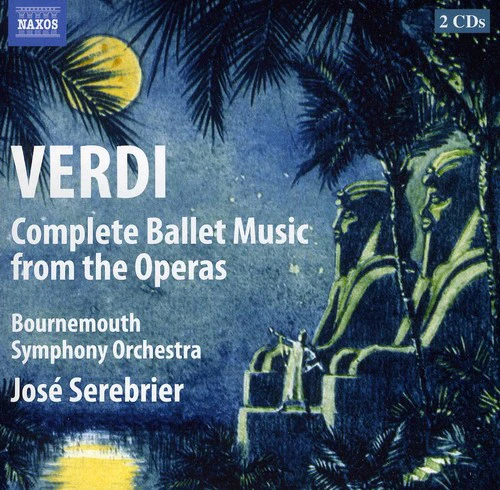
Verdi: Complete Ballet Music From The Operas / Serebrier, Bournemouth Symphony

The only other serious competition in this repertoire, and it’s not as complete as this release (the Aida items are missing), is an old Philips Due mostly conducted by the late Antonio de Almeida. Those are good performances, but they don’t outclass these, either interpretively or sonically. You might say that it doesn’t take much interpretive insight to conduct Italian ballet music, but ultimately the goal is always the same: to avoid boredom. This may be even harder in music whose purpose is largely decorative and expressively limited. It’s to Serebrier’s (and Verdi’s) credit that there isn’t a bar here that fails to entertain, or that doesn’t make an excellent case for believing that this music is of much higher quality than its reputation suggests.
The ballet from Aida is well known, of course, but that from Otello is a minor masterpiece in a strikingly similar vein. “The Four Seasons” ballet from I vespri siciliani is Verdi’s largest, lasting a solid half an hour, and it’s wonderfully performed here. It has moments that you might mistake for Delibes or Tchaikovsky. Don Carlos is also fully mature Verdi, while the ballet in Macbeth is pretty well known as it’s often included in modern performances of the opera (the witches’ waltz at the end is particularly fun). The two big “finds” for most listeners will be the extensive ballet music from Jérusalem (a.k.a. I lombardi), and the similarly large-scale (20 minutes) dance episodes from Il trovatore. This last item quotes the “gypsy” tunes from the opera’s first act, including the Anvil Chorus, and it’s really delightful. The sonics are clear and vivid, and with a playing time of nearly two hours, this set easily becomes the modern reference for this undervalued repertoire.
-- ClassicsToday.com
The only other serious competition in this repertoire, and it’s not as complete as this release (the Aida items are missing), is an old Philips Due mostly conducted by the late Antonio de Almeida. Those are good performances, but they don’t outclass these, either interpretively or sonically. You might say that it doesn’t take much interpretive insight to conduct Italian ballet music, but ultimately the goal is always the same: to avoid boredom. This may be even harder in music whose purpose is largely decorative and expressively limited. It’s to Serebrier’s (and Verdi’s) credit that there isn’t a bar here that fails to entertain, or that doesn’t make an excellent case for believing that this music is of much higher quality than its reputation suggests.
The ballet from Aida is well known, of course, but that from Otello is a minor masterpiece in a strikingly similar vein. “The Four Seasons” ballet from I vespri siciliani is Verdi’s largest, lasting a solid half an hour, and it’s wonderfully performed here. It has moments that you might mistake for Delibes or Tchaikovsky. Don Carlos is also fully mature Verdi, while the ballet in Macbeth is pretty well known as it’s often included in modern performances of the opera (the witches’ waltz at the end is particularly fun). The two big “finds” for most listeners will be the extensive ballet music from Jérusalem (a.k.a. I lombardi), and the similarly large-scale (20 minutes) dance episodes from Il trovatore. This last item quotes the “gypsy” tunes from the opera’s first act, including the Anvil Chorus, and it’s really delightful. The sonics are clear and vivid, and with a playing time of nearly two hours, this set easily becomes the modern reference for this undervalued repertoire.
-- ClassicsToday.com
$10.50
Original: $29.99
-65%Verdi: Complete Ballet Music From The Operas / Serebrier, Bournemouth Symphony—
$29.99
$10.50Description
The only other serious competition in this repertoire, and it’s not as complete as this release (the Aida items are missing), is an old Philips Due mostly conducted by the late Antonio de Almeida. Those are good performances, but they don’t outclass these, either interpretively or sonically. You might say that it doesn’t take much interpretive insight to conduct Italian ballet music, but ultimately the goal is always the same: to avoid boredom. This may be even harder in music whose purpose is largely decorative and expressively limited. It’s to Serebrier’s (and Verdi’s) credit that there isn’t a bar here that fails to entertain, or that doesn’t make an excellent case for believing that this music is of much higher quality than its reputation suggests.
The ballet from Aida is well known, of course, but that from Otello is a minor masterpiece in a strikingly similar vein. “The Four Seasons” ballet from I vespri siciliani is Verdi’s largest, lasting a solid half an hour, and it’s wonderfully performed here. It has moments that you might mistake for Delibes or Tchaikovsky. Don Carlos is also fully mature Verdi, while the ballet in Macbeth is pretty well known as it’s often included in modern performances of the opera (the witches’ waltz at the end is particularly fun). The two big “finds” for most listeners will be the extensive ballet music from Jérusalem (a.k.a. I lombardi), and the similarly large-scale (20 minutes) dance episodes from Il trovatore. This last item quotes the “gypsy” tunes from the opera’s first act, including the Anvil Chorus, and it’s really delightful. The sonics are clear and vivid, and with a playing time of nearly two hours, this set easily becomes the modern reference for this undervalued repertoire.
-- ClassicsToday.com