🎉 Up to 70% Off Selected ItemsShop Sale

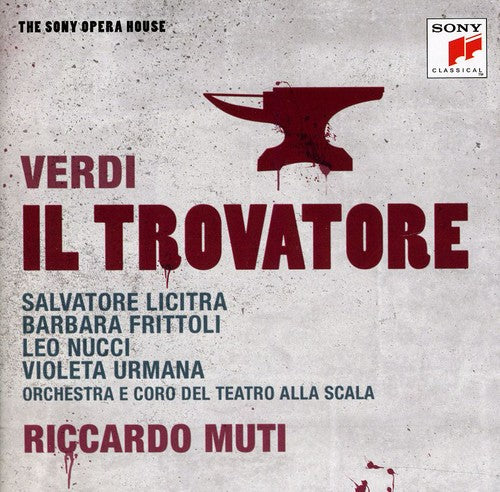
Verdi: Il Trovatore / Licitra, Frittoli, Nucci, Muti
Since there are dozens of recordings of Il trovatore available, of which a half dozen are more than good, no one would have guessed that the world needed another. But here, taken from a series of live performances at La Scala in December of 2000, Riccardo Muti gives us a thrilling reading, filled with a type of energy we rarely encounter live and even more rarely on disc. The score is presented complete, with all repeats, and no optional high notes. (Muti attempts to justify the omission of Manrico’s optional high C at the close of “Di quella pira” in the booklet; it reads like nonsense: “…he runs off to save this crazy old lady he is not even sure is his mother…. This is someone who sings and holds high Cs? Where is the truth in that?” Huh, Riccardo?). Nevertheless both Leonora and Azucena add tiny but appealing embellishments (more like variations) to their vocal lines once or twice: so how is that justified?
Never mind—Muti whips the orchestra into a fantastic frenzy during Manrico’s manic cabaletta; elsewhere it sighs with Leonora or accompanies ideally. Perhaps the most impressive thing about this set is its rhythmic thrust and accuracy; no singer is allowed to hold back the musical line, and by not permitting any star-turn rubatos the action remains vibrant. The Leonora/di Luna duet in Act 4 moves along at a remarkable clip, almost breathlessly, reminiscent of Donizetti at his best. And there is less of the oom-pah-in-the-orchestra effect audible in this performance than in any other of this work I can think of; and while the ghastly story unfolds well, it is the peaceful, one-on-one moments that stay in the memory.
Frittoli is an elegant Leonora, singing with accuracy and dignity. The sound itself is not soft and caressing, but she does nice things with words and dynamics. The late Salvatore Licitra would appear to have been a real “Italian” tenor, capable of nice mobidezza in “Ah si, ben mio,” and in the soft scenes with Azucena; elsewhere he’s generous of voice and exciting. Violetta Urmana has a voice almost too beautiful for Azucena; we’ve all come to prefer a chestier, more aggressive sound (Cossotto, Bumbry, etc), but here she’s in keeping with the intimacy Muti’s after and she sings not only realistically but gorgeously. Leo Nucci is a bit long in the tooth to be a brute of a di Luna, and he wavers from pitch occasionally, but his innate musicality saves the day.
The La Scala forces play and sing for Muti as if they feared for their lives—you can draw your own conclusions. The engineers have captured the stage ambiance and balance beautifully while keeping extraneous sounds very limited; the audience was apparently forced to sit on its collective hands until the end of acts and were threatened with death if they coughed or sniffled. In all, this Trovatore is an ear-opener.
--Robert Levine, ClassicsToday.com
Never mind—Muti whips the orchestra into a fantastic frenzy during Manrico’s manic cabaletta; elsewhere it sighs with Leonora or accompanies ideally. Perhaps the most impressive thing about this set is its rhythmic thrust and accuracy; no singer is allowed to hold back the musical line, and by not permitting any star-turn rubatos the action remains vibrant. The Leonora/di Luna duet in Act 4 moves along at a remarkable clip, almost breathlessly, reminiscent of Donizetti at his best. And there is less of the oom-pah-in-the-orchestra effect audible in this performance than in any other of this work I can think of; and while the ghastly story unfolds well, it is the peaceful, one-on-one moments that stay in the memory.
Frittoli is an elegant Leonora, singing with accuracy and dignity. The sound itself is not soft and caressing, but she does nice things with words and dynamics. The late Salvatore Licitra would appear to have been a real “Italian” tenor, capable of nice mobidezza in “Ah si, ben mio,” and in the soft scenes with Azucena; elsewhere he’s generous of voice and exciting. Violetta Urmana has a voice almost too beautiful for Azucena; we’ve all come to prefer a chestier, more aggressive sound (Cossotto, Bumbry, etc), but here she’s in keeping with the intimacy Muti’s after and she sings not only realistically but gorgeously. Leo Nucci is a bit long in the tooth to be a brute of a di Luna, and he wavers from pitch occasionally, but his innate musicality saves the day.
The La Scala forces play and sing for Muti as if they feared for their lives—you can draw your own conclusions. The engineers have captured the stage ambiance and balance beautifully while keeping extraneous sounds very limited; the audience was apparently forced to sit on its collective hands until the end of acts and were threatened with death if they coughed or sniffled. In all, this Trovatore is an ear-opener.
--Robert Levine, ClassicsToday.com
Since there are dozens of recordings of Il trovatore available, of which a half dozen are more than good, no one would have guessed that the world needed another. But here, taken from a series of live performances at La Scala in December of 2000, Riccardo Muti gives us a thrilling reading, filled with a type of energy we rarely encounter live and even more rarely on disc. The score is presented complete, with all repeats, and no optional high notes. (Muti attempts to justify the omission of Manrico’s optional high C at the close of “Di quella pira” in the booklet; it reads like nonsense: “…he runs off to save this crazy old lady he is not even sure is his mother…. This is someone who sings and holds high Cs? Where is the truth in that?” Huh, Riccardo?). Nevertheless both Leonora and Azucena add tiny but appealing embellishments (more like variations) to their vocal lines once or twice: so how is that justified?
Never mind—Muti whips the orchestra into a fantastic frenzy during Manrico’s manic cabaletta; elsewhere it sighs with Leonora or accompanies ideally. Perhaps the most impressive thing about this set is its rhythmic thrust and accuracy; no singer is allowed to hold back the musical line, and by not permitting any star-turn rubatos the action remains vibrant. The Leonora/di Luna duet in Act 4 moves along at a remarkable clip, almost breathlessly, reminiscent of Donizetti at his best. And there is less of the oom-pah-in-the-orchestra effect audible in this performance than in any other of this work I can think of; and while the ghastly story unfolds well, it is the peaceful, one-on-one moments that stay in the memory.
Frittoli is an elegant Leonora, singing with accuracy and dignity. The sound itself is not soft and caressing, but she does nice things with words and dynamics. The late Salvatore Licitra would appear to have been a real “Italian” tenor, capable of nice mobidezza in “Ah si, ben mio,” and in the soft scenes with Azucena; elsewhere he’s generous of voice and exciting. Violetta Urmana has a voice almost too beautiful for Azucena; we’ve all come to prefer a chestier, more aggressive sound (Cossotto, Bumbry, etc), but here she’s in keeping with the intimacy Muti’s after and she sings not only realistically but gorgeously. Leo Nucci is a bit long in the tooth to be a brute of a di Luna, and he wavers from pitch occasionally, but his innate musicality saves the day.
The La Scala forces play and sing for Muti as if they feared for their lives—you can draw your own conclusions. The engineers have captured the stage ambiance and balance beautifully while keeping extraneous sounds very limited; the audience was apparently forced to sit on its collective hands until the end of acts and were threatened with death if they coughed or sniffled. In all, this Trovatore is an ear-opener.
--Robert Levine, ClassicsToday.com
Never mind—Muti whips the orchestra into a fantastic frenzy during Manrico’s manic cabaletta; elsewhere it sighs with Leonora or accompanies ideally. Perhaps the most impressive thing about this set is its rhythmic thrust and accuracy; no singer is allowed to hold back the musical line, and by not permitting any star-turn rubatos the action remains vibrant. The Leonora/di Luna duet in Act 4 moves along at a remarkable clip, almost breathlessly, reminiscent of Donizetti at his best. And there is less of the oom-pah-in-the-orchestra effect audible in this performance than in any other of this work I can think of; and while the ghastly story unfolds well, it is the peaceful, one-on-one moments that stay in the memory.
Frittoli is an elegant Leonora, singing with accuracy and dignity. The sound itself is not soft and caressing, but she does nice things with words and dynamics. The late Salvatore Licitra would appear to have been a real “Italian” tenor, capable of nice mobidezza in “Ah si, ben mio,” and in the soft scenes with Azucena; elsewhere he’s generous of voice and exciting. Violetta Urmana has a voice almost too beautiful for Azucena; we’ve all come to prefer a chestier, more aggressive sound (Cossotto, Bumbry, etc), but here she’s in keeping with the intimacy Muti’s after and she sings not only realistically but gorgeously. Leo Nucci is a bit long in the tooth to be a brute of a di Luna, and he wavers from pitch occasionally, but his innate musicality saves the day.
The La Scala forces play and sing for Muti as if they feared for their lives—you can draw your own conclusions. The engineers have captured the stage ambiance and balance beautifully while keeping extraneous sounds very limited; the audience was apparently forced to sit on its collective hands until the end of acts and were threatened with death if they coughed or sniffled. In all, this Trovatore is an ear-opener.
--Robert Levine, ClassicsToday.com
$13.98
Verdi: Il Trovatore / Licitra, Frittoli, Nucci, Muti—
$13.98
Description
Since there are dozens of recordings of Il trovatore available, of which a half dozen are more than good, no one would have guessed that the world needed another. But here, taken from a series of live performances at La Scala in December of 2000, Riccardo Muti gives us a thrilling reading, filled with a type of energy we rarely encounter live and even more rarely on disc. The score is presented complete, with all repeats, and no optional high notes. (Muti attempts to justify the omission of Manrico’s optional high C at the close of “Di quella pira” in the booklet; it reads like nonsense: “…he runs off to save this crazy old lady he is not even sure is his mother…. This is someone who sings and holds high Cs? Where is the truth in that?” Huh, Riccardo?). Nevertheless both Leonora and Azucena add tiny but appealing embellishments (more like variations) to their vocal lines once or twice: so how is that justified?
Never mind—Muti whips the orchestra into a fantastic frenzy during Manrico’s manic cabaletta; elsewhere it sighs with Leonora or accompanies ideally. Perhaps the most impressive thing about this set is its rhythmic thrust and accuracy; no singer is allowed to hold back the musical line, and by not permitting any star-turn rubatos the action remains vibrant. The Leonora/di Luna duet in Act 4 moves along at a remarkable clip, almost breathlessly, reminiscent of Donizetti at his best. And there is less of the oom-pah-in-the-orchestra effect audible in this performance than in any other of this work I can think of; and while the ghastly story unfolds well, it is the peaceful, one-on-one moments that stay in the memory.
Frittoli is an elegant Leonora, singing with accuracy and dignity. The sound itself is not soft and caressing, but she does nice things with words and dynamics. The late Salvatore Licitra would appear to have been a real “Italian” tenor, capable of nice mobidezza in “Ah si, ben mio,” and in the soft scenes with Azucena; elsewhere he’s generous of voice and exciting. Violetta Urmana has a voice almost too beautiful for Azucena; we’ve all come to prefer a chestier, more aggressive sound (Cossotto, Bumbry, etc), but here she’s in keeping with the intimacy Muti’s after and she sings not only realistically but gorgeously. Leo Nucci is a bit long in the tooth to be a brute of a di Luna, and he wavers from pitch occasionally, but his innate musicality saves the day.
The La Scala forces play and sing for Muti as if they feared for their lives—you can draw your own conclusions. The engineers have captured the stage ambiance and balance beautifully while keeping extraneous sounds very limited; the audience was apparently forced to sit on its collective hands until the end of acts and were threatened with death if they coughed or sniffled. In all, this Trovatore is an ear-opener.
--Robert Levine, ClassicsToday.com
Never mind—Muti whips the orchestra into a fantastic frenzy during Manrico’s manic cabaletta; elsewhere it sighs with Leonora or accompanies ideally. Perhaps the most impressive thing about this set is its rhythmic thrust and accuracy; no singer is allowed to hold back the musical line, and by not permitting any star-turn rubatos the action remains vibrant. The Leonora/di Luna duet in Act 4 moves along at a remarkable clip, almost breathlessly, reminiscent of Donizetti at his best. And there is less of the oom-pah-in-the-orchestra effect audible in this performance than in any other of this work I can think of; and while the ghastly story unfolds well, it is the peaceful, one-on-one moments that stay in the memory.
Frittoli is an elegant Leonora, singing with accuracy and dignity. The sound itself is not soft and caressing, but she does nice things with words and dynamics. The late Salvatore Licitra would appear to have been a real “Italian” tenor, capable of nice mobidezza in “Ah si, ben mio,” and in the soft scenes with Azucena; elsewhere he’s generous of voice and exciting. Violetta Urmana has a voice almost too beautiful for Azucena; we’ve all come to prefer a chestier, more aggressive sound (Cossotto, Bumbry, etc), but here she’s in keeping with the intimacy Muti’s after and she sings not only realistically but gorgeously. Leo Nucci is a bit long in the tooth to be a brute of a di Luna, and he wavers from pitch occasionally, but his innate musicality saves the day.
The La Scala forces play and sing for Muti as if they feared for their lives—you can draw your own conclusions. The engineers have captured the stage ambiance and balance beautifully while keeping extraneous sounds very limited; the audience was apparently forced to sit on its collective hands until the end of acts and were threatened with death if they coughed or sniffled. In all, this Trovatore is an ear-opener.
--Robert Levine, ClassicsToday.com