🎉 Up to 70% Off Selected ItemsShop Sale

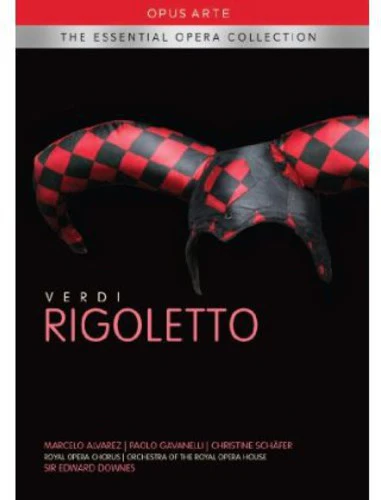
Verdi: Rigoletto / Downes, Alvarez, Schafer, Gavanelli
VERDI Rigoletto & • Edward Downes, cond; Christine Schäfer (Gilda); Marcelo Álvarez (Duke of Mantua); Paolo Gavanelli (Rigoletto); Eric Halfvarson (Sparafucile); Elizabeth Sikora (Giovanna); Graciela Araya (Maddalena); Peter Auty (Borsa); Giovan Battista Parodi (Monterone); Royal Op O & Ch • OPUS ARTE 6005 (DVD: 135:15 + 11:33) Live: London 9/19/2001.
& Documentary: Verdi Through the Looking Glass (17:50); Interview with David McVicar
This Rigoletto directed by David McVicar, last available on a Kultur DVD in 2009, is not to be confused with the other Marcelo Álvarez Rigoletto with soprano Inva Mula and baritone Carlos Alvarez (originally issued by TDK in 2004 and reissued by Arthaus Musik in 2010). I reviewed the latter performance in Fanfare 34:2 and found it interesting but somewhat ho-hum. This one apparently made its appearance in a boxed set from the BBC that also included productions of Falstaff and Il trovatore. Unless the Fanfare Archive is incorrect (I checked under “Singers” for Paolo Gavanelli as well as under “Composers & Works” for “Verdi Rigoletto”), this one seems to have somehow escaped being previously reviewed in Fanfare.
McVicar, in his brief interview, describes Rigoletto as “a scream of rage” against social inequality. He’s probably right. He also brings up the Communist Manifesto and relates Verdi to it. He’s probably wrong. Rigoletto was just good old Victor Hugo, and Hugo had a lifelong fascination with hunchbacks and other physically deformed humans. That’s all it is. It’s not a Communist plot. “It deals with questions of what is beautiful, what is ugly,” he continues, and in that he is 100 percent correct. That was, indeed, Hugo’s focal point. Neither Tribolet (Rigoletto) nor Quasimodo (the hunchback of Notre Dame) are bad people, just unfortunate in the way they were born. “This [opera] is about things that are darker, things that are more unpalatable,” McVicar continues, and this, indeed, is the focus of his production.
An interesting point of dramatic relationship between the two DVD Rigolettos: in neither one does the title character have a real “hunchback” as one would imagine, for instance, from seeing either the Lon Chaney or Charles Laughton films of The Hunchback of Notre Dame. They have, rather, a sort of bulging shark fin growing out of their shoulders. One of the most impressive characterizations of the title role (and I’ve mentioned this before) was a 1970s filmed performance in which Rolando Panerai, his back bulging and deformed, scampered across the stage like some sort of huge and unsettling spider. I don’t demand that every Rigoletto act that way, but Panerai’s conception was uncomfortable to watch in a bizarre, black humor concept.
Thus, in McVicar’s mind, the opening “grand ballroom scene” has no splendor whatsoever. It is a dark, almost forbidding atmosphere in which topless women carouse like whores with the courtiers. The Duke of Mantua’s court has nothing festive, celebratory, or grand about it; it is seamy and disgusting, like the Duke himself. Yet the Duke is handsome and looks (relatively) innocent; it is his twisted jester who personifies all the ugliness inside of him, though Rigoletto is actually the most acutely self-aware person up there. He knows exactly what’s going on, what his function is within the court, and so is able to play up to the Duke’s depravity in a black-humor sort of way and thus win his favor.
Marcelo Álvarez, though a very accomplished tenor, is not one of the world’s great stage actors, thus he follows McVicar’s stage directions—looking rather blasé, jaded, and bored with the many topless beauties in his court—without really getting into the character the way a Jon Vickers, for instance, would have, yet he is certainly good enough to fit into the overall concept. “Questa o quella” sounds almost more brutal than jolly; this is no devil-may-care flirt, but a lecherous Don Juan with no pretense at looking or acting like a gentleman—except when he is play-acting with Gilda. In a way, however, I found the overwhelming number of topless women carousing around like whores to be too much of a bad thing. OK, fine, you made your point. Do you have to keep drumming it over our head like Gene Krupa’s tom-toms? Enough already. I mean, why would they even bother getting dressed in the first place if all they’re going to do is run around laughing and having their dresses pulled down and their knickers pulled up? Yet vocally and dramatically, this performance really takes off. Downes drives his orchestra, chorus, and soloists like a man possessed—I haven’t heard such a well-conducted Rigoletto since the old Bonynge recording—and all the solo voices are good in the first scene, even the dark sound of Parodi as Monterone. Gavanelli not only has a first-class voice, he knows how to use it for both musical and dramatic effect and is a fine stage actor as well. Vocally, the one fly in the ointment is Halfvarson as Sparafucile. His voice has a squally sound, which is exacerbated by an uneven flutter bordering on wobble, but he is a good stage actor, so that’s half the battle won.
I’ve long felt that Edward Downes was one of the more underrated opera conductors in the world. For whatever reason, he always seemed to be overshadowed by other British opera conductors: John Barbirolli when he was younger, John Pritchard when he was older, and later by Antonio Pappano; yet though I am also a big fan of Pappano, there has never been any question in my mind that Downes was always better than Barbirolli or Pritchard, and his work here is splendid. He takes slightly more relaxed tempos than you might be familiar with from the Richard Bonynge or Francesco Molinari-Pradelli recordings, and certainly more relaxed than Arturo Toscanini took act III back in 1944, yet as always his conducting has real “bite.” Not only the brass and winds, but also the strings, speak to you as the drama unfolds on stage, and that, to me, is definitely the mark of a great conductor. Here, too, he uses rubato, rallentandos, and other rhythmic devices to occasionally elongate the musical line without distorting it, as well as a wide range of dynamics and accents to make the music “speak.” A sterling example of how he works may be heard in “Pari siamo,” that difficult quasi-parlando aria in which the title character vacillates between self-reflection and loathing of the court and those he must serve and make laugh. This has always been, for me, one of the supreme highlights of this opera, yet too many baritones run through it as if it were a bel canto exercise. Gavanelli and Downes know exactly how to play it, and it comes off beautifully. The baritone here reveals as great a command of soft singing and half-shades as of ringing, forte high notes.
There’s a bit of luxury casting here in having Christine Schäfer, the world’s most famous exponent of Berg’s Lulu, singing Gilda. She is in superb voice and, more importantly, is a fine stage actress. Moreover, she is able to bring the voice “down” enough from its usual stratospheric heights to give the middle and lower ranges some richness and depth, something I would not have expected of her prior to hearing this. Toscanini, defying operatic conventions of his day and long afterward, insisted that Gilda be sung by a strong lyric soprano voice of the sort that could conceivably also sing Aida and Leonora. For generations, collectors have been enamored of the 1944 performance he gave of act III with Zinka Milanov as Gilda, but although Milanov sang very well her basic timbre was wrong for the part. It was simply too dark and matronly-sounding, more like a 40-year-old Gilda. Toscanini had a much better soprano in his 1943 broadcast, Gertrude Ribla. My other favorite Gildas in the lyric soprano mold are Maria Callas, Cristina Deutekom (only in the first duet with Rigoletto; I don’t think she ever sang the complete role on stage) and Margarita Rinaldi in the aforementioned performance with Panerai, but to this very short list I now add Schäfer. She not only sings it well but brings an entirely new dimension to Gilda that only Ribla and Callas came close to. I was also delightfully surprised to hear that many of the normal cuts in the music were opened up here. In “E il sol dell’anima,” Álvarez sings some of the phrases with something close to the melting legato and sensual phrasing of Tito Schipa—another pleasant surprise. Both soprano and tenor hit the high D? at the end of “Addio, addio,” yet both cut it off short as the score prescribes. Verdi would have been very pleased by this, yet perhaps more so by Schäfer’s near miraculous performance of “Caro nome.” She is even better, musically and dramatically, in this worn-out set piece than Callas or Rinaldi, binding the phrases beautifully yet still “clipping” the descending eighth notes as the score demands, limning every trill, however short, with dramatic meaning. This is surely the work of a great singing actress, and Schäfer does herself proud. Unlike so many practitioners of this role over the decades, Schäfer doesn’t “give them what they want to hear” but what the score dictates, and the aria is all the stronger for it.
One of the more brilliant moments in this production comes when the Duke sings “Ella mi fu rapita … Parmi veder le lagrime.” You finally understand the words. You’re not necessarily supposed to feel sorry for the Duke, but you are supposed to understand that Gilda’s purity of character made him come close to mending his ways. Would he have? Probably not, and that is the dramatic irony of the aria. Also interestingly, vocal delicacy and dramatic subtlety crown the second half of Rigoletto’s “Cortigianni” aria, with Gavanelli singing as tenderly in this section as Giuseppe de Luca once did, albeit with greater dramatic meaning in his delivery.
Wonder of wonders, Álvarez sings “La donna è mobile” with lightness and delicacy—again, à la Schipa—though he does not resist the temptation to sing the unwritten high B at the end. Yet he does also, even more surprisingly, sing the opening solo lines of “Bella figlia dell’amore” with equal delicacy, at once bringing the voice down to a mere thread of sound, a fil da voce, which makes a much greater dramatic impact than shouting it out. Graciela Araya is an excellent Maddalena, both vocally and histrionically, and the quartet ends quietly with no one banging out a high note—again, as the score directs—and Downes’s conducting of the storm scene is just as powerful as Toscanini’s. The final scene is touchingly sung and acted. All in all, a splendid performance.
The mini-documentary Verdi Through the Looking-Glass features one of the strangest and most exclusive clubs in the world: a group of old men in Parma who are named after each of Verdi’s operas! So you get to meet Macbeth, Il giorno di regno, I masnadieri, Rigoletto, Otello, Aida, Falstaff, La forza del destino, I due Foscari, etc. in the flesh. (They don’t mention whether or not one of them is named Messa da Requiem!) And they sit around and drink green-colored alcoholic beverages (the color comes from kiwi juice) at nine in the morning!
FANFARE: Lynn René Bayley
VERDI Rigoletto & • Edward Downes, cond; Christine Schäfer (Gilda); Marcelo Álvarez (Duke of Mantua); Paolo Gavanelli (Rigoletto); Eric Halfvarson (Sparafucile); Elizabeth Sikora (Giovanna); Graciela Araya (Maddalena); Peter Auty (Borsa); Giovan Battista Parodi (Monterone); Royal Op O & Ch • OPUS ARTE 6005 (DVD: 135:15 + 11:33) Live: London 9/19/2001.
& Documentary: Verdi Through the Looking Glass (17:50); Interview with David McVicar
This Rigoletto directed by David McVicar, last available on a Kultur DVD in 2009, is not to be confused with the other Marcelo Álvarez Rigoletto with soprano Inva Mula and baritone Carlos Alvarez (originally issued by TDK in 2004 and reissued by Arthaus Musik in 2010). I reviewed the latter performance in Fanfare 34:2 and found it interesting but somewhat ho-hum. This one apparently made its appearance in a boxed set from the BBC that also included productions of Falstaff and Il trovatore. Unless the Fanfare Archive is incorrect (I checked under “Singers” for Paolo Gavanelli as well as under “Composers & Works” for “Verdi Rigoletto”), this one seems to have somehow escaped being previously reviewed in Fanfare.
McVicar, in his brief interview, describes Rigoletto as “a scream of rage” against social inequality. He’s probably right. He also brings up the Communist Manifesto and relates Verdi to it. He’s probably wrong. Rigoletto was just good old Victor Hugo, and Hugo had a lifelong fascination with hunchbacks and other physically deformed humans. That’s all it is. It’s not a Communist plot. “It deals with questions of what is beautiful, what is ugly,” he continues, and in that he is 100 percent correct. That was, indeed, Hugo’s focal point. Neither Tribolet (Rigoletto) nor Quasimodo (the hunchback of Notre Dame) are bad people, just unfortunate in the way they were born. “This [opera] is about things that are darker, things that are more unpalatable,” McVicar continues, and this, indeed, is the focus of his production.
An interesting point of dramatic relationship between the two DVD Rigolettos: in neither one does the title character have a real “hunchback” as one would imagine, for instance, from seeing either the Lon Chaney or Charles Laughton films of The Hunchback of Notre Dame. They have, rather, a sort of bulging shark fin growing out of their shoulders. One of the most impressive characterizations of the title role (and I’ve mentioned this before) was a 1970s filmed performance in which Rolando Panerai, his back bulging and deformed, scampered across the stage like some sort of huge and unsettling spider. I don’t demand that every Rigoletto act that way, but Panerai’s conception was uncomfortable to watch in a bizarre, black humor concept.
Thus, in McVicar’s mind, the opening “grand ballroom scene” has no splendor whatsoever. It is a dark, almost forbidding atmosphere in which topless women carouse like whores with the courtiers. The Duke of Mantua’s court has nothing festive, celebratory, or grand about it; it is seamy and disgusting, like the Duke himself. Yet the Duke is handsome and looks (relatively) innocent; it is his twisted jester who personifies all the ugliness inside of him, though Rigoletto is actually the most acutely self-aware person up there. He knows exactly what’s going on, what his function is within the court, and so is able to play up to the Duke’s depravity in a black-humor sort of way and thus win his favor.
Marcelo Álvarez, though a very accomplished tenor, is not one of the world’s great stage actors, thus he follows McVicar’s stage directions—looking rather blasé, jaded, and bored with the many topless beauties in his court—without really getting into the character the way a Jon Vickers, for instance, would have, yet he is certainly good enough to fit into the overall concept. “Questa o quella” sounds almost more brutal than jolly; this is no devil-may-care flirt, but a lecherous Don Juan with no pretense at looking or acting like a gentleman—except when he is play-acting with Gilda. In a way, however, I found the overwhelming number of topless women carousing around like whores to be too much of a bad thing. OK, fine, you made your point. Do you have to keep drumming it over our head like Gene Krupa’s tom-toms? Enough already. I mean, why would they even bother getting dressed in the first place if all they’re going to do is run around laughing and having their dresses pulled down and their knickers pulled up? Yet vocally and dramatically, this performance really takes off. Downes drives his orchestra, chorus, and soloists like a man possessed—I haven’t heard such a well-conducted Rigoletto since the old Bonynge recording—and all the solo voices are good in the first scene, even the dark sound of Parodi as Monterone. Gavanelli not only has a first-class voice, he knows how to use it for both musical and dramatic effect and is a fine stage actor as well. Vocally, the one fly in the ointment is Halfvarson as Sparafucile. His voice has a squally sound, which is exacerbated by an uneven flutter bordering on wobble, but he is a good stage actor, so that’s half the battle won.
I’ve long felt that Edward Downes was one of the more underrated opera conductors in the world. For whatever reason, he always seemed to be overshadowed by other British opera conductors: John Barbirolli when he was younger, John Pritchard when he was older, and later by Antonio Pappano; yet though I am also a big fan of Pappano, there has never been any question in my mind that Downes was always better than Barbirolli or Pritchard, and his work here is splendid. He takes slightly more relaxed tempos than you might be familiar with from the Richard Bonynge or Francesco Molinari-Pradelli recordings, and certainly more relaxed than Arturo Toscanini took act III back in 1944, yet as always his conducting has real “bite.” Not only the brass and winds, but also the strings, speak to you as the drama unfolds on stage, and that, to me, is definitely the mark of a great conductor. Here, too, he uses rubato, rallentandos, and other rhythmic devices to occasionally elongate the musical line without distorting it, as well as a wide range of dynamics and accents to make the music “speak.” A sterling example of how he works may be heard in “Pari siamo,” that difficult quasi-parlando aria in which the title character vacillates between self-reflection and loathing of the court and those he must serve and make laugh. This has always been, for me, one of the supreme highlights of this opera, yet too many baritones run through it as if it were a bel canto exercise. Gavanelli and Downes know exactly how to play it, and it comes off beautifully. The baritone here reveals as great a command of soft singing and half-shades as of ringing, forte high notes.
There’s a bit of luxury casting here in having Christine Schäfer, the world’s most famous exponent of Berg’s Lulu, singing Gilda. She is in superb voice and, more importantly, is a fine stage actress. Moreover, she is able to bring the voice “down” enough from its usual stratospheric heights to give the middle and lower ranges some richness and depth, something I would not have expected of her prior to hearing this. Toscanini, defying operatic conventions of his day and long afterward, insisted that Gilda be sung by a strong lyric soprano voice of the sort that could conceivably also sing Aida and Leonora. For generations, collectors have been enamored of the 1944 performance he gave of act III with Zinka Milanov as Gilda, but although Milanov sang very well her basic timbre was wrong for the part. It was simply too dark and matronly-sounding, more like a 40-year-old Gilda. Toscanini had a much better soprano in his 1943 broadcast, Gertrude Ribla. My other favorite Gildas in the lyric soprano mold are Maria Callas, Cristina Deutekom (only in the first duet with Rigoletto; I don’t think she ever sang the complete role on stage) and Margarita Rinaldi in the aforementioned performance with Panerai, but to this very short list I now add Schäfer. She not only sings it well but brings an entirely new dimension to Gilda that only Ribla and Callas came close to. I was also delightfully surprised to hear that many of the normal cuts in the music were opened up here. In “E il sol dell’anima,” Álvarez sings some of the phrases with something close to the melting legato and sensual phrasing of Tito Schipa—another pleasant surprise. Both soprano and tenor hit the high D? at the end of “Addio, addio,” yet both cut it off short as the score prescribes. Verdi would have been very pleased by this, yet perhaps more so by Schäfer’s near miraculous performance of “Caro nome.” She is even better, musically and dramatically, in this worn-out set piece than Callas or Rinaldi, binding the phrases beautifully yet still “clipping” the descending eighth notes as the score demands, limning every trill, however short, with dramatic meaning. This is surely the work of a great singing actress, and Schäfer does herself proud. Unlike so many practitioners of this role over the decades, Schäfer doesn’t “give them what they want to hear” but what the score dictates, and the aria is all the stronger for it.
One of the more brilliant moments in this production comes when the Duke sings “Ella mi fu rapita … Parmi veder le lagrime.” You finally understand the words. You’re not necessarily supposed to feel sorry for the Duke, but you are supposed to understand that Gilda’s purity of character made him come close to mending his ways. Would he have? Probably not, and that is the dramatic irony of the aria. Also interestingly, vocal delicacy and dramatic subtlety crown the second half of Rigoletto’s “Cortigianni” aria, with Gavanelli singing as tenderly in this section as Giuseppe de Luca once did, albeit with greater dramatic meaning in his delivery.
Wonder of wonders, Álvarez sings “La donna è mobile” with lightness and delicacy—again, à la Schipa—though he does not resist the temptation to sing the unwritten high B at the end. Yet he does also, even more surprisingly, sing the opening solo lines of “Bella figlia dell’amore” with equal delicacy, at once bringing the voice down to a mere thread of sound, a fil da voce, which makes a much greater dramatic impact than shouting it out. Graciela Araya is an excellent Maddalena, both vocally and histrionically, and the quartet ends quietly with no one banging out a high note—again, as the score directs—and Downes’s conducting of the storm scene is just as powerful as Toscanini’s. The final scene is touchingly sung and acted. All in all, a splendid performance.
The mini-documentary Verdi Through the Looking-Glass features one of the strangest and most exclusive clubs in the world: a group of old men in Parma who are named after each of Verdi’s operas! So you get to meet Macbeth, Il giorno di regno, I masnadieri, Rigoletto, Otello, Aida, Falstaff, La forza del destino, I due Foscari, etc. in the flesh. (They don’t mention whether or not one of them is named Messa da Requiem!) And they sit around and drink green-colored alcoholic beverages (the color comes from kiwi juice) at nine in the morning!
FANFARE: Lynn René Bayley
$21.99
Verdi: Rigoletto / Downes, Alvarez, Schafer, Gavanelli—
$21.99
Description
VERDI Rigoletto & • Edward Downes, cond; Christine Schäfer (Gilda); Marcelo Álvarez (Duke of Mantua); Paolo Gavanelli (Rigoletto); Eric Halfvarson (Sparafucile); Elizabeth Sikora (Giovanna); Graciela Araya (Maddalena); Peter Auty (Borsa); Giovan Battista Parodi (Monterone); Royal Op O & Ch • OPUS ARTE 6005 (DVD: 135:15 + 11:33) Live: London 9/19/2001.
& Documentary: Verdi Through the Looking Glass (17:50); Interview with David McVicar
This Rigoletto directed by David McVicar, last available on a Kultur DVD in 2009, is not to be confused with the other Marcelo Álvarez Rigoletto with soprano Inva Mula and baritone Carlos Alvarez (originally issued by TDK in 2004 and reissued by Arthaus Musik in 2010). I reviewed the latter performance in Fanfare 34:2 and found it interesting but somewhat ho-hum. This one apparently made its appearance in a boxed set from the BBC that also included productions of Falstaff and Il trovatore. Unless the Fanfare Archive is incorrect (I checked under “Singers” for Paolo Gavanelli as well as under “Composers & Works” for “Verdi Rigoletto”), this one seems to have somehow escaped being previously reviewed in Fanfare.
McVicar, in his brief interview, describes Rigoletto as “a scream of rage” against social inequality. He’s probably right. He also brings up the Communist Manifesto and relates Verdi to it. He’s probably wrong. Rigoletto was just good old Victor Hugo, and Hugo had a lifelong fascination with hunchbacks and other physically deformed humans. That’s all it is. It’s not a Communist plot. “It deals with questions of what is beautiful, what is ugly,” he continues, and in that he is 100 percent correct. That was, indeed, Hugo’s focal point. Neither Tribolet (Rigoletto) nor Quasimodo (the hunchback of Notre Dame) are bad people, just unfortunate in the way they were born. “This [opera] is about things that are darker, things that are more unpalatable,” McVicar continues, and this, indeed, is the focus of his production.
An interesting point of dramatic relationship between the two DVD Rigolettos: in neither one does the title character have a real “hunchback” as one would imagine, for instance, from seeing either the Lon Chaney or Charles Laughton films of The Hunchback of Notre Dame. They have, rather, a sort of bulging shark fin growing out of their shoulders. One of the most impressive characterizations of the title role (and I’ve mentioned this before) was a 1970s filmed performance in which Rolando Panerai, his back bulging and deformed, scampered across the stage like some sort of huge and unsettling spider. I don’t demand that every Rigoletto act that way, but Panerai’s conception was uncomfortable to watch in a bizarre, black humor concept.
Thus, in McVicar’s mind, the opening “grand ballroom scene” has no splendor whatsoever. It is a dark, almost forbidding atmosphere in which topless women carouse like whores with the courtiers. The Duke of Mantua’s court has nothing festive, celebratory, or grand about it; it is seamy and disgusting, like the Duke himself. Yet the Duke is handsome and looks (relatively) innocent; it is his twisted jester who personifies all the ugliness inside of him, though Rigoletto is actually the most acutely self-aware person up there. He knows exactly what’s going on, what his function is within the court, and so is able to play up to the Duke’s depravity in a black-humor sort of way and thus win his favor.
Marcelo Álvarez, though a very accomplished tenor, is not one of the world’s great stage actors, thus he follows McVicar’s stage directions—looking rather blasé, jaded, and bored with the many topless beauties in his court—without really getting into the character the way a Jon Vickers, for instance, would have, yet he is certainly good enough to fit into the overall concept. “Questa o quella” sounds almost more brutal than jolly; this is no devil-may-care flirt, but a lecherous Don Juan with no pretense at looking or acting like a gentleman—except when he is play-acting with Gilda. In a way, however, I found the overwhelming number of topless women carousing around like whores to be too much of a bad thing. OK, fine, you made your point. Do you have to keep drumming it over our head like Gene Krupa’s tom-toms? Enough already. I mean, why would they even bother getting dressed in the first place if all they’re going to do is run around laughing and having their dresses pulled down and their knickers pulled up? Yet vocally and dramatically, this performance really takes off. Downes drives his orchestra, chorus, and soloists like a man possessed—I haven’t heard such a well-conducted Rigoletto since the old Bonynge recording—and all the solo voices are good in the first scene, even the dark sound of Parodi as Monterone. Gavanelli not only has a first-class voice, he knows how to use it for both musical and dramatic effect and is a fine stage actor as well. Vocally, the one fly in the ointment is Halfvarson as Sparafucile. His voice has a squally sound, which is exacerbated by an uneven flutter bordering on wobble, but he is a good stage actor, so that’s half the battle won.
I’ve long felt that Edward Downes was one of the more underrated opera conductors in the world. For whatever reason, he always seemed to be overshadowed by other British opera conductors: John Barbirolli when he was younger, John Pritchard when he was older, and later by Antonio Pappano; yet though I am also a big fan of Pappano, there has never been any question in my mind that Downes was always better than Barbirolli or Pritchard, and his work here is splendid. He takes slightly more relaxed tempos than you might be familiar with from the Richard Bonynge or Francesco Molinari-Pradelli recordings, and certainly more relaxed than Arturo Toscanini took act III back in 1944, yet as always his conducting has real “bite.” Not only the brass and winds, but also the strings, speak to you as the drama unfolds on stage, and that, to me, is definitely the mark of a great conductor. Here, too, he uses rubato, rallentandos, and other rhythmic devices to occasionally elongate the musical line without distorting it, as well as a wide range of dynamics and accents to make the music “speak.” A sterling example of how he works may be heard in “Pari siamo,” that difficult quasi-parlando aria in which the title character vacillates between self-reflection and loathing of the court and those he must serve and make laugh. This has always been, for me, one of the supreme highlights of this opera, yet too many baritones run through it as if it were a bel canto exercise. Gavanelli and Downes know exactly how to play it, and it comes off beautifully. The baritone here reveals as great a command of soft singing and half-shades as of ringing, forte high notes.
There’s a bit of luxury casting here in having Christine Schäfer, the world’s most famous exponent of Berg’s Lulu, singing Gilda. She is in superb voice and, more importantly, is a fine stage actress. Moreover, she is able to bring the voice “down” enough from its usual stratospheric heights to give the middle and lower ranges some richness and depth, something I would not have expected of her prior to hearing this. Toscanini, defying operatic conventions of his day and long afterward, insisted that Gilda be sung by a strong lyric soprano voice of the sort that could conceivably also sing Aida and Leonora. For generations, collectors have been enamored of the 1944 performance he gave of act III with Zinka Milanov as Gilda, but although Milanov sang very well her basic timbre was wrong for the part. It was simply too dark and matronly-sounding, more like a 40-year-old Gilda. Toscanini had a much better soprano in his 1943 broadcast, Gertrude Ribla. My other favorite Gildas in the lyric soprano mold are Maria Callas, Cristina Deutekom (only in the first duet with Rigoletto; I don’t think she ever sang the complete role on stage) and Margarita Rinaldi in the aforementioned performance with Panerai, but to this very short list I now add Schäfer. She not only sings it well but brings an entirely new dimension to Gilda that only Ribla and Callas came close to. I was also delightfully surprised to hear that many of the normal cuts in the music were opened up here. In “E il sol dell’anima,” Álvarez sings some of the phrases with something close to the melting legato and sensual phrasing of Tito Schipa—another pleasant surprise. Both soprano and tenor hit the high D? at the end of “Addio, addio,” yet both cut it off short as the score prescribes. Verdi would have been very pleased by this, yet perhaps more so by Schäfer’s near miraculous performance of “Caro nome.” She is even better, musically and dramatically, in this worn-out set piece than Callas or Rinaldi, binding the phrases beautifully yet still “clipping” the descending eighth notes as the score demands, limning every trill, however short, with dramatic meaning. This is surely the work of a great singing actress, and Schäfer does herself proud. Unlike so many practitioners of this role over the decades, Schäfer doesn’t “give them what they want to hear” but what the score dictates, and the aria is all the stronger for it.
One of the more brilliant moments in this production comes when the Duke sings “Ella mi fu rapita … Parmi veder le lagrime.” You finally understand the words. You’re not necessarily supposed to feel sorry for the Duke, but you are supposed to understand that Gilda’s purity of character made him come close to mending his ways. Would he have? Probably not, and that is the dramatic irony of the aria. Also interestingly, vocal delicacy and dramatic subtlety crown the second half of Rigoletto’s “Cortigianni” aria, with Gavanelli singing as tenderly in this section as Giuseppe de Luca once did, albeit with greater dramatic meaning in his delivery.
Wonder of wonders, Álvarez sings “La donna è mobile” with lightness and delicacy—again, à la Schipa—though he does not resist the temptation to sing the unwritten high B at the end. Yet he does also, even more surprisingly, sing the opening solo lines of “Bella figlia dell’amore” with equal delicacy, at once bringing the voice down to a mere thread of sound, a fil da voce, which makes a much greater dramatic impact than shouting it out. Graciela Araya is an excellent Maddalena, both vocally and histrionically, and the quartet ends quietly with no one banging out a high note—again, as the score directs—and Downes’s conducting of the storm scene is just as powerful as Toscanini’s. The final scene is touchingly sung and acted. All in all, a splendid performance.
The mini-documentary Verdi Through the Looking-Glass features one of the strangest and most exclusive clubs in the world: a group of old men in Parma who are named after each of Verdi’s operas! So you get to meet Macbeth, Il giorno di regno, I masnadieri, Rigoletto, Otello, Aida, Falstaff, La forza del destino, I due Foscari, etc. in the flesh. (They don’t mention whether or not one of them is named Messa da Requiem!) And they sit around and drink green-colored alcoholic beverages (the color comes from kiwi juice) at nine in the morning!
FANFARE: Lynn René Bayley