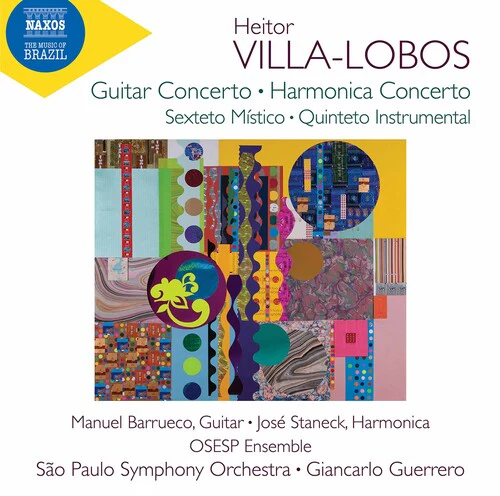
Villa-Lobos: Concertos for Guitar & Harmonica & Other Works / Guerrero, Sao Paulo Symphony
The concertos and chamber works on this album show Villa-Lobos’s unceasing enthusiasm for new colors and sonorities in his music. The Concerto for Guitar and Small Orchestra was his last work for the instrument and written for Segovia. A cornerstone of the repertoire, it contains soaring melodies and rhythmic vitality couched in virtuosic writing. Exploring the instrument’s full harmonic and chromatic possibilities, the Concerto for Harmonica is also deftly orchestrated. New and daring sonic combinations are to be heard in the two chamber works demonstrating the composer’s extraordinary gift for seductive lyricism.
REVIEW:
The more you listen to Villa-Lobos, the more it seems as though he had a giant block of characteristic music that allowed him to cut off chunks of different shapes and sizes that he called “Guitar Concerto”, “Harmonica Concerto”, “Sexteto Místico”, etc. It’s not that it all sounds the same–it’s just so much the product of a single, unique personality. This splendid program consists of chunks featuring unusual instruments, or combinations of instruments. The best known work here is the Guitar Concerto, an almost impossible piece as regards balance of forces that’s marvelously played by Manuel Barrueco. The problems of audibility are easily solved on recordings, as here, by placing the soloist well out in front of the orchestra, but I’m happy to report that performance noises are still minimal.
The Harmonica Concerto is a rarity, and sounds atrociously difficult to perform. If you don’t know the instrument well, you would never imagine its wide range of pitch and expression, and surprisingly pleasant basic timbre. José Staneck must have lips of steel just to get through the piece, but he does much more than that, offering moments of real sensitivity and grace. The Sexteto Místico is a brief work in one movement scored for–get this–flute, oboe, alto saxophone, guitar, harp, and celesta. There’s nothing like it anywhere else, and the sheer sound of it is so captivating that it almost doesn’t matter what notes the musicians are playing. Fortunately, it seems that they offer the right ones.
The most “normal” piece here is the Quinteto Instrumental for flute, harp, and string trio, a substantial work in three movements as long as any of the concertos (about 17 minutes). Villa-Lobos revels in the music’s exotic sounds and luscious textures, and you will too. The uniformly first-rate performances by members of the São Paulo Symphony under the vital and sensitive direction of Giancarlo Guerrero are excellently engineered, making the whole disc a joy from start to finish–a true voyage of discovery and delight.
– ClassicsToday (David Hurwitz)
The concertos and chamber works on this album show Villa-Lobos’s unceasing enthusiasm for new colors and sonorities in his music. The Concerto for Guitar and Small Orchestra was his last work for the instrument and written for Segovia. A cornerstone of the repertoire, it contains soaring melodies and rhythmic vitality couched in virtuosic writing. Exploring the instrument’s full harmonic and chromatic possibilities, the Concerto for Harmonica is also deftly orchestrated. New and daring sonic combinations are to be heard in the two chamber works demonstrating the composer’s extraordinary gift for seductive lyricism.
REVIEW:
The more you listen to Villa-Lobos, the more it seems as though he had a giant block of characteristic music that allowed him to cut off chunks of different shapes and sizes that he called “Guitar Concerto”, “Harmonica Concerto”, “Sexteto Místico”, etc. It’s not that it all sounds the same–it’s just so much the product of a single, unique personality. This splendid program consists of chunks featuring unusual instruments, or combinations of instruments. The best known work here is the Guitar Concerto, an almost impossible piece as regards balance of forces that’s marvelously played by Manuel Barrueco. The problems of audibility are easily solved on recordings, as here, by placing the soloist well out in front of the orchestra, but I’m happy to report that performance noises are still minimal.
The Harmonica Concerto is a rarity, and sounds atrociously difficult to perform. If you don’t know the instrument well, you would never imagine its wide range of pitch and expression, and surprisingly pleasant basic timbre. José Staneck must have lips of steel just to get through the piece, but he does much more than that, offering moments of real sensitivity and grace. The Sexteto Místico is a brief work in one movement scored for–get this–flute, oboe, alto saxophone, guitar, harp, and celesta. There’s nothing like it anywhere else, and the sheer sound of it is so captivating that it almost doesn’t matter what notes the musicians are playing. Fortunately, it seems that they offer the right ones.
The most “normal” piece here is the Quinteto Instrumental for flute, harp, and string trio, a substantial work in three movements as long as any of the concertos (about 17 minutes). Villa-Lobos revels in the music’s exotic sounds and luscious textures, and you will too. The uniformly first-rate performances by members of the São Paulo Symphony under the vital and sensitive direction of Giancarlo Guerrero are excellently engineered, making the whole disc a joy from start to finish–a true voyage of discovery and delight.
– ClassicsToday (David Hurwitz)
Original: $13.99
-65%$13.99
$4.90Description
The concertos and chamber works on this album show Villa-Lobos’s unceasing enthusiasm for new colors and sonorities in his music. The Concerto for Guitar and Small Orchestra was his last work for the instrument and written for Segovia. A cornerstone of the repertoire, it contains soaring melodies and rhythmic vitality couched in virtuosic writing. Exploring the instrument’s full harmonic and chromatic possibilities, the Concerto for Harmonica is also deftly orchestrated. New and daring sonic combinations are to be heard in the two chamber works demonstrating the composer’s extraordinary gift for seductive lyricism.
REVIEW:
The more you listen to Villa-Lobos, the more it seems as though he had a giant block of characteristic music that allowed him to cut off chunks of different shapes and sizes that he called “Guitar Concerto”, “Harmonica Concerto”, “Sexteto Místico”, etc. It’s not that it all sounds the same–it’s just so much the product of a single, unique personality. This splendid program consists of chunks featuring unusual instruments, or combinations of instruments. The best known work here is the Guitar Concerto, an almost impossible piece as regards balance of forces that’s marvelously played by Manuel Barrueco. The problems of audibility are easily solved on recordings, as here, by placing the soloist well out in front of the orchestra, but I’m happy to report that performance noises are still minimal.
The Harmonica Concerto is a rarity, and sounds atrociously difficult to perform. If you don’t know the instrument well, you would never imagine its wide range of pitch and expression, and surprisingly pleasant basic timbre. José Staneck must have lips of steel just to get through the piece, but he does much more than that, offering moments of real sensitivity and grace. The Sexteto Místico is a brief work in one movement scored for–get this–flute, oboe, alto saxophone, guitar, harp, and celesta. There’s nothing like it anywhere else, and the sheer sound of it is so captivating that it almost doesn’t matter what notes the musicians are playing. Fortunately, it seems that they offer the right ones.
The most “normal” piece here is the Quinteto Instrumental for flute, harp, and string trio, a substantial work in three movements as long as any of the concertos (about 17 minutes). Villa-Lobos revels in the music’s exotic sounds and luscious textures, and you will too. The uniformly first-rate performances by members of the São Paulo Symphony under the vital and sensitive direction of Giancarlo Guerrero are excellently engineered, making the whole disc a joy from start to finish–a true voyage of discovery and delight.
– ClassicsToday (David Hurwitz)