🎉 Up to 70% Off Selected ItemsShop Sale

1 / 2
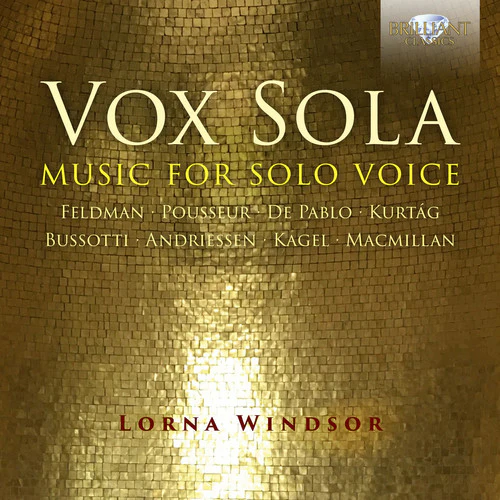
Vox Sola: Music for Solo Voice / Windsor
Lorna Windsor’s selection of eight 20th and 21st-century composers highlights how the voice incarnates different expressive forms more than any instrument. Left naked in its primeval state, the voice leads each composer to rediscover his personal voice, unfettered by convention. Six of the eight composers represented here were born within the same five years, from 1926 (Kurtág and Feldman) to 1931 (Bussotti, Kagel), in 1929 Pousseur, in 1930 De Pablo. Andriessen was born slightly after in 1939 whilst only Macmillan (b.1959) belongs to the following generation. Bold simplicity is the keynote of Feldman’s brief setting of Rilke, Only: purely diatonic across its two minute span, whereas Henri Pousseur’s equally concise tribute to Baudelaire uses a 12-tone technique to create the illusion of diatonicism. In the hands of Luis de Pablo, Góngora’s evocation of a flight of storks creating patterns in the sky, is suggested by melismatic use of the voice, with arpeggios and filigree in quasi-instrumental notation, with arabesque-like writing which hints at distant Arabic hues of flamenco. In Einige Sätze aus den Sudelbüchern Georg Christoph Lichtenbergs, György Kurtág set the caustic aphorisms of a18th-century German physicist and writer with lightning flashes of insight and expression. By contrast, A Song of the Sea by Louis Andriessen requires the singer to sit (in performance) with a doll on her lap as she tells a sad little story with a simplicity redolent of folksong. Bussotti and Kagel both made far more thoroughgoing exploration of vocal technique in the Lettura di Braibanti and The Tower of Babel respectively. Lorna Windsor closes her recital with the most extended work on the album: in angustiis II, a lament by James Macmillan which presents a grief-stricken image of humanity crying out to God. She is a specialist in early and contemporary repertoire who can call upon several languages as mother tongues.
Lorna Windsor’s selection of eight 20th and 21st-century composers highlights how the voice incarnates different expressive forms more than any instrument. Left naked in its primeval state, the voice leads each composer to rediscover his personal voice, unfettered by convention. Six of the eight composers represented here were born within the same five years, from 1926 (Kurtág and Feldman) to 1931 (Bussotti, Kagel), in 1929 Pousseur, in 1930 De Pablo. Andriessen was born slightly after in 1939 whilst only Macmillan (b.1959) belongs to the following generation. Bold simplicity is the keynote of Feldman’s brief setting of Rilke, Only: purely diatonic across its two minute span, whereas Henri Pousseur’s equally concise tribute to Baudelaire uses a 12-tone technique to create the illusion of diatonicism. In the hands of Luis de Pablo, Góngora’s evocation of a flight of storks creating patterns in the sky, is suggested by melismatic use of the voice, with arpeggios and filigree in quasi-instrumental notation, with arabesque-like writing which hints at distant Arabic hues of flamenco. In Einige Sätze aus den Sudelbüchern Georg Christoph Lichtenbergs, György Kurtág set the caustic aphorisms of a18th-century German physicist and writer with lightning flashes of insight and expression. By contrast, A Song of the Sea by Louis Andriessen requires the singer to sit (in performance) with a doll on her lap as she tells a sad little story with a simplicity redolent of folksong. Bussotti and Kagel both made far more thoroughgoing exploration of vocal technique in the Lettura di Braibanti and The Tower of Babel respectively. Lorna Windsor closes her recital with the most extended work on the album: in angustiis II, a lament by James Macmillan which presents a grief-stricken image of humanity crying out to God. She is a specialist in early and contemporary repertoire who can call upon several languages as mother tongues.
$15.99
Vox Sola: Music for Solo Voice / Windsor—
$15.99
Description
Lorna Windsor’s selection of eight 20th and 21st-century composers highlights how the voice incarnates different expressive forms more than any instrument. Left naked in its primeval state, the voice leads each composer to rediscover his personal voice, unfettered by convention. Six of the eight composers represented here were born within the same five years, from 1926 (Kurtág and Feldman) to 1931 (Bussotti, Kagel), in 1929 Pousseur, in 1930 De Pablo. Andriessen was born slightly after in 1939 whilst only Macmillan (b.1959) belongs to the following generation. Bold simplicity is the keynote of Feldman’s brief setting of Rilke, Only: purely diatonic across its two minute span, whereas Henri Pousseur’s equally concise tribute to Baudelaire uses a 12-tone technique to create the illusion of diatonicism. In the hands of Luis de Pablo, Góngora’s evocation of a flight of storks creating patterns in the sky, is suggested by melismatic use of the voice, with arpeggios and filigree in quasi-instrumental notation, with arabesque-like writing which hints at distant Arabic hues of flamenco. In Einige Sätze aus den Sudelbüchern Georg Christoph Lichtenbergs, György Kurtág set the caustic aphorisms of a18th-century German physicist and writer with lightning flashes of insight and expression. By contrast, A Song of the Sea by Louis Andriessen requires the singer to sit (in performance) with a doll on her lap as she tells a sad little story with a simplicity redolent of folksong. Bussotti and Kagel both made far more thoroughgoing exploration of vocal technique in the Lettura di Braibanti and The Tower of Babel respectively. Lorna Windsor closes her recital with the most extended work on the album: in angustiis II, a lament by James Macmillan which presents a grief-stricken image of humanity crying out to God. She is a specialist in early and contemporary repertoire who can call upon several languages as mother tongues.