🎉 Up to 70% Off Selected ItemsShop Sale

1 / 2
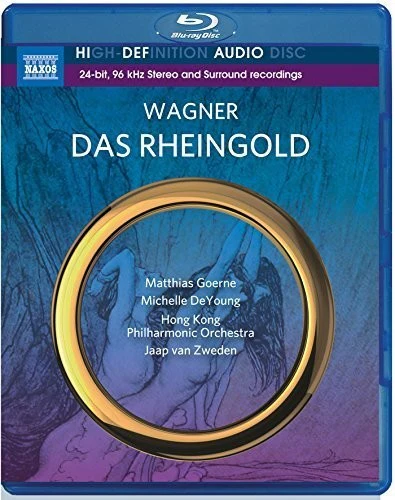
Wagner: Das Rheingold / Deyoung, Goerne, Begley, Reid [blu-ray Audio]
This is an audio-only (i.e., with no video content) Blu-ray disc playable only on Blu-ray players.
It is also available on standard CD.
Taken from two concert performances in January, 2015, this is the first installment of an entire Ring Cycle from the Hong Kong Philharmonic under Jaap van Zweden to be recorded by Naxos. It makes you hungry for the rest.
The recording is clean and clear, with no artificial anything. Van Zweden’s approach is closest in memory to Herbert von Karajan’s–intimate and chamber-like, a family drama that happens to be played out in magical, mythological terms. Also like Karajan, van Zweden takes his time (at 2 hours and 33 minutes, this is on the longish side) and offers seamless segues between scenes. When a solo instrument is featured in Wagner’s dense orchestration, it is given a spotlight, and beautiful moments are to be bathed in–the motif after the Rainbow Bridge is created and the singing that follows rarely have sounded so tuneful and lovely. The Hong Kong Philharmonic is not Berlin or Vienna or the Met, but it has nothing to fear–the playing throughout is smooth and handsome. The opening Rhine passage is dark but clear, the piling up of the gold in Scene IV is beautifully built, and the opera’s final moments are indeed the grandest, as they should be–one of the few instances when van Zweden pulls out all the stops.
The storytelling is at the fore; impeccable diction is the order of the day. As revolting as Alberich always is, we can actually hear the flirtatious playfulness in the opera’s opening moments until he realizes that he doesn’t have a chance. And from then on, he’s simply vile–Peter Sidhom sings with an audible sneer and a ringing top to the voice that we rarely get in this role. He’s a baritone with remarkable “face”.
The back and forth between the fine, unexaggerated Fricka of Michelle De Young and the remarkable, surprising Wotan of Matthias Goerne is natural and familiar, and Goerne is the surprise of the performance. His experience and expertise as a Lieder singer comes in very handy in this opera: his interacting with Loge and his cajoling of Mime and Alberich all are textually and dynamically right-on. The bottom of the voice sounds remarkably rich, and while the top notes are brighter than we normally hear, he has authority. One wonders, however, about his Walküre Wotan….
David Cangelosi’s slimy Mime is vivid and actually sung–note for note, and Kim Begley’s Loge is performed with wonderful detachment: he knows he’s smarter than anyone else. Deborah Humble’s Erda could have been darker-hued, but her attention to the text turns her scene into the “event” it should be. Anna Samuil’s Freia is much like every other soprano’s who sings the part: good at complaining and being afraid. Kwangchul Youn’s Fasolt is on a grand scale; Stephen Milling’s Fafner not so much. Froh, small part though it is, deserves a better profile than Charles Reid gives it, and the Donner of Oleksandr Pushniak begins his “Heda…” on an unsteady note but recovers quickly. The Rhinemaidens–Eri Nakamura, Aurhelia Varak, and Hermine Haselböck–are a terrific, articulate, tuneful trio...
First choice among Rheingolds is still the Decca, but Testament’s release of a 1955 Bayreuth performance with Hans Hotter is certainly in the running, and as a non-gimmicky performance, may even be better. But this new set gives a wonderful overall view of this opera, and at a remarkable price.
-- Robert Levine, ClassicsToday.com
It is also available on standard CD.
Taken from two concert performances in January, 2015, this is the first installment of an entire Ring Cycle from the Hong Kong Philharmonic under Jaap van Zweden to be recorded by Naxos. It makes you hungry for the rest.
The recording is clean and clear, with no artificial anything. Van Zweden’s approach is closest in memory to Herbert von Karajan’s–intimate and chamber-like, a family drama that happens to be played out in magical, mythological terms. Also like Karajan, van Zweden takes his time (at 2 hours and 33 minutes, this is on the longish side) and offers seamless segues between scenes. When a solo instrument is featured in Wagner’s dense orchestration, it is given a spotlight, and beautiful moments are to be bathed in–the motif after the Rainbow Bridge is created and the singing that follows rarely have sounded so tuneful and lovely. The Hong Kong Philharmonic is not Berlin or Vienna or the Met, but it has nothing to fear–the playing throughout is smooth and handsome. The opening Rhine passage is dark but clear, the piling up of the gold in Scene IV is beautifully built, and the opera’s final moments are indeed the grandest, as they should be–one of the few instances when van Zweden pulls out all the stops.
The storytelling is at the fore; impeccable diction is the order of the day. As revolting as Alberich always is, we can actually hear the flirtatious playfulness in the opera’s opening moments until he realizes that he doesn’t have a chance. And from then on, he’s simply vile–Peter Sidhom sings with an audible sneer and a ringing top to the voice that we rarely get in this role. He’s a baritone with remarkable “face”.
The back and forth between the fine, unexaggerated Fricka of Michelle De Young and the remarkable, surprising Wotan of Matthias Goerne is natural and familiar, and Goerne is the surprise of the performance. His experience and expertise as a Lieder singer comes in very handy in this opera: his interacting with Loge and his cajoling of Mime and Alberich all are textually and dynamically right-on. The bottom of the voice sounds remarkably rich, and while the top notes are brighter than we normally hear, he has authority. One wonders, however, about his Walküre Wotan….
David Cangelosi’s slimy Mime is vivid and actually sung–note for note, and Kim Begley’s Loge is performed with wonderful detachment: he knows he’s smarter than anyone else. Deborah Humble’s Erda could have been darker-hued, but her attention to the text turns her scene into the “event” it should be. Anna Samuil’s Freia is much like every other soprano’s who sings the part: good at complaining and being afraid. Kwangchul Youn’s Fasolt is on a grand scale; Stephen Milling’s Fafner not so much. Froh, small part though it is, deserves a better profile than Charles Reid gives it, and the Donner of Oleksandr Pushniak begins his “Heda…” on an unsteady note but recovers quickly. The Rhinemaidens–Eri Nakamura, Aurhelia Varak, and Hermine Haselböck–are a terrific, articulate, tuneful trio...
First choice among Rheingolds is still the Decca, but Testament’s release of a 1955 Bayreuth performance with Hans Hotter is certainly in the running, and as a non-gimmicky performance, may even be better. But this new set gives a wonderful overall view of this opera, and at a remarkable price.
-- Robert Levine, ClassicsToday.com
This is an audio-only (i.e., with no video content) Blu-ray disc playable only on Blu-ray players.
It is also available on standard CD.
Taken from two concert performances in January, 2015, this is the first installment of an entire Ring Cycle from the Hong Kong Philharmonic under Jaap van Zweden to be recorded by Naxos. It makes you hungry for the rest.
The recording is clean and clear, with no artificial anything. Van Zweden’s approach is closest in memory to Herbert von Karajan’s–intimate and chamber-like, a family drama that happens to be played out in magical, mythological terms. Also like Karajan, van Zweden takes his time (at 2 hours and 33 minutes, this is on the longish side) and offers seamless segues between scenes. When a solo instrument is featured in Wagner’s dense orchestration, it is given a spotlight, and beautiful moments are to be bathed in–the motif after the Rainbow Bridge is created and the singing that follows rarely have sounded so tuneful and lovely. The Hong Kong Philharmonic is not Berlin or Vienna or the Met, but it has nothing to fear–the playing throughout is smooth and handsome. The opening Rhine passage is dark but clear, the piling up of the gold in Scene IV is beautifully built, and the opera’s final moments are indeed the grandest, as they should be–one of the few instances when van Zweden pulls out all the stops.
The storytelling is at the fore; impeccable diction is the order of the day. As revolting as Alberich always is, we can actually hear the flirtatious playfulness in the opera’s opening moments until he realizes that he doesn’t have a chance. And from then on, he’s simply vile–Peter Sidhom sings with an audible sneer and a ringing top to the voice that we rarely get in this role. He’s a baritone with remarkable “face”.
The back and forth between the fine, unexaggerated Fricka of Michelle De Young and the remarkable, surprising Wotan of Matthias Goerne is natural and familiar, and Goerne is the surprise of the performance. His experience and expertise as a Lieder singer comes in very handy in this opera: his interacting with Loge and his cajoling of Mime and Alberich all are textually and dynamically right-on. The bottom of the voice sounds remarkably rich, and while the top notes are brighter than we normally hear, he has authority. One wonders, however, about his Walküre Wotan….
David Cangelosi’s slimy Mime is vivid and actually sung–note for note, and Kim Begley’s Loge is performed with wonderful detachment: he knows he’s smarter than anyone else. Deborah Humble’s Erda could have been darker-hued, but her attention to the text turns her scene into the “event” it should be. Anna Samuil’s Freia is much like every other soprano’s who sings the part: good at complaining and being afraid. Kwangchul Youn’s Fasolt is on a grand scale; Stephen Milling’s Fafner not so much. Froh, small part though it is, deserves a better profile than Charles Reid gives it, and the Donner of Oleksandr Pushniak begins his “Heda…” on an unsteady note but recovers quickly. The Rhinemaidens–Eri Nakamura, Aurhelia Varak, and Hermine Haselböck–are a terrific, articulate, tuneful trio...
First choice among Rheingolds is still the Decca, but Testament’s release of a 1955 Bayreuth performance with Hans Hotter is certainly in the running, and as a non-gimmicky performance, may even be better. But this new set gives a wonderful overall view of this opera, and at a remarkable price.
-- Robert Levine, ClassicsToday.com
It is also available on standard CD.
Taken from two concert performances in January, 2015, this is the first installment of an entire Ring Cycle from the Hong Kong Philharmonic under Jaap van Zweden to be recorded by Naxos. It makes you hungry for the rest.
The recording is clean and clear, with no artificial anything. Van Zweden’s approach is closest in memory to Herbert von Karajan’s–intimate and chamber-like, a family drama that happens to be played out in magical, mythological terms. Also like Karajan, van Zweden takes his time (at 2 hours and 33 minutes, this is on the longish side) and offers seamless segues between scenes. When a solo instrument is featured in Wagner’s dense orchestration, it is given a spotlight, and beautiful moments are to be bathed in–the motif after the Rainbow Bridge is created and the singing that follows rarely have sounded so tuneful and lovely. The Hong Kong Philharmonic is not Berlin or Vienna or the Met, but it has nothing to fear–the playing throughout is smooth and handsome. The opening Rhine passage is dark but clear, the piling up of the gold in Scene IV is beautifully built, and the opera’s final moments are indeed the grandest, as they should be–one of the few instances when van Zweden pulls out all the stops.
The storytelling is at the fore; impeccable diction is the order of the day. As revolting as Alberich always is, we can actually hear the flirtatious playfulness in the opera’s opening moments until he realizes that he doesn’t have a chance. And from then on, he’s simply vile–Peter Sidhom sings with an audible sneer and a ringing top to the voice that we rarely get in this role. He’s a baritone with remarkable “face”.
The back and forth between the fine, unexaggerated Fricka of Michelle De Young and the remarkable, surprising Wotan of Matthias Goerne is natural and familiar, and Goerne is the surprise of the performance. His experience and expertise as a Lieder singer comes in very handy in this opera: his interacting with Loge and his cajoling of Mime and Alberich all are textually and dynamically right-on. The bottom of the voice sounds remarkably rich, and while the top notes are brighter than we normally hear, he has authority. One wonders, however, about his Walküre Wotan….
David Cangelosi’s slimy Mime is vivid and actually sung–note for note, and Kim Begley’s Loge is performed with wonderful detachment: he knows he’s smarter than anyone else. Deborah Humble’s Erda could have been darker-hued, but her attention to the text turns her scene into the “event” it should be. Anna Samuil’s Freia is much like every other soprano’s who sings the part: good at complaining and being afraid. Kwangchul Youn’s Fasolt is on a grand scale; Stephen Milling’s Fafner not so much. Froh, small part though it is, deserves a better profile than Charles Reid gives it, and the Donner of Oleksandr Pushniak begins his “Heda…” on an unsteady note but recovers quickly. The Rhinemaidens–Eri Nakamura, Aurhelia Varak, and Hermine Haselböck–are a terrific, articulate, tuneful trio...
First choice among Rheingolds is still the Decca, but Testament’s release of a 1955 Bayreuth performance with Hans Hotter is certainly in the running, and as a non-gimmicky performance, may even be better. But this new set gives a wonderful overall view of this opera, and at a remarkable price.
-- Robert Levine, ClassicsToday.com
$4.20
Original: $11.99
-65%Wagner: Das Rheingold / Deyoung, Goerne, Begley, Reid [blu-ray Audio]—
$11.99
$4.20Description
This is an audio-only (i.e., with no video content) Blu-ray disc playable only on Blu-ray players.
It is also available on standard CD.
Taken from two concert performances in January, 2015, this is the first installment of an entire Ring Cycle from the Hong Kong Philharmonic under Jaap van Zweden to be recorded by Naxos. It makes you hungry for the rest.
The recording is clean and clear, with no artificial anything. Van Zweden’s approach is closest in memory to Herbert von Karajan’s–intimate and chamber-like, a family drama that happens to be played out in magical, mythological terms. Also like Karajan, van Zweden takes his time (at 2 hours and 33 minutes, this is on the longish side) and offers seamless segues between scenes. When a solo instrument is featured in Wagner’s dense orchestration, it is given a spotlight, and beautiful moments are to be bathed in–the motif after the Rainbow Bridge is created and the singing that follows rarely have sounded so tuneful and lovely. The Hong Kong Philharmonic is not Berlin or Vienna or the Met, but it has nothing to fear–the playing throughout is smooth and handsome. The opening Rhine passage is dark but clear, the piling up of the gold in Scene IV is beautifully built, and the opera’s final moments are indeed the grandest, as they should be–one of the few instances when van Zweden pulls out all the stops.
The storytelling is at the fore; impeccable diction is the order of the day. As revolting as Alberich always is, we can actually hear the flirtatious playfulness in the opera’s opening moments until he realizes that he doesn’t have a chance. And from then on, he’s simply vile–Peter Sidhom sings with an audible sneer and a ringing top to the voice that we rarely get in this role. He’s a baritone with remarkable “face”.
The back and forth between the fine, unexaggerated Fricka of Michelle De Young and the remarkable, surprising Wotan of Matthias Goerne is natural and familiar, and Goerne is the surprise of the performance. His experience and expertise as a Lieder singer comes in very handy in this opera: his interacting with Loge and his cajoling of Mime and Alberich all are textually and dynamically right-on. The bottom of the voice sounds remarkably rich, and while the top notes are brighter than we normally hear, he has authority. One wonders, however, about his Walküre Wotan….
David Cangelosi’s slimy Mime is vivid and actually sung–note for note, and Kim Begley’s Loge is performed with wonderful detachment: he knows he’s smarter than anyone else. Deborah Humble’s Erda could have been darker-hued, but her attention to the text turns her scene into the “event” it should be. Anna Samuil’s Freia is much like every other soprano’s who sings the part: good at complaining and being afraid. Kwangchul Youn’s Fasolt is on a grand scale; Stephen Milling’s Fafner not so much. Froh, small part though it is, deserves a better profile than Charles Reid gives it, and the Donner of Oleksandr Pushniak begins his “Heda…” on an unsteady note but recovers quickly. The Rhinemaidens–Eri Nakamura, Aurhelia Varak, and Hermine Haselböck–are a terrific, articulate, tuneful trio...
First choice among Rheingolds is still the Decca, but Testament’s release of a 1955 Bayreuth performance with Hans Hotter is certainly in the running, and as a non-gimmicky performance, may even be better. But this new set gives a wonderful overall view of this opera, and at a remarkable price.
-- Robert Levine, ClassicsToday.com
It is also available on standard CD.
Taken from two concert performances in January, 2015, this is the first installment of an entire Ring Cycle from the Hong Kong Philharmonic under Jaap van Zweden to be recorded by Naxos. It makes you hungry for the rest.
The recording is clean and clear, with no artificial anything. Van Zweden’s approach is closest in memory to Herbert von Karajan’s–intimate and chamber-like, a family drama that happens to be played out in magical, mythological terms. Also like Karajan, van Zweden takes his time (at 2 hours and 33 minutes, this is on the longish side) and offers seamless segues between scenes. When a solo instrument is featured in Wagner’s dense orchestration, it is given a spotlight, and beautiful moments are to be bathed in–the motif after the Rainbow Bridge is created and the singing that follows rarely have sounded so tuneful and lovely. The Hong Kong Philharmonic is not Berlin or Vienna or the Met, but it has nothing to fear–the playing throughout is smooth and handsome. The opening Rhine passage is dark but clear, the piling up of the gold in Scene IV is beautifully built, and the opera’s final moments are indeed the grandest, as they should be–one of the few instances when van Zweden pulls out all the stops.
The storytelling is at the fore; impeccable diction is the order of the day. As revolting as Alberich always is, we can actually hear the flirtatious playfulness in the opera’s opening moments until he realizes that he doesn’t have a chance. And from then on, he’s simply vile–Peter Sidhom sings with an audible sneer and a ringing top to the voice that we rarely get in this role. He’s a baritone with remarkable “face”.
The back and forth between the fine, unexaggerated Fricka of Michelle De Young and the remarkable, surprising Wotan of Matthias Goerne is natural and familiar, and Goerne is the surprise of the performance. His experience and expertise as a Lieder singer comes in very handy in this opera: his interacting with Loge and his cajoling of Mime and Alberich all are textually and dynamically right-on. The bottom of the voice sounds remarkably rich, and while the top notes are brighter than we normally hear, he has authority. One wonders, however, about his Walküre Wotan….
David Cangelosi’s slimy Mime is vivid and actually sung–note for note, and Kim Begley’s Loge is performed with wonderful detachment: he knows he’s smarter than anyone else. Deborah Humble’s Erda could have been darker-hued, but her attention to the text turns her scene into the “event” it should be. Anna Samuil’s Freia is much like every other soprano’s who sings the part: good at complaining and being afraid. Kwangchul Youn’s Fasolt is on a grand scale; Stephen Milling’s Fafner not so much. Froh, small part though it is, deserves a better profile than Charles Reid gives it, and the Donner of Oleksandr Pushniak begins his “Heda…” on an unsteady note but recovers quickly. The Rhinemaidens–Eri Nakamura, Aurhelia Varak, and Hermine Haselböck–are a terrific, articulate, tuneful trio...
First choice among Rheingolds is still the Decca, but Testament’s release of a 1955 Bayreuth performance with Hans Hotter is certainly in the running, and as a non-gimmicky performance, may even be better. But this new set gives a wonderful overall view of this opera, and at a remarkable price.
-- Robert Levine, ClassicsToday.com